
106
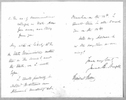
5. The no. of denominational colleges in [Natr} How far away are they from you. My [ ] is likely to be in State Universities [ ] [ ] in the Univ and the State is 2 [ ] [ ]. I shall probably be called to attend an Alumni meeting at Omaha on the 13th. I should then be able to [ ] you on the 14th. Will my [ ] be in the day time or evening? Yours very truly James B. Angell
[ ] [ ]
107
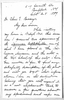
209 Seventh St. Buffalo NY Sept. 28. 1889
Dr. Chas. E. Bessey
My Dear Sir
While visiting my home in Neligh Neb. this summer I procured two specimens of the Ipomoea leptophylla, one of which I have placed in the Nat Science Museum and the other in the High School, of this city. I have been unable so far, to find any satisfactory description of the plant and write you to get what information I can on the subject believing that you will regard it as a not unpleasant task to answer a few questions about my specimens and refer me
108
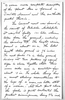
to some more complete description of the plant than is found in Coulters Manual and the authorities quoted there in.
The largest root was found in the vicinity of Oakdale, Antelope Co. It weighed fully 100 lbs when taken from the ground- including the spreading top. The height above ground is about 40 in. The total length below ground is 76 inches. The root forks 32 in. below ground dividing into two portions of equal size so close together that their inner sides are in contact for about 18 in. the whole thing has a most striking resemblance to the legs of a man or better still of a woman. All that part above the fork is quite contracted the greatest circumference being 9 1/2 inch.
109
3
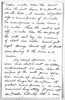
Within 9 inches below the point where the root begins to expand- or at the "hips" -it reaches its greatest size a circumference of 38 inches. The circumference 10 inches lower is 34 inches. Where the root is cut off, -76 inches below the surface of the earth each "leg" has a circum. of about six inches. Several good sized prongs branch off at points corresponding to the knees and lower.
My second specimen is a large onion shaped root, its bottom surface about 48 inches below the surface of the earth, giving off a large number of branches in an almost horizontal direction. Its greatest circumference is 40 inches measured horizontally. It gives out no branches laterally but is con-
110
4
tinued to the surface of the earth by three branches, close together each measuring hardly two inches in diameter.
It weighs in its present dried condition, 49 pounds. One of our local botanists thinks its flattened shape may be due to its striking a rock which prevented its downward growth, and caused a lateral expansion and the formation of horizontal branches on the under surface. This is not impossible, since the specimen grew in the valley of the Verdigris in Knox Co. where there is considerable rock close to the surface.
If you will tell me whether either of these two plants is typical of the species with regard to form and size