
451
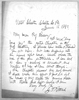
West Chester Chester Co pa June 16. 1886.
My Dear Prof Bessey
I rec'd. "long long ago" the extra Chapter on the G[?] Anatomy. I should have written & thanked you at once, but was suffering with an injured right hand, which made the use of the pen intolerable. I have had a year of [?] on accident, and venture to hope I am about through.
The Chapter pleased me very much. I shall make an effort to put it into the hands of my classes this coming season. With thanks and best wishes I am
Very Truly Yrs. J. T. Rothrock
452
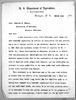
U. S. Department of Agriculture, Bureau of Animal Industry.
Washington, D. C., March 22nd 1886.
Prof. Charles E. Bessey, University of Nebraska, Lincoln, Nebraska,
Dear Sir:
I have recieved a slip from a Nebraska paper (name and date wanting) containing an article on inoculation for hog cholera, and I see a similar article in the Breeders' Gazette for March 18, p. 382. Both are evidently either written or inspired by Dr. J. Gerth, Jr., State Veterinarian of Nebraska. In both it is stated that the microscopical investigations were made by you, and it is asserted unqualifiedly that in the examination of hogs which had died of American swine plague near Lincoln, you had discovered the presence in large quantities of the same germs that were contained in the virus obtained from Pasteur.
This statement is so important and at the same time differs so widely from the results of my investigations that I trust you will pardon this rather long letter and the inquiries made in it. Having been engaged in a constant investigation of swine plague for the past eight years, and being in an official position where it is necessary to keep the public informed as to the progress of this class of investigations, I would thank you for at least brief
453
U. S. Department of Agriculture, Bureau of Animal Industry.
Washington, D. C., 1886.
2 B.
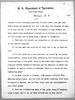
replies to the following questions in order that I may not only avoid doing you injustice but that I may have the material at hand to do you justice. I am the more interested in this because we have lately made substantial progress as we believe in the study of this disease and in developing a method of prevention.
1. What were the nature and characters of the germ contained in the Pasteur vaccine?
2. Did you make any cultures of this, and if so, in what media?
3. If this germ was a fine bacillus, as stated by the German investigators, please state what characters were replied upon in the investigations of the germs found in American swine plague to distinguish between Pasteur's bacillus and the bacillus of mouse septicaemia, so called, which is sometimes found as a septic or contaminating germ?
4. In what liquids or tissues, from animals affected with American swine plague, did you find the germs indentical with those in Pasteur's vaccine, and did they exist pure and uncontaminated with other germs?
5. Were any cultivations made of the germs found in American swine plague, and if so, by what methods and in what media?

454
U. S. Department of Agriculture, Bureau of Animal Industry.
Washignton, D. C., 1886.
3 B.
6. Were any inoculation experiments made with pure cultures of such germs to determine which were pathogenic?
7. If the germs found in Pasteur's vaccine are identical with the germs which cause American swine plague, and a mild attack was produced in your experimental animals by this vaccine, how do you account for the fact that your animals were unable to resist exposure to the contagion of American swine plague, seeing that such mild attacks unquestionably confer immunity against the rouget of France?
8. Do you authorize and endorse the statements by D. Gerth referred to above, viz., (1) that microbes indentical with those in Pasteur's vaccine exist in American swine plague; (2) that American swine plague is caused by this same germ; (3) that Pasteur's vaccine does not confer immunity from the disease for which it was intended; and (4) that inoculation for swine plague is consequently a failure?
9. Can you furnish me a preparation for microscopical examination which shows the germs found in the swine plague of Nebraska?
I trust you will appreciate my reasons for desiring information on this subject and that you may find time to give me an early reply, even though it be brief.
455
U. S. Department of Agriculture, Bureau of Animal Industry.
Washington, D. C., 1886.
4 B.
Begging that you will excuse the length of this letter and the presumption which leads me to ask so many questions of a stranger, I remain,
With much esteem, Your obedient servant, [T. E. Salmon?], Chief of Bureau.