
471
M. W. M.
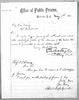
Office of Public Printer, Washington, D. C., May 11th, 1886.
Prof. Geo. Vasey, Agl. Department.
Sir:
In reply to your favor of the 10th inst. will state that electrotype plates of the "Grasses of the United States" will be furnished a one (1) dollar each.
Very Respectfully, [Cades?] Taylor C[?] Chief Clerk.
Prof C E Bessey Dear Sir
Above you have the answer as to electrotypes of Grasses.
I send you another package of Grasses to day.
Truly Yours Geo. Vasey Botanist Dept Agriculture
472
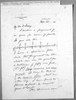
The University of Nebraska, Lincoln.
Department [of B]otany. Sept 25 1886
My dear Dr Vasey,
I enclose a fragment of a grass for name, if possible. It grows like this...
[illustration]
I have a specimen from which the fragment was taken wjhich ran over the ground for a distance of fifty one feet. (51 ft) Its [sic.] runners are above ground. It may be that it is the main stem which runs in this way. I have found no flowers or fruit, so cannot guess it out.
The specimen came
474
In sending specimens of plants for investigation it is desirable to have the leaves, flowers, and fruit; and in the case of bulbous plants the bulbs, also. When they are sent from a distance it is best to prepare the specimens by drying them under pressure between folds of absorbent paper, otherwise the parts shrink and break so as to be hardly recognizable. When the dried plants are sent they should be protected from breakage in the mail by being inclosed between pieces of stiff pasteboard. Packages weighing less than four pounds can be sent by mail sat the rate of one cent per ounce. Write the name of the sender on the outside. In the letter accompanying the specimens state where collected, the date, and any other particulars of the plant, whether reputed poisonous, pestiferous, medicinal, or useful.
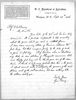
U. S. Department of Agriculture, Division of Botany, Washington, D. C., Sept 29th 1886.
Prof. C E Bessey. My dear Sir
Your letter of the 23d inst. has been duly received. it is perhaps impossible to tell accurately what the grass which you send is without flowers. I have seen running stolon of [Panicura obtusium?] ten feet long, but that compares poorly by the side of such as yours 51 feet long. Prof Scribner when in Montana says that he saw stolons of [Phragmitus communis?] that were thirty feet long, and he thinks yours are of the same kind. I think it to be very probable that this is the grass I spent several weeks this summer investigating the grasses of the arid plains west of the 100th meridian, but saw nothing like the stolons sent by you.
Truly Yours Geo. Vasey
475
The University of Ne[bra]ska, Lincoln.
Department of B[ota]ny. Nov 8 1886
My dear Dr Vasey
I mail you a grass toay from Chase Co neb (near Colorado state line). It is something like a sunted [Poa pratencii?]. It resembles [Poa eateni?] in description, but I have no spms. of that species. It bears some resemblance to P. [flexaera?], and is [?] a little like P. [compressa?]. But it does not appear to be any one of them. The specimen [was?] handed to me by a gentleman who had pulled it up some time