

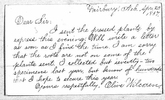
727
Fairbury, Nev. Apr. 20 1887
Dear Sir:
I sent the pressed plants by express this evening. Will write a letter as soon as I find the time. I am sorry that the roots are not on some of the plants sent. I collected but seventy-two specimens last year, but know of hundereds that I hope to secure this year.
Yours respectfully, Olive Wilcoren.
728
This page is not transcribed, please Help Transcribe this page
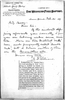
729
EXECUTIVE COMMITTEE --OF THE- Nebraska Yearly Meeting --or- Freewill Baptists.
A. D. WILLIAMS. D. D., Chairman, Kenesaw, Rev. EDWARD ROOT, Assistant, Weeping Water, G. W. KNAPP, B. D. See. and Treas. Kenesaw. Rev. WM. MARKS. Hon. B. F. ISAMAN.
--OFFICE OF-
THE WESTERN FREE BAPTIST.
Kenesaw, Nebraska, Feb. 26 1887
Prof. Bessey:
Dear Sir,
If the enclosed clips [?]ing represents you correctly, I fear you are laboring under some mistake. There are two distinct "works" here, each frequently called " Tumble Weed", but I believe neither of them are the Amarantus alba.
Yours very truly,
A. D. Williams.
TUMBLE WEED.--A common Eastern weed, according to Prof. C. E. Bessey, is modified by climate on the Western plains and prairies into a compact plant, whose stout, curving branches give it an approximately spherical form, and which is called "tumble-weed" from the fact that when the stem is broken near the ground by the Autumn gales the upper part goes rolling and tumbling before the wind, often for miles. In the East the species Amarantus albus [italicized], is a straggling herb, remaining rooted long after its death at the close of the season.

730
This page is not transcribed, please Help Transcribe this page