
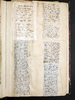
Page 11
THE "BULL PUNCHERS" GRIEF. The M. K. & T., now I won't tell a lie, Is the slowest dam road, running under the sky; We pick up old iron with a full tain of stock, Then run into to town with the famous dutch clock.
Texas Charley and others of "Bull Punch" renown, Have sweat, punched and swore, when their cattte were down, While you in your office was drinking old rye, But the Long Horns will meet you in hell when you die.
There's a road that's now running which is not so slow, The name of this road is the San Francisco; Twenty miles to the hour is the time card they use, And the cattle go in with nary a bruise.
The San Francisco is the road you can see, For in Speaking our mind we are perfectly free, Now of all the roads running, beat it if you can. While it is commanded by Uncle Dan.
And last but not least, is the yards at Rollo, Where all cattle men from Texas are bound to go; Your cattle are hungry, you ask for more hay, Joe Stewart has men who will quickly obey.
CHICAGO RUN. But hark, what is that we hear ticking on high? Its the damnable box that causes cattle to die, It says ten miles an hour on this infernal line, We are stopping at Stations and waiting for time.
We are loading at Hannibal, the truth I will tell. We have got among friends and straight out of hell. We cross the wide river, the cattle left are few, But they brace up on reaching the C. B. & Q.
If we catch the inventor of this infernal box, We'll hire a maiden to give him the pox; We'll lay him down flat, pound his ass with a hammer. Until his touch-hole shall whistle the Star Spangle Banner.
But at last we have found a new place called Caldwell. Where the stockmen all drive their cattle to sell; This road is the road as you will quickly see As we run into town on the L. L. & G.
And now to conclude, for I won't you have think, These verses were got up to create any stink, We will all die in time, that you all will agree, And bid a good buy to that damnable line, the M. K. & T.
"THE PRAIRIE WAIF." "Buffalo Bill" (Hon. W. F. Cody) and his company appeared in the thrilling and romantic border drama of "The Prairie Waif," at the Grand Opera last night, before a large audience. The opening performance gave ample satisfaction, the piece, while devoid of much of the "blood and thunder" business that might be expected, was full of thrilling interest, the plot of the play not being lost in the amusement created by the couple of comical characters who take part in the dramatic representation. The play is a four act one, based upon scenes taken from Buffalo Bill's past history, and the wild border life of the West is given with great realistic effect and cannot fail to please. It is full of romance, and yet so true to life that no one can witness the presentation of the Prairie Waif without appreciating it. "Buffalo Bill" is the great central figure of the piece, and he received an ovation on appearing, while time and again he drew forth unbounded applause by his excellent acting. Miss Lizzie Fletcher, as the "Prairie Waif" was excellent. Miss Connie Thompson, as "Sadie," Jule Keen as "Hans," a Dutchman, and C. Wilson Charles as "Capt. Russell," an Irish officer, were all good, and formed the humorous characters in the play. The Danite villains were Jim and Jack Hardie, represented by Harry Clifton and George T. James, while Mark Stanley, another Mormonite, was a drunken tool in their hands. William Wright represented "Lone Deer," and Harry Melmer "Yellow Hand." They were all good in their respective lines. The genuine Cheyenne Indians, in their war-dance, with horrible music, was a great feature in the play. "Jack Cass," the trained donkey, proved an amusing actor as well as "Hans," who was very comical. In one of the acts Mr. Cody gave an exhibition of his fancy rifle shooting, and showed great skill as a marksman, shooting in various positions. Buffalo Bill and his party are well worth seeing. They play here two nights more, with a matinee to-morrow afternoon. His Excellency has intimated his intention of being present at the performance to-night.
THE HARVARDS AND BUFFALO BILL. Mr. Cody last evening extended an invite to the Harvard boys to come to the Opera House and see the "Prairie Waif." They gladly accepted the invitation, and, as the following note will show, mark their appreciation of the courtesy extended to them:
RUSSELL HOUSE, Ottawa, November 1. The Hon. W. F. Cody. DEAR SIR,--I wish to thank you, on behalf of the "Harvard University Foot Ball Club," for the very pleasant evening which we spent last night. I am only sorry that strict training prevented us from seeing the performance to the end. Very sincerely yours, WILLIAM H. MANNING, Capt. H. U. F. B. C.
"BUFFALO BILL" attracted to the Howard Opera House, last evening, a fair-size and highly enthusiastic audience. The play--"the Prairie Waif"-- is of the good old melodramatic kind, abounding in thrilling situations and effective tableaux. "Buffalo Bill" is as fine a specimen of manhood as we have ever seen, and as far as physical beauty goes would adorn any stage. His rifle-shooting is something really remarkable and well deserved the enthusiastic applause it received. Mis Fletcher is a good actress, and the same can be said of Miss Thompson' and Mr. Keen, Mr. Charles and the other members of the company did very well in the parts assigned them. The audience was immensely pleased and the applause was almost continuous.
BUFFALO BILL. Music Hall was never, but once before, so crammed with people as last night. There were at least 1600 in a house that should only hold 1200, and even women stood up all through the exciting scenes of "Buffalo Bill at Bay." The Hon. W. F. Cody is still a specimen of manly beauty and, as heretofore, always comes in at the right time in the play and excites the wildest enthusiasm of his audience. The play is in four acts, was written by Mr. Ingraham, who is to be congratulated on a work of more than usual merit. The boy chief of the Pawnees is good and so is the band of Indians that assist in the development of the plot. There will be a matinee this afternoon and another performance to-night.
"BUFFALO BILL."--This has been a memorable season in Ottawa for theatre-goers, the excellent character of the troupes visiting us being a flattering tribute to our reputation as a drama-loving people. Jos. Murphy, Bartley Campbell's "Galley Slave," Lawrence Barrett, Tony Denier, Spanish Students, D'Oyly Carte's "Pirates of Penzance," and a host of other notables in the theatrical line. The procession is still further to be made memorable by the appearance of a man whose name for years has been associated with the border history of the United States. We refer to the great Government scout--Indian fighter, novelist and actor--Hon. Wm. F. Cody, better known to the general public as "Buffalo Bill," whose appearance here in the thrilling drama, "The Prairie Waif," commencing Monday evening, November 1st. and continuing Tuesday and Wednesday, and a grand family matinee on Wednesday afternoon at 2 o'clock, which will be in all probability the signal of an immense turn out. The company embraces Buffalo Bill himslef, a troupe of Cheyenne Indian chiefs, a star dramatic company, and a superb orchestra and brass band.--Ottawa
Buffalo Bill. The Opera House was crowded last night on the occasion of the first appearance of Buffalo Bill and his company in "The Prairie Waif," a drama illustrative of border life in which Bill figured so conspicuously. The play is full of thrilling situations, without the intoduction of the blood and thunder business, with which such pieces usually abound. The great hunter and the terror of the Western Indians was, as might be supposed, the great centre of attraction, and drew forth unbounded applause. He took three different characters, and displayed a good deal of histrionic ability. An incidental to the play was his fancy rifle shooting, in which he did some marvellous shooting in every conceivable position. He was loudly applauded. He was ably supported by Jule Keen, a German, a very funny Dutchman, and Miss Lizzie Fletcher as Onita, for whome Bill displayed such great courage; Miss Connie Thompson and others. Not the least attractive feature was the band of Cheyenne Indians, who performed their war dance to perfection. A trained donkey was also on the bill of fare, and adeed its quota to the amusement of the evening. The greatest enthusiasm was manifested throughout, and it is safe to say the company will be greeted with another large audience to-night. The balcony was so crowded last night that many persons who had purchased tickets went away, intending to use them this evening, when His Excellency the Governor General will be present. The members of the Harvard College Football Club occupied four complimentary boxes.
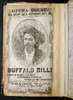
Page 12
OPERA HOUSE.
ONE NIGHT ONLY -- SATURDAY, OCT. 2D.
A NEW AND POWERFUL DRAMA -- THE RENOWNED GEVERNMENT SCOUT AND GUIDE,
[HON. W. F. CODY,]
BUFFALO BILL!
SUPPORTED BY
A TROUPE OF CHEYENNE INDIAN CHIEFS!
A STAR DRAMATIC COMPANY, and
SUPERB BRASS BAND AND ORCHESTRA!
Making the LARGEST COMBINATION traveling this season, embracing as it does 25 FRIST CLASS ARTISTS, who will appear in BUFFALO BILL'S new drama by JOHN A. STEVENS, author of "Unknown," entitled the
"PRAIRIE WAIF,"
A STORY OF THE WEST.
ACT I. Prairie Waif. (Lapse of one year between 1st and 2d Acts.) ACT II. Home of Buffalo Bill. ACT III. The Attack and Defiance. ACT IV. The Rescue.
MR. CODY, "Buffalo Bill," will give an exhibition of Fancy Rifle Shooting in which he as acknowled pre-eminent and alone.
Upon the arrival of the Company in town look out for the Street Parade by the Indians on Horseback, headed by BUFFALO BILL'S SERENADE BAND.
POPULAR PRICE OF ADMISSION. Reserved Seats 75 cents. For sale at Skinner's Bookstore.
WM. F. CODY, Prop. and Mang'r. JOSH E. OGDEN, Business Manager.
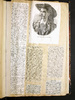
Page 13
Hon. W. F. Cody-"Buffalo Bill."
We give in this weeks' issue a picture of Hon. W. F. Cody, a man known the world over as a border hero of whom too much cannot be said in the way of praise for valuable aervices rendered the Government as an army scout, guide, and Indian fighter. Born in Iowa in 1843, at a time when the State was a border, and at an early age going with his father to Kansas, in the midst of the troubles there that "tried men's souls" William f. Cody was reared amid scenes of danger, and met with many thrilling adventures here he reached his thirteenth year, becoming a "boy hero" when killing his first Indian before he entered the teens. the death of his father, from the reslut of wounds recieved in the Kansas War, left the boy the support of his mother and sisters, and, precocious for his years, he joined an emigrant train as teamster, and rapidly rose from that position to hunter and guide over the overland trails to the Far West. Of his numerous adventures, narrow escapes, Indian battles, and hardship volumes could be written, for he made his name famous along the border from Utah to Texas, and, though a mere boy in years, few men were his superior in strength and endurance, while the cunning, and, in fact, won the name of being able to "out-Injun, Injun." Of Mr. Cody's gaining the title of "Buffalo Bill" several stories are told, one of which is that when a boy-hunter to one of russel, Major, and Wadell's trains carrying government supplies west to the forts, he was alone on the prairie one day hunting, when he espied a tremendous herd of buffaloes coming toward him at full speed. The train encampment was miles away, the boy was on foot, and there was but one chance to escape being trampled to death, and that was to reach a lone cottonwood tree some distance off. A fleet runner, he gained the tree, and drew himself up into the branches just as the herd of thousands of buffaloes coming tearing along beneath him. Scarcely hah he menatly congratulated himslef upon his lucky escape, when he espied behind the herd half a hundred Sioux warriors in full pursuit, and he knew that they would make short work of him, for they would also pass under the tree.
To remain was certain death, and his fetile mind saw a chance, one in a thousand, and he seized upon it at once.
He would drop down on the back of a huge Buffalo bull, and thus ride out of danger.
This he did, landing astride of the back of an animal that, frightened fearfully, endeavorewd to throw him off, but in vain.
Fortunatley the herd headed iin the direction of the train encampment, and as the men ran out to secure fresh buffalo meat, they saw that one of the bulls had a rider, and a crack shot bringing the animal down, it was found to be Bill Cody, who was then and there christened Buffalo Bill.
Another account is that when hunting for the hounds on the Kansas Pacific Railroad, he in one season killed 4,280 buffaloes, and thereby won the title that he is know by the world over.
As a pony express rider, when fifteen years of age, under the famous alf Slade, Buffalo Bill [word] as being a rider of marvelous skill and entrance, making on one occasion a continuous ride 332 miles, and accomplishing the whole distance in 22 hours, truly a wonderful feat.
But it was when he became a scout in the army that he made his greatest name, and the general officers under whom he has served, and those who have served with him, give him the credit of being [word] of unimpaired skill in prairie craft, indominable courage, a miraculous marksman with rifle and revolver, and at all times a gentleman.
Receiving only a common-school education, Buffalo Bill has since educated himself, for, a thorough reader of human nature and close observer [word] men and things, he falls, nauturall, into the [word] of polite society, while, a great reader, he has [word] and of general information one would not be-[word] possible to be attained by a person who had [word] his arduous, busy, and adventurous life.
Over six feet in height, formed like an Apollo, [word] as handsome as a picture, he is a man to at-[word] universal attention wherever he goes, to [word], however, he seems utterly indifferent.
At the time of the visit of the Grand Duke [word] to the United States, General Sheridan [word] [?]ted Buffalo Bill as his guide, and he received the duke a magnificent diamon ring in re[word] for his services, and an invitation to visit him [word] [?]ussia, which Mr. Cody says he will one day [word].
[word]ing also as guide and hunter for numerous [word] of English noblemen hunting on the plains, also for Mr. James Gordon Bennett, J. G. [word], Leonard and Lawrence Jerome, Colonel [word] Crosby, and other noted Americans, he became known as a "bona fide" frontiersman.
[word] becoming famous through his own deeds, [word]ody was seized upon as the hero of many an [word] true tale" in the weekly papers, and was to come to the East and engage in a dramatic [word] [?]ise, in which he ahs been successfl as an [?]nd made a snug fortune.
A pistol and rifle shot Mr. Cody has no [word], and his deeds with firearms are simply [word]ous, and must be seen to be believed.
[?]resent, Mr. Cody resides at North Platte, area, where he has a large cattle ranch, which [word] him a handsome sum annually, and where [?]own as a "cattle king."
"BUFFALO BILL" (W. F. CODY).-- SEE PAGE 307.
Academy of Music-- Buffalo Bill-- "Alvin Joslin"-- Mahn's Opera Company, The Adelphi.
Hon. Wm. F. Cody ("Buffalo Bill") and his company gave the first of two performances at the Academy of Music last evening, and the audience was a large on. The dress circle was well filled, there was no unoccupied room in the family circle, and as for the gallery, that proved utterly inadequate and several scores of the gods failed to gain admission.
The play was "The Prairie Waif," written expressly for Mr. Cody by John A. Stevens, author of "Unknown," and is, we think, the best border drama Mr. Cody appeared in his original role of "Buffalo Bill," and played his part in a way peculiar to himself. He has the benefit of exciting situations and strong climaxes and figures in them to good advantage. As everybody knows, he is a fine looking fellow, graceful in manner, and gentlemanly in deportment. He can draw a knife, pull a revolver and handle a rifle more gracefully and effectively than any man we know of, and he never fails to bring down the house in his heroic scenes. His role was well sustained and his performance showed a versatility which pleased the audience exceedingly. The supporting company is the best he has played here. The "Mark Stanley" of Mr. R. C. White is a good performance; the "Jim Hardie" and "Jack Hardie" of Harry Clifton and George James are well taken care of; Mr. Jule Keen is very funny as "Hans," and the other gentlemen in the cast are unexceptionable.
Miss Lizzie Fletcher makes a pretty "Oneta;" and Connie Thompson, as a matter of course, afforded amusement as the soubrette. "The Prairie Waif" will have its last performance here this evening.
AMUSEMENT NOTES. Buffalo Bill and his combination drew a splendid house at Comstock's last night in his new play, the Prairie Waif. There was an unusually large sprinkling of ladies in the audience. Josh E. Ogden, formerly press agent for Mr. Cody, is now his business manager. He states that the receipts last night were over one thousand dollars, and thirty-five hundred dollars during the week.
GRAND OPERA-HOUSE-- BUFFALO BILL. That the romance with which popular fancy has invested the life of a border hero and scout has an almost unlimited power of attraction was demonstrated at the Grand Opera-house last evening, when an audience completely crowing the upper portions of the house and comfortably filling the lower portion gathered to see Buffalo Bill in the drama "The Prairie Waif." It is fitting that when, by the natural evolution of events, a man who has gained for himself a national reputation by his participation in life on the frontier, finds his occupation gone, he should live again the life of danger and romantic adventure in the mimic representations of the stage. Hero worship is a fact, and the success which Mr. Cody has met with in his life as an actor is the result of a form of hero worship. His drama "The Prairie Waif" is about such a dramatic production as one naturally expects from the author of that "dramatic nightmare, Unknown." But "The Prairie Waif" is a much better drama than the ones in which Mr. Cody has hither to appeared. It possesses some continuity of action has little of the blood-and-thunder qualities, and introduces the three all-important elements in border dramas-- mountains, a Dutchman and a jackass. Mr. Cody's acting is not amenable to the ordinary rules of criticism, and it is not necessary that it should be criticised. But his rifle shooting may be given unqualified praise, and was made a leading feature of the show. Of the support, Miss Lizzie Fletcher deserves complimentary mention for her very pleasing assumption of Onita. She is an intelligent actress, and ably seconds the effort of the star. Jule Keene, as hans, made us unnatural and imporbable a Dutchman as the wildest gallery god could wish for. The subordinates in the cast were equal to the requirements made, and Miss Conine Thompson, in a soubrette part, was shown favor for her comely appearance and bright acting. A band of genuine Indians lent the aid of realism to the drama with "war-whoops, war-dances, and 'ughs.'" "The Prairie Waif" will be repeated to-night.
Buffalo Bill. The CAPITAL was the recipient of a pleasant visit, last evening from Mr. Josh E. Ogden, the gentlemanly business manager of the Buffalo Bill Combination. Mr. Ogden was for eight years an advance agent and is now on his return trip with Bill as Business Manager. There was an immense audience at Comstock's, last night, to witness the rendition of the "Prairie Waif." The crowd down stairs in the parquette and dress-circle seats, which were all occupied, was noticeable, there being a large number of ladies present. The company gave evident satisfaction, and was heartily applauded.
Page 14
Buffalo Bill. this celebrated scout, border hero and actor last night made his fourth appearance before a Youngstwon audience, and it is superfluous to say the Opera House was crowded from gallerty to parquette front. The play, "Prairie Waif," scarcely gives opportunity for the grand natural dramatic powers of Mr. Cody, the central figure, but taken altogether gives general satidfaction. Right here it is not out of place to say a few words, now that the show is over, regarding this remarkable man, Cody. Only 38 years of age, his life has been a strange and eventful one. Frank Leslie's Times says of him: "Of his numerous adventures, narrow escapes, Indian battles and hardships, volumes could be written, for he made his name famous along the border from Utah to texas, and, though a mere boy in years, few men were his superior in strength and endurance, while the cunning of the red man he matched with equal cunning, and, in fact, won the name of being able to out-Injun Injun." In regard to his soubriquet "Buffalo Bill," the same authority says: "When a boy-hunter to one of Russel, Major, and Waddell's trains carrying Government supplies west to the forts, he was alone on the prairie one day hunting, when he espied a tremendous herd of buffaloes coming toward him at full speed. The train encampment was miles away, the boy was on foot, and there was but one chance to escape being trampled to death, and that was to reach a lone cotton wood tree some distance off. A fleet runner, he gained the tree, and drew himself up into the branches just as the herd of thousands of buffaloes came tearing along beneath him. Scarcely had he mentally congratulated himself upon his lucky escape, when he espied behind the herd half a hundred Sioux warriors in full pursuit, and he knew they would make short work of him, for they would also pass under the tree. To remain was certain death, and his fertile mind saw a chance, one in a thousand, and he seized upon it at once. He would drop down on the back of a huge buffalo bull, and thus ride out the danger. This he did, landing astide of the back of an animal that, frightened fearfully, endeavored to throw him off, but in vain. Fortunately the herd headed in the direction of the train encampment, and as the men ran out to secure fresh buffalo meat, they saw that one of the bulls has a rider, and a crack shot bringing the animal down, it was found to be Bill Cody, who was then and there christened Buffalo Bill." Personally, Mr. Cody is a quiet, gentlemanly eprson in private life. During the past year he has lost over $30,000 on his ranche in Nebraska, fromthe severe winter, he being a heavy dealer in stock. The writer has vivid recollections of many thrilling incidents occurring during two years passed with Mr. Cody in Nebraska. Cody's nomination and election to the Nebraska State Senate, under the circumstances, probably goes as fat to show his popularity at home as anything else. The district is overwhelmingly Republican; Mr. Cody is a Democrat; the "boys," not liking the Republican nomination, nominated Cody and elected him by a handsome majority. Shortly after his election, and during a legislative vacation, the Sioux, who are ever at war with the Pawnees and Omahas, made a raid under these circumstances: Each summer the Pawnees are allowed six weeks in Southern Nebraska to hunt buffalo. In 1873, while making this hunt, the Sioux gathered about fifteen hundred warriors, and making a forced march, corralled the poor Pawnees, only about 800 in number, all told, in a canyon on the Republican river. The news came to North Platte just before the terrible event which followed occurred. Cody was enjoying a social glass of lager and teiling of Indian campaigns, when a cow-boy rode in, telling the story every settler dreads--"The Sioux are on the war-path!" In less than tn minutes, fifteen men were in the saddle, Cody leading. A terribly exhausting ride, with but few stops for "breathing" the ponies, and the canon was reached. Never stopping to consult anyone, Cody, revo'ver in either hand, rode into a perfect field of carnage. Three hundred Pawnees, among them squaws and papooses, lay dead and mutilated. The Sioux chiefs, "Whistler" and "Pawneee-Killer," two as blood-thirsty red devils as ever scalped friend of enemy, were wild drunk with their carnival of blood, and declaring war upon all mankind. To cut details, in less than five minutes quiet reigned. The Sioux stopped their onslaught, the Pawnees began gathering their dead, each family to itself, and so the situation remaind until military arived, and the marauders were marched back to their reservation. This is only one of scores of instances where Cody exercised his wonderful influence over the Indians. To this influence and his judicious exercise of it, he owes most of his popularity among the border settlers. An upright business man and generous souled gentleman, "Bill" Cody has [?] of friends everywhere, and [?] in Youngstown.
Grand Opera House. "THE PRAIRIE WAIF." "Buffalo Bill," supported by a good company, appeared to a very large house last night--1,675 people. The Prairie Waif" is no doubt the strongest border drama now upon the stage, and contains a number of hair-breadth escapes, thrilling incidents and everything necessary to awaken the enthusiasm of the audience, as was manifest by the loud applause that greeted every act. The scenery was beautiful, especially the opening of the second act. The cast was as follows: Buffalo Bill.....................................................................................Wm. F. Cody Representing Three District Western Characters. Mark Stanley.....................................................................................R. C. White Jim Hardie..............{Danties}.........................................................Harry Clifton Jack Hardie....................................{Danties}..................................Geo. T. James Hans................................................................................................Jules Keene Capt. russell............................................................................C. Wilson Charles General Brown.................................................................................Robert Neil E. Overton, a Sutler.....................................................................Harvey M. Pike Lone Deer...................................................................................William Wright Lieut. Saunders...............................................................................Harry Irving Yellow Hand, Cheyenne Chief.......................................................Harry Melmer Lieut. White..........................................................................................E. Booth Jack Cass...................................................................................................Jerry Onita...................................................................................Miss Lizzie Fletcher Sadie.............................................................................Miss Connie Thompson Miss Fletcher is a pleasing little actress, and renders her role well, though at times her voice is a little to light to giver the proper expression to the line. "Hans" and "Sadie" created considerable merriment by their witticicsms. Mr. Cody proves quite as good actor as he is a scout. His rifle-shooting was very fine. During the fourth act, a band of genuine Cheyenne Indians introduced a war-dance, which seemed very life-like. The play will be repeated tonight, and parties wishing seats should secure them in advanced and avoid the rush.
ACADEMY OF MUSIC-BUFFALO BILL. One of the most blustering and disagreeable storms of the winter prevailed last evenign, and people arrived at the Academy covered with clinging snow, but despite this fact the house was crowded. The audience was immensely pleased with the play and forgot all its troubles in the enjoyment of the "wild romance of the far West." Hon. W. F. Cody, (Buffalo Bill) appears this time in a new drama "Prairie Waif," which permits of his impersonating three distinct Weastern characters. The piece has all the charm of the dime novel, embodied in living forms of scouts, Indians, Mormon Danites and wild animals, and represented in absorbing reality. Buffalo Bill acts with the same assumption of indifferent bravery which characterizes all his stage work. His exhibition of fancy rifle-shooting is very attractice. The company supporting is adequate to the play, and it is given with the requisite effect. The show will remain the balance of the week.
The reciepts at the Buffalo Bill performance last night were $825. In the gallery were 550 people, family circles 155 and 520 down stairs.
Josh E. Ogden, business manager of the Buffalo Bill combination, called at the Express office last night. He has held his present position for over eight years.
BUFFALO BILL. Any person who is curious to know the number of our citizens who cultivate the style of literature of which Beadle's dime novels and the New York Ledger are fair samples should have gone to the Opera House last night, where that class of our residents was out in force. The drama of the "Prairie Waif," as rendered by Buffalo Bill, three or four Indians, a Dutchman, a couple of girls, several soldiers, some Mormons and a jackass is from the lurid pen of John A. Stevens who is also guilty of the crime of having perpetrated "The Unknown" upon a suffering humanity, though in justice to the author it must be acknowledged that the "Prairie Waif" is slightly better than any of his former efforts. That this sort of stuff is relished by a large class of people in any place must sorrowfully be confessed and that Terrie Haute is no exception to the rule is also true, anyone situated within two blocks of the Opera House during the course of performances last evening would have borne witness, for the boisterous approval of the audience must certainly have been heard a long distance. Buffalo Bill is a fine looking fellow and a good rifle shot but his best friend would never call him an actor. With a considerable amount of red fire, a small arsenal of firearms and a drama in which he always arrives in the nick of time to rescue the heroine, slay the villians, together with a paltry dozen or two of Indians, he usually contrives, however, to satisfy the not very exacting demands of the crowds which patronize him. Like Bob Ingersoll with is lectures he probably realizes that this sort of thing pays and don't care a "cuss" for those who don't appreciate it. The support was very fair.
Buffalo Bill. A large and appreciative audience repaired to the Grand Opera-house last evening, in the face of the storm to witness the rendition of "Prairie Waif," by Buffalo Bill and his support. The house was filled early and promptly at 8 o'clock the curtain arose, and it was soon evident that the audience would receive the worth of their money, a fact that has not been the case with several performances of a like nature that have visited the Star City. With a popular management the house would not have contained the crowd. The general attractice appearance, a good acting and fine shooting of the buffalo killer, gained him favor with the house. His parts were void of that swaggering, slouchy way so common to those representing the frontiersman. The support was very good, and to compliment any one would only be unjustice to all The company's scenery was of no little consquence, and added greatly to the effect. It entirely filled the bill. and was up to expectation.
Buffalo Bill nnd Texas Jack Confused. Two little boys were holding an animated discussion on Printing House square Saturday afternoon. "No you can't fool me" one of them was saying, 'Buffaler Bill's dead." "Oh! git out," said the other "he's comin' here nex' week; don't I see the bill?" "Doan' I tell you agin Buffler Bill's dead; did'nt I hear Jimmy McFadden say he read it in the papers"? "How long 'go" said the other impatiently, as if he feared the sad intelligence might be true. "Why he died 'bout year ago," was the withering reply. The other boy looked crushed for a moment; then a big smile lit up his countenance and he cried out: "Bill, it war Texas Jack you mean" "Yes" replied Bill after a moments though "your right, it war Texas Jack that died; Buffler Bill war alive." And then the two Young Ameican's strolled over to the bill board and stood for a quarter of an hour absorbed in the thrilling scenes of "The Prairie Waif" and the manly form of their idol "Buffler Bill."
Page 15
Evening Recorder (Brockville)
--Quite a large number of citizens were on hand this morning, when the omnibus conveying the Buffalo Bill Company arrived down town, and considerable anxiety was manifested to get a look at the renowned ranger and guide. Those who had pictured him as an ideal of manly strength and beauty, were not disappointed, as Bill is certainly a big handsome fellow, and although reared on the plains, bears no evidence of being uncivilized except the long hair which falls far below his shoulders. As soon as he arrived in town he despatched a messenger to the residence of Major Walsh, requesting an interview, which was at once granted, and the two celebrated frontiersmen were shortly afterwards engaged in a friendly controversy. Although the Major has never before been engaged in conversation with Bill, he has often been near him on the plains and at the time of the Custer fight had an opportunity of witnessing his prowess as an Indian fighter and guide. Particular mention was made of the affray in '76 when Bill distinguished himself by his duel with Yellow-Hand, the Cheyenne Chief, in which he had a pretty narrow escape. The interview was a very pleasant one and lasted about half an hour, at the close of which time the scout pressed upon the Major the acceptance of a box for himself and family at the performance to-night.
Clinton Iowa Daily Herald
Buffalo Bill's Entertainment.
An unusually large audience, in point of numbers, asembled at Davis Opera House last evening and enjoyed the mirth-inspiring and deeply interesting drama of "The Prairie Waif," with its stirring presentation of border life. The play, although critics have declared its lack of plot, forms nevertheless a well connected story, the central figures being the inimitable "Buffalo Bill," with his manly form, indomitable spirit, generous impulses and trusty rifle, by W. F. Cody; "Onita," a charming delineation of maiden simplicity and piquancy, by Miss Lizzie Fletcher; "Sadie," a pert and pretty American lass, by Miss Connie Thompson; "Mark Stanley," the drunken yet not wholly depraved tool of the Danites, by R. C. White; "Jim" and "Jack Hardie," the unscrupulous Mormon villains, by Harry Clifton and Geo. T. James; "Hans," the rollicking German, by Jule Keen; "Capt. Russell," the jolly Irishman, by C. W. Charles; the gorgeously trapped Indians, and the demure mule, while other characters made up a varied and meritorious cast. During one act Mr. Cody gave an admirable exhibition of fancy rifle shooting, and in another the Cheyennes executed a real war dance, while the whole play abounded in interest and called forth repeated roars of applause. The fine orchestra won general praise.
North Adams Mass Hoosac Valley News
The famous western guide, scout and trapper, Hon. Wm. F. Cody, familiarly known as "Buffalo Bill," supported by a strong combination, will present his popular border drama, the "Prairie Waif" at Wilson hall this Wednesday evening. The play was written expressly for Buffalo Bill by John A. Stevens, author of "Unkown," and is replete with truthful and thrilling incidents of border life. This company will unquestionably be greeted with a full house.
Vermont Rutland Daily Herald
--The Buffalo Bill company played the "Prairie Waif," to a large and enthusiastic audience in the town hall last evening. Mr. Cody takes the character of the scout aand hero of the plains, Buffalo Bill, and is supported by a full company, including a band of genuine Cheyenne Indians. In the fourth act the Indians appear in scalp and war dances. The play is of the dime-novel sort, with plenty of shooting and fighting, and is the particular delight of the gallery gods.
New York Sunday Courier
Windsor Theatre.
An immense audience, numbering over 3,800, filled this house last Monday evening to witness the first representation of John A. Stevens' new play, "The Prairie Waif," with Buffalo Bill in the chief role. We will venture to say that he has never appeared before a more enthusiastic or demonstrative audience.
The "Prairie Waif" is a four-act border drama of the most thrilling description, and treats of the adventures of the heroine, Onita, the daughter of General Brown, who is lost in childhood and adopted and finally married by Buffalo Bill. It is an exceedingly strong play of its kind; in fact, it is the best one Mr. Cody has ever played in. Every act closes with a hair-lifting situation, to the great delight of the audience. Of Mr. Cody'a acting we can only say that the part was written expressly for him and fits him like a glove. In his romantic apparel and broad slouched hat he was all that a critical audience could desire. It is impossible to describe the thrill of excitement which ran through the house and culminated in a burst of applause which fairly shook the building, when the great scout, who in the guise of a drunken old man had over heared the plotting of the conspirators, suddedly stripped off his disguise and appeared before them with drawn weapons. The company supporting Mr. Cody is an excellent one. Miss Lizzie Fletcher, who made her New York debut in the role of Onita, is a very pretty and graceful actress. She gave an intelligent and charming portrayal of her part, which was received with general favor by her auditors. Miss Connie Thompson, who will be remembered as having taken the emotional "cake" in "Suspected," also deserves credit for her excellent acting in the soubrette tole of Sadie. As Mark Stanley Mr. R. C. White showed decided ability, and played the part of a weak, drunken old man with real feeling and power. Ralph Delmore as General Brown created a favorable impression by the intelligent rendering of his role.
To-morrow evening Miss Ada Gray, supported by the Charles A. Watkins Combination, will make her apearance in "East Lynne." Miss Gray is well known throughout the West, where she has for some time been a popular star. She is best described by a writer in the Cincinnati Commercial, who says: "Miss Gray is destined to stand in the front rank of her profession; she has the rate combination of talents that give individuality and distinctness of purpose to all that she does--never in doubt herself as to the meaning and purpose of the author--she conceives as by intuition, and executes with boldness and finish. Nature has moulded her in her kindest moods. A face full of expression, an eye capable of emitting at a glance the feelings that stir the soul, a presence commanding and full of grace, added to a voice that rises high in scenes of passion, withers with scorn, and pleads for pity in its wealth of tendernerness. No voice, unless we except the lower register of Mr. Forrest, contains such a wealth of organ tones, such range, such compass and wonderful reserve power in a vocal sense. It is admirably trained, and in the portrayal of passion, power and intelligence lights up the character with a halo of genius. In the child scene of 'East Lynne' she rose to such grandeur and power as to congeal her audience into silence; the wail of grief, the agony of a heart breaking with remorse and sorrow, brought tears to many eyes unseen to weep."
Vermont Rutland Daily Herald
The Buffalo Bill company played the "Prairie Waif" to a large and enthusiastic audience in the town and evening. Mr. Cody takes the character of the scout and hero of the plains, Buffalo Bill is supported by a full company, including a band of genuine Cheyenne Indians. In the fourth act the Indians appear in scalp and war dances. The play is of the dime-novel sort, with plenty of shooting and fighting, and is the particular delight of gallery gods.