
476
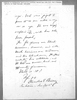
ago, but who forgot to pass it to me until a day or so ago. It was simply [crafted?] [?], and has not been pressed.
The [fc.?] [?] are blunt, [?], [??], and with much [?] on [mid-nerve?] and two lateral ones. The plan evidently has [?], and its [?] are narrow, hard, and apparently [?].
What is it?
Tly &c Charles E Bessey Poa Audina – Aus Nov 12th 86
477
In sending specimens of plants for investigation it is desirable to have the leaves, flowers, and fruit; and, in the case of bulbous plants, the bulbs, also. When they are sent from a distance it is bets to prepare the specimens by drying them under pressure between folds of absorbent paper, otherwise the parts shrink and break so as to be hardly recognizable. When the dried plants are sent they should be protected from breakage in the mail by being inclosed between pieces of stiff pasteboard. Packages weighing less than four pounds can be sent by mail at the rate of one cent per ounce. Write the name of the sender on the outside. In the letter accompanying the specimens state where collected, the date, and any other particulars of the plant, whether reputed poisonous, pestiferous, medicinal, or useful.
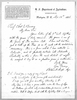
U. S. Department of Agriculture, Division of Botany, Washington, D. C., Nov 12th 1886.
Prof. Chas E Bessey My dear Sir
Your letter of the 8th inst. together with the grass is duly received. The grass is one of the forms of Poa audina [Nult?]. I have not had time yet to take up the Poas so as to make all the subdivisions necessary. This is a form which I have collected in Colorado, and it probably extends into Nebraska. Probably as this is from the arid district it might be useful to try it as a pasture grass in cultivation.
Truly Yours Geo. Vasey Botanist Dept. Agr.
P. S. I send you a copy of my Report on the investigation of the Grasses of the arid districts. I hope you will find something interesting in it. My idea is to have a grass station under the Com. of Agr. at Wallace – for which only 5 or 6000 dollars per annum will be needed. Will it interfere at all with the Ag. College Bill in Congress?
478
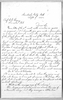
Central City Neb Sept 9 1886
Prof. C. E. Bessey Lincoln Neb.
Dear Sir.
Your letter of the 6th inst. with circular on grasses, is received and I herewith give you such information as I have at present, and I also send you some branches of the plant from the south and of the Platte bridge.
The plant is quite common on waste sandy land and during its earlier growth has considerable foliage, the leaves getting to be two inches long. The branches I send are from several different plants, so that you can see the leaves (which have mostly fallen). I noticed none of it growing on the pasture on either side of the railroad tracvk; which leads me to think that the cattle have eaten it and possibly it may have some value as forage. The root is annual. I have not noticed it growing only on land that has once been plowed, and cannot say whether it is indigenous or adventive. If you desire I will send you specimens in blossom next summer.
As to Sand Cherries:
It is some twelve miles out to where they grow and I do not know as I can get specimens with foliage this fall, but I will send you a few to transplant at the earliest opportunity.
What is the average size of the cherries?
The larger and sweeter ones are about the sixze of a Murrillo cherry, but they average a little less.
479
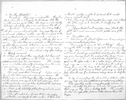
2 Are they palatable?
Uncooked: They are very considerable; they have the peculiar flavor belonging to all cherries, but the smalles ones are quite bitter; the larger are best slightly bittersweet when fully ripe, and most persons like them.
Cooked: Since you were here I have talked with five women (all good cooks). One says they are of no account whatever; another says they are equal to the best cultivated cherries, and recommends [?]ing a little vinegar with them in cooking either for pies or in sauce, the other three are moderate in their praise, and say. that they are good for both pies or sauce, but are apt to be a trifle bitter; one recommends [?]ing sugar with them and [?] them stand a day after cooking.
3 Already answered.
4 I have not observed them very closely, but have not noticed any difference in the bushes so as to tell which would have the best cherries. the bushes and the berries are nearly alike all over a patch.
5 Have they been cultivated etc?
Not very much that I know of. I have seen a few bushes that were set out near a house; the bushes were somewhat larger than they usually grow wild, and the cherries were equal to the best wild ones, but whether particular care was taken to pick out the best ones to transplant I do not know.
6 What is the probability of their proving valuable under cultivation?
I have often expressed no opinion that under proper cultivation, and especially if improved by a skillful horti
-culturist, varieties might be produced that would prove a valuable fruit.
7 & 8 They may be propagated from seed, but I think the better way is, to transplant directly from the prairies.
If you desire I will send you some plants this fall, and next summer I will gather some of the seed.
9 Description etc.
Not having the plant before me I cannot give a very accurate description.
Commonly known as "Sand Cherry." Grown among the hills usually in sand soil, but occasionally on clay; stems somewhat inclined, fropm 1 to 2 feet height, not much branching, and (I think) sprouting from the root, one year, having fruit, the next and then dying; leaves oblong-linear with only short [?], bright shining green on the upper side, 1 to 2 inches long; flowering in early May, [sic.] singular or [?] clusters from the axils of leaves from near the base to the top of the stem, flowers small, fruit dark brown or black, ripening in last of July, from the size of a Richmond cherry down to half the size.
To-day since writing the above I have talked with a young lady who has gathered and cooked many of them.
She says they make a very fine jelly and can be made into [batter?] like plums, but are not so good in that way as they have a puckery taste. The smaller bushes she says often produce better cherries than the larger.
480
As to the "Circular on Grasses": Do you wish for specimens the common ordinary growth for botanical specimens, or the largest that can be found to exhibit at a fair etc?
When do you wish to make your report? It will be a good deal of work to look this whole matter up in a week or month and even then I could hardly get information of much value, but if any time within a year or two will answer, it will be a pastime for me and I hope of service to you.
Yours Truly [Mark?] Whited Central City Merrick Co Neb.