

31
6 Park Village East London N.W. Dec. 15th 1885.
My dear Sir
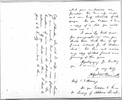
At the last meeting of the American Association for the Advancement of Science I think you read a paper on the reproduction of the [Lygneceae?], in which you came to a different conclusion from that to which I have done in the sexual differentiation of the cells. As it is a subject in which I take great interest, I should very much like to see a detailed [?] of the observations on
32
which your conclusions are founded. We have only at present seen brief abstracts of the paper. Do you happen to have a copy of it that you could send me?
I send by book [post?] a few paragraphs in case you should [sic.] think them of [?] interest for [?] "N[?]". We have not received any copy of that Journal since January of this year.
Apologizing for troubling you, I remain,
Yrs very truly Alfred W. Bennett
Prof. C. E. Bessey.
Do you happent o know Dr. [Loring?] of [sic.] Lincoln
City, Nebraksa, who, with his wife, [were?] in London for some months last winter, & were fellow travellers of mine across the Atlantic in the autumn. If you should meet them, I shall be glad to be kindly remembered to them.
33
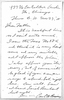
137 No Central Ave Austin Sta, Chicago.
Thurs. [A. M.?] Nov 23, '85
Dear Father
It is breakfast time so I can't write much. I saw the Tues No & 3A and think it is very handsome and very suitable and I approve the plan. I also a[prove your intinerary, but of coruse will be glad if you can arrange to spend Sat. right here. Am well. Saw and heard Sarah B[?]hart last night.
Your son Carl A. Bessey.
34
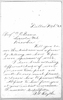
Diller. Neb. 11/6. 85.
Prof. C. E. Bessey, Lincoln, Neb. Dear Sir,
Will you do me the kindness and a favor by telling me how to preserve specimens of wood.
I have been collecting different kinds of wood for some time past and will be very much pleased to learn how to preserve them.
Hoping to hear from you at your earliest convenience I remain.
Respectfully B. J. Blythe.
35
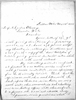
Diller. Neb. Nov. 13d. 1885.
Prof. Charles E. Bessey Lincon, Nebr. Dear Sir.
Your letter of the 7th inst. giving directions for preserving woods is at hand, and please accept my thanks in return for directions and also for the copy of the "Amer' Nat. Extra" of October, giving general botanical noes which were read with much interest.
My collecting will be confined at present to our native woods and I will with pleasure contribute some specimens for the University Cabinet. Think that the specimens will show much better with the bark upon them as some kinds are very much alike when seasoned i.e. ash & hackberry and even hickory appear alike when surfaced to a person who does not examine closely.
I presume some questions which I