
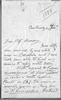
86
Cambridge Mar, 4.
Dear Prof. Bessey,
Your letter was received by me while I was in Bermuda and I have not been able to find any leisure to reply until today.
With regard to Puccima [?], it first [?] in [?], North Carolina plants in 1867. THe name is wrongly given in [?] [?] as P. [?] [?]
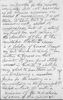
87
[2]
am responsible for the mistake originally, I do not know, but as all my own specimen[s?] are labelled P. microsporaea, I do not think it likely that I on this occasion only spelled it microspora but it is certainly my fault for not calling the attention of Ellis to the mistake: Whether the species is P. lobeliae of [Gerard?] i cannot say [?] think it likely I have written to Gerard on that point. If you find other errors in Cent. III, I shall be very glad to hear them as I am preparing a [sic.] paper for the academy as a commentary on the forms published in Cent. III with a revision of the N. A. species of some of the [?]
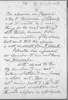
88
[3]
[to Bessey 4-IV-1881]
The specimen on [?] is the P. [?] of [?] and it would be a nice thing for the next century. I still think, however, from an examination of the speciments last sent that the species is not destinct from P. [?].
Schroeter has expressed no opinion to me on P. [?] var. [?].
With regard to the A[?]. Am. B[?]. I am not certain whether I can furnish a whole set. There is a set minus part I; II & III are in good condition. Part III will appear in a fortnight
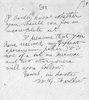
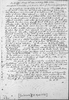
90
March 7. 1881 [?]
Am. [?] Sci. 3d [?] [?] XIX [?] 109. Jan'y. 1880. 1.75.
classification & description of [N?]. American species of characeae?; by B. D. H[a?]lstead.
The [?] paper directly relating to the American charae appeared in this journal in 1843, [?]; the "[?] [?] of the charae of North [?] Prof. [?] [Braun?], communicated by Dr. Engelmann." Two years later a notice of American charae appeared in a note to [Plantae?] [?], published in the Boston Journal of Natural History. Since that date he has only scattered references to charae in local lists & reports of different expeditions, [?] within the last few years when the attention of our botanists has been more frequently turned to the species of the small but interesting order. The task of determining native species will be much facilitated by two books which have recently appeared, one by Dr. J. F. Allen entitled Characeae Americanae, an illustrated work of which two parts have appeared, has already been noticed in this journal. The other, originaly presented as a graduating thesis at Harvard University in May 1878, by B. D. H[a?]lstead, is now published in part in the Proceedings of the Boston Society of Drafted Botany. There is a short introduction, giving a general account of the structure of the order, followed by detailed descriptions of the 18 species known to the writer from an examination of the Herbaria at Cambridge and a number of P[?] collections. Of the species 8 belong to [Netulla?], [10?] to [Tolypella?], and 9 to Chara. One new species C. [?] is described. Among the more interesting species, we may mention [N?]. [gelatinaea?] found by R[?] in the Santee Canal, & the beautified G. gymnopus, var. [elyans?], which was first found by [?] in [Essay?] County, Massachusetts, where it has recently been rediscovered by Mr. Robinson; & it is now known in other localities. As a whole the paper shows indications of careful study, & there is only one portion which we would criticise.
The group of the Gynopodae including C. gymnopus to C. r[?] should be compared with C. [polyphylla?] var. [?] [?] which as it seems to us, may have been confounded with what Mr. Halstead considers to be the typical C. gymnopus.
It should also be compared with C. [sejuneta?] [Brown?], a species certainly approaching C. r[?].
The literature of the old C. m[?] & C. [sejuneta?] is very obscure, & these two species figure unpleasantly in the footnotes of inaccessible articles, but we hope to have eventually from Mr. Halstead a further elucidation of the Gymnopodae.
W. G. F.