
156
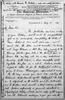
The edition of the Session [?] Bulletin is exhausted nearly, but please [continues below]
Edited by Dr. A. S. Packard, Jr., and Prof. E. D. Cope.
Associate Editors Dr. Elliott Coues, Department of Mammals and Birds, Prof. O. T. Mason, Department of Anthropology, Ellis H. Yarnall, Esq. Dep. of Geography and Travels, Dr. R. H. Ward, Department of Microscopy.
[continued from above:] send me the names of 12–15 most important persons, + I will try to [see?] them–
The American Naturalist. A Popular Illustrated Magazine of Natural History and Travel.
Letters on business connected with the American Naturalist should be addressed to the Publishers, McCalla & Stavely, 237-9 Dock Stree, Philadelphia, Pa.
Terms of Naturalist, $4.00 a year.
[side note:] Mr J. [?]. Gardner's address could be reached by addressing [?] Messer McMillan + Co. London.
Providence, R. I., Aug. 10 1880
My Dear Sir.
The publishers sent me a copy of your Botany, and I write to congratulate you on so successfully completing the task, I have looked it over with some care – and I much like the plan and its execution. The trouble with [?]'s [Botamis?] is that they refer mainly to the [Honeing?] plants – your book is the first American one to give a person like my self who has a very superficial knowledge of the subject, a clear conception of the vegetable kingdom as a [?]. I shall venture myself to notice it for the Naturalist, instead of giving it [to? ?] [?] – specialist to review.
By the way would you feel like editing the Botanical department of the Naturalist? The duties are to adjudicate on the articles sent for publications and to prepare each [?] a [brief?] resume of botanical [?] especially in general, [?] + physiological botany. I will send a copy of the [magazine?] + all the botanical exchanges, + give you all the
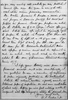
157
[?] you may want of notes + articles you may publish. I cannot offer more this year as some of the other [asst.?] editors receive [?] [?]. Mr. Watson promised to prepare a review of botanical [?] in America for 1879, but could not [prepare?] his promise. Could you prepare an article for the [?] no. of 8-10 [papers?]? I will offer you what I did him + for which he originally agreed to prepare the article [?]$10,00. If so then send the [?] to me by Sept. 5th or 18th if you can. If you havent time to get it [ready?] for [Sept.?] can you do the same for the [?] Naturalist. Minor notes + papers of [course?] could not be referred to in such an article – only such work as has [?] added to the sum of American botanical knowledge during 1879.
I hope your Botany will prove a financial success, as it will scientifically. I am gratified to see a number of references to papers originally published in the Naturalist. I think this volume (XIV) contains a goodly number of botanical papers of importance. We need more contributions of short notes. Hoping you will feel willing + able to cooperate with [?] + myself in editing the journal, [I am?], Yours most truly, A. J. Packard, Jr.
158
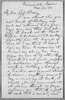
Grinnell, Iowa Nov. 26 '80
My dear Prof. Bessey,
I was about when your [last?] book of Botany was sent, and returned but a few days ago, and then did not find the book at the Post Office but received it subsequently from the hands of Prs. M., so that I [have?] had no time to examine it. Indeed, my study has been given so much to other things that I do not feel competent to criticize your thorough work in botany; but if, as a Teacher and general student of science, anything occurs to me in reading the book, I shall gladly communicate it. A glance through its pages impresses me that it is just the work that is needed, and
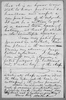
159
that it is an honor to our state to have produced so handsome and useful a compendium of the subject. It will be a motive to get in a second term, here, of botany, at least for students in the scientific course.
Some very fetid fungi preserved in alcohol, have been placed in the museum [sic.] during my absernce, – large hollow cylinders. I brought home with me, in glycerin, a fetid fungus of brilliant red, 3 inches long – of this shape [ILLUSTRATION] – an indelicate shape as well as odor. The thin tube, not the head, is collapsed; the color preserved.
Made considerable collections, East, of marine invertebrates, and of [?] rocks (Eastern Mass.). Does Prof, Beal wish to exchange anything?
Yours truly, H. W. [Packard?]
160
Progress of Science
Two Germans say they have discovered a method of "[?]" plants grow. In the apparatus the growing plant is connected with a disc, having in its center an indicator which moves visibly and regularly, and this, on a scale 50 times magnified, denotes the progress in growth. Both disc and indicator are metal, and when brought in contact with an electric hammer, the electric current being interrupted at each of the divided interstices of the disc, the growth of the plant is as perceptible to the ear as to the eye.
"The flame of fire in the bush."
Ex. III, 2 – 3 – 4; Deut. XXXIII, 16: Celsius argues that it ws Rubus vulgaris, i.e., R. fruticosus, the bramble of black-berry bush; it is identified by Speugel as the Hebrew Sēneh, terming it the Rubus sanctus. Others seem to think it was sort of a thorn bush, but fail to identify it.
— Vide Smith's Bible [Dic.?] for further inf.
The below recently taken from a Chicago paper: "A remarkable plant is now at "Kew Gardens," London. The plant has just been brought from the Arabian Desert, and numberous scientists declare it to be identical with the "burning bush" which Moses saw burst into flame at his approach and blaze for some time without being consumed. The plant at Kew, which grows to the height of 5 or 6 feet, possesses the remarkable property of exhaling an inflammable gas from its flowers, which, on being approached by a light, takes fire and burns brightly for a few moments. The plant in the meanwhile remaining uninjured, – owing to its [?]."
"In the hot desert of Arabia, where the plant naturally grows more vigorously than at Kew, a larger quantity of this gas is exhaled and it is probable that the fierce rays of the sun [so?] frequently cause to take fire. It cannot be said that the discovery of this plant and its strange characteristics add greatly