

41
Chicago Globe ________________ WAR DANCE AT THE FAIR. ________ Eighty-Five Indians Occupy the Administration Building.
One of the most pleasing features that transpired in the Administration building at the World's Fair grounds yesterday, immediately after the scenes following President Cleveland's act of pressing the key which set the machinery in motion, was the war dance, given by eight five of Buffalo Bill's Indians. The dance was given in honor of President Cleveland and the members of his cabinet. Some members of the presidential party were unfortunate in not being afforded an opportunity of witnessing the whole performance, as they were, at the beginning, in another part of the building.
There was a happy reception accorded the eighty-five stalwart Indian braves in war paint and feathers as they filed in singly through the south door of the main floor of the Administration building. Among the chiefs easily recognized was "Rain-in-the-Face," the noted Sioux warrior and counselor of Sitting Bull in the many bloody battles fought during the '70s, and which finally resulted in the massacre of Gen. Custer and his band of brave soldiers on the Little Big Horn.
Strange as it may seem to visitors to the World's Fair, no American Indians are quartered in Midway plaisance, where nearly every race on the face of the globe is represented. The importance of the Indian in the affairs of American history seems never to have been fully appreciated by the management; at any rate he has been entirely ignored in a most important department of the Fair.
Every seat in the great amphitheater of the Wild West show and almost every available foot of standing room was occupied at yesterday's performance. There were 18,000 paid admissions. Exactly ninety-three eastern newspaper men and foreign journalists and correspondents attended the performance. ____________
People on the Platform.
One hundred feet from the east portal of the administration building a small table, covered with the United States flag, stood on a platform six feet in height. Resting on the stars and stripes was the velvet base of the magic key that was to send the thrill into machinery hall and formally open the Exposition. Above this rich velvet and gold pyramid the key itself rested like a beautiful jewel.
Stretching upward and backward from this center piece rose the grand stand, tier on tier.
It was 10 o'clock when little groups of men and women began to appear in the broad stretch of terraced seats. They stood about and talked and looked up at the clouds and wondered why everything seeemd to be late. Still the spectators gathered--ten came into the grand stand and a hundred clustered below in the proportion of ten to one.
It was a remarkable gathering in may ways that filled the grand stand. Not only were there men and women of distinction among them, but a dozen nations contributed to the assemblage. Chicago's representatiev men were there, almost to a man, it seemed. Congress was represented in both houses in this earlier gathering, the army, and navy, the bench and the bar held a place. It was among the foreign contingent that attention was chiefly directed.
Three figures well to the front received gen
Chicago Daily News May 2/93.
eral notice. They were the Scottish earl of Aberdeen, Sir Edward Birbeck, and Sir Henry Wood. Baron Kunowski came on the platform accompanied by Marshall Field. Abdul Rahman, rajah of Jahore, was a noticeable figure, dressed in black with a purple apron tied about him, and with an oriental wealth of insignia across his broad expanse of shirt front. Fred Douglass' dark face and long, white fleece showed near the big frame of Buffalo Bill, who, wearing a white sombrero, passed among the throng to be admired.
Indians Greet the Great White Chief.
Buffalo Bill did not take his Indians to Midway plaisance to meet the president. Rocky Bear, the venerable chief of the Sioux, issued orders Sunady night for his young warriors to dress themselves in their best clothing for Monday noon. Having painted themselves yesterday morning and tied fresh ribbons in their long black hair seventy-five Ogalallas and Brules were taken to administration buliding to meet Mr. Cleveland. There were in charge of Major Burke and old Jack Nelson, a scout. It was the biggest crowd Nelson ever got into in his life. He had not gone far before a wall of people swept him off his feet and drove his old coonskin hat into the jaws of a mountain lion resting on a pedestal at one of the approaches to the lagoons. The Indians were taken into administration building and led to the top floor. The panorama spread out before them was so grand and so startling that they could not suppress their emotions. It was with difficulty that they were led downstairs. Rocky Bear was introduced to the president. They shook hands. The president said "How do you do?" The Sioux said "How?" and then both bowed profoundly.
After Rocky Bear left the president he called Major Burke to one corner of the building and gave his estimate of Mr. Cleveland. "Leela tonka," he said, and when Major Burke was asked what "leela tonka" meant he said that Rocky Bear was satisfied because the president was fat, and that, being fat and big, he must be a good president.
Old Flat Iron, a scout with a nose like the beak of an eagle, was so badly scared during his ride in the elevator that he clung in terror upon the neck of Agent Small, who accompanied him. When he reached the bottom the old fellow exclaimed: "Leela washta!" (very good), and the, drawing his blue blanket about his head, he fought his way with the rest of the warriors through the great crowd surrounding them.
Chicago Times
Their Ancestors Greeted Columbus.
Only less striking than the guide venders was Buffalo Bill's detachment of Indians. They wore the fullest of their full war paint The nodding plumes of their war bonnets waved above the heads of the throng, and there was a rush to see the men whose ancestors greeted Columbus, the representatives of the only nation permitted no recognition on the platform at the inaugural ceremonies held in Columbus' honor. Shouts of delight arose from the throng as the braves passed on their way, answering the applause with their own shrill war whoop. May 2/93.
Chicago Herald May 2/93.
It was the greatest crowd Chicago has ever seen or probably ever will witness.
Taking a Bird's-eye View.
Viewed from the balcony of the administration building the crowd presented an unusual and a wonderful apperance. Looking directly down on the ground in front of the grand stand not an inch of terra firma was to be seen, so densely were the people massed together. Toward the edges of the crowd it was a little more open. It was into one of these open spaces on the left that Buffalo Bill marched his band of Sioux warrior, while the grand stand was yet filling up. The color lent by the fanciful headdress of the braves and their red, blue and yellow wrappings was a pleasing break in the solid mass of black hats worn by the men, who formed the majority of the crowd. The wide, white hat of the noted scout identified him the moment he turned around the corner of the building, and the crowd made a dash in the direction of the new arrivals, soon surrounding them. The original Americans were shortly taken over to the opposite corner of the building, it taking them fully half an hour to get there. They forced an opening which closed instantly behind them. Beyond the little dots of color here and there in ladies' hats--and the crushed wearers were sprinkled through the crowds in goodly numbers--the Indians gave the bright spot to the scene.
COL. CODY'S INDIANS AT THE FAIR.
Chicago [word?] may 2/93.
Aborigines Grow Enthusiastic Over the Stirring Spectacle.
Had it not been for the fine speciments of the noble red men sent over from the wild west show the aborigines of the country whose ancestors it was that Columbus discovered 400 years ago would not have been represented at the opening yesterday. Eighty-five red Indians rigged out in theri richest beads, feathers, and war paitn viewed the inauguration ceremonies. They wre extended the courtesy of an admission to the administration building, and while there went to the top of the building and were enchanted with a fine view of the "big water." Rocky Bear, who had been at Washington during President Cleveland's former administration, impressed upon his fellow braves the good qualities of the "great father," and the enkindled enthusiasm resulted in a terrific "Ogallala" salute to the president.
The manager quit selling tickets at the wild west show yesterday afternoon when 17,000 people were inside and thousands of others were at the gates. Pleasant weather had fully demonstrated the tastes of the people for entertainment of this sort. The Indian historical tableaux, the wild-riding cowboys, the expert marksmanship of Miss Oakley and Mr. Baker, as well as the grand company of rough riders and the musical drill of soldiers of all nations stirred up the vast audiences to profound depths.
The reception given to Col. Cody by the audience amounted to an ovation. Everything points to the fact that Buffalo Bill will repeat here the success which attended him at the Paris exposition, when the crowned potentates of the earth scrambled over each other to gain front seats at the show. ___________________
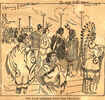
(IMAGE) THE PAST LOOKING UPON THE PRESENT.
SCENES AND INCIDENTS. ________
Kicking Bear Salutes the President--Mr. Cleveland and the "Japs."
BUREAU OF THE WORLD, CHICAGO, May 1.--Over 100 full-blooded Indians, mostly Sioux, witnessed the platform ceremonies. They were headed by old Rain-in-the-Face, who was conspicuous in the Custer massacre. They sat stoically through the exercises, and when they were over announced that they were the real Americans and that the earth belonged to them. Kicking Bear insisted on shaking hands with the president. He received the privilege and said:
"Great chief. Me chief, too. Me Kicking Bear."
The president said he had heard of Kicking Bear.
New York World May 2/93
AMY LESLIE AT THE FAIR. ____________ Yesterday's Opening of the Fair the Grandest of All Previous Inaugural Events. ____________ A PRETTY PICTURE MADE BY INDIANS. ____________ What the Park Will Offer in the Way of Lovers' Walks a Month from Now. ____________
The grandeur, dramatic intensity and poetry of yesterday's Fair inauguration cannot be compassed in words. The simplicity, grace and earnest dignity of the ceremonies, the beauty of the spectacle and the pictuersque incompleteness of the surroundings gave the day something of the awesome solemnity of imagined creation.
Minor inconveniences seemed forgotten; there was only the mighty stretch toward heaven of glistening domes, marble arms and gigantic eagles' wings, brave statues and histories in emblazoned tablets. Out upon the battling whitecaps of Lake Michigan hung a thousand greetingsfrom exultant ships. The presence of strange friends and unaccustomed tongues, costumes known to us only through the spangled veils of art and verse and with it all the tumult of life and pride and youthful hopes. To me there was nothing lacking except a more accommodating weather bureau.
Seas of mud, a morass, a swamp, from the gates to the lake and back whichever way the road might lead. The unkindest trick the skies ever played this ambitious city. But neither the storm king nor the general indication of hurried and partial preparation could mar the impressive hour of midday, when multitudes stood in hushed attendance upon the treasured words they could not hear but trustfully welcomed; awaited the magic touch of authority which thrilled the wheels and foutains, rent the mist with piercing engine shrieks and tumultuous hurrahs and unfurled a forest of banners till the turrets of every shining roof blossomed into color.
A very pretty accident gave an unexpected American tinge to the climax of the interesting ceremonies. Cody's Indians were permitted to go upon the highest balcony of the administration building where they might see the flags run up. By an unintentional gauge of time that seemed strategic just as the machinery began to roar, the whistles blow and the magnificent chorus intone "My Country, 'Tis of Thee," these Indians in their resplendent war-paint, gorgeous necklets and representative American savagery appeared on the north abutment of the building, a blazing line of character moving along with high, flaunting crests of feathers and flaming blankets which stood out against the gleaming white of the staff dome like a rainbow cleft into remembrances of a lost, primitive glory. Nothing in the day's occurrences appealed to sympathetic patriotism so much as this fallen majesty slowlly filing out of sight as the flags of all nations swept satin kisses through the air, waving congratulation to cultured achievement and sumissive admiration to a new world.

42
Chicago Globe _____________ WAR DANCE AT THE FAIR. ________ Eighty-Five Indian Occupy the Administration Building.
One of the most pleasing features that transpired in the Administration building at the World's Fair grounds yesterday, immediately after the scenes following President Cleverland's act of pressing the key which set the machinery in motion, was the war dance, given by eight five of Buffalo Bill's Indians. The dance was given in honor of President Cleveland and the members of his cabinet. Some members of the presidential party were unfortunate in not being afforded an opportunity of witnessing the whole performance, as they were, at the beginning, in another part of the building.
There was a happy reception accorded the eighty-five stalwart Indian braves in war paint and feathers as they filed in singly through the south door of the main floor of the Administration building. Among the chiefs easily recognized was "Rain-in-the-Face," the noted Sioux warrior and counselor of Sitting Bull in the many bloody battles fought during the '70s, and which finally resulted in the massacre of Gen. Custer and his band of brave soldiers on the Little Big Horn.
Strange as it may seem to visitors to the World's Fair, no American Indians are quartered in Midway plaisance, where nearly every race on the face of the globe is represented. The importance of the Indian in the affairs of American history seems never ot have been fully appreciated by the management; at any rate he has been entirely ignored in a most important department of the Fair.
Every seat in the great amphitheater of the Wild West show and almost every available foot of standing room was occupied at yesterday's performance. There were 18,000 paid admissions. Exactly ninety-three eastern newspaper men and foreign journalists and corresspondents attended the performance.
43
Opening of World's Fair
Chicago Inter Ocean May 2/93.
[Drawing]
THE PAST LOOKING UPON THE PRESENT.
44
"BUFFALO BILL" IN THE RING.
However much the unfortunuate weather has affected the attendance at the world's fair, it seems to have had little or no effect on the patronage extended to Buffalo Bill's Wild West, which is located at its very gates. The daily performances are given at the regular hours whether the rain pours in torrents or the sun shines brightly. Col. W. F. Cody (Buffalo Bill) has gathered around him a remarkable assemblage of typical characters, and in conjunction with them depicts scenes of historical interest, in which he and his associates prominently figured. The wild horses captured on the plains and brough here especially for the purpose are ridden by veritable Indians and cowboys from the prairies of the great weset. Picked detachments from the best cavalry regiments of Europe and from our own regulars excecute their practical and fancy drills, and altogether a series of thrilling and intensely interesting features is presented to the audience.
Mental exhaustion and brain fatigue Promptly cured by Bromo-Selzter.
Chicago Dispatch
May 6/93.

45
Chicago Daily New 5 May 1893
THE DAILY NEW ________________________ AMY LESLIE AT THE FAIR. ____________ Some Reflection as to What Might Have Been Done in American Art ____________ VISIT TO BUFFALO BILL AND HIS MEN. ____________ Rain-in-the-Face a Particularly Amiable Indian--Other Incidents of the Day. ____________ [By Special Private Wire from the Daily News World's Fair Bureau.]
If there had been a decisive American spirit in the commision upon art in this Columbian Exposition instead of revivals of mythological symphonies, classics and the rightful inheritances of worlds crumbling with mellowed perfections there would have been something of the daring originality, vigor and unique emphasis indicative of our own history, our undeveloped splendors and gradual advancement in the profligate natural resources of the greatest country, the newest country and the most ambitious country on earth. Instead of the eternal procession of tiresomely perfect gods and goddesses, allegories, revered freaks and European celebrities there might have been a glorious unveiling of the unbroken, golden splendors of American awakening, an indisputable chronology and some recognition of the most picturesque figures in our thrilling vicissitudes.
Instead of familiar old Ceres (this time in such luxury of grace and plenty) or inexhaustible Bacchus, sacred bovines and impious feasters, an American would have lifted on the walls of agricultural hall great pansy-eyed Texas steers, feather-crested Indians, a sun-dance, a Rocky mountain hero, or an even dozen of them and a wilderness of picturesque beauty. On the highest point of vantage, instead of pillaging buried art, America might have been honored with the effort of an artist who felt the magnitude of his own country. Any one of the men employed would have greeted the innovation with rejoices. They must be tired as the least enthusiastic of us of endless views of the myths, the gods and the artistic chestnuts. Fancy a nineteenth century artist deliberately perching himself upon a ladder to map out a Diana or Triton at all comparable with the hundreds which have confronted him during his studies abroad in every investigated quarter from the catacombs to Monte Carlo. While Church, our most decisive creator, must needs distort his brush with "The Viking's Daughter" Macmonnies, Millet, Symonds and the rest of the Columbian immortals have wrestled with gigantic beauties of antiquity until the wonderful Fair looks least like America of any place this side of the world of the obelisks. Any one of these artists or the greater ones honoring the nations with charming art would have reveled in the novelty of picturesque America. It might not have necessarily interfered with the encyclical marble appearance of the Apollos, Venuses, Hebes and adipose Cupids, but what Americans might have enjoyed showing the congress of nations would be types of our own idolized heroes, the like of which ornament no other history. Our warriors, pioneers, savages and broad acres. I--it is I, because I am American from the crown of my head to the ground my feet caress--I would have reveled in a colossal reproduction of the adored heroes inspiring American boys of the last century to courageous undertaking, press of civilization and the audacious vehemence of rightful war. Now, about the only art-rememberance is epitomized in the magnificent examples of the American tiger in on man's magnificent pums.
* * *
Some time ago I listened to a pleasant discourse upon World's-Fair art by Lorado Taft, and though intensely enthusiastic and complimentary, as every one must needs be in commenting upon the exquisite works, about every third model Mr. Taft would dismiss with the significantly amiable remark: "I do not quite know what it represents or signifies, except that it is eminently artistic and beautiful." That is the one absent quality in the gracious art smiling with life at our portals. It does not quite mean anything American, and therefore does not speak to stranger visitors of our nation, but reminds them of their own, and commemoration of signal events are not entitled to so much of a country's homage. It is one thing to discover a world and another to people it, jewel it with heaven's gentlest benisons and slave for the might, glory and perfection of all its promised wealth. If any memory of the pioneer force in American culture is indicated in the World's-Fair decorative exhibitions it must be very stealthily expressed. In place of gilded Dianas and huge Ajaxes, winged houris and exultant dragons how infinitely more surprising and dramatic would have been a group of ungovernable prairie horses, startling western riders and Daniel Boone, Kit Carson, old Jim Bridger or Buffalo Bill. Of course the primitive slush of illiterate penny-dreadfuls has tarnished the princely achievements of this type of American hero. We are accustomed to a sort of dime-novel or Frank Chanfrau interpretation of these splendid characters and the proof of great worthless is that even under so uncouth a cloud they have alway shone out resplendent.
* * * I was more impressed with this forgiveable virtue by a visit to Cody's "Wild West" today. There is the American Exposition which will attract foreigners when they are tired of staring at the Italian gentleness of faultless outlines and evidences of superb culture. They will bring up at the Cody show every time and they will find Americans, real Americans, there--if not in the audience, in the performance.
How a heroic statue of Buffalo Bill, with his magnificent ohysique, picturesque accouterments and scout impetuosity, would have stood out among the dulcet elegances of foreign art! Clad in fringed deer-skins--than which not Grecian drapery is more genuinely graceful and artistic--with the high boots which typify hardship and the country's savage estate, his inseparable gun, fiery horse and incomparable inherent pose!
Cody is one of the most imposing men in apperance that America ever grew in her kindly atmosphere. In his earlier days a hint of the border desperado lurked in his blazing eyes and the poetic fierceness of his mien and coloring. Now it is all subdued into pleasantness and he is the kindliest, most benign gentleman, as simple as a village priest and learned as a savant of Chartreuse. I haave just left him in his beaded regalia (which is not dress, but rest for him), and I do no think I ever spent a more delightful hour. His history, teeming with romance, is familiar to everybody in two continents, but his social personality is known to a favored few, in which treasured category I herewith enroll myself. All the gray that has been thrust into his whirlwind life has centered itself in the edges of his beautiful hair. For the rest he is ruddy, straight as the sturdiest buck in his troupe and graceful as an eagle. He talks in the quaint mountaineer language which robs English of all its proper crudities. It is a lazy, molodious sort of drawl tremendously fascinating and unapproachable except by a thoroughbred trapper, a cool soldier and American westerner.
* * * His own tent at the show is a dream of improvised luxury. There are couches of tempting comfort and such a bewildering plethora of Indian ornament that further entertainment scarcely seems called for but he thinks of a thousand charming favors and offers them in such an every-day simple manner that one scarcely appreciates that there has been any effort made in courtesy. Mr. Cody is perfectly natural. He has acquired no alien airs or manner in his marvelous travels and successses, has never lost the atmosphere of the boundless plains, the inspiration of discovery and attempt, nor the honest bravery of a lonely scout who dares break through savagery and peril for nothing much more than hardy sustenance and exciting adventure.
He has gathered about him a host of clever men and all tongues are spoken under the white tents of the "Wild West Show." The colonel don't speak much of anything but musical, trapper-English and Indian, but he makes himself understood in every camp. I went from one cleanly tent to another and found that most of the soldiers from other battlefields than ours could speak French, some of them very correctly. The Indians growl a sort of Canuk patois which is a distortion of the French, and the Arab shiek speaks most beautifully in both English and French. I think that next to the Indians perhaps this mannerly Turk was the most alluring of all the camping attractions, unless dashing Miss Oakley be excepted.
In the tent of the Arabian leader I was introduced to a lovely young Arabian woman who was herself a shower of bright smiles and beauty. She was the wife of the Arab leader and was dressed in a Parisian fashion very becoming and stylish, though she looked as if a filmy veil, sold silk sashes and the oriental trousers might fit her in sweeter appropriateness. She was introduced as "La Belle Fatima," and chattered in fin de globe French, told me all about the different Arabian war implements with which the tent is loaded down in decoration, laughed, brought out two stalwart young Syrians, who seemed quite as delightful as her charming self or her husband, and we had an impromptu Turkish cafe while Col. Cody went about the other tents to warn lounging Indians and smoking soldiers of the probable appearance in their midst of the rather unusual feminine intruder.
First I was presented to Rain-in-the-Face, a mild, inoffensive old warrior, who looked as if he had never done anything more reprehensible than eat oatmeal all this active life. They all wanted to shake with me and seized my hand in a hearty, friendly way, smile large, oleaginous smiles at me and look straight into my eyes in rather an informal but reassuring manner. Curly, the only survivor of the unhappy Custer massacre, accompanies Mr. Rain-in-the-Face and a pleasant group of white men headed by Wickham join the party in Sitting Bull's cabin. Outside suddenly there raises a fearful din, strange animal yelps and the beating of tightened drums and shuffle of moccasined feet. The young braves are executing a ghost dance and are arrayed in startling coats of paint and tufts of feathers, principally paint. One splendidly built young fellow is naked to his feet, except a cloud of tanned dog-skin about his loins, gorgeously embroidered in beads and feather-bones. He is painted a warm terra cotta and, as he dances, his back is a study of delicte muscles and perfection in outline. A sturdy little Indian boy is called out of the dance, which he leaves reluctantly to greet me. He is the baby, growing very fast, which Burke found wandering among the dead on the battlefield of Wounded Knee, and boasts the cosmopolitan title of Johnnie Burke No Neck.
While I was conversing in Hiawatha quotations to the youthful No Neck an old and somewhat indignant Indian pushed his way through the group around me and made several emphatic remarks to Buffalo Bill, then strode up to me with his tomahawk in a pleasingly convenient attitude. He is the miedicine man and wants to bless me, shake hands and recite an inspiring incantation over my trembling head. He is immensely complimentary, Cody assures me. I suspect both the swarthy doctor and the colonel, but I find that the proper thing to do upon all occasions of doubt is to shake hands furiously with the lowly red man, whether he is out for scalps or wampum. Annie Oakley's tent is next invaded and the clever little sharp-shooter welcomes us royally. Her tent is a bower of comfort and taste. A bright Axminister carpet, rugs, cougar skins and buckshin trappings are all about in artistic confusion. She has a glass of wine and a suggestion of honest entiente cordiale awaiting me when I enter. Guns, guns, guns everywhere, in everybody's tent, but in this particular one they are swagger, what a seaman would call taut and jaunty sorts of firearms. Miss Oakley is not only a wonderful shot but an actress of no mean opretensions and her comedy in her dextrous exhibition of shooting, which is one of the features of the show, is half her performance.
* * * A kindly old lady tehn takes me into an adjoining canvas, where she has piles of unfinished costumes and sewing machines that look pretty busy. She is the mother of the entire camp and has been with Cody for fifteen years. The Russian prince, Ivan Makharadze Richter, a tremendously swell vaquero and an expert bolas wielder are in turn presented to me, and then the infinitely more interesting groups of Indians lounging about the tents close to the fires. One charming characteristic of the fiery, untamed monarch of the plains is his prodigious talent for resting. Indians can rest more to the square inch than any class of royalty I ever ran across. They show is simply tremendous. I can well see how strangers to such brilliant spectacular nature might rave over it. I was born and raised where occurences identical with the dramatic incidents of this exhibition were not at all unusual, and the show is intensely ex-exciting to me. It is not theatrical, save that the dramatic force of reality is always the most thrilling achievement in stupendous spectacles. As for the riding, the entire exhibition shows conclusively that America possesses not only the most daring but the most graceful riders in the world. It is diverting to note the difference in the seat, carriage and management of horses in each representative rider. An Indian hugs the animal close, lifting the hrose, instead of bearing weight upon it. Every muscle of an Indian's body trembles in response to the horse's gait. He sticks to the saddle or bareback by a sort of capillary attraction. The cowboy and Mexican do not touch a horse but wear him out. The rider seems winged and has his hands full of ropes and reins and everything but the expected. Germans are huge, bulky riders, who bounce and shake and take good care of their horses. Cossacks ride a horse like it was stationary and cast-iron and the Arabs whirl about a mass of circling drapery and arms. A Frenchman is always le beau sabreur, but he can't ride even a rocking-horse. The most beautiful, graceful and easiest riders in the world are American cavalrymen. In Cody's show they are magnificent. Handsome, of course. I was assured to-day by a very insinuating and attractive lieutenent of New York's 8th, that American military men are always handsome and brilliant and brave.
AMY LESLIE. _____________________________
63d St. Opposite World's Fair.
NOW OPEN--RAIN OR SHINE.
Every day at 3 P. M., Sundays Included
Voted a World-Beater.
The Open Sesame to the World's Fair Subject.
100 Vivid Realistic and Historic Tableaux Miss Annie Oakley, Master Johnny Baker, in Marksmanship.
The Key to All Congress of Rough Riders of the World.
COSSACKS OF THE CAUCASUS ARABS, TARTARS, SYRIANS, ENGLISH, FRENCH, GERMAN and AMERICAN SOLDIERS.
450 PEOPLE IN THE SADDLE INDIANS, COWBOYS, MEXICANS, RURALIE, SPANISH GAUCHOS, VAQUEROS.
Detachments of Cavalry of all Nations --------IN A------- Monster International Musical Drill. _________
SCENIC SPLENDERS The Climax in combined interest of all Exhibitions.
TWICE A DAY, Rain or shine, 3 and 8 P. M. 18,000 seats. Covered grand stand. Admission 50 cents, Children under 10 years 25 cents. Grand electric light illumination.
A HERD OF BUFFALOS, WILD STEERS AND BUCKING BRONCOS
Alley L. Illinois Central, Grip, Electric and Horse Cars all stop at 63d St. Entrace.
Chicago [?] [3/7?] _______ Buffalo Bill's Big Show.
The exhibitions of the great Wild West at Sixty-third street, opposite the world's fair, constantly grow in public favor and the enthusiasm of the spectators is unbounded. The character of the entertainment is so unique, its various features so realistic, and as an entirely it is so practically illustrative of the scenes, incidents, and people who inhabit the prairies and mountains of the far west that it is not surprising that it has already become a fixed and powerful world's fair attraction. The Wild West is unprecedented as an attraction that introduces the identical characters of whom it tells. The Indians that take part in the entertainmetn are the very ones who were prominent in the stirring scenes of the frontier; the horses they ride are veritable untamed western products, and the scenes they enact have been actual occurences. The Cossacks, Arabs, Mexicans, and cowboys are not imitators, but are the genuine articles, and the military are actual enlisted members of the different corps they represent. Last, but the most prominent of all, is Col. W. F. Cody (Buffalo Bill), whose record as scout, guide, and hero of the plains is attested by the highest military authority, and whose history is part of the history of the early days of the great wild west. The vast arena is crowded at every performance, there being two each day, no matter what the character of the weather. __________