
36
Chicagoans to read a bit of his life history as told to a reporter for the DAILY GLOBE yesterday by himself in his own modest way.
"I was born," said the colonel, "in Scott county, Iowa, from which place my father, Isaac Cody, emigrated a few years afterward to the distant frontier territory of Kansas, settling near Fort Leavenworth. While I was yet a boy my father was killed in what was
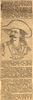
(DRAWING) HON. W. F. Cody. "Buffalo Bill."
known as the 'border war,' and my youth was passed amid all the excitements and turmoil of that unsettled community.
"Being used from a child to shooting and riding, at an early age I entered the dangerous and difficult business on the plains known as 'pony expressing.' I accompanied Gen. Albert Sidney Johnstone on his Utah expedition, guided trains overland, hunted for a living and finally become scout and guide for the now celbrate Fifth cavalry, of which Gen. E. A. Carr was the major. When the Kansas Pacific railroad was in course of construction I was employed by the contractors to supply meat to the laborers while building the road. The first season, I remember, I killed 4,862 buffaloes, besides many deer and antelope.
"During the construction of the Union Pacific I was retained as chief of scouts in the department that protected the
37
Chicago Tribune 5/1
BURNHAM GIVES A BREAKFAST.
One Hundred and Six of His Associates in the Great Work the Guests.
One hundred and six invited guests enjoyed yesterday morning the hospitality of Director of Works Burnham in a breakfast given in Music Hall at Jackson Park. Yesterday marked presumably the close of Mr. Burnham's work. He has built the Fiar, and as he surveyed the completed buildings he felt grateful to the many who had aided him in efforts. So he decided to give a breakfast and to it he invited the architects, artists, directors, and others who have been associated with him in the work.
At 10 o'clock most of those invited were present, and they took seats in the hall where the orchestral performances are to be given. They were agreeably surprised when a few minutes later Theodore Thomas' big orchestra of 120 pieces began for their benefit a rehearsal. At the conclusion of the rehearsal Mr. Burnham led his guests to recital hall, which is up-stairs and at the rear of the concert-room. Here the guests were seated at four tables, three of them ran east and west, and along their eastern and extended the fourth table. At its center in the seat of honor was Mr. Burnham, on his right Frederick Law Olmstead, and on his left Theodore Thomas. On the tables were beautiful cut flowers, and about the room were ferns, and potted plants which Uncle John Thorpe furnished for the occasion. All the decorations were of superior character and the menu sufficiently tempting. It ran thus:
Strawberries. Broiled white fish, cucumber salad. Lamb chops, with green peas. Broiled spring chicken, potato croquettes. Lettuce salad. Coffee and cheese. Montraehet, Chateau La Rose, Monopole, club dry, cigars, and cordials.
38
Everybody drank from Mr. Burnham's loving cup. It was that magnificent token of esteem which was given Mr. Burnham at the banquet in his honor held recently in New York. Mr. Burnham.'was the first speaker, though the speakıng was wholly informal. He gave a brief résumé of what had been accomplished and the status of affairs. He had many kind words for the achievements of Mr. Olmsted and a toast was drank to the latter's health. Mr. Olmsted cares more for landscape gardening than speech making, so he responded but briefly. Thomas B. Bryan, Commissioner at Large of the Exposition, paid a beautiful tribute to Mr. Burnham's success as Director of Works, and then he recurred to the two artists who have passed away since they became connected with the Exposition. They were John W. Root, the architect, and H. S. Codman, the associate of Mr. Olmsted in landscape architecture. As a fitting token of esteem to their memory the company rose and stood for a few moments with their heads bowed in silence. Director Lyman J. Gage had much to say of the beauties of the architectural splendor afford in the White City. Director Ferd W. Peck felt called upon to speak in the name of the Exposition, the City of Chicago, and the people of the republic, of the appreciation which they had for the people who had made the Fair. James S. Norton devoted a short speech to Sunday opening. He said that from a religious standpoint the Fair should be open Sunday. During the several hours which the breakfast lasted there were two military bands performing where the orchestra had rehearsed. Many of those invited could not be present, but sent regrets. Among those in attendance were:
Milward Adams, J. Fred Aytoun, O. F. Aldis, Maitland Armstrong, C. B. Atwood, J. W. Alvord, Dankmor Adler, C. K. G. Billings, Thomas B. Bryan, Max Bendix, D. H. Burnham, W. L. Brown, W. T. Baker, E. B. Butler, Theodore Baur, J. J. Boyle, Mark L. Crawford. Isaac M. Camp, William J. Chalmers, Charles H. Chappell, Henry Ives Cobb, O. C. Coleman, Col. William F. Cody, Col. R. C. Cloowry, Codman, Dewitt C. John Cregier P. Codman, Arthur, Dixon. John T. Dickinson, Charles Deering, W. L. Dodge, Lawrence E. Earle, James W. Ellsworth, C. F. Foster, C. G. Fuller, Henry Fuller, D. C. French, Johannes Gelert, Charles Graham, E. R. Graham, E. R. Graham E. E. Garnsey, Lyman J. Gage, W. H. Holcomb, H. N. Higinbotham, Charles Henrotin, F. M. Howe, W. L. B, Jenney, Edward Kemeys, W. P. Ketcham, William D. Kerfoot, Milton B. W. Kirk, Thomas J. Lefens, B. B. Lamb, E. F. Lawrence, George S. Lord, Andrew McNally, E. F. D. Millet, Louis Millet, William S. MacHorg, C. F. Mc Kim, W. B. Mundio, Frederick MacMonnies, H. A. McNeill, Walter McEwen, Gari Melchers, Charles McDonald, Adolph Nathan, James S. Norton, F. L. Olmsted, J. J. P. Odell, J. J. Sullivan, M. B. Pickett, R. H. Pierce, Washington Porter, T. W. Palmer, E. S. Pike, F. W. Peck, Erskine M. Phelps, George B. Post, A. P. Proctor, B. L. Pratt, A. M. Roth, Schild, Edmund Rice, A. H. Ravell, E. P. Ripley, Frank H. Roy, Alexander Sandier, E. C. Shankland, George Sohneider, J. W. Scott, Capt. F. M. Symonds, Louis Sullivan, Carl Rohl-smith, Charles H. Schwab, J. W. St. Clair H. B. Stone Lorado Taft, W. L. Tomlins, Theodore Thomas, C. Y. Turner, Georgo H. Wilson, R. A. Wallor, F. M. Whitehouse, Charles Wacker, Edwin Walker, G. H. Wheeler, Otto Young.
39
Chicago Herald
May 1/ 93
TWO CENTS.
LOVING CUP QUAFFED.
MR. BURNHAM'S JOLLY BREAKFAST.
Those Whose Deft Wits and Hands Created Them Turn Over the Fair Buildings to Those Who Control - They Smoke Pipes and Hear Thomas' Music.
At a breakfast given in music hall yesterday morning Director of Works (World's Fair) Burnham, representing the designers and artists of the fair, delivered the great buildings at Jackson part to their owners, the directors of the exposition.
The ceremony brought together, on the eve of the Inauguration, the men who created and those who control the fair. America's most eminent artists were there. Chicago business men, who juggle with millions, sat at table with them, and after the breakfast and wine artist and millionaire lighted corncob pipes and blew clouds of smoke across the frosted linen. The affair was refreshingly informal. The guests sat about the boards without removing their hats or overcoats. Some of them wore newly ironed tiles, others came in the kind of hats affected by politicians in southern Illinois, while still others tramped through the rain in jaunty yachting caps.
Buffalo Bill, the only man there who was neither artist nor official of the fair, sat under a white sombrero of enormous size and told Banker Odell and Architect Cobb all about his wild life on the plains. Once he raise the wide sombrero. It was when the massive loving cup given to Mr. Burnham by New York artists was passed to th eold scout by Mr. Odell. Bill dropped his hat on the floor and shook his long locks defiantly as he rose to salute Mr. Burnham. He received an ovation as he raised the cup to his lips that was only equaled by the enthusiasm that greeted Frederick L. Olmsted, the landscape gardener, who had a seat at Mr. Burnham's right.
40
Chicago THE DAILY NEWS. May 2/93
eral notice. They were the Scottish earl of Aberdeen, Sir Edward Birbeck, and Sir Henry Wood. Baron Kunowski came on the platform accompanied by Marshall Field. Abdul Rahman, rajah of Jahore, was a noticeable figure, dressed in black, with a purple apron tied about him, and with an oriental wealth of insignia across his broad expanse of shirt front. Fred Douglass' dark face and long, white fleece showed near the big frame of Buffalo Bill, who, wearing a white sombrero, passed among the throng to be admired.