
76
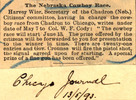
The Nebraska Cowboy Race.
Harvey Wier, Secretary of the Chadron (Neb.) Citizen's committee, having in charge the cowboy race from Chadron to Chicago, writes underrated of May 7 to Col. W. F. Cody: "The Cowboy race will start June 13. The prize offered by the citizens will be forwarded to you for presentation to the winner in time. There are twenty-one entries and Gov. Grounse will fire the pistol shot, the signal agreed upon for staring. A special prize of a fine gun has been offered."
Chicago Journal 13/5/93
77
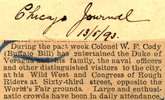
Chicago Journal 13/5/93
During the past week Colonel W. F. Cody (Buffalo Bill) has entertained the Duke of Veragua and his family, the naval officers and other distinguished visitors to the city, at his Wild West and Congress of Rough Riders at Sixty-third street, opposite the World's Fair grounds. Large and enthusiastic crowds have been in daily attendance.
78
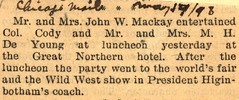
Chicago Mail May 14/98
Mr. and Mrs. John W. Mackay entertained Col. Cody and Mr. and Mrs. M. H. De Young at luncheon yesterday at the Great Northern hotel. After the luncheon the party went to the world's fair and the Wild West show in President Higinbotham's coach.

79
People's Press DULUTH AND SUPERIOR, MAY 13, 1893
THE WILD WEST
Amy Leslie. brilliant descriptive writer and art critic contribute to the Chicago News a long article in which she takes the same position as THE PEOPLE'S PRESS, i.e., that Buffalo Bill's American Historical Exhibit is the most appropriate and interesting department of the World's Fair. Buffalo Bill's Park adjoins Jackson Park. and is therefore virtually a department of the Exposition, although under a separate management. The amiable Amy says:
Some time ago I listened to a pleasant discourse upon World's-Fair art by Lorado Toft, and though intensely enthusiastic and complimentary, as every one must needs be in commenting upon the exquisite works, about every third model Mr. Taft would dismiss with the significantly amiable remark: "I do not quite knɔw what it represents or signifies, except that it is eminently artistic and beautiful." That is the one absent quality in the gracious art smiling with life at our portals. It does not quite mean anything American, and therefore does not speak to stranger visitors of our nation, but reminds them of their own, and commemoration of signal events are not entitled to so much of a country's homage. It is one thing to discover a world and another to people it, jewel it with heaven's gentlest benisons and slays for the might, glory and perfection of all its promised wealth. If any memory of the pioneer force in American culture is indicated in the World's-Fair decorative exhibitions it must be very stealthily expressed. In place of gilded Dianas and huge Ajaxes, winged houris and exultant dragons, how infinitely more surprising and dramatic would have been e group of ungovernable prairie horses, startling western riders and Daniel Boone, Kit Carson, old Jim Bridger and Buffalo Bill. Of course the primitive slush of illiterate penny dreadfuls has tarnished the princely achievements of this type of American hero. We are accustomed to a sort of dime-novel or Frank Chanfrau interpretation of there splendid characters and the proof of great worthiness is that even under so uncouth a cloud they have always shone out resplendent.
I was more impressed with this forgivable virtue by a visıt to Cody's if Wild West" today. There is the American Exposition which will attract foreigners when they are tired of staring at the Italian gentleness of faultless outlines and evidence of superb culture. They will bring up at the Cody show every time and they will find Americans real Americans, there-if not in the audience, in the performance.
How a heroic statue of Buffalo Bill, with his magnificent physique, picturesque accouterments and scout impetuosity, would, have stood out among the dulcet elegances of foreign art! Clad in fringed deer-skins-than which not Grecian drapery is more genuinely graceful and artistic with the high boots which typify hardship and the country's savage estate, his inseparable gun, fiery horse and incomparable inherent pose!
and the beating of tightened drums and shuffle of moccasined feet. The younger braves are executing a ghost dance and are arrayed in startling coa's of paint and tufts of feathers, principally paint, One splendidly built young fellow is naked to his feet except a cloud of taunted dog-skin about his loins, gorgeously embroidered in beads and feather-bones. He is painted a a warm terra cotta and, as he dances, his back is a study of delicate muscles and perfection in outline. A study little Indian boy is called out of the dance, which he leaves reluctantly to greet me. He is the baby, growing very fast, which Burke found wandering among the dead on the field of Wounded Knee, and boasts the cosmopolitan title of Johnnie Burke No Neck.
Instead of familiar old Ceres (this time in such luxury of grace and plenty) or inexhaustible Bacchus, sacred bovines and impious feasters, an America would have lifted on the walls of agricultural hall great palsy-eyed Texas steers, feather-crested Indians, a sundance, a Rucky mountain hero, or an even dozen of them and a wilderness of picturesque beauty. On the highest point of vantage, instead of pillaging buried art, America might have been honored with the effort of an artist who felt the magnitude of his own country. Any one of the men employed would have greeted the innovation with rejoices. They must be tired as the least enthusiastic of us of endless views of the myths, the gods and the artistic chestnuts. Fancy a nineteenth century artist deliberately perching himself upon a ladder to map out a Diana or Triton at all comparable with the hundreds which have confronted him during his studies abroad in every investigated quarter from the catacombs to Monte Carlo. While Church, our decisive creator, must needs distort his brush with "The Viking's Daughter" Macmonnies, Millet. Symonds and the rest of the Columbian immortals have wrestled with gigantic beauties of antiquity until the wonderful Fair look least like America of any place this side of the world of the obelisks. Any one of these artists "or the greater ones of the nations with charming art would have reveled in the novelty of picturesque America. It might not have necessarily interfered with the encyclical marble appearance of the Apollos, Venuses, Hebes and adipose Cupids, but what Americans might have enjoyed showing the congress of nations would be re types of our own idolized heroes, the like of which ornament no other history. Our warriors, pioneers, savages and broad acres. I-it is I, because I am American from the crown of my head to the ground my feet caress-I'd have reveled in a colossal reproduction of the adored heroes inspiring American boys of the last century to courageous undertaking, press of civilization and the audacious vehemence of rightful war. Now, about the only art-remembrance of the march of stupendous America improvement is epitomized in one man's magnificent puma.
A kindly old lady then takes me into an adjoining canvas, where she has piles of unfinished costumes and sewing machines that

80
Cody is one of the most imposing men in appearance that America ever grew in her kindly atmosphere. In his earlier days a hint of the border desperado lurked in his blazing eyes and the poetic fierceness of his mien and coloring. Now it is all subdued into pleasantness and he is the kindliest most benign gentleman, as simple as a village priest and learned as a savant of Chartreuse. I have just left bin in his beaded regalia (which is not dress, but rest for him) and I do not think I ever spent a more delightful hour. His history, teeming with romance, is familiar to everybody in two continents, but his social personality is known to a favored few, in which treasured category I herewith enroll myself. All the gray that has been thrust into bis whirlwind life has centered itself in the edges of his beautiful hair, For the rest he is ruddy, straight as the sturdiest buck in is troupe and graceful as an eagle. He talks in the quaint mountaineer language which robs English of all its proper crudities. It is a lazy, melodious sort of drawl tremendously fascinating and unapproachable except by a thoroughbred trapper, a cool soldier and American westerner.
His own tent at the show is a dream of improvised luxury. There are couches of tempting comfort and such a bewildering plethora of Indian ornament that further entertainment scarcely seems called for but he thinks of a thousand charming favors and offers them in such an everyday simple manner that one scarcely appreciates that there has been any effort made in courtesy. Mr. Cody is perfectly natural, He has acquired no alien airs or manner in his marvelous travels and successes, has never lost the atmosphere of the boundless plains, the inspiration of discovery and attempt, nor the honest bravery of a lonely scout for nothing much more than hardy sustenance and exciting adventure.
He has gathered about him a host of clever men and all tongues are spoken under the white tents of the "Wild West Show."
First I was presented to Rain-in-the-Face, a mild inoffensive old warrior, who looked as if he had never done anything more reprehensible than eat oatmeal all his active life. They all wanted to share with me and seized my hand in a friendly way smile large, oleaginous smiles at me and looked straight into my eyes in rather an informal but reassuring manner. Curly, the only survivor of the unhappy Custer massacre, accompanies Mr. Rain -in-the- Face and a pleasant group of white men headed by Wickham join the party in Sitting Bull's cabin. Outside suddenly here raises a fearful din, strange animal yelps look pretty busy. She is the mother of the entire camp and has been with Cody for fifteen years. The Russian prince, Ivan Makharadze Richter, a tremendously swell vaquero and an expert bolas wielder are in turn presented to me, and then the infinitely more interesting groups of Indians lounging about the tents close to the fires, One changing characteristic of the fiery untamed noarch of the plains is his prodigious talent for resting. Indians can rest more to the square inch therapy class of royalty I ever ran across. The show is simply tremendous. I can see how strangers to such brilliant spectacular nature might rave over it. I was born and raised where occurrences identical with the dramatic incidents of this exhibition were not at all unusual, and the show is intensely exciting to me. It is not theatrical, save that the dramatic force of reality is always the most thrilling achievement in stupendous spectacles. As for the riding, the entire exhibition shows conclusively that America possesses not only the most daring but the most graceful riders in the world. It is diverting to note the difference in the seat, carriage and management of horses in each representative rider. An Indian hugs the animal close, lifting the horse, instead of bearing weight upon it. Every muscle of an Indian's body trembles in response to the horse's gait. He sticks to the saddle or bareback by a sort of capillary attraction. The cowboy and Mexican do not touch a horse but wear him out. The rider seems winged and has his hands full of ropes and reins and everything but the expected. Germans are huge, bulky riders, who bounce and shake and take good care of their horses. Cossacks ride a horse like it was stationary and cast-iron and Arabs whirl. about a mass of circling drapery and arms. A Frenchman is always le beau sabreur, but he can't ride even a rocking-horse. The most beautiful and easiest riders in the world are American cavalrymen. In Cody's show they are magnificent. Handsome, of course. I was assured to-day by a very insinuating and att raçtive lieutenant of New York's 8th, that American military men are always handsome and brilliant and brave.
AMY LESLIE.