
66
bullet holes when he was killed, hangs from the same hinges upon which it swung on that fateful day in December, 1890, when the old enemy of the pale face received the wounds that sent him into eternity.
The log cabin is filled with curious trophies and relics, not the least interesting being a
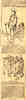
(DRAWING) CURLY, THE CROW SCOUT.
large bull skin on which, with consummate art, Sitting Bull had drawn a number of graceful horses. That he painted them in blue and red and yellow was doubtless due to the fact that he had no colors but those af forded by the mineral hills of the northwest with which to do his work. A find portrait in the oil of the old man, done by Mrs. Weldon
(DRAWING) THE WAR DANCE.
of Brookyn, adorns the cabin wall, and the Sioux Indians in Buffalo Bill's show admire this accurate likeness very much and declare it "good."
At the cabin yesterday afternoon were Rain-in-the-Face, the chief, who led Custer and his gallant 200 into the jaws of death at the Little Big Horn, and "Curly," the Crow scout, who was Custer's most trusted mes senger, and who was the sole survivor of that dreadful massacre. It was Curly whom Custer sent to Gen. Terry for aid after he found himself caught in the trap that Chief Gaul and Rain-in-the-Face had set for him. As a study in recent Indian history the log cabin and its habitues can scarcely be ex celled.
67
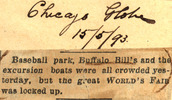
Chicago Globe
15/5/93.
Baseball park, Buffalo Bill's and the excursion boats were all crowded yesterday, but the great WORLD'S FAIR was locked up.

68
Chicago Dispatch 12/5/93
CHIEF OF SCOUTS _________ Frontier Hero Whose Name Will Live in History. _________ Colonel William F. Cody and His Valuable Services to His Country. _________ His Valor and Courage the Theme of the Great Writers of the War--Praised by Custer, Logan and Sheridan, and Indorsed by Buell, Emory, Merritt and Sherman--Endured the Terrors of the West for the Protection of the People and Not for Cheap Notoriety. _________ In the mind of the rising generation there exists considerable doubt as to whether or not such a thing as a real live frontier scout ever existed. Yet along the borders of the Arkansas river and its numerous tributaries, on the sides of the black hills, are hundrends of little graves where no loving hand has set even a headstone to mark the spot where a scout lies, while on the great prairies and in the river bottoms and valleys hundreds of little heaps of whitened bones show where faithful scouts, in twos and threes, have fallen beneath the shower of hostile arrows.
Greatest of Them All.
Among those who have survived the awful privations of this hazardous life, the most conspicuous of all the heroes of the plains is Colonel W. F. Cody, or, as he is better known, Buffalo Bill. During the past thirty years no name has been so often mentioned in the war office reports as that of Colonel Cody. In the writings of Generals Custer, Logan and Sheridan, as well as many other famous Indian fighters, Colonel Cody is a prominent figure and is held to the light as the ideal scout, a courageous soldier and a patriot of the stamp to which the west owes its present prosperity. No thoughtful person can hesitate to give much men as Wild Bill Hitchcock, California Joe, Frank Gruard, gallant Jim White and Buffalo Bill the undying credit they deserve. Of these brave men who guided our little frontier regiments in and out of the hostile countries, who rode by night and day to fight nad die beside the wagon train or adobe cabin of some unfortunate settler, Buffalo Bill alone remains. The history of his life is but a part of that of his country.
Name Lives in History.
Thousands of letters from such men as Generals Sheridan, Custer, Logan, Buell, Emory, Merritt and Sherman, show how high Colonel Cody was held in their estimation and how much confidence these warriors placed in his abilities and advice. In late years Colonel J. W. Forsyth and General Miles have shown the same confidence, which the records of the war department prove was never violated. Though in the service of his country many years and the hero of a thousand desperate rides, and though he could justly claim the credit of a dozen battles, Colonel Cody has asked nothing from the government beyond the ordinary pay of a scout when on actual duty, and, while holding a colonel's commission, he has always preferred to assume the more dangerous duties of a scout.
It is as it should be, that the honor or conveying to the residents of foreign lands at least a faint idea of the hardships and privations that marked the onward march of the pioneers in bygone days, should devolve upon the man whose very name was held in reverence by those of the weaker sex who, by chance or fortune, had found their way into the far west; whose name has in war times bruoght something akin to fear to the stoic red man.
Buffalo Bill is proud of his title; he thinks more of the uncouth appellation than of the military handle "Colonel," which his army connection entitles him to use. Nor is this altogether to be wondered at. It was under this cognomen that he learned the cunning of the copper skinned aboriginals and became and adept in fighting them with their own weapon--devilish stealth. Under this title W. F. Cody earned the reputation of being the "greatest scout on earth."
In all the broken country known as the far west there is not a footpath, perhaps, where the treacherous warrior has trod, but Buffalo Bill can point it out. No man today, either in or out of the army, is better accquainted with the general topography of that territory.
Led the March.
The march of civilization has been gradual. In 1865 there were fully 165,000 Pawnee, Sioux, Cheyenne, Kiowa and Arapahoe Indians in and about the Bad Lands and No Man's Land districts. Each succeeding year saw the great tribes lessened in strength of numbers, and their decedence could only be likened to the disappearance of the mighty herds of buffalo that once roamed the plains. Perhaps the Sioux uprising in 1891 is the last revolt of Indians the world will have to contend with. To the young minds the tales of carly struggles are always welcome as well as beneficial and no one will argue but that an illustration of those pioneer times is a great aid to the rising generation. Nor will anyone contend that the effort could be successfully accomplished by any other than one who had spent a life on the plains.
William F. Cody knew scarce any home for years but the rolling prairies and broken hills. To him the whizz of the hated red man's arrow was sweet music, for it portended a fray; the battle clouds were many nights his only shelter from the heavens. As the years rolled on William F. Cody was lost to view and in his place Buffalo Bill attained fame and honor. To-day he stand above all as the best all around crack shot and his steady arm has sent more than one red-faced warrior to the happy hunting ground and, perchance, a long account. It is, then, fitting and proper that Buffalo Bill should assume to teach the growing generation the great lessons of life on the frontier in bygone days.
Chicago Sunday Democrat
The editor of THE SUNDAY DEMOCRAT has known Colonel Cody for the past twenty-five years. He has done more, perhaps, to build up the western country than any other living man. The War Department at Washington will show conclusively that his record is that of a brave man and a great scout. He needs no certificate of character to prove these facts, but THE SUNDAY DEMOCRAT gives below a few of the numerous strong letters from the highest civil and military authorities in this country. His fame is worldwide. He is as well known and beloved in Europe as in America, but he is an American of whom we are justly proud.
STATE OF NEBRASKA.
To all whom these presents shall come, greeting:
Know ye, that I, John M. Thayer, governor of the state of Nebraska, reposing special trust and confidence in the integrity, patriotism and ability of the Hon. William F. Cody, on behalf an in the name of the state, do hereby appoint and commission him as aide-de-camp of my staff, with the rank of colonel, and do authorize and empower him to discharge the duties of said office according to law.
[SEAL.] In testimony whereof I have hereunto subscribed my name and caused to be affixed the great seal of the state. Done at Lincoln this 8th day of March, A. D., 1867. JOHN M. THAYER. By the governor. G. L. LAUR, Sec'y of State.
The following letter received with a photograph of the hero of the "March to the Sea," Gen. W. T. Sherman:
New York, December 25, 1886. To Col. Wm. F. Cody: With the best compliments of one who, in 1866, was guided by him up the Republican, then occupied by the Cheyennes and Arapahoes as their ancestral hunting grounds, now transformed into farms and cattle ranches, in better harmony with modern civilization, and with his best wishes that he succeed in his honorable efforts to represent the scenes of that day to a generation then unborn. W. T. SHERMAN, Gen'l.
New York, December 28, 1886. Col. Wm. F. Cody: DEAR SIR:--Recalling the many facts that came to me while I was adjutant-general of the Division of the Missouri, under General Sheridan, bearing upon your efficiency, fidelity, and daring as a guide and scout over the country west of the Missouri river and east of the Rocky Mountains. I take pleasure in observing your success in depicting in the East the early life of the West. Very truly yours, JAMES B. FRY, Ass't Adj't Gen'l, Brevet Maj. Gen'l, U. S. A.
Headquarters Army of the U. S. A. Washington, D. C., Jan. 7, 1887. Col. Wm. F. Cody was a scout, and served in my command on the western frontier for many years. He was always ready for duty, and was a cool, brave man, with unimpeachable character. I take pleasure in commending him for the many services he has rendered to the Army, whose respect he enjoys for his manly qualities. P. H. SHERIDAN, Lieut-Gen'l,
Los Angeles, Cal. Jan. 7, 1878. Col. Wm. F. Cody: Dear Sir--Having visited your great exhibition in St. Louis and New York City, I desire to congratulate you on the success of your enterprise. I was much interested in teh various life-like representations of western scenery, as well as the fine exhibition of skilled marksmanship and magnificent horsemanship. You not only represent the many interesting features of frontier life, but also the difficulties and dangers that have been encountered by teh adventurous and fearless pioneers of civilization. The wild Indian life as it was a few years ago will soon be a ting of the past, but you appear to have selected a good class of Indians to represent that race of people, and I regard your exhibition as not only very interesting but practionally instructive. Your services on the frontier were exceedingly valuable. With best wishes for your success, believe me very truly yours, NELSON A. MILES, Brigadier-General, U. S. A.
"HE IS KING OF THEM ALL." Headquarters, Mounted Recruiting Service, St. Louis, Mo., May 7, 1885. Major John M. Burke: Dear Sir--I take pleasure in saying that in an experience of about thirty years on the plains and in the mountains, I have seen a great many guides, scouts, trailers, and hunters, and Buffalo Bill (W. F. Cody) is King of them all. He has been with me in seven Indian fights, and his services have been invaluable. Very respectfully yours, EUGENE A. CARR, Brevet Major-General, U. S. A. ________
Bonaparte and Gen. Miles and Staff Guests of Col. Cody.
All the tourists of America and foreign countries who have Chicago as their objective point, recently or remotely, have heard of Buffalo Bill's Wild West exhibition, and keep the fact well in mind. They seem to be improving the opportunity pretty fast for at every performance, afternoon and evening, the most interested spectators are the tourists. Yesterday there was royal blood in attendance. Prince Roland Bonaparte and his suite were the guests of Col. W. F. Cody, as well as Gen. Nelson A. Miles and staff. After the performance the entire party was entertained by Col. Cody in his private quarters. Prince Bonaparte was greatly pleased with the exhibition. He found in Col. Cody a most interesting conversationalist. The colonel regaled the prince with many stories of his life as a scout. The hour of the evening performance has been changed from 8 to 8:30 o'clock. ___________________ Chicago [S....?] 15/5/93
Chicago Herald 15/5/9[3?]
BUFFALO BILL'S "WILD WEST."
For realism that actually illustrates without being in any degree offensive, for picturesque groupings, admirable arrangement of color, effect and incident, Buffalo Bill's "Wild West" has rarely, if ever, been equaled. The beautiful drill of the representative cavalry detachments from England, Germany, France and the United States always evokes rounds of deserved applause. The wonderful work of the Indian, the cowboy, the Cossack, the Mexican and the Arab excites wonder and admiration. The horsemen of the world, rough and educated, are fully represented and give handsome exhibitions. Visitors are comfortably provided for in all sorts of weather, as rain or shine makes no difference in the performance, which is given twice each day, Sundays included. All railroads going south land passengers almost at the very gates of the "Wild West." The Illinois Central has built a commodious new station, as has also the elevated railroad. The cable and electric cars take visitors to the entrance, as also do the handsome coaches of the Columbian Coach company.
Chicago Daily News
Nate Saulsbury was one of the most brilliant comedians who ever ventured his talents in farce cemedy. He was then a clean-shaven, neat, brisk young man, with the quizzing glance and sarcasm of a character-student and a mimic. He was a delightful after-dinner talker and had the wit of current and classic literature at his sharp tongue's end. He was immensely popular and financially little less than a marvel to the average thespic fortune hunter. Now Mr. Saulsbury is joint proprietor of Buffalo Bill's Wild West and a millionaire--has ranches, rentals, lives most of his time in a tent within shooting distance of yelping Comanches and is finely aging with deep-cut facial lines of calculation, a hardy prairie complexion, square shoulders and pointed whiskers. But he is not a whit less entertaining. He is the greatest impromptu story teller I ever knew.
He has forgotten that he ever was an actor but the genius of mimicry and keen appreciation of humor has never deserted him. I caught him this morning in one of his most amusing reminiscent moods. The encouraging weather and the first boot-shine that conscience really could approve since the opening of the Wild West show had mellowed Nathan into a mood embroidered with halos.
He greeted me with a smile worth one gondolier pour-boire and enthusiastically offered me the bouquet of tuberoses and cape jassamine Col. Cody always has in his own tent. I accepted the smile and waited for the celebrated scout's arrival to add some permission to the deed of flowers, then finally attuned Nate's susceptible lyre into the serio-comic. He hummed "Up Went the Price," "I Flatter That I Stutter," and recited scraps of heroic measure from the grander dramatists, then fell into patriotic recollection of his visit to Spain. A propos the Columbian Exposition he referred to that celebrated statue of the venerated hero of this immediate hour which adorns the Barcelona harbor. Nothing more superb in sculpture has been contributed to art. It stands looking out to sea with such magnificent sympathy, reverence and pride expressed that any wanderer must be arrested by its grandeur.
Maj. Burke and Saulsbury landed as near the port of Barcelona as foreign ships are permitted to come. The harbor is quite a respectful distance from the crumbling-walled vegas of "balmy garlic and guitar," and the mornign the doughty major and Nate arrived it was sultry, damp and threatening. Everything was retarded by Spanish vigilance, their show was in custody about eight miles at sea and likely to stay there awhile, Nate was hungry and had not been a howling success in his divers efforts to "hablo" at the surprised natives, so he was not quite in tune with a patriotic vertigo which seized the major at sight of the Barcelona Columbus.
"Yes," vigorously asserted Nate, "it's good, the best I ever saw, but where is the hotel and bill-poster?"
"Saulsbury," orated the major, lifting his hat, "can't you drop the show when in the presence of America's discoverer?"
"That's all right, Burke, but business before the spread eagle."
"Well, sir," said the major with heroic dignity, "if you insist upon shop interest in such an imposing presence permit me to present it to you in another light. There stands our advance agent 400 years ahead of us!"
Nate has a small book of jokes laid up against the major, but this was one instance when the military gentleman had the best of it.
John Mackay gave Cody, Saulsbury and Major Burke a dinner in Paris a year or so ago and a party of tremendous swells belonging to the Mackay set were there to meet the westerners. The subject of Texas outlawry was broached and the major waxed eloquent in the defense of that doubtful state. "Nobody risks any personal inconvenience, sirs, in traveling through Texas. It is the golden state of the union and her citizens are both courteous nad law-abiding. Why, talk about necessary fire-arms! I am a soldier and I went through the entire state without anything more than a toothpick."
"Well," said Saulsbury, "that's all you needed. You didn't do anything but eat."
Saulsbury married Miss Ray Samuels, a pretty soprano singer, who had something of a fortune left her by somebody. He has a charming family of boys and girls and they all travel wherever the energetic father goes.
May 15/93 [......... .........?]
Chicago [..........?] 15/5/9[3?]
Colonel Cody's Wild West is the Mecca of European visitors. The English, French, German, Italian and Belgian press representatives all visited the camp of Buffalo Bill on arrival. The latest visitor was Prince Roland Bonaparte, who is well known on the continent as a scientist and as a leader among anthropological students. When the Wild West was in Paris the congress of anthropologists daily visited the camp and photographed the Indians, also taking the texture of hair, color of eyes and other peculiarities of the red man, and interviewed them on the traditions and superstitions of their race. The result will be chronicled in a history of man by that congress. The prince and his party of scientists visited the Wild West yesterday, renewing old acquaintances and expressing the pleasure the entertainment gave, as well as the interest now attached to it, by its aggregation of different races, by the student of mankind. On Saturday General Miles and staff highly complimented Colonel Cody on his congress of primitive horsemen and his national military exhibition.
Chicao Dispatch May 15/9[3?]
A party of fiteen Sioux Indians dressed in gaudy blankets attracted much attention in the rotunda of the administration building this morning. The redmen did not seem to mind the crowds, but were intent on looking at the great building and many grunts of satisfaction were heard. The Indians are here for the purpose of seeing the big show.
Chicago Dispatch 15/5/93
VIEW OVER THE FENCE __________ THAT'S ALL THE FAIR THE MASSES SEE __________ They Pour Down South by Thousands, Overflowing Buffalo Bill's Show, Patronizing Fakirs and Hanging Around the Gates in Trying to Get a Little Fun. __________
Another fair day dawned over Jackson park yesterday and the sun dispensed a pleasant warmth over the white city. The flowers opened their petals to bathe them in the sun's rays and the birds fluttered around the budding trees on the wooded island. But the gay crowd that gave a human picturesqueness to the world's fair was absent. Only a few figures moved about the grounds and the only sound that proclaimed the presence of human beings within the gates was the tapping of hammers and the buzz of saws. Again a puritanical Sabbath had been observed at the world's fair.
Fully 25,000 people found their way down to the world's fair grounds yesterday. Sabbatarians disputed the number of people who tried to get into Jackson park last Sunday. A little calculation of yesterday's attendance will easily place the matter beyound doubt. From 10 o'clock in the morning until 5 in the evening there was an almost continuous stream of wanderers passing down Stony Island avenue along the whole western extent of the fair grounds. Then there was a line of buggies, carriages, tallyho coaches and other rigs, which contained people who desired to have a glimpse of the fair buildings over the fence. And while these people passed along, whether on foot or in carriages, a host had crowded into Buffalo Bill's show. Every seat was occupied. The accommodation is estimated to be sufficient for at least 18,000 people. When the show was over the streets were literally packed with people who would have spent their time wandering through the world's fair but for the action of the sabbatarians. Prince Roland Bonaparte and a party of friends drove down to the fair but stopped at the show, as did Sol Smith Russell and several members of his company.
WILL BE A HOT RACE. __________ Cyclists and Cowboys to Ride from Chadron, Neb., to Chicago. __________ ABOUT 500 MILES TO COVER. __________ First Great Road Race Between Horses and Men on Record--They Willl Start June 1. ________
On June 13 will start from Chadron, Neb., one of the most unique and interesting cycling races. Two men mounted on bicycles and two men mounted on horses will run over the country roads that lie between the Nebraska town and Chicago, and the sport promises to be hot and full of strategy for at least a good bit of the distance. This affair has come about through a scheme of the Hon. William F. Cody, otherwise known as "Buffalo Bill," to have run from Chadron a race between cowboys on horses. It was announced some time ago that two hardy cowboys would start from Chadron on June 13, mounted on their favorite horses, and make a race for life across the great stretch of country between the starting point and this city. Of course the affair would be attended with great eclat on the finish of the race in Chicago, but the pesky wheelmen promise to take the edge off the plan my making the pace for the cowboys, and, as a matter of course, beating them badly. Buffalo Bill cannot prevent the two Nebraskan cyclists from starting at the same time and on the same road with the cowboys even is he had the desire to do so, which is by no means probable. The cyclists have an idea that they can ride the boots off the wild men of the plains, and if the enthusiasm that is now being worked up about the race out in Chadron is any voucher, the wheelmen will give the horsemen such a chase as they never before knew the like of.
The distance to be ridden over is about 500 miles, a few miles of which are in Nebraska and the balance in the states of Iowa and Illinois. The country roads in the latter two commonwealths are, as a general rule, in every fair condition in the month of June, and if they cyclists are at all in condition they can leave the cowboys so far behind that the whole affair will be forgotten before the horsemen can get into town. Such, at least, is the opinion of local wheelmen who have been consulted about it. The average road rider over average roads can do ten miles an hour nicely. This will be the average running and will include stops. But giving the cyclists an extra day for rest and idling they can assuredly do the 500 miles in six days. Such riding as this would kill any horse in the world in one day. General Miles, of the Department of the Missouri, who knows something of the capacity of horses for road work, laughs at the idea of any animal, however well fitted for such travel, doing 100 miles in twelve hours. How easily it is done by wheelmen is demonstrated by the existence of hundreds of "century," or 100-mile, clubs scattered all over the country. The race will not be a relay race. The cowboys are to use the same horses, and the two wheelmen who start from Chadron will finish the ride themselves. But even should the cowboys desire to take relays of horses they cannot hope to catch the cyclists, for one man is worth a dozen horses.
The race will be full of interest, at least for cyclists, who will make bets on the event--not on the possibility of the cowboys winning, but on the number of miles the cyclists will beat them. This is the first time that horses and men have been matched on the road and the experiment will go far toward showing the superiority of the one over the other as couriers of war. The cyclists have written to A. G. Spalding & Bro. for Victor wheels on which they propose to make the trip.

69
Chicago Dispatch 12/5/93
CHIEF OF SCOUTS
Frontier Hero Whose Name Will Live in History.
Colonel William F. Cody and His Valuable Services to His Country.
His Valor and Courage the Theme of the Great Writers of the War - Praised by Custer, Logan and Sheridan, and Indorsed by Buell, Emory, Merritt and Sherman - Endured the Terrors of the West for the Protection of the People and Not for Cheap Notoriety.
In the mind of the rising generation there exists considerable doubt as to whether or not such a thing as a real live frontier scout ever existed. Yet along the borders of the Arkansas river and its numerous tributaries, on the side of the black hills, are hundrends of little graves where no loving hand has set even a headstone to mark the spot where a scout lies, while on the great prairies and in the river bottoms and valleys hundreds of little heaps of whitened bones show where faithful scouts, in twos and threes, have fallen beneath the shower of hostile arrows.
Greatest of Them All.
Among those who have survived the awful privations of this hazardous life, the most conspicuous of all the heroes of the plains is Colonel W. F. Cody, or, as he is better known, Buffalo Bill. During the past thirty years no name has been so often mentioned in the war office reports as that of Colonel Cody. In the writings of General Custer, Logan and Sheridan, as well as many other famous Indian fights, Colonel Cody is a prominent figure and is held to the light as the ideal scout, a courageous soldier and a patriot of the stamp to which the west owes its present prosperity. No thoughtful person can hesitate to give such men as Wild Bill Hitchcock, California Joe, Frank Gruard, gallant Jim White and Buffalo Bill the undying credit they deserve. Of these brave men who guided our little frontier regiments in and out of the hostile countries, who rode by night and day to fight and die beside the wagon train or adobe cabin of some unfortunate settler, Buffalo Bill alone remains. The history of his life is but a part of that of his country.
Name Lives in History.
Thousands of letters from such men as Generals Sheridan, Custer, Logan, Buell, Emory, Merritt and Sherman, show how high Colonel Cody was held in their estimation and how much confidence these warriors placed in his abilities and advice. In late years Colonel J. W. Forsyth and General Miles have shown the same confidence, which the records of the war department prove was never violated. Though in the service of his country many tyears and the hero of a thousand desperate rides, and though he could justly claim the credit of a dozen battles, Colonel Cody has asked nothing from the government beyond the ordinary pay of a scout when on actual duty, and, while holding a colonel's commission, he has always preferred to assume the more dangerous duties of a scout.

70
Chicago Daily News
Nate Saulsbury was one of the most brilliant comedians who ever ventured his talents in farce comedy. He was then a clean-shaven, neat, brisk young man, with the quizzing glance and sarcasm of a character-student and a mimic. He was a delightful after-dinner talker and had the wit of current and classic literature at his sharp tongue's end. He was immensely popular and financially little less than a marvel to the average thespic fortune hunter. Now Mr. Saulsbury is joint proprietor of Buffalo Bill's Wild West and a millionaire--has ranches, rentals, lives most of his time in a tent within shooting distance of yelping Comanches and is finely aging with deep-cut facial lines of calculation, a hardy prairie complexion, square shoulders and pointed whiskers. But he is not a whit less entertaining. He is the greatest impromptu story teller I ever knew.
He has forgotten that he ever was an actor but the genius of mimicry and keen appreciation of humor has never deserted him. I caught him this morning in one of his most amusing reminiscent moods. The encouraging weather and the first boot-shine that conscience really could approve since the opening of the Wild West show had mellowed Nathan into a mood embroidered with halos.
He greeted me with a smile worth one gondolier pour-boire and enthusiastically offered me the bouquet of tuberoses and cape jessamine Col. Cody always has in his own tent. I accepted the smile and waited for the celebrated scout's arrival to add some permission to the deed of flowers, then finally attuned Nate's susceptible lyre into the serio-comic. He hummed "Up Went the Price," "I Flatter That I Stutter," and recited scraps of heroic measure from the grander dramatists, then fell into patriotic recollection of his visit to Spain. Apropos the Columbian Exposition he referred to that celebrated statue of the venerated hero of this immediate hour which adorns the Barcelona harbor. Nothing more superb in sculpture has been contributed to art. It stands looking out to sea with such magnificent sympathy, reverence and pride expressed that any wanderer must be arrested by its grandeur.
Maj. Burke and Saulsbury landed as near the port of Barcelona as foreign ships are permitted to come. The harbor is quite a respectful distance from the crumbling-walled vegas of "balmy garlic and guitar," and the morning the doughty major and Nate arrived it was sultry, damp and threatening. Everything was retarded by Spanish vigilance, their show was in custody about eight miles at sea and likely to stay there awhile, Nate was hungry and had not been a howling success in his divers efforts to "hablo" at the surprised natives, so he was not quite in tune with a patriotic vertigo which seized the major at sight of the Barcelona Columbus.
"Yes," vigorously asserted Nate, "it's good, the best I ever saw, but where is the hotel and bill-poster?"
"Saulsbury," orated the major, lifting his hat, "can't you drop the show when in the presence of America's discoverer?"
"That's all right, Burke, but business before the spread eagle."
"Well, sir," said the major with heroic dignity, "if you insist upon shop interest in such an imposing presence permit me to present it to you in another light. There stands our advance agent 400 years ahead of us!"
Nate has a small book of jokes laid up against the major, but this was one instance when the military gentleman had the best of it.
John Mackay gave Cody, Saulsbury and Maj. Burke a dinner in Paris a year or so ago and a party of tremendous swells belonging to the Mackay set were there to meet the westerners. The subject of Texas outlawry was broached and the major waxed eloquent in the defense of that doubtful state. "Nobody risks any personal inconvenience, sirs, in traveling through Texas. It is the golden state of the union and her citizens are both courteous and law abiding. Why, talk about necessary fire-arms! I am a soldier and I went through the entire state without anything more than a toothpick."
"Well," said Saulsbury, "that's all you needed. You didn't do anything but eat."
Saulsbury married Miss Ray Samuels, a pretty soprano singer, who had something of a fortune left her by somebody. He has a charming family of boys and girls and they all travel wherever the energetic father goes.
May 15/93 * * * [......... .........?]