
131
MANCHESTER OPERA HOUSE.
E. W. HARRINGTON... Manager.
FRANK P. COLBY... Advertising Agent.
Saturday, March 18. The Noted Scout,
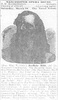
[image]
[Hon. Wm. F. Cody.] Buffalo Bill. and his Mammoth Combination. The Beautiful Sioux Indian Princess. He-Nu-Kaw. (The First Born). Harry E. Burgess. Boy Chief of the Pawnees; the youngest chief of whom any record is given. A genuine band of noted Winnebago Indian Chiefs, supported by a powerful Dramatic Company, producing Buffalo Bill's New Drama. "The Prairie Waif," a Story of the Far West! Fancy Rifle Shooting by Buffalo Bill, who is acknowledged pre-eminent and alone. A grand street parade. Buffalo Bill Silver Cornet Band and Orchestra. Popular prices - 75, 50, 35, 25c. For sale at box office, commencing Thursday morning. Wm. F. Cody, Proprietor and Manager. Josh F. Ogden, Business Manager. Harry Sellers, General Agent. 14,5t
132
Buffalo Bill in the "Prairie Waif."
Buffalo Bill and company are so sure of attracting a crowded house in this city that it seems unnecessary to do more than call public attention to the fact that Saturday evening of this week is the time set for their appearance. The play to be brought out is "The Prairie Waif," one in which the celebrated scout was seen here last season, and one that is generally regarded as better adapted for displaying his specialties than any other in which he has ever figured. His remarkable skill with the rifle will again be shown, a group of Indians will be exhibited, and altogether the performance may be set down in advance as one certain to delight the audience present. The sale of seats opens Thursdaymorning.
133
BUFFALO BILL
Some Interesting Points in the Career of the Famous Scout.
His Nebraska Home and Stock Raising Enterprises.
The name of Buffalo Bill is as well known to the people of this country as that of almost any other living American. It was first brought before the public by the story writer, Ned Buntline, through the columns of the New York Weekly in a series of thrilling sketches of border life, based on facts and incidents connected with the hardy frontier experience of the famous scout. Many who read these tales believed them to be widely exaggerated, and even to this day there are plenty of people who think that the daring deeds of bravery and startling adventures of Buffalo Bill, so familiar to a large element of the public, are wholly untrue and are employed simply as advertising dodges to add popularity to his business. But those who have taken pains to inquire into the true history of the man, those who know Mr. Cody personally, need no further proofs to convince them that he has encountered all the hardships and dangers among the Indians that are so familiarly associated with his name; that as a frontier scout he is without a peer, and that he is in other respects a remarkable man, whose name is likely to be remembered many centuries hence and to be spoken of by the historian when it comes record the incidents incumbent upon the production of civilization of the red man. The significant answer. "A man, every inch of me," made by Mr. Cody in his play of "The Pirate Waif" to one of the villains of the piece, well expresses the make up of him who gave it. Socially, Mr. Cody is one of the most genial of men. Large hearted, frank, courteous and gentlemanly to everybody, he has achieved an acquaintance as broad as the nation. He is, moreover, possessed of an uncommonly high degree of worldly wisdom, much as the latter. Those who have witnessed his skill with the former will readily imagine how expert he may be. His present show season closes the 29th of next month, and another season will not begin till September. He expects to have a new play for next season. One has been written for him by Ingraham and Foster, entitled "Back in Twenty Days," with which Mr. Cody is much pleased. He regards Manchester as the banner town for his business in the east, and next year he intends to visit here on Saturday so as to give two performances, one a matinee. He was induced to go upon the stage by Ned Buntline, and the wisdom of the latter's choice for his friends has been roundly demonstrated. "The Prairied Waif" netted between forty and fifty thousand dollars last season, and promises at the close of this season to exceed the sum. Mr. Cody has for a number of years had a great desire to visit Europe, but he believes in the saying, "Let well enough alone," and as long as he continues to harvest money as rapidly as now, he is content to remain in this country. When he does go, he has a scheme in mind that seems to contain every element of popularity. On his cattle ranche he has twenty young buffaloes that have been running with the cattle until they have become perfectly manageable. these he intends to ship together with a half-dozen of the most fearless Indian riders that he can procure, and a number of expert lassoers. To this combination he will add his own presence, and then give in some large inclosure, an eye exhibition, that he thinks will astonish the natives. There will be an Indian fight on horseback, a buffalo hunt and other exciting features never yet shown in public. Mr. Cody has received numerous flattering offers to make the trip, but when he goes he will do so under his own management.
From time to time there have appeared in print anecdotes of "Buffalo Bill's" traveling experiences, some of which have been rather exciting. The Fred May trouble, the particulars of which were published in these columns at the time are well remembered and were true. Mr. Cody is the last person to seek trouble, and will do considerable to avoid it, but when he is insulted or his business needlessly meddled with, he is likely to prove a hot customer for those who oppose him.

134
is without a peer, and that he is in other respects a remarkable man, whose name is likely to be remembered many centuries hence and to be spoken of by the historian when it comes record the incidents incumbent upon the production of civilization of the red man. The significant answer, "A man, every inch of men," made by Mr. Cody in his play of "The Prairie Waif" to one of the villains of the piece, well expresses the make up of him who gave it. Socially, Mr. Cody is one of the most genial of men. Large hearted, frank, courteous and gentlemanly to everybody, he has achieved an acquaintance as broad as the nation. He is, moreover, possessed of an uncommonly high degree of worldly wisdom, and plenty of that desirable element known as common sense. It was gentlemanly instincts, linked with his good-nature and ability, that made him so great a friend of Gen. Sheridan, and it was these characteristics, together with his perfect fitness for the position, that secured for him the honor acting as guide for the Duke Alexis of Russia on his celebrated buffalo hunt through the west. In personal appearance Buffalo Bill is very striking. He has a splendid physique, handsome, regular features that become more apparent upon close inspection, and his marvelous strength and suppleness are all they are represented to be.
A MIRROR reporter called upon Mr. Cody at his room at the Chandler House during his recent stay in the city, and there enjoyed a most agreeable interview with the gentleman. It is supposed that the general public is pretty thoroughly informed by this time concerning Mr. Cody's career. It has been often detailed, and ought to be familiar, if it is not. But the distinguished scout and actor said some things to the writer during their pleasant chat that were certainly new to him, and may be to others. They were assuredly interesting, and being so will bear repetition. To the playgoer who never fails to attend the performances of Buffalo Bill, the hero of the stage is thought of now only in the capacity of an actor, an occupation that he has lucrative followed for ten seasons, but five months in the year Mr. Cody enjoys his home in Nebraska, where he owns a cattle France, and where he is to start this spring a horse France. His cattle is situated among the so-called "sand hills" of country, and upon it he has 6000 head of cattle. In this business he has an associate, Mr. North, the firm being known as Cody & North. During the summer twenty men are engaged in rounding up the cattle, but in winter one-fifth of the number are able to perform the work. The men employed are the famous "cow and other exciting features never yet shown in public. Mr. Cody has received numerous flattering offers to make the trip, but when he goes he will do so under his own management.
From time to time there have appeared in print anecdotes of "Buffalo Bill's" traveling experiences, some of which have been rather exciting. The Fred May trouble, the particulars of which were published in these columns at the time, are well remembered and were true. Mr. Cody is the last person to seek trouble, and will do considerable to avoid it, but when he is insulted or his business needlessly meddled with, he is likely to prove a hot customer for those who oppose him. In visiting various towns he frequently encounters difficulties of one kind and another. At Whitehall, New York, this season, is played to an audience partly composed of drunken canal men, whom the police authorities did not dare to molest. They were noisy during the first three acts of the play, but when the fourth was reached, and the Indians started up their war dance, several of the more excitable left their seats and commenced giving an imitation of the dance in the theater aisles. One, more courageous than the rest, came forward toward the stage, interrupted the orchestra, captured one of the instruments, and with it attempted to get upon the stage. Mr. Cody, who had just entered disguised as an old medicine man, called for police assistance, but none could be had at any price, so he took the law into his own hands. As the disturbed was clambering up the side he was ordered to get down, but instead of doing so made an insulting reply, whereupon Bill let him feel the weight of his medicine staff which he carries in his hand in this part. The man fell like a dead weight, and his companions seeing his fate, instead of rallying to the rescue, vacated the house immediately, and the play went one. The man who was struck had his scalp laid open in a ghastly manner, and the next morning Mr. Cody was summoned before the police court, and fined for assault. Being obliged to leave town that forenoon he had no time to contest the case, and so did the quickest thing--settled. In his scape with May he was the last to take part, but when he did go in the burly New Yorker was tossed about like a ship in a storm. One of the most annoying personages Mr. Cody said he ever came in contact with was the seller of some patent, who has often visited this city, bearing some border title. He heard from him frequently as a slanderer, and finally met him and showed

135
summer twenty men are engaged in rounding up the cattle, but in winter one-fifth of the number are able to perform the work. The men employed are the famous "cow boys." Each man supplied with eight horses of mustang breed, those tireless animals that stand only about fourteen hands high, but are capable of accomplishing wondering feats of endurance. A horse often covers a distances of seventy-five miles a day. Owing to the high price of grain in Nebraska the horses are not given any, yet without it they thrive. Having eight horses under his charge a man uses one only one day in about every three and a half, so that the animal has a long period of rest before it is called upon to repeat its work. In this way they get along without shrinking. The pasturage is rich, and the horses grow fat and hardy upon it. Speaking upon the subject of riding to the saddle, Mr. Cody said that the gait of the mustang was a walk and a lope. Occasionally one was found that single-footed, but not often. He preferred a loping horse for long jaunts, and so did most of the riders on the plains. They could out-last horses of any other gait. He always rode with short stirrups, and did not believe in the long stirrup style. The English fashion of trotting-horse style. The English fashion of trotting-horse riding he ridiculed. Mr. Cody mentioned one fine rider, Spotted Horse, among his Indians. He challenged any one to produce a horse that he could not manage. The Indian delighted in securing an animal that was excitable and vicious. He generally rode bareback because he had not confidence in livery stable saddles, or the skill of hostlers in adjusting them. On the plains he always used a saddle. Mr. Cody carries his own, and a splendid piece of workmanship it is. Leaving the matter of saddle horses, Mr. Cody touched upon his new enterprise, that of a horse ranche.
Mr. Cody's home is located at North Platte, where he owns a spendid residence and a magnificent estate of 1,500 acres. On this he already has 150 farm mar es, two well bred stallions, one Ben Patchen, foaled in 1859 by George M. Patchen, and a five-years-old Cassius M. Clay. He has besides a Jack and a herd of Hereford cattle, lately purchased. This department of stock raising is managed solely by Mr. Cody. In the summer the owner passes his time in looking after his interests, and in hunting such game as elk, deer, antelope, duck, geese, and prairie chickens, being found in abundance. Mr. Cody uses both a rifle and shot gun, the former for wing shooting quite as patent who has often visited this city, bearing some border title. He heard from him frequently as a slanderer, and finally met him and showed him up to the public in his true colors. This did not satisfy the facer and he at various times continued his brawling. At last Bill got a reckoning with him, and it was such a one that has quieted his mouth ever since. But it is not in the role of a fighter that Mr. Cody delights to figure. He dislikes this sort of notoriety, but in his business he is more or less placed in positions where he has got to stand up for his rights or get trodden upon. As he never weakens the former attitude is inevitable.
Mr. Cody has lately become possessed of information that is not unlikely to greatly enrich him. He states that the Cody family, of which he is a member, has brought suit for valuable property at Cleveland, Ohio. Mr. Cody says that the heirs of Philip Cody, his grandfather, were the parties who are suing. They claim 50 acres of land in the sixteenth ward of Cleveland. The property is valued at $1,600,000. There are seven heirs, children of the two sons of Philip Cody. The latter died at Cleveland in 1848 and was of unsound mind. Three years previous he deeded away his property, then mostly farm land, for a mere song. Only lately the heirs have come into possession of this knowledge, and have begun suit against each person who owns property on the disputed land. Many offers of compromise have been made, but none have been accepted.