

241
BUFFALO BILL.
The Opera house was crowded last night to see "Buffalo Bill" and his company in the drama "The Prairie Waif." The lower part of the house was crowded and the gallery was jammed, many standing up throughout the entire evening unable to get seats. The play is, as was expected, a highly sensational one, the plot itself being very light, and serving simply to hold together a series of scenes from border life. There plenty of thrilling situations, hair breadth escapes, shooting, etc., and yet, there is a refreshing relief in the line of comedy which ran through it. "Buffalo Bill" made a remarkably fine exhibition of fancy rifle shooting. The trick donkey Jerry made much fun, and the Indian dances proved at least a novelty. There was very little really artistic work done, but there was a great variety in the features of the entertainment, and it evidently pleased the crowd greatly, and applause was liberally bestowed.
242
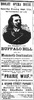
HOOLEY OPERA HOUSE.
---------------
Saturday Evening Sept. 17th. The Illustrious Scout and Guide.
(Hon. WILLIAM F. CODY) BUFFALO BILL
AND HIS
Mammoth Combination Comprising the following Stellar attraction: DR. F. POWELL (White Beaver), Medicine Chief of the Winnebago Sioux. HE-ME-KAW (the first born), the most beautiful Indian Girl in the world. A noted band of SIOUX INDIAN CHIEFS, Supported by a Powerful Dramatic Company!
Producing John A. Stevens' great Western Drama, entitled "PRAIRIE WAIF."
Silver Cornet Band & Orchestra
A GRAND STREET PARADE!
Upon the arrival of the company,
Marvellous Rifle Shooting,
By Buffalo Bill.
Reserved seats, 75 cents, to be had at Belden's jewelry Store.
WM. F. CODY...........Proprietor and Manager JOSH. E. OGDEN............Business Manager HARRY SELLERS..............General Agent 90brept13d5t
243
BUFFALO BILL'S BLARNEY.
A SENTINEL SCALPER WITH THE SCOUT AND HIS BIG INDIANS.
A HAPPY RECOGNITION PRESERVES HIS REMAINING HAIR - CODY'S OPINION OF THE ARMY AND THE THIEVING AGENTS - MISUSED REDSKINS - SITTING BULL AND CAPT. JACK - ANOTHER INDIAN WAR INEVITABLE.
According to the bills, "Hon. W. F. Cody'' has been playing at the Academy of Music for two nights and matinee in a grand spectacular sort of drama, in which "Buffalo Bill'' was the hero, and which is replete with stage thunder, red fire, scalp dances and Cheyenne warriors. Buffalo Bill, being none other than Mr. Cody himself, is well known as a frontiersman, scout and Indian slayer, and the idea suggested itself that perhaps some information of interest concerning the vexed Indian problem could be obtained from him. Accordingly, a bald-headed member of The Sentinel's staff was detailed to interview him, being convinced that by reason of his barrenness he could face the savage warriors with impunity. At the close of the matinees, yesterday, the reporter in question waited in the hall-way for an introduction to the presence of the great scout of the western wilds, Mr. Cody was
WASHING OFF HIS WAR PAINT
when the h. h. reporter timidly rapped at the door of his dressing room. A remarkably savage warrior pulled the door partially ajar and in choice Cheyennee inquired: "Well, now, what's the matter with you?" "A reporter would like to interview Mr. Cody." Mr. Cody appeared, slightly disarranged, and begged a few moments' time to arrange his toilet. Meantime, the painted savage was closely scanning the reporter's features, as if in search of some strawberry mark. At last a broad smile illuminated his swarthy face, and he said: "Hallo, old man! I haven't seen you before since the fire. Come in!" Feeling that the remnant of his scalp was safe, the reporter entered, and the wild warrior introduced him to the scout of the western wilds, who received him with a cordial greeting, and at once asked for his friend Capt. Charley King, late adjutant of the Fifth United States Cavalry.
The reporter informed Mr. Cody that Capt. King was now at the State University at Madison, employed in teaching the young idea how to shoot according to the practice regulations of the army.
"I should like to see Charley," said Buffalo Bill. "He is a brave man and a splendid soldier. He was present at my killing of Yellow Hand, the Cheyenne Chief, which we have introduced in our play. He was
A SPLENDID LITTLE OFFICER
ROCKED BY THIEVING AGENTS,
ever since Grant's administration. I hope for a change in the Indian policy, with a change of administration, which I think sure to come. For a hundred years the government has been trying to find out what to do with the Indians, and they don't know now. I never knew a treaty with them but what was first broken by the whites. You saw the dispatch this morning about Capt. Payne? I skirmished with him for years. He wanted me to go with him into the Indian Territory, but I thought it was wrong. We have no right to take their lands away without pay."
"What is your idea about turning them over to the War Department?"
"It would do with some. With others it would not. Those self-sustaining Indians should be allowed the same privileges as the whites, and treated as well, so long as they behave themselves. They should have the same laws. You can't drive a wild Indian into civilization. They must be led into it.
THE UTE WAR
was brought on by the whites. The miners went into their reservations because there was gold there. Some Indians were killed and some whites. Then they called for troops and Thernburg came with his men - and got licked. They say Indians are treacherous. If they get away with the white officers I think they are good soldiers. They never got ahead of me by jumping out from behind rocks. I think Capt. Jack the best general in America. With seventy-five men he kept a whole army back for forty-seven days.
"Do you think the Utes any more treacherous than the balance?"
"No, I do not. Nor any more than the whites. Where is the white man who would not fight if everything was taken away from him? I'm dog-goened if I wouldn't. Give every man a show. They were here first, and have a better right here than we have."
"Do you know Sitting Bull, Mr. Cody?"
"I know him when I was a boy. Of his recent movements I know nothing except through the press. I have not seen him for many years."
"Is he, as report says, an educated man?"
"No, sir! He can't speak a word of English. Do you know how he got his name? The Indians take their names from some transaction in their lives. Well, one time he shot a buffalo in the loins, and it fell on its haunches. He mounted it back, and thus got THE NAME OF SITTING BULL."
"Is he intelligent?"
"He is a great warrior. He handles his men well and has a thorough knowledge of the country."
"What do you think of the future of the Sioux?"
"I think they will all drift back again."
"Do you think Sitting Bull will ever become civilized?"
"I can't tell. He says he will never surrender, but others have said so and still have given up. Do you know, I think there will be another general Indian war before this thing
is settled. There are a great many dissatisfied Indians."
"Do you think the army large enough for such an emergency?"
"Oh, yes! The standing army might be larger, but the militia
244
tinel's staff was detailed to interview him, being convinced that by reason of his barrenness he could face the savage warriors with impunity. At the close of the matinees, yesterday, the reporter in question waited in the hall-way for an introduction to the presence of the great scout of the western wilds, Mr. Cody was
WASHING OFF HIS WAR PAINT
when the h. h. reporter timidly rapped at the door of his dressing room. A remarkably savage warrior pulled the door partially ajar and in choice Cheyennee inquired: "Well, now, what's the matter with you?" "A reporter would like to interview Mr. Cody." Mr. Cody appeared, slightly disarranged, and begged a few moments' time to arrange his toilet. Meantime, the painted savage was closely scanning the reporter's features, as if in search of some strawberry mark. At last a broad smile illuminated his swarthy face, and he said: "Hello, old man! I haven't seen you before since the fire. Come in!" Feeling that the remnant of his scalp was safe, the reporter entered, and the wild warrior introduced him to the scout of the western wilds, who received him with a cordial greeting, and at once asked for his friend Capt. Charley King, late adjutant of the Fifth United States Cavalry.
The reporter informed Mr. Cody that Capt. King was now at the State University at Madison, employed in teaching the young idea how to shoot according to the practice regulations of the army.
"I should like to see Charley," said Buffalo Bill. "He is a brave man and a splendid soldier. He was present at my killing of Yellow Hand, the Cheyenne Chief, which we have introduced in our play. He was
A SPLENDID LITTLE OFFICER,
brave as a lion. Always volunteering for posts of danger, and always ready to go to the front."
By this time Mr. Cody was in his civilized costume and the reporter looked him over tall, straight as an arrow, handsome in feature and pleasing in address, he is the idea of physical manhood, and his conversation is much more easy and fluent than one would suppose possible. Taking a seat, he signified his readiness to be interviewed, and the reporter proceeded:
"Mr. Cody, do you know anything about Ouray's successor?"
"No; I don't even know who he is. I have paid no attention to the Utes lately. I understand Ouray is dead, and I know nothing later."
"You are familiar with the Utes, are you not?"
"Not so much so as I am with the Cheyennes, Arapahoes and Sioux. At the late Ute war, however, I was the first one Gen. Sheridan telegraphed to, to go forward as a scout. I have been a guide in the Department of the Platte for eighteen years. I was in fifty-two fights in which the Fifth Cavalry, Capt. King's regiment, were engaged. King, however, was away much of that time, on detached service."
"Are you familiar with the Ute Character?"
"The Indians are all about the same in character. I think they have been badly used. I have led the army against them as a scout, but always with regret. They have their side of the story. For honesty and virtue, I think the Indians are ahead of the whites. They have been.
me by jumping out from behind rocks. I think Capt. Jack the best general in America. With seventy-five men he kept a whole army back for forty seven days.
"Do you think the Utes any more treacherous than the balance?"
"No, I do not. Nor any more than the whites. Where is the white man who would not fight if everything was taken away from him? I'm dog-goened if I wouldn't. Give every man a show. They were here first, and have a better right here than we have."
"Do you know Sitting Bull, Mr. Cody?"
"I know him when I was a boy. Of his recent movements I know nothing except through the press. I have not seen him for many years."
"Is he, as report says, an educated man?"
"No, sir! He can't speak a word of English. Do you know how he got his name? The Indians take their names from some transaction in their lives. Well, one time he shot a buffalo in the loins, and it fell on its haunches. He mounted it back, and thus got
THE NAME OF SITTING BULL."
"Is he intelligent?"
"He is a great warrior. He handles his men well and has a thorough knowledge of the country."
"What do you think of the future of the Sioux?"
"I think they will all drift back again."
"Do you think Sitting Bull will ever become civilized?"
"I can't tell. He says he will never surrender, but others have said so and still have given up. Do you know, I think there will be another general Indian war before this thing is settled. There are a great many dissatisfied Indians."
"Do you think the army large enough for such an emergency?"
"Oh, yes! The standing army might be larger, but the militia system is growing so that in a short time a magnificent army could be raised. They are all learning to shoot, too. Another war, and the privates would pretty much all know which end of the gun goes off."
"You are confident THERE WILL BE ANOTHER WAR?"
"Oh, yes. And they will make it warm, too. The Indians are all well armed, and, according to the old adage, they believe 'in times of peace prepare for war.' They are all the time hiding away ammunition."
"Would you turn out, in such an event, if called on?"
"Oh, I suppose so; but it would be with regret. You see, my own home would be in danger. Dakota, Wyoming and northwestern Nebraska would suffer badly. There are many Sioux there."
Mr. Cody then related instances of thieving on the part of agents, that had come within his knowledge, asserting that by giving the War Department, control of the uncivilized savages this sort of thing would stop.
Anybody who imagined Buffalo Bill to be no more than a howling terror of the plains makes a mistake.
245
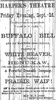
HARPER'S THEATRE
Friday Evening, Sept. 2d.
The Illustrious Scout and Guide ("HON. W. F. CODY.")
BUFFALO BILL
AND HIS MAMMOTH COMBINATION.
Supported by WHITE BEAVER, (DR. F. POWELL)
HE-NU-KAW, (The most beautiful Indian Girl in the World,) and A Powerful Dramatic Company.
John A Steven's Great Drama, entitled
PRAIRIE WAIF!
A Grand Street Parade given daily at noon. Reserved Seats 75 cents; to be had at the Harper House Drug Store.
HON W. F. CODY, Proprietor and Manager.