
196
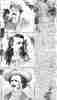
The Scouts of the Prairie, the drama produced at the Arch Street-Theatre last night, was written by Mr. "Ned [Buntline]" for the purpose of affording two genuine scouts an opportunity to tread the boards a[?] win histori[cal] honors and dollars. As might have need expected, the play, considered as a literary work, is beneath contempt. It is written with a purpose, down to the very low [intellectual] level of the boys and the adult [?] who obtain enjoyment from the [?] of [?] novels. There are skirmishes and scrimmages, captures and rescues, love passages with maidens of a brick dust color, wardances, scalping and all the stuff whereof the popular Indian stories are constructed. But the heroes of the play rather than the play itself, are the attract[?]. The part of "Buffalo Bill is taken by William himself, while "Texas Jack" [?] [?] by that identical exile from the Lone Star State. This arrangement at least has the merit of novelty. Imagine Julius Caesar playing his own part in the tragedy named after him, or Ri[?]lieu himself interpreting Bulwer! It would be very interesting, and yet if we thought that eiter of these gentlemen could possibl have acted upon the stage as badly as there two persons from the far west, we should rejoice that death had made such a terrible mischance impossible. Nothing could be worse from an artistic point of view than the performance of Buffalo Bill and his friend and there never was anything worse of its kind since Thespis bellowed from a cart-tail. This is one of the first fruits of the pacification of the Indians. The operations in hair conducted by Buffalo Bill, were interrupted. Having no Sioux to scalp, he nightly scalps the muse of tragedy. If the establishment of the peace policy of the President is to be followed by such by such consequences as this, every lover of the drama will at once become an enemy of the administration and demand war to the knife against the red man.
The lines allotted to Buffalo Bill are not arduous, and no vast amount of study and intellectual effort is required to unfold their meaning to the audience; and yet the wild and ineffectual struggles of the actor with them would make a contrary impression upon the uniformed. Imagine a boy of ten years, at school, explaining the unnecessary filial piety and devotion of Casabianca, and a very correct idea of the Buffalo's methods of treating the English language will be obtained. It is absoliutely picturesque in its absurdity. Texas Jack speaks rather more naturally, although with a certain awkwardness which, even in the author's finest passages, impresses one with the conviction that the actor is perpetrating a somewhat clumsy gag. The most effective members of the company are two or three Indians, who, when they are not executing a war-dance, or brandishing tin tomahawks, stand grim and silent, looking as gloomy and sad amid all the hurley-burley and noise, as if their squaws and popooses had just been ushered to the happy hunting grounds at the very moment when those last fragments of baked dog disagreed with the bereaved relatives.
But it is undeniable that a certain interest does attach to the two white men apart from their absurd attempts to act. They are both fine-looking men, Buffalo Bill particularly, having an exceedingly handsome face and noble carriage. And then, when we see them rush in with pistols and rifles and slay a dozen Indians at a time, or watch the dexterous gentleman from Texas throw lasse with delicate precision, or observe both of them tear the red-flannel scalps from the heads of their fallen enemies, it is comforting to know that they have done this kind of thing all their lives in deadly earnest. The exitement in the gallery during these passages was something wonderful to witness. There was not one boy of all the thousand present who did not scream and yell whenever there was a genuine war
197
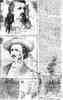
worse from an artistic point of view than the performance of Buffalo Bill and his friend and there never was anything worse of its kind since Thespis bellowed from a cart-tail. This is one of the first fruits of the pacification of the Indians. The operations in hair conducted by Buffalo Bill, were interrupted. Having no Sioux to scalp, he nightly scalps the muse of tragedy. If the establishment of the peace policy of the President is to be followed by such by such consequences as this, every lover of the drama will at once become an enemy of the administration and demand war to the knife against the red man.
The lines allotted to Buffalo Bill are not arduous, and no vast amount of study and intellectual effort is required to unfold their meaning to the audience; and yet the wild and ineffectual struggles of the actor with them would make a contrary impression upon the uniformed. Imagine a boy of ten years, at school, explaining the unnecessary filial piety and devotion of Casabianca, and a very correct idea of the Buffalo's methods of treating the English language will be obtained. It is absoliutely picturesque in its absurdity. Texas Jack speaks rather more naturally, although with a certain awkwardness which, even in the author's finest passages, impresses one with the conviction that the actor is perpetrating a somewhat clumsy gag. The most effective members of the company are two or three Indians, who, when they are not executing a war-dance, or brandishing tin tomahawks, stand grim and silent, looking as gloomy and sad amid all the hurley-burley and noise, as if their squaws and popooses had just been ushered to the happy hunting grounds at the very moment when those last fragments of baked dog disagreed with the bereaved relatives.
But it is undeniable that a certain interest does attach to the two white men apart from their absurd attempts to act. They are both fine-looking men, Buffalo Bill particularly, having an exceedingly handsome face and noble carriage. And then, when we see them rush in with pistols and rifles and slay a dozen Indians at a time, or watch the dexterous gentleman from Texas throw lasse with delicate precision, or observe both of them tear the red-flannel scalps from the heads of their fallen enemies, it is comforting to know that they have done this kind of thing all their lives in deadly earnest. The exitement in the gallery during these passages was something wonderful to witness. There was not one boy of all the thousand present who did not scream and yell whenever there was a genuine war whoop upon the stage or a shot from Buffalo Bill's own rifle, until the very savages them selves must have felt that the battle-cries of thier forefathers were, to, the vociferations of these young pale faces, as the croaking of a [from] to the screech of a fog whistle. It was a gala night for the [urchins] who have fed upon Ned Buntline in the story papers, and if every boy of them did not, last evening, firmly and finally resolved to become a scout and a slaver of Indians at the very first opportunity, the nature of boys has changed wonderfully.
The subordinate members of the company are not much more efficient than the stars, but the two ladies [where] present the Indian maidens do tolerably well, once of them singing in a very creditable manner. The Scouts of the Prairie will be produced again to-night.
198
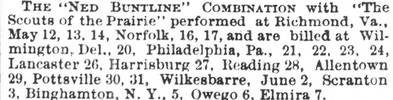
THE "NED BUNTLINE" COMBINATION with "The Scouts of the Prairie" performed at Richmond, Va., May 12, 13, 14, Norfolk, 16, 17, and are billed at Wil-mington, Del., 20, Philadelphia, Pa., 21, 22, 23, 24, Lancaster 26, Harrisburg 27, Reading 28, Allentown 29, Pottsville 30,31, Wilkesbarre, June 2, Scranton 3, Binghamton, N. Y., 5, Owego 6. Elmira 7.
199
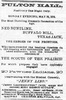
FULTON HALL. Positively One Night Only. MONDAY EVENING, MAY 20, 1878. The Most Thrilling Dramatic Sensation of the Age, NED BUNTLINE, BUFFALO BILL, TEXAS JACK, THE HEROES OF THE FRONTIER, Who have crowded the leading theatres :In the country with fashionable and astonished audiences, with the wonderful emotion of THE SCOUTS OF THE PRAIRIE! For which purpose they have expressly engaged 20 Pawnee Indians. 20 Commencing with the Musical Comedy, "JENNY LIND." "JENNY LEATHERLUNGS," (with songs and dances) MISS BESSIE SUDLOW. Admission........50 etx, Reserved Seats...75 cts. Reserved Seats can be secured six days in advance at Weathaeffer's BookStore, may20 6td CHARLES MELVILLE, Agt.
200
The Prairie Scouts.-BUFFALO BILL FAILS TO APPEAR. - Fulton Hall was filled last evening to its utmost capacity by a very demonstrative (?, audience, to witness the "blood and thunder" scenes to be performed upon the stage. When the people, constituting the audience, first entered the Hall, they were all in a quandary as to what was to be brought forth-not a programme to be seen. Some person must have thought of it, however, and after the had already commenced, small programmes were circulated, which bore the characters of the play, the "Prairie Scouts" being preceded by "Jenny Lind at Last," in which Miss Bessie Sudlow gave some very capital burlesque acting, while the comicalities of D. C. Davenport were duly appreciated. This piece through the whole play, remarks that were decidedly vulgar, were freely used by the principal characters. The main feature of the evening, "The Prairie Scouts," in regard to its acting at least, may be pronounced somewhat of a success. It was put upon the stage, and the genuine Indians gave a novelty to the performance - a decided novelty we may say, for each and every one of them was killed no less than five times by actual count. Buffalo Bill was not present to assume his character, it being announced that he had been denied by the sickness of his wife. This announcement was made after the performance was over. In the character of Cale Durg, the trapper, Ned Buntline showed himself an actor as well as novelist, and Miss Bessle Sudlow, as Dove Eye, was excellent. But the most artistic acting was given by Senorita Eloe Carfano, as Hazel Eye, combining with physical beauty, rare powers of elocution and dramatic talent. The comedians of the play, D. C. Davenport and Walter Fletcher, in their respective Irish and Datch characters, kept the house in a roar, and received repeated encores.