

171
THE DRAMA.
NIBLO'S GARDEN - THE SCOUTS OF THE PRAIRIE.
In Niblo's Garden, last night, an assemblage of about 4,000 persons beheld a spectacle which is mildly and feebly characterized as extraordinary. The occasion was that of the first performance in this city of a dramatic work called “The Scouts of the Prairie;" and, for our own poor part, it gave us wonder great as our delight to see this representation. What it gave to the audience, in general, conjecture struggles to determine. The multitude, which was rather a coarse one, hailed it with frequent noise, and seemed especially rejoiced at those portions wherein guns were shot off and gore was started. Those supreme moments occurred with sufficient frequency to keep the theater in a tumult, and, if that means success, the display was successful. To speak of it seriously is very difficult; to speak of it patiently is impossible. The play of “The Scouts of the Prairie '' is idiotic; the action that gave it illustration is tomfoolery: there was but one person of the stage- Mr. George C. Davenport - who possesses a particle of talent for acting, and the stuff allotted to his interpretation in mere folly. It is not a play. However, that this remarkable exhibition has been brought forward. It comes as a medium for the presentation of two persons - Mr. Cody and Mr. Omohundro, otherwise known as Buffalo Bull and Texas Jack - who are understood to have once been trappers, or hunters or something of that kind, on the prairies of the South West. These two young men movie about the stage with supple strides, and manifested strength; agility and good humor. They have, it appears, been blessed with fine physical constitutions, and, ad driver of the peaceful night omnibus we should say they might attain a lofty eminence. Mr. Cody, the Buffalo Bill, discharged pistols in a very liberal way and, at times, when surrounded with defunct Indians, and standing stalwart In a cloud of smoke and dust, through which the yelps of the supers sounded in hideous discord, he was sublime, The dramatic business in which he was engaged contemplated the rescue of a hunter from the outshops of a Mormons, and the incidental killing of all the savage willing gun-shot distance. Mr. Ned Buntline, the author of the conception, delivered some options on the use of liquor, which he said was injurious and had done a great deal of harm. A reference to Father Mathew rendered this ebullition quite thrilling, Mr., Buntline was several times captured and bound, but he's continued to preach, and he contrived to escape from bondage, the stake, and all perils else, till happily the end of the second net,-he was slain. Mr. Buntline seemed, in a vague, far-off way, to be aping the really, grand portraiture of Pathfinder, is Cooper's well-known novel. If he has any sense at all, which seems doubtful, this gentleman must be aware that his pretensions as a play - writer are ridiculous. The managers of Niblo's (Garden have produced his "realism" because they believe that it will pay-and so it with, if audacious nose use, so absolute as to be really magnificent, chances to produce upon the public mind the effect of novelty. They have put it upon the stage in carefully constructed attire and have advertised it with their customary skill. Mile Morlacchi, a peerless dancer, but very absurd as an actress, played an Indian girl, last night, and was laughed at, as she deserved to be, The Hon. Mr. Cody, called out at the end of the first act, made a short speech, full of boyish candor. To dwell upon details would be idle - since the whole subject is worse than trivial, and since those who are responsible for this [?] use of a beautiful stage and one of the most delightful theaters in the country may be grateful to see it in universal laughter. DRAMATIC NOTES.
AMUSEMENTS. NIBLO'S GARDEN--THE "SCOUTS OF THE PRAIRIE." Mr. Ned Buntline has now entered a field in which he can at least make money. He has written a play called the "Scouts of the Prairie," which has no more interest than the many stories of Western life which he has given to the world; but fortunately there are resources which the dramatist can command that are unknown to the novelist. Mr. Ned Buntline enacts a part in his play. It was this and the kindred fact that the somewhat famous Buffalo Bill would support, together with a band of real Indians, that drew an overwhelming audience last evening to Niblo's Garden, filling the gallery at least an hour before the curtain rose with the noisiest of urchins, and later filled the aisles and lobby with an eager crowd. The play, as may readily be imagined, is destitute of any literary or dramatic merit whatever. It scarcely coheres sufficiently to interest one in the story. It furnishes a series of traditional pictures in which the red men make bombastic speeches about the dew, the morning cloud, and the baseness of he white man. They have a strong desire to capture somebody, and consequently jump about and yell and fall upon a trapper called Cale Durg, who is no less a person age than Ned Buntline. The tie him to a tree and prepare to roast him. And at that moment Buffalo Bill.
THE SCOUTS OF THE PRAIRIE. Since the first night of the "Black Crook '' we have seen so such jam at Niblo's as that of last evening. Seats aisles, stairs and galleries were crod'de to overflowing, the family circle was packed with people until it looked like a thickset hedge, and gods and “pitites”vied with each other in the laughter and applause that greeted the successive scenes of "The Scouts of the Prairie," To criticize this composition as a play, or analyze its plot, would be ridiculous, for it has nothing to do with art. It is simply a dime novel set scenery. In its fustian temperance lectures, it's pinckbeck heroes, and it's unnatural presentation of the borderer's life and character is highly absurd; while it is made to appear still middle so by the personation of full-blood and halt-blood Indian girls by Italian coryphees, who combine broken English with rant, and strut in equal measure But censure must stop here. Considered as a catchpenny show, it is one of the most entertaining and enjoyable ever seen on our theatrical boards. The bringing of Buffalo Bill and Texas Jack and their seventeen Pawnee scouts by the voluptuous girls of the ballet to cut and hack and shoot and yell is an idea of striking originality. It is the coming of Mahoment to the mountain, as the mountain could not [?] would not go to Mahomet, and it will prove a great pecuniary success to the management. Buffalo Bill and Texas Jack are fine, lusty, muscular, handsome young fellows. Their bodies are suppleness itself, and their bearing and glance mark their long familiarity with free life of the prairie. Their principal occupation in this piece, as a Boston critic has truthfully remarked, seems to consist of rushing on the stage at intervals and firing off handsome guns and revolvers. It should also be remarked that Texas Jack shows his contempt for shams by the gusto with which he does some kissing business that is assigned to him. He smacks his girl like the snapping of a cap. But the boys do have some speaking allotted to them, and get through it with no little credit to their trainers. The main interest in their performance lies in their indicating to us ignorant New Yorkers just how they fight Indians, scout, scalp, and throw the laszoo. Their very presence on the stage gives a fine flavor of realism to the whole affair, und sounds an audience, away pleased from a play that, without them and their doings, would make both pit and gallery yawn.- Ned Buntline, the author and hero of the piece, acted his part with rheumatic intentness, outbisoning Bill and Jack themselves in the strangeness of his accoutrements and impressiveness of getup. He is a born sensationalist, but no doubt a good fellow at heart; and we hope he may reap an abundant reward from this latest and most ambitious of his theatrical undertakings. [?] by Nr. Voegtlin was, as usual, excellent.
THE SCOUTS OF THE PRAIRIE "Ned Buntline's" sensational drama, "Scouts of the Prairie" was given in Corinthian Hall last evening before a packed audience. The original heroes," "Buffalo Bill," Han. W.F. CODY, and "Texas Jack," J.B. OMOHUNDRO, with the celebrated novel writer, Col. E. C. Z. JUDSON, "Ned Buntline" appeared in the prominent parts of the drama and judging from the frequent and prolonged applause, gave the best satisfaction. The above celebrities were, of course, the great attraction, yet the "peerless Morlacchi," Dove Eye and the redskin chief had plenty of admirers. The Scouts rendered their part in that bold, free and easy manner, characteristic of frontier men representing their characters "to the life.'' When in mortal combat with the redskins, they exhibited a careless way of handling their seven shooters which caused a feeling of uneasiness among the timid portion of the audience. The appeared in the costume worn in service on the plains. Care Durg (Col. JUDSON) look and appeared every inch in trapper, and when captured and shoot delivered his "last shot" with unerring aim, before closing by his comrades, who gave the reds a red-hot reception, coming off triumphant. M'lle Morlacchi, the Italian danseuse, rendered the character of Dove Eye with great success, considering that it is somewhat out of here line. Scareely any against accent was noticeable in her English pronunciation. Hazel Eye also did finely, and: In fact, every member of the troupe, "Injuns" and all, spoke and acted their parts perfectly. A matinee will be given

172
[?] gave an [?] 31st, called " The [?] presented the spoo [?] humanity [?] from [?] society. Whistling mas [?] foreign to the interior of Niblo's [?] dominated in the upper tier, while the lower floors were rendered impassable by the better class of in [?] [?] hunters. Feminine hats and feathers dotted the orchestra chairs and dress circle, indicationg that the auditorium was not exclusively occupied by the genus [?]. The curtain rose promptly at eight on a string of pleasentries which, in the natural fitness of things, proved to be a contrast to the terrible sensation of the evening. " The Broken Bank; or, a rough Corner in New York" a novel specimen of amateur farce-writting. [?] rendered in a manner that indicated how [?] it had impressed the actores. After this preparatory [?] the orchestra played a brilliant overture and the curtain went up on a very pretty rock set scene with [?] mountains in perspective. It would be [?] [?] to attempt a criticism of Buffalo Bill, Texas Jack, [?] Buntline, or the Pawnee savages. They are [?] [?], but simply natural curiosities that the public [?] to see. The piece is also beyond the pale of review, as it merely serves as a ve [?] for exhibiting three noted individuals whose lives and habits have been semi-aboriginal, and who only propose to illustrate on the stage of a civilized theatre the scene enacted by them in the savage bun ting [?] of the red man. were these [?] actors. they would avoid the error of indulging in long moral platitudes, or the grave offence of [?] ride es [?] [?]. The heroes of the current sensation are what they profess, trappers, guides and scouts, and have every reason to be gratified whith the ovation which has greeted them in this city. The cast, with the above exceptions, bore the names of some very fair actors, who were evidently embar essed by the limited scope afforded them. With the ladies, however, the case was entirely different. There are two notable female parts, Harsl-eye and Dove-eye. Miss Eloa Carfano, in the former, seemed to have im [?] the condensed emene of tragic queens since the days of the elder Siddous. Her "r's" were sharply pronounced, and rolled with the precision of a first-class snare-drummer, Eddy and McKean Ba ehanan in their palmy days could not com pare in tragic expression with Elos Carfano. She was occasionally applauded by some of the audience, who remembered the nights when their souls were similarly stirred at the old National and Chathem Theatre. Miss Mor lacchi personated a gently Indin maden with a stongly marked Italian accent, coupled with decidedly [?] abilities. She was fortunate in being assigned a role that was unobtrusive and [?]. The Indians performed their scalp and war dances in the highest style of aboriginal art. The scenery was very good, notably the final picture of a [?] on [?]; the incidental musical hurries were once the property of Balfe's "Bohemian Girl;" the remainder of the cast impersonated original characters from other well-known sensation plays. Curiosity to see so singular a party will unquestionably create a popular desire to witness what has never been given in New York before, nor is likely to be offered again during the current century. On the 14th, the celebrated "Yoker" family will make their first appearance in their renowned [?] for two weeks only. [illegible line]
173
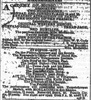
ACADEMY MUSIC BROOKLYN
TWO NIGHTS ONLY MONDAY AND TUESDAY, April 14 and 15
GREATEST ATTRACTION ON EARTH, THE SCOUTS OF THE PRAIRIE
Introducing the ORIGINAL WESTERN HEROES BUFFALO BILL TEXAS JACK, NED BUNTLINE, The peerless danseuse, Mlle Morlacchi Twenty Indians Warriors
THE SCOUTS OF THE PRAIRIE
Buffalo Bill, by the original bero.......Hon. W. F. Cody Texas Jack, by the original hero......J. B. Omohundro Cale Durg…………..........................Ned Buntline Dove Byo...........................................Mlle, Morlacchi SYNOPSIS-ACT 1 On the PlainsTrapper and the Scouts The Renegade's Camp-Peril of Hazel Eye. Ned Buntiine's Temperance Lecture. Cale Durg at the Torture Post. The Indian Dance-The Rescue. ACT II Texas Jack and his Lasso. The Loves of Buffalo Bill. The Death of Cale Durg. The Trapper's Last Shot. ACT III The Scout's Oath of Vengeance. The Scalp Dance-The Knife Fight. The Triumph of the Scouts The Prairie on Fire.
The performance will commence with Terpsichorean Sketch, with MORLACCHI five dances. Admission, 76 cents. Reserved Seats, $1. Family, Circle, 50 cents. Box sheet now open from 8 A. M. until 5.P.M
174
THE SCOUTS AT THE ACADEMY.
"See Naples and die," was the exclamation of an ancient Italian patriot, but here today, in cold blood, we exclaim, without prejudice, "See the Scouts of the Prairie on the stage and die rather than see them again." Not that a second look would in any way destroy the first impression, but because it might remove, in some measure, the fine romantic flavor, the đelightful poetical aroms, always associated in the memory with delicately conceived and cunningly wrought creations of the imagination. It is with dramatic performances as with pictures, the gleam and glory of the first revelation can never be forgotten, although both picture and drama may, at last, by familiarity, become things of indifference. Frequent contemplation has the effect of building a bridge of commonplace across which we have to pass in order to reach the Arabian retrospect which else would have stood to the mind as a glorious reality. In recognition of this fact it is that we say "die, rather than see the scouts a second time;" nothing in the form of dramatic pleasure will compensate for the loss which the spectator would certainly sustain, should he be tempted to such a second experience.
“The Scouts" were at the Academy last night, and their presence, having been duly advertised, had the effect of thronging the gallery of that classic edifice with an audience altogether representative of the polite patrons of what, for the want of a better name, is known as popular, fiction, done up in ten cent packages The youths and maidens who revel in frontier sketches, who dream of warwhoops and sealp hunts, who waking fancy teams with hatchets, soalping knives, tomahawks and firearms, whose high conception of life have been reared upon the deeds of the stolcal Lo and his genie adversary, the dauntless peddler of moccasins and bear skins, occupied all the front seats and made themselves pardonably conspicuous by the frequency and heartiness of their applause. There were several ladies and gentlemen present of an earlier generation who had not, it was evident, got beyond the traditions of Scott, Thackeray and Dickens, but they were in such a miserable minority that they wisely concluded to look with complacency upon things which their prejudices, under other circumstances, would have led them to combat. For the information of the undramatic and literate reader, it is proper to state here that "The Scouts of the Prairie" is a realistic picture of wild Western life, in three acts, by that most accomplished winter, Mr. Ned Buntline. The scenes are laid generally among the Rocky Mountain that is, they are arranged for the convenience of scene painters, so that a lava bed, a yellow stone canon or forest of ten thousand years old California pine traces may with equal propriety be called into use. The play is, upon the whole, highly moral; it has three commendable ends in view, to show first that Buffalo Bill, Texas Jack and Cale Durg (Ned Buntline) are the three greatest men that ever lived; second, that Lo, the poor Indian, is a fraud, and third that gunpowder and bourbon whisky are the most destructive and explosive material agents at present known to the descendants of Adam. If the plot were not so complicated we would explain it at length, but it's subtle character will not admit of proper analysis at the hands of daily

175
The play is, upon the whole, highly moral; it has three commendable ends in view, to show first that Buffalo Bill, Texas Jack and Cale Durg (Ned Buntline) are the three greatest men that ever lived; second, that Lo, the poor Indian, is a fraud, and third that gunpowder and bourbon whisky are the most destructive and explosive material agents at present known to the descendants of Adam. If the plot were not so complicated we would explain it at length, but it's subtle character will not admit of proper analysis at the hands of daily journalism. Suffice it to say that the plot passes ordinary comprehension, and is only less remarkable than the heroes it calls into work. Before describing the illustrations and never to be forgotten trinity, the reader must know that the "Scouts" is prefaced by a beautiful and most impressive sketch called "Love's Battle," This gem serves three highly useful purposes- First, that of a prologue to the "Scouts;" second, to display the versatility of Mormon Ben, and third, to exhibit the delicate, airy, and altogether admirable form of the sprightly Mlle, Morlacohi, who dances the brain of Mormon Benjamin clean away in a maze of gauze skirts, tight drawers, languishing looks and suggestive smiles, The battle ends with Benjamin's capitulation, just as every body with any perception of justice saw it must end.
The battle being over the curtain rises upon any portion of the Rocky Mountains conveniently at hand in the theatre. The part at hand in the Academy last night bore a suspicious resemblance to the imposing eminence that did service a few weeks ago in Jefferson's Rip Van Winkle. The first character who appeared was the tragic and impressive Cale Durg (Mr. Edward Buntline writer of soul stirring romance for the kitchen companion, and waiting maid souvenir). Thegentle Cale with a stately tread advances to the footlights, ans in a husky voice proceeds to apostrophise the orchestra, the rooks, mountains and silvery steams so dear to him. He tells in a sweetly confidential tone how, induced to leave the haunts of white avarice, he had found a home among those wilds, and experienced a friendship at the hands of these great grand and glorious products of nature (still talking earnestly at the leader of the German band) that had amply compensated for the loss of civilized luxurious. In the taking soliloquy he consumes five minutes, to the delight of the youths and maidens before referred to. At its and he suddenly recollects that his object on the scene was not so much to charm the woods and hills as to meet his friends Texas Jack and Buffalo Bill. He wonders for a moment that they have not yet appeared, but looking at the sun discovers that it is just the moment when the braves were to appear, and with that discovery they do appear, to the immense delight of the gallery. Over the heights constructed for Rip Van Winkle's goblins the rade hunters make their descent, and are soon by the side of the redoubtable Cale, and then there is a scene, and what a scene! The sweet familiarity, the ease, the grace, the intense naturalness, are not to be described. The three look at the leader of the orchestra, and make that good soul shake in his boots as they swear to take his scalp at the first favorable opportunity. After this they look to their arms and, seeing evidently for the first time that they are nre, proceed to puff the makers who presented them. The scene closes at this joint and the next opens with an Indian fight in which several trihes are entirely