

211
The Globe Trotting Gordons
By Elia W. Peattie.
(Copyright, 1900 By Daily Story Publishing Company)
Home Hill is an inconveniently located suburb of Chicago, but the Fordons lived in it because they could not afford to live in the city They would not have objected to a mansion on the Lake Shore drive, but they managed fairly well in a six-room cottage at the rear of a village lot, and they had the pleasure of looking out upon a timid lawn and a dozen straggling oaks which the drainage had not yet succeded in killing off They had also one arboreant treassure in the way of a mullberry tree of wide-spreading branches, which had been sociably incorporated into the front porch it furnished the main support of the porch, in fact, and gave to the house a look of great primitiveness When Father Gordon came home at night and ant him down under its whispering branches, he would remark to Mother Gordon and the children.
'Really if we were in Jamaica, instead of this accursed climate, we couldn't have anything finer than this."
'We never could have a tree we would be so fond of." Annabel would say 'but we might have a tree which would give us shade all the year 'round If we were in Jamaice we could build a palmetto hut around a bananna tree and'
"And have little skylight in the roof" broke in Pierpont "And reach-through them for our breakfast"
'If it wan't for the cost of trasportation" said Father Fordon, "we really wouldn't find it very difficult to go to Jamaica, and once there we would be sure to make our living some way."
'Oh, we could live upon next to nothing" broke, the Mother Gordon enthusiasitically "I could braid the girls hats out of sea grass and we could save all our millinery bills"
The Gordons it will be perceived, did not feel settled The truth is, they had the qualities which go to make up an old family, and they were irritatingly young They would have liked what they were pleased to term "associations," and these were among the many things which they had never been able to collect Moreover, they felt that when they did establish themselves it outght to be in a land of sunshine For when the winds of winter began to blow, and the lake, which had smiled upon them in kindly fashion, assured a sullien frown, then the Gorstoves and dreams of the south, with its glorious sunshine haunted both waking and sleeping moments But by the time the Fordones had paid last weeks grocery bill, and purchased shors for some needy member of the family, and settled about the coal and laid by odd chanage for the church, and loaned a dollar to a friend, they had hardly money enough left to take them as far as Lincoln park.
"I have thought at times that father might be able to secure a position as light housekeeper on one of the Floridian keys" said mother one evening
'Don't we have light housekeeping enough?' asked Annabel
"We could have alittle arable land." went on her mother. Ignoring the interuption, "and every member of the family could make a specialty of some ore thing Say I took pineapples and Annabel sweet potatoes, and Christians peanuts, and the boys'
"Oh, never mind us mother" broke in the boys "We'd just as soon youd did all the work"
'Moreover." continued mother. "we could raise sisal hemp and do our own spinning The girls would look lovely spinning"
But I have apland" said Nixon gravely It seems very practical to me It is ducks"
'Ducks; cried the family with one voice.
"Why not" asked Nixon with dignity "We can purchase some of those cheap lands in Alabama or Louisiana, selecting some that are plentifully intersected with creeks so that our water fowl will thrive and raise birds for the northern market"
"Thats a good idea," said Annabel with decisions"And of course we would felt the trees to build your house. Lets have the house in two parts with an open fallery between She had a drawer full of 'elevations' which she had drawn as the different enthusiasms of the nomadic Hodous presented themselves.
'Horses are absurdly cheap," continued Nixon 'And we would raise alfalfa for todder.' Of course we would have cattle and goats The voung kids could be sold for their skins In certain sections of that southern country are great deposits of time We might move in where there are the ruins of an old kiln. Indeed I know of such a place in Alabama with a house drew it from his pocket, 'showing the exact location of the place I have also been to see the railway company about reduction or rates for immigrants
"you seem to have looked into the matter quite thoroughly," said father Gordon in a respectfil tone of voice He was very tired that night and he had a cold in his head The thought of the piney woods was [?]
So it came about that this paricular fantasia of the Fordons grew to be a serious matter-or so nearly a serious matter that they could not tell the difference No native Alabamian was ever so well posted concerning the products of his state as were the Gordons who had never seen it They knew statistics-and went to far as to quote them-concerning ducks, turkys, chickens, hogs, pears, grapes, wine, melons and apples They talked about callcarious loam they had theories concerning fodder In brief, the Gordons were prepared to ender the old state, slate with impertinent energy and to revolutionze-almost everything!
As the gray sky scowled and the water pipes froze, and nature treated all inhabitant of the temperate zone like stepchildren the impatience of the Gordons intrased They were deterred by two things-lack of money and inability to realize a dream They had indulged so ling in dreams that it seemed like effrontery to enter with the bold striede of actuality into the pleasing land of fairy
The friends of the Gordons groaned They had made imaginary journeys with the Gordons to the pecan lands of Texas, to the sheep country of California, to the silk worm district of Southern France-may, they had even consented to talk about the resources of South Africa. But they had not hitherto been asked to entertain one idea or more than three or four weeks, during which time they acquired an amount of interesting data upon each subject But Alabama would not down, and when they saw the Gordons actually bring home packing boxes they felt that something ought ot be done
'Why, if the dear things got what they watned they wouldn't have any more fun," said a neigbor.
'Mere material means of trasportation would never suit the Gordons," said another, "They were made to travel in swapboats"
March weny by, wild and cruel
CANT SEE THE REST

212
Twenty-third and J streets Wedensday evening Gene Mayfield umpired the same, the score being 12 to 11 in favor of the striplings Federal Labor Union No. 7,112 has changed its regular time and place of meeting and will hereafter meet every Friday night at houtsky's hall All members are requested to meet Friday night.
CUBAN COURTS MUST ACT. Their Duty to see That E.G. Hathbonels Arrested. Washington, D.C. July 28.- "The secretary of war does not issue orders to courts," replied Secretary Root to the direct question as to whether or not he had given orders for the arrest of E.G. Rathbone, late director of posts in Cuba. He also added that General Wood did not issue orders to the courts of Cuba. He said the proceeding on the part of General Wood would be according to the same instructions given by the attorney general to a district attorney to proceed with the prosecution of persons charged with offenses against the government. The Bristow report would be made the basis of the prosecution against the persons who were charged with offenses against the postal laws. It was learned later that General Wood and Acting General Foshes of the Cuban postal service had taken the initial steps already toward bringing the case of ex-Director General Rathbone to the attention of the judicial authorities of Cuba. Secretary Root's attention was called to alleged charges against Major Black of the engineer department at Havana. It had been published that these charges were made by General Wood. Secretary Root said there was no foundation for the statement, but on the contrary General Wood had spoken highly of the engineer, department in Havana. The expenditures by the engineer department, as well as all other in Cuba, were being investigated, but nothing that would call for any criticism had been found." AVICE, By Elia W. Peattie.
(Copyrighted 1900 Daily Store Publishing Company) Richard Dunkirk measured x feet and two inches in his stocking feet, and could, without effort, expand his chest five and a half inches He was not sure quite how much he could lift, how long he could run nor how strong a man he could throw, because his experience was naturally limited, living as he did, in the heart of a city. where the prowess of selfishness and greed and the ability to grind were the things which counted. He had never forded a river nor climbed a mountain, nor faced the winderness. He had never killed a wild beast. He went his quiet way from the house to the office on a warmed and lighted train, he pushed an electric button whenhe wanted any service button when he wanted any service performed, and was prevented at every turn from showing that he was at all superior to the common run of men. But he felt that this superiority existed. he was always expecting that his moment would come and then he would utilize the yet untested strength and courage which were his He had no doubt that he would yet know the thrill which heroes feel. And without being vain, it would have been impossible for him to have been unconcious of the great beauty of his face and frame When he swung down the street men envied him for his vigor When he played cricket or tennis or golf he knew just as well as if he had been told that he did it with a verse which other men strove in vain to imitate and which brought the administration of the women frankly into their eyes. He reckoned on this beauty and strength and grace in helping him to win the love of Advice Ingersoll, and cursed the fate which made the modern wooing tame and dull Why was he not privileged to win this lovely girl by the exercise of courage and skill? Had he chosen his century better he might have had her hand as the trophy of successful joust. As it was, there was nothing from which he might even protect her. The comfortable, well-ordered, lawful time, with its ingenuity and wealth, was her shield and buckler, her strong tower and fortress. He had nothing to do but tamely ask for her love, which she gave with perfect readiness He was deprived even of the excitement of overcoming her resistance Truly, it was a pilant age! Moreover, everyone approved of the engagement. It was impossible to make an emotional drama out of the simple comedy, They loved, they were engaged, they were congratulated, matrons consulted Avice about her intentions as to a menage, girls gave her luncheons, fellos entertained him at bachelor breakfasts, and when Avice and he were together she talked about her trousseau, or he planned their wedding journey. The stress of passion, the exquisite pain of parting-he desired nothing more of course, than one of those tentative partings which lovers in search of emotion affect-were all denied him. At first it was a pleasure to him to know that Avice intensely admired his physical attraction If she was vexed at him he had only to exercise a little patience and she had forgiven him for the sake of his smile, and because of that abounding. triumphant strength of his expressing itself in fine outlines and in movements of grace and power, He attired himself very carefully and selected amusements which would make his vigor conspicious, and he fed on the admiration of the girl he loved as a bee feeds on honey. The wedding drew near, and it seemed as if the world of material things was giving the lovers the best it could. Richard prospered, and built a home, and within furnished it with glowing colors Presents were showered upon them. The two appeared to be submerged in the pleasure of palpable things-house furnishings, garments, flowers, plate, crystal-al of these beautiful creations were theirs and there seemed to be no time to think of anything else. The autumn ame hard after the summer. and drove her breathless, over the astricken hills. Almost before the grapes were ripe that year the frost came Got it happened, that, one morning, when Richard was going to his work, he slipped on the inclined sidewalk leading from the trainyard to the street and rolled under the engine of one of the suburban trains. The bystanders were actually incredulous for a second. The man had been so strong and tall and apparently sure-footed-so impressive a human engine, so to speak, that it seemed impossible that any mere contivance of iron and steam could defeat him But when they drew the great beautiful frame from the vicious wheels, one leg was found to be severed near the hip. They took him to the hospital and for two days and a night he did nothing but beg to be killed. "Kill me and put me out of my pain!" he cried and then: "Kill me and let me be rid of myself! I can't live to be a burden to othes ill be of no use to anyone now! No one will want me! And suddenly he realized the folly of building his house of love on the sands He had counted on his physical attractions to persuade his love, and now he was a malmed. Ineffective piteous thing! "Advice! Advice! Advice!" He alled through the night, half in delirium. He remembered the words she whispered the words she whispered to him in their happiest hours-those hours of enchanting folly to which the world cedes lovers the right. "No one is so strong as you dearest You are like a god among other man What a pity we are not early Christians! I should so like to be saved from a devouring lion by you. It had been a great jest Now it was the most serious thing in the world to him. Well he wished it was all over! He wished she would come and that he could speak the words releasing her, and see her go out of the door and know the supreme pang was past and that the time for patience and endurance was at hand He began to realize that there were forms of courage demanded which did not involve a triumphant body. Words came finally that Avice was at the hospital. The young lady, has been here three times before sir" said the attentant but the doctor would not allow her to be admitted. She can remain fifteen minutes only. Fifteen minutes! It would be long enough- it would serve He set his teeth hard and fixed his eyes upon the floor. The minutes dragged along like wounded makes, and then the door opened, and the stood in it, a bird of glowing plumage, all brown and scarlet Her face was white with pity, but her eyes shown with something which was not pity. Richard would not see this look he was firm in his despair. She came softly toward him and sank down by the bed and laid her cheek against his. For a moment he permitted himself to enjoy the ineffable delight of this embrace. Then he pushed her away feebly. The sooner its over, the better. Avice," he said through his set teeth. I'd rather say the last word the first minute, and and know the amputation was through with so to speak" The last word, Dick? Why, you're going to get well, dearest The doctor said there wasn't a doubt of it. You'll be wellin time for our wedding, love I asked the doctor if it would be necessary to change the date, and he said he thought not." Richard shook his head. "I know," he said. "I know. You are willing to be sacrificial and all that, my dearest, but I have no intention of letting you. I know what you have loved in me You have often told me, you know. You have been pleased because I was taller and stronger than other men No people will pity me-I shall be a cripple-and they will never be through with pitying you if you marry me So it's good by that we are to say today and I'd rather If you don't mind, that it was said quickly." I shall never say it, Richard Dunkirk! I've no desire to commit suicide and that is what it would mean to me If you don't love me that's another matter" "Oh," he interrupted "If I don't love you! He caught her hand and held it as in a vise She went on: Or perhaps you think a wife will be a burden But I'll work, and I'll be economical! Dick! I'll do anything. so you won't send me away. The tears which she had meant to keep back out of consideration for his weakness streamed over her cheeks "Why, you mean it! You will take me as I am-a frequent of a man? I thought-he hesitated. It is hard to say it, but recently I have feared that you did not find me congenial I feared that it was not myself you loved, but - he blushed To have completed the sentence would have been to have said something which might have been mistaken for vanity. Avie made a quotation. If there is enough of your body left to your soul, I will marry you," she said. TALK OF RAILWAY ALLIANCE. Conference Which May Mean Much to Iowa and Nebraska Roads. St. Paul. Minn. July 28-The Dispatch today published the following. One explanation of the visit to St. Paul yesterday of President Ering and Third Vice President Bird of the Milwaukee & St. Paul railway is taht these two officials were here to consult with President Mellen and Third Vice President Hannsford of the Northern Pacific relative to a close traffic alliance between the two systems with especial reference to the Duluth Short Line The alliance is not only valuable to Chicago and contiguous territory on the Milwaukee St. Paul road, but is especially valuable to the Dakotas, Iowa, Nebraska and other states which are crossed and recrossed by branches of that system it will permit that road to unload grain at Duluth practically on its own tracks. Iowa Boy Sails For China. Special Dispatch to the World-Herald. Crescent, Ia, July 26.- A little daughter of A. rost was kicked in the stomach by a vicious horse last night and was seriously if not fatally injured. She is still unconcious. fourteen hours after being hurt. Mrs. G.B. Larison has returned from a visit to her son Perry at Chadron, Neb. Her son is an engineer on the Elkhorn road. Mr. and Mrs. Harry Ovit of Magnolia, Ia. are here visiting with Mrs. H. A. Gideon. mother of Mrs. Ovit Mr. E. Coleman has sold out everything and will try his fortune in Colorado Sam Livingston of Omaha has been here for a week looking after his farm, where he is feeding a large lot of cattle Mr. J.C. Dennis, foreman of the Illinois Central railroad bridge builders, has received a letter from his son at San Francisco, saying that he would sail for China n the 20th. He is in the marine service.
SOCIALIST OF TEXAS. San Antonia.- Tex, July 26- The socialists of Texas in state convention today nominated G.H. Royal of Lampasas, for governor, and E. Bellenger of San Antonia, for Lieutenant governor.
The Fact is Tom Keene Cigars COST DEALERS MORE THAN OTHER 5C CIGARS THEREFORE A FEW DO NOT CARRY THEM BUT MOST DO. SO ASK FOR THEM. A MILD, SWEET AND PLEASANT SMOKE, WHICH WE RECOMMEND AS OUR BEST 5C CIGAR.
PEREGOY & MOORE, Wholesale Agents.
213
MRS. PEATTIE'S BOOK OF STORIES
Under the title, "A Mountain Woman," noted, has issued a book of short stories which we believe will win for her a place among the most eminent American writers.
Mrs. Peattie for several years has written for an ever-widening circle of admirers. Her work upon the World-Herald day by day has given her a reputation in the west equaled by no other woman, while her occasional contributions to the magazines of the country have made her known to the rapidly swelling multitude of magazine readers in all parts of the United States.
The literary critic of the Chicago Times-Herald has written such an admirable critique of the "The Mountain Woman" that we republish it on this page in lieu of a review by the World-Herald, which might be considered somewhat prejudiced in the author's favor.
Without setting itself up as a prophet the World Herald ventures the prediction that Mrs. Peattie has now formally entered upon a literary career which will make her a wide reputation.

214
ABOUT “THE CRAZY STORE’ -------- An Emporium of Wonderful Merchandise Which Delights the Children. -------- Mrs. Peattie Visits This Remarkable Matt and Writes of Its Pleasures and Pleasantness -------- One Place Where Ten Cents is Considered a Fortune and Where a Penny is Given Consideration. -------- The children call it “the crazy store.”
It is the modern equivalent for Pandora’s box—except that most of the things contained, in it are pleasant. The “crazy store,” of mighty fame, is kept by a man named -------. but after all, there is supposed to be nothing in a name. Moreover, all the children know his name. For the children are his patrons. Those who stumble toward Parnasens at the Park school are his patrons in chief. He is their purveyor His aim is to please.
And how does he perform this difficult task? Finally enough. He is as pleasant as chips—and the universal pleasantness of ships is a subject of international proverb He chatters and talks, laughs and tempts. The children think he is one of the most important of men. They gather in his store as men gather in saloons, or women at sociable. When they get, so numerous that they tear off one another’s coats, he sends a few of them out Sometimes so many boys and girls are packed in this emporium of delights that it is impossible to close the door, though the morning be ever so frosty, In the pocket or the hand of each child is a penny, or 5 cents, or perhaps even 10. Anybody who has 10 is looked upon with envy, and the possessor unconsciously assumes an air of charming hauteur. Of course, if one has 10 cents it is mighty hard to tell what to get. Ten cents will buy such a lot. And there are so many things to choose from. There are tops—in top season there are hundreds of tops—there are dolls, plain, dolls, dolls with fuzzy hair, dolls with little ra[mpits?] and horses and dogs printed all over the calico, of which their bodies are made there are sham watches, glit paper, tissue paper of all the hues of the prism, silver paper, paper dolls, little wax candles, lead pencils, slate pencils, trains of tin cars, tablets, tiny paper furniture, doll bureaus, brownies, balls, and balls and balls, ink, [muellage?], [ruics?], sponges, slates colored chalk, white chalk, strings for kites, bats, marbles—what beautiful marbles bearing mysterious technical names understood only by the infantile gamblers who play the noble game There is candy of many [soris?], French bon bons lie side by side with giant sticks of licorice, with balls of licorice, which look like small cannon balls, and must be just about as disastrous when taken in the stomach. There is nut candy, pink candy, honest sticks of candy of the old-fashioned sort, pretty designs in candy—quite the intest thing—there are tempting marshmallows. A B C licorice drops, novelties to tempt the willing penny from the over laden pocket of the eager juvenile purchaser
Of course there are, here and there, some uninteresting things for grown up people, such as thread, silk, needles, pins, emories, rubber hair pins, cigars, a dusty copy of Prosper Mrimee’s Carmen. another terribly fascinating novel. “A Beautiful Woman’s Sin,” with the picture on the outside of a décor making an incision in the arm of a veiled woman, whom you feel quite sure is not the woman he thinks it is, “The Black Cat” very chic, but [rusts?], [rise?], in the window loaves of bread, quantities of cake and but the fingers are out of breath making the list
To do the little shop justice it has a good collection of periodical literature and many of the neighbors in that community of well to do people obtain their magazines through the agency of the man who keeps the wonderful store
Moreover, if is on want glazing done, that is where you to. if you want skates sharp[?]; that is [?] where you go. If you want [?] points put in tops you also go there, At times you are able to strike the grentes’ bargains. At one time it was possible to buy a variegated chenille monkey there for a penny Every child in the Park school from the kindergarten to the eighth graded owned one or more little chenille monkeys Some were [?] and green Some were yellow and blue There was a terrible run on them The man in the crazy shop sold out his stock of monkeys before he knew what had happened. He has the all of making things fashionable At one time every child who wished to he in the mode had a candy pig—generally green (vegetable dyes—perfectly harmless and beautiful to look at). No home in the neighborhood was what it ought to be without a green candy pig Of course there was a furore over brownie pins, which cost a quarter of a cent and sold for 5 Some boys wore eight or ten brownie pins on the lapel of their coats. There was a great rivalry in those days in this particular form of decoration The man in the shop said nothing, but merrily snapped his little money drawer
There is almost always some prize to he purchased at the “crazy store” Usually there are to be bought for a penny It is much more interesting to buy something mysterious than something understood. The “Sweetheart’ prize for example, comes in a neat little diamond shared box, and contains some lemon drops and—the prize You give the prize, whatever it may be to the boy you like best, if you are a girl There is always some prize to be had Novelties are forever being produced Children weary quickly of one thing They are not an easy set of customers to please
The man in the crazy store has the adroitness of a hotel clerk He knows the name of every one if the children who patronize him Not only does he serve the young ladies and gentleman of the Park school—of whom th r[?] must be about 400 but he has a large number of youthful patrons who come from afar to peep into his show cases
Why there are children who come miles to buy thing of me,” he says, “my place is known all over the city”
Very likely, very likely
Just ask any child within a radius of a mile around the park school, about the ‘crazy store” and see his eyes light up, and listen to the tale he will tell. For it is at the “crazy store” that the child learns his first lesson in barter and sale. ELIA W PEATTIE
215
LET US NOT BE VANDALS
Mrs. Peattie Asks That Historic Buildings Be Preserved for the Future.
Old Landmarks in the Life of the Republic Which Deserve a Tender Care in Their Day of Decay.
There used to be an idea that a republic should not indulge in reminiscence. It was supposed to be the duty of citizens of a republic to look forward and not back. But there never yet was an arbitrary rule made for the regulation of man’s emotions, which was not speedily broken. And thus it has come about in 200 years of hot history that we are as fond and proud of old associations as any other country.
In some ways we have a great advantage over other countries when it comes to dealing with historic persons And that is that our distinguished personages are honest in their distinction. They are not noticed because they are Stuarts, Howards or Guelphs, but because they have individually done something heroic, or brilliant, or sacrificial. And the lives of such are bound together in a bundle as David would have said—with the history of this republic is the history of individuals, and little by little this intensely interesting fact is coming to be appreciated.
A number of gentlemen at the city of Washington have been laboring recently to promulgate this idea, and they have formed themselves, or been formed, into the Memorial Association of the District of Columbia. This association has been formed of a threefold purpose.
First—of preserving the most note worthy houses at the capital of this country, that have been made historic by the residence of the nation’s greatest men.
Second—Of suitably marking, by tablets or otherwise, the houses and places throughout the city of chief interest to the multitudes of Americans and foreigners who annually visit the capital.
Third—Of thus cultivating that historic spirit and that reverence for the memories of the founders and leaders of the republic upon which an intelligent and abiding patriotism so largely depends.
The membership of this association is interesting it is composed of Chief Justice Melville W. Fuller, General John M Schofield, ex Secretary of State John W. Foster, B W. Warder. S P Langley the astronomer. A. B Hagner, J C Bancroft Davis once assistant secretary of state and the nephew of the historian Bancroft. Walter S Cox a judge of the district court, S H Kauffmunn A. R. Spofford, the librarian of congress, John Hay, the poet. J W Douglass Myron M Parker, Gardiner G Hubbard, W D Davidge S. R. Franklin, Charles C. Glover, and the Roy Tennis S Hamlin of the Church of the Covenant at Washington.
The little circular sent about the country by the association contains the following
The rapid growth of the city of Washington and the transformation of residence streets into business centers are already obliterating many of our historic buildings. Few people know that where even the very greatest of our statesmen had their homes while they were making, or interpreting, or executing the laws of the republic. We have names that the civilized world honors, their chief work was done in this city, yet the visitor here has no means of satisfying his praiseworthy desire to look upon the places they made memorable The vast work of building up a young nation has left us little time for cultivating the historic spirit But we have now reached a period when we need no longer bend every energy to subdue nature and to insure material prosperity. We may pause a little to secure the higher refinements of a splendid civilization. And among these refinements, none is more precious than that worthy pride in our best national traits and achievements which cannot exist apart from some intimate acquaintance with the life and work of our greatest men
“Moved by such considerations, we have formed Memorial Association of the District of Columbia and have so cured incorporation under the laws of the district. Pursuant to a joint resolution of the two houses of congress, approved June 14 1892, we have been appointed, six each by the president of the United States, the president of the senate and the speaker of house of representatives, as members of the association. The term of service is three years one third of the members being appointed annually We have adopted by laws elected officers, and chosen a board of five directors to manage the details of our work under the instruction of our association. We are prohibited by our charter from receiving any compensation for our labors. We have recently issued a small pamphlet of twenty seven pages, giving careful information as to a few of the historic houses and places within the district. We desire as soon as may be, to mark with suitable tablets the most notable houses still standing in which the greatest men of our nation’s car[lier?] years have lived and labored. And we especially wish to purchase the house on Tenth street in which President Lincoln died It is the only building at the capital distinctly associated with him. We wish to restore it to the condition it was then, both externally and internally to gather in it such mementos of Mr Lincoln as can be procured, and to make it a perpetual abrine of patriotic pilgrimage for the millions that venerate his memory. The title to this and to any other historic houses or places preserved by the labors of the association will, by our charter, vest in the United States, and remain under the control and management of the association at the will of congress.
“We look to the congress to enable this work to be speedily entered upon, and these patriotic designs carried out, which we believe will greatly inure to the benefits of the whole nation, which takes a worthy pride in its magnificent capital. No time could be more appropriate for the inception of such an undertaking than this historic and memorial year.
This sets forth succinctly the plan which this company of gentlemen, with Justice Fuller as their president. have laid out. It is one in which every American must feel an interest, and which the romancer regards with affection For he knows that, pressed like leaves in looks, the rich colors faded, but still apparent the histories of fascinating men and women he impressed in the personality of these old places.
In the current number of Scribner’s Magazine is an article by the Rev Tennis S. Hamlin on the “Historic House of Washington.” It is rich with the stories of the men and women who have made Washington the “Paris of America,” and one is perplexed at the idea of making selections from it, for its stories have suggested one another in a way to form a happy sequence, which isolated quotations cannot but destroy.
In the article are the descriptions of famous houses—houses renowned for hospitality, for brilliant company, for ad[roitest?] lobbying—and the article is agreeably illustrated with views from these historic mansions.
But if one would be glad to see the home where the fascinating and benevolent Mrs Van Ness lived, and to walk in the room where Decatur dined with his guests and see the room where Colonel Taylore danced, it would still very much more like to have reverently preserved the house associated with Lincoln, and to have it filled with all the mementos of him which can be procured and authenticated.
Apropos of mementos of Lincoln, there is a little story told of Richard Harding Davis, which it is not particularly pleasant to associate with that brilliant young writer He was to be presented to Edwin Booth at the Actors club, and wishing to impress the occasion in some way upon the mind of the venerable actor and to give him some token of his respect, Mr Davis met him with this speech
“This is a very great pleasure, indeed, Mr. Booth, and was of so much import to me, that, anticipating it, I looked among my theatrical curios to select some souvenir. Will you let me give you the one I consider most interesting? It is a copy of the program of the play at Ford’s theater the night that Abraham Lincoln was shot.”
Poor Davis! He had the pain of seeing Booth reel and nearly fall. Someone hurried him away, And then, for the first time, Mr. Davis learned how closely associated with the assassin was Edwin Booth. How he ever escaped acquiring that knowledge before is one of those things which no man can explain.
It is a fact as certain as that smoke flies upward, that if there were a museum of Lincoln souvenirs at Washington, that not an American or foreigner of intelligence would visit Washington without looking at these relics. For beloved as Lincoln was in his life, it is only now, with the focus that time gives, that the true proportions of the man became apparent. There is not, in history, a man so revered. About him there is the halo of martyrdom. And stronger than that is the luster cast by a character which stands for the American ideal. He is what all Americans would like to be, and in searching for a man who seems the best result of our republican institutions, we point to Lincoln.
Let his homely, familiar, restful face but appear in the transformation of a stereopticon display, or in the extravaganza or in a play, and the audience cannot get enough of it. They look upon it as if it still had the power to protect, guide and encourage. And the flag itself cannot inspire them to equal demonstrations.
Yes, decidedly, the house associated with him, and many another mansion of the beautiful capital, ought to be preserved. How numerous the associations are in connection with certain of these houses, it needs an article with the space and scope of the one referred to in Scribners to set forth. They are filled with illustrious associations.
And we have reached another rung in our evolution when we perceive the educating influence that a preservation of such memorials has
ELIA W. PEATTIE.
SILAS A. HOLCOMB. A Sketch of the Career of the Independent Nominee.
A gentleman who has known Judge Holcomb for many years writes, at the request of the WORLD HERALD, the following:
Judge Silas Alexander Holcomb, the populist nominee for judge of the supreme court, was born in a farm in Gibson county, Indiana, in 1858, and is in his 36th year. His early life was spent on the Indiana homestead, where he worked in the summer and attended district school during the winter. His early education was confined to the opportunities afforded by the common schools of his natives state, supplemented by a course in a normal academy or high school.
At the age of 17 years he began teaching school, an occupation which he followed for upward of four years While teaching, he was preparing himself for entering college, with the view of taking up the study and practice of law at the close of a collegiate course. But his father dying in 1878 he was left with the responsibilities of caring for a widowed mother and younger brothers and a sister. This necessitated the relinquishment of his plan for a college education, but such time as he could spare from teaching and farm labor, was devoted to legal studies.
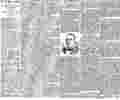
SILAS A. HOLCOMB.
In 1879, with his mother and her family, the judge followed the westward course of empire to Hamilton county in this state. He there worked on a farm for one year, when he entered the law office of Thummel & Platt at Grand Island as a student. He remained with them in this capacity two years, when he was admitted to the bar at an examination held before judge George W. Post at Central City. This examination was taken part in by ex-Supreme Judge M. B. Reese, who was at that time prosecuting attorney for that judicial district, and incidentally a member of the bar committee on examinations.
Judge Holcomb was married in April, 1882, his family now consisting of himself, moved with his wife to Custer county and began the practice of law at Broken Bow, where he has since continuously resided. After locating at Broken Bow he practiced law about one year alone, when he formed a co-partnership with [Jon?] S Kirkpatrick, now of Lincoln, a co-partnership which continued for over seven years or until his nomination by the independents for the position of district judge in the Twelfth district in the fall of 1891, a position to which he was elected over Judge 1, G. Hemer and which he now holds.
When practicing at this bar Judge Holcomb was perhaps the peer of any lawyer in the state. His professional career, from its beginning until his elevation to the bench, was attended with the success that always accompanies diligence, ability and integrity. It was not altogether to his clear, cogent and powerful reasoning that he owed his success as a trial lawyer, but as much to the confidence reposed in him as a man and lawyer by court and jury alike.
As a judge he has shown himself to be not only learned in the law, but one of the strictest integrity. He has no friends to reward, no enemies to punish. To appreciate him he has only to be seen and known by those who have been his associates and friends those many years. His personal, professional and judicial career is without a stain, is above reproach. He is a son of whom Nebraska may well be proud.
In physique and intellect the judge is a large man, on upon whom nature has bestowed her best gifts with lavish hand. He is a splendid specimen of physical manhood. In stature, six feet and two inches, with the proportions of an athlete. He has the commanding figure and classic features of an Apollo, combining in his character the strength of an oak and rock, with the gentleness of a child. If he errs it is on mercy’s side, and in behalf of those who have no help of man. A few years ago when he was known simply as “Silas,’ or “Aleck” Holcomb, he was pointed out to the writer as one who bore upon his form and face the patent of nobility.
Prior to his affiliation with the independent party he was a democrat, but was never a politician. Should he be elected to the high position for which he is a candidate, and for which his qualifications so eminently fit him, the public may be assured that every interest that may come before him as a member of the supreme court for adjudication will receive at his hands the same palms taking care and fidelity that have characterized his findings on the district bench, where he has been and is a model judge.
HEARD HERE AND THERE.
City Electrician Cowgill, like all specialists, likes to talk on his hobby. And, bye-the-bye, Mr. Cowgill has a very good specialty and talks interestingly and entertainingly on it, which cannot, more’s the pity, he said of all specialists. In answer to a seemingly innocent question put to him yesterday he commenced talking of volts and ohms and colons and watts and amperes and a number of other things that were not as understandable to his visitor as would have been so many expressions in Sioux. Mr. Cowgill then explained and this is the way his explanation was understood; in order that the gentlemen’s professional reputation may not be injured it is not stated that it is what he said but what he was understood to say:
“The volt is the unit of pressure of electrical force and the ampere is the unit of quantity or current. One volt ad one ampere make one watt, ten volts and ten amperes make 100 watts. The [?] is the [?] of resistance and it, too, must be taken into consideration in the measurement of electricity. For example: stretch a fine wire between these two points to feed five incandescent lamps and you have fifty volts. Now stretch this wire, putting your body with its, say 6,000, ohms resistance and you only have half an ampere. That electrical machine which was exhibited by Dr. Kolnstam the other evening had a voltage up into the hundreds of thousands. It threw a spark twenty inches, and you could have held your hand and let it go through it, and it would go through it or anything else, without serious injury. If you had held a cardboard in its path it would bore a fine hole through it, but not like a hole you would make with a pin. With a pin you could tell, from the bulging on the other side, the side the pin had entered. Pierced with the spark both sides would be the same, and there would be no bulging. That spark had an immense voltage or pressure, but no amperage or quantity to it. It is still a question what voltage, taking into consideration the ohmage or resistance, of course, would kill a man. If you would touch a bare incandescent lamp wire, fifty-two volts, it would just give you a pleasant shock. But still one man in Omaha, under peculiarly favorable circumstances—for the current that is, not for him—met his death, it is believed, by coming in contact with one of them. In New York state, in electrocuting criminals, they use about 1,800 volts
“I suppose the oldest Masou in the country lives in Omaha. In fact, he lives in pretty near every city in the country, and he also dies every few weeks. But when you come to talk about the oldest postmaster in the country, a little place in my state can beat them all,” said W. H. Miller of Albany, N. Y., last night. “If the records did not bear out the story I would hardly care to say that we have a postmaster who has held office over sixty-five years. He is Roswell Beardsly of North Lansing and he was appointed during the administration of John Quincy Adams by Postmaster General John McLean. Mr. Beardsly is and always has been a staunch democrat, but that never made any difference about his holding onto his little post[?]. He is still healthy and active, though, of course, a very old man, but he expects to round out the century handling man. He might be given as an example of the saying that few die and none resign.”
“Of course we are not Christians or civilized, but just poor devils running over the country without homes or anything else—or, at least, that’s what some people think of us. But we are improving, we’re marching onward, you see.” said a New York drummer in Omaha yesterday on his semi-annual trip to the coast taking orders for next spring delivery. “The actors and the old soldiers, the printers and the ministers, the bootsblacks and even recently the newspaper men all have ‘homes’ in different parts of the country. ‘Well, we are going to have a ‘home,’ too. It will be built by the Traveler’s Home association of America, but for short will probably be called the ‘Drummer’s Home.’ Buffalo is making a strong bid for it and offers a fine hue site, but some of the boys think it would be too cold there. The site committee has visited a number of places and will report at a national meeting of the association to be held in Syracuse, October 10. When we get it built drop around and see us. So long.”
“Business might be better, but still the south is getting all right,” said J. Monroe of Tennessee, inst evening, after he had walked all around the office of an Omaha hotel looking for a fire at which to warm and dry himself. “I can give you one instance of this which may be interesting. Of course we all know that good names and newspapers are identical in paying qualities. A few days ago the Memphis Appeal-Avalanche executed a mortgage for fifty odd thousand dollars and at the same time took up and canceled a mortgage for $200,000. In a short time it will pay off this last mortgage and will then begin to make millionaires out of its stockholders.”
“Have you heard of the case that is making the supreme court of Connecticut lie awake o’ nights, the case of a man who is not even charged with the commission of any crime, and yet is in prison for life, and the court has not yet found any way to legally release Lim?” asked a member of the Douglas county bara yesterday, to answer to a request for new if you [?] have not I’ll tell you a query, [?] you man named Edmonds waste [?] about a year ago, charged with [?] to burn a neighbor’s barn, H[?] who is said to be insane, was the [?] ness against him, and Edmonds [?] that there is a conspiracy to [?] him in jail. The justice of the pe[?] bound him over, fixing his bond at $300, to the superior court. But the case was not called at the next term, several terms have since been held, and Edmonds has now waived his right to a trial, and is, you may say, in jail for life. The justice of this peace who bound him over of course has no jurisdiction, the court which should have tried him declares that it can do nothing now, and the supreme court attention has just been called to the case. But on the face of the case it can do nothing, and, as I said, Edmonds, according to law, is in jail for life One man under exactly similar circumstances did stay in a Connecticut prison for several years. He would have stald there for life but he happened to be a French counsel at New York he was released on condition that he would go to France at once and never return to this country. Yes, there are some que er things in law, and Connecticut law furnishes several good examples of the fact.” -- Business is going west. Lenman’s wall paper store has located on corner 17th and Douglas sts.