
86
Elia W. Peattie: Memory of a Visit
By Irene C. Byrne.
A FINE personality is composed of such intangible elusive qualities that like a delicate flavor or a subtle odor is difficult to analyze. It is hard to tell just what constitutes an interesting woman's charm but when a large circle of friends of diverse sorts if not colors unite in recognizing that charm we know that it is even though it is not named. So in speaking of the people who know her best we can gain perhaps some idea of Mrs. Peattie whose latest book 'The Beleaguered Forest, has recently been highly praised for the beauty of its literary [?].
To her home, marked by the refinement and individually distinguishing every thing that is an expression of her that [?] come men and women who are of the best, intellectually, to be found in Chicago, that great, gray city which seems to be a gigantic maelstrom drawing to itself the talent which has birth in smaller and more secluded places.
My visit with her was a short one but so much was crowded into it that in [?] seems that it must have been longer. One day we devoted to the clubs. We took luncheon at the Woman's club in a quiet, homelike dining from to which only members and their friends are admitted in a city of magnificent distances like Chicago it is a great boon to the women to have this cozy retired place of their own. Here was served a dainty palatable but essentially 'womanish' lunch for the very modest sum of 25 cents. There was no public meeting of the club but in the spacious parlors there was an exhibit of paintings. Most of these were like the lunch, 'womanish' -- that is dainty and delicate rather than strong and forceful. But one or two were discussing the advisability of buying one. Miss Ada L Sweet well known throughout the west as a pension agent who is at once [?] and successful was while talking to us, asked if she would contribute to pay for it.
['Nobindned,'?] she said in a most business-like was ' I do not believe in individual members of the club Daving for anything while we have a large [?} fund in the treasure I believe in [?]ing not hoarding the club [mones?]
Thin started an argument as to the difference between hoarding and [?] [?] and we left them like club [?] were late comfortable, well legends furnished There were good pictures on the walls and some chuming bits of Miss I [?] Putters modeling on the tables But they were not no beautiful as the rooms of the Fortnightly, which were in the same building indeed everything was in this building its very name the Fine Arts, showing for what purpose it is used it is devoted to studios and club rooms The Fortnightly is perhaps the most exclusive of Chicago intellectual clubs and though social position and wealth are not conditions of its membership many of the women belonging to it have both These women have attended to each detail of the furnishing and old mahogany and old china old wood prints and carved blackwood days chairs, exquisite silver and fine color scheme of walls tugs and woodwork make up an aesthetic and distinctive interior
After a peep into the Fortnightly we went to Ralph Clarkson's studio where we found The People Mr Clarkson is a well known portrait painter and his studio is a most int resting one in it oaoh [?], meets The Little Room, so called from a link written by one of its members, Mrs Woane who is not only a writer but a charming women and article willer smith who makes most exquisite and [?]silver work
The Little Room is not a club in the sense that it does anything at its meltings it is [?] a gathering of the brightest and most talented people, artists writers sculptors and doors, who for an hour or tao retain from being clever and talk in a most model was together each one trying hard not to say all the good things which is indeed, unselfish Whenever a writer or actor or artist or musician of repute come to Chicago he is inited to meet theme people at The Little Room This week, my visit was three years ago, remember, the guest of honor was Hall Caine Really, between you and me, I think I was the most distinguished person present for while everyone else had printed a book, or painted a picture, or played a play, I was unique in that I had done none of these. Amid so many clever people dull one was anomaly, the bright and shining light Hall Caine, most ' Svenguliesque" in appearance, was most human in datercourse, being very unlike Zangwill, who the week before had followed the Bibileat Injunction literally and said only "yen.' and "pay" and that with the most bored manner possible Mr Caine expressed giant pleasure at the cordial manner in which the American public had received him and spoke in some surprise of the warm hospitality that had been extended to him We explained to him that this was not because he was English, but because we were American One of his anecdotes interested me because of its uncanniness He said that while-talking of Shelley to William Ronetti Danite Gabriel's brother, Rossetti said ' I have a lock of Shelley's hair which I will show you" On opening the case holding it a lock of snow white hair was disclosed
Why exclaimed Mr. Caine. ' I thought Shelley a hair was auburn"
So this was, " responded Rosetti, the last time I saw it"
This was rather creepy until a matter of fact person suggested that possibly Shelley's hair had been stolen and this substituted We all looked our contempt for the scientist mind which sought for a simple, natural reason and robbed us of our shivers Lillian Bell, now Lillian Bell Rogue interested me even more than the author of " the Christian and The Eternal City. handsome, well dressed and tall she would be statuesque were she not so vivacious but June and wills after-dinner tales told with an inimitable gusto are not compatible, and in these she abound She was contained unlike our "womanish' lunch for she possesses in a remarkable degree the [?] popper of personalities for though I imagine that a wit as sharp and bright and quick as hers could cut to the [?] if need be, she showed none of that this afternoon WHile talking to her and her sister, Mrs Lessing Mr [?] who has since [?] [?] [?] Alone was presented to Mrs Lessing Ah you are Bec he said 'I knew you front your sisters willing [?] isn't It dreadful the was she willes about me and makes me public property "Why don't you, to get even waite about her" "Write about [?] broke in Mrs Houge "Why, none of my families [?] write They can only take their mark You brilliant creature I thought You are making your mark by writing
Hamlin Harland with his study farmers frame was there I wanted to ask his if Rose Datcher were happy in her married life, but [?] he might not like to discuss family affairs As he stood talking to George Fox, Harpers correspondent, looking over the expanse of gras sky, gras lake and said, gray roofs which the window afforded, one of them remarked of the view, "Significant but not beautiful " Ithought that would be a good epitome of Garlands work Henes Fuller [?] in but would not stay Mr. Rosswell Field new of Boston. who has the joke-loving dispotion of his dead brother. the poet was heard saying [?] to Garland, who is a total abstainer "No, Garland I positively refuse to go out for a drink with you"
It was a stimulating afternoon and as I recall the bright gaskets and spontaneous wit of those who made it so, I fed vers grateful to the woman who stood sponsor for me and gave me an opportunity to enjoy it And not the least line quilty of those whom I met was their appreciation of her movable, memorable personalities and the talent, a talent which has found expression in many short [?] and is now displayed in
The [?] [?] it mas not be [?] to those who read Mrs. [?] [?] to know that this story was almost [?] for the publishers two [?] new bit was burned with many other manuscripts in a fire that destroyed her studio [?] cabin in the Michigan pine wood [?] [?] some of the fear and [?] of that night fire. burning in the [?] of the forest may be found in the written story
If an [?] in also the quiet courage and [?] of purpose which helped the woman [?] bear the loss of [?] moths work and without complaining to set about to do over again

87
ONE MORE HOPEFUL LETTER
Mr. Peattie's Course Is Not Entirely Through Lands of Destitution and Woe.
He Finds Some Sections Where the People Are Able to Take Care of Their Own Poor.
The Lesson of the Futility of Trying to Farm on Stock Ranges Taught—Irrigation Means Prosperity.
(Still another letter filled with hope and chronicling good cheer is the seventh of Mr. Peattie's communications. Mr. Peattie writes from Cheyenne and Kimball counties, where things are in happy contrast to the situation elsewhere.)
Sidney. Cheyenne County, Neb., Dec. 19.—This county has but one person in the poor house, and is taking care of six families, by issuing warrants to them for $4 or $5 per month. But few have left the county within the past year, as the vote of November showed about the same number as was cast at the previous election. The relief work already done among the farmers and ranchers who needed it has been distributed largely by the Rev. Bir. Albin, the Lutheran minister, who was made a relief agent here by Chairman Ludden. He was greatly assisted by the ladies of Sidney, principally members of the Ladies' guild, the Good Samaritans, or the Woman's Relief corps. Mr. Albin said:
"I have received no supplies from Mr. Ludden yet, but I am advised that they have been shipped. we are taking care of about fifteen families. They have received some clothing, a little provisions and so forth, and I believe, are fairly comfortable, There is really not much distress in Cheyenne county, and I have no doubt that we will be able to amply take care of our poor."
NOT SO BADLY FIXED.
The Rev. George A. Beacher of the Episcopal church, who was just returned from one of his extended tours as far north as the Burlington road and as far west as Gering, in Scott's Bluffs county, reports that the settler in the region he traversed appear not to be as bad off as they were a year ago.
Mr. Atkins, one of the county commissioners, said:
"But few applications have been made for aid to the board. We are giving from $4 to $5 per month, instead of putting them into the poorhouse, which would be a very expensive thing for the county. We have been allowing some relief, principally provisions, to some others. But ranching is so extensively practiced in Cheyenne county that there is not so much destitution as there would be if we had more farmers. Of course up on the Belmont ditch farming is done on a large scale. Splendid crops have been raised on the land under the ditch and all other irrigating plants up there. There divide which is unavailable for successful farming purposes is good grazing ground, and between the two we count ourselves fortunate. Of course we have some isolated cases of destitution, and pretty bad ones, too, but there is no general distress.
SEED IS ALL THAT'S NEEDED.
Cheyenne county is in good financial condition, and if seed is furnished in relief need come from the state.
Mr. F. C. Condon of Omaha, who is associated with G. I. Hunt and John A. McShane in the celebrated Belmont ditch, passed through here Sunday on his way to the property. He said:
"The Belmont ditch is one of the most successful examples of irrigation in the west. It is about forty miles long and irrigates about 40,000 acres. Some wonders in the way of the production of vegetables and grain were accomplished this year, and the products brought the highest prices. large quantities of hay were grown, and the country along the ditch produced the only crops this county had. There are some smaller ditches, and the land under them also produces good crops. Irrigation is the only salvation of Western Nebraska, and the sooner this fact is recognized the better."
STOCK IS THEIR SALVATION.
Kimball county does not appear to be in danger of immediate distress. Its financial condition is good, but it has no funds which the law allows it to distribute to destitute persons. But of these there appears to be no great number in spite of the fact that about three fair crops in nine years in the record. The people are poor--poor to a degree hardly equaled in Omaha, but they have this in their favor—they each have a little stock which can be exchanged for money or provisions. Five only have applied for aid. The Danes of Kimball, Banner and Cheyenne received a carload of goods from their fellow-countrymen near Fremont, containing among other things a large quantity of flour and provisions, and about ninety bundles of clothing. The Danes Kimball county got about half of this relief.
Kimball county has suffered dreadfully in the last few years as regards crops, and were it not for its excellence as a grazing county, it would now be of little worth, Some patches of land, especially in the northeastern corner and the adjoining corner of Banner county, produced splendid crops this year, The soil is a black loam and the region enjoyed several local rains during the growing season, Corn produced there brings 60 cents of the farmers and wheat the same figure and 10 cents more at the stores, The stores of Kimball are doing well, and in the face of the hard times a splendid stone building, the lower floor of which is to be occupied as a general store, has been erected during the past season by one of Kimball's merchants.
HELPED BY A GOOD MAN.
The Bank of Kimball, in the hands of a man who has grown up with the place for the last ten years, and who is a practical cattleman and farmer, has been a potent factor in holding the community from the depression which has seized the state.
In my haste to get to the extreme southwest counties I did not go either to Banne or Scotts Bluffs. The former will need some relief, but every one tells me that the latter is one of the most prosperous in the state, owing to the extent of the irrigation practiced there, A traveling man returned from Gering says it is a sight for sore eyes to see the difference between that and other sections of Western Nebraska, I saw pictures of potato and cabbage fields under cultivation last summer, and for extent and vigor of growth they resembled the best California vegetable gardens, everyone out west gives Scotts Bluffs county a great reputation for its achievements by irrigation, and it undoubtedly deserves all the good things which are said of it.
IRRIGATION MEANS PROSPERITY.
The people are gradually admitting that with irrigation this country can be made to yield regular and abundant crops of everything which grows in the temperate zone, and that those portions which cannot be irrigated should be abandoned for farming and given over to stock raising, for which they are pre-eminently fitted, More economical farming methods will undoubtedly prevail in the future, for the producers have been taught a terrible lesson of late years, and it is not improbable that even the character of the men engaged in agricultural pursuits will itself be changed for the better,
R. B. PEATTIE.

88
IN A MORE HOPEFUL VEIN
Mr. Peattie's Sixth Drouth Letter Tells of an Oasis in the Desert.
A Part of the County Where There Was Plenty Water and Where Things Are Better.
Just a Little Flash of Light in the Gloom Which Hovers Over the Starving Sand Hills Country.
(The World-Herald's special envoy into the drouth country, Mr. Robert B Peattie, writes more hopefully today, he having apparently struck an oasis in the desert This is Mr. Peattie's sixth letter A better idea of the actual situation which exists in the land of poverty cannot be obtained than that given by a perusal of his previous correspondence)
Chappel, Deuel Couty, Neb, Dec 19—For the first time in my wanderings I have come upon a county where the destitution is not general This county is not generally stricken, although but few crops were raised, none at all on the table lands. The valley along the Platte river, where irrigation is being practiced to some extent, raised some corn, a little wheat and a small quantity of alfalfa Here and there small patches of potatoes and other vegetables were grown where wind-mill pumps were utilized, and on these articles the farmers will subsist during the winter months. Seed will have to be generally distributed in the spring The farmers out here are better able to stand the present pinching circumstances than some people, for the very good reason that they have never known much better times.
Of course there are a good many who have applied for aid of the county commissioners, and there are others who have solicited clothes and food in the towns along the Union Pacific. These have all been accommodated. The county is in fair financial condition. Its warrants sell at 95 and it has some funds available for the relief of the distressed. Were it not for having reduced the valuation 25 per cent the county would be in better shape to cope with the present emergency.
Up on the river, about half way between the north and south lines of the county, there is a good deal of land where considerable hay is raised. This is bringing $10. The farming community up there has built a few ditches and irrigated a small portion of the lands. Wind-mill irrigation is likewise practiced to some extent both there and in the valley of Lodge Pole creek not far from this town. Wherever the means is at hand the farmers have pretty generally taken up the work of putting a certain portion of their lands under water, and have succeeded in keeping the wolf from the door---if he is not too large. Some of these men have rigged up pumps of their own make, built reservoirs of several thousand barrels capacity and are filling these preparatory for next year's work.
PLENTY WATER
Here at Chappell an inexhaustible supply of water is reached at from ten to twenty feet below the surface and in many instances two pumps fall to reduce the level. Along Lodge Pole creek the farmers successfully irrigate by means of pumps, dams and reservoirs, and raise at least a living stock of vegetables. The question of irrigation north and south of the sand hills will soon be solved.The hills themselves will always be good for grazing at least.
The fact that stock-raising has always been practice here accounts in part for the fact that more actual destitution does not exist in Deuel county. The cows find pretty good picking all over the county and horses too, until the heavy snows set in. The extreme northern portion is a heavy stock country and large shipments are made from there every year.
It must not be supposed, however, that the outlook is rosy or even comfortable. As in other places, I have visited many who are suffering for proper for, fuel and clothing. The popular dish of flour and milk cooked on a fire of cow chips is very common. Meat is a rarity and coffee unknown outside of the towns. The clothing is of the meanest description and Big Springs and Chapell have given away nearly every article of raiment which is fit to wear. It is a common thing where two children are in the family for them to take turns wearing the same clothes to school, going alternate days.
No supplies, that I can hear of, have been received from Lincoln and the existence of the governor's committee was unknown here. I was given the name of C. Bauer, before I left Omaha, as the name of a relief agent appointed by Mr. Ludden County Attorney Kiefer, County Judge Wolfe, Commissioner Thompson, and several other persons of whom I inquired, knew of no such person at Big Springs or any place else in the county. The first two named have recently returned from political tours and claim to know everyone in the southern part of the county, but no now of that name.
FLOUR AND MILK. Where distress exists, it is no new thing, for a man who stumped the county as long ago as last July found the farmers living on flour and milk at that time. It is a question if the flour yet holds out in some districts.
At Chapell I found considerable indignation at the act of the Buildington & Missouri road for its charge of something over $40 on a carload of supplies for some Mennonite farmers about seven or eight miles north of here. They were almost out of flour and other provisions and their pastor visited Seward county, his former home, and succeeded in collecting there and at other points a carload of supplies. This was shipped to Venango on that road in Perkins county. From there it was to be freighted overland, but when the wagons went down to do this, they were told that the charges would have to be paid first. They claimed that arrangements had been made for the free transportion of these supplies as an act of charity, but the agents had not been notified, and a subscription was taken up among the Deuel county people and the goods finally reached their destination after two days' hauling. The county attorney wrote to Omaha concerning the matter, but was told that Deuel county was not in the Burlington & Missouri territory, and therefore outside of the free delivery. That is true, so far as the road not touching the county is concerned, but the northern part of the county patronizes the road extensively. The mistake was made in not shipping the goods from Milford in Seward county to Kearney, and thence via the Union Pacific to Chappell.
The Mennonite church is in the southern part of the country, although its membership extends north to the river, but the Burlington & Missouri undoubtedly thought that the location of the edifice made it Union Pacific territory and acted accordingly.
Coming up to this place in the comfortable caboose of a freight train the fat crew entertained me with stories of the "thriving farmers" who robbed the coal cars at Ogalalla, and other points where freight trains stopped to water.
"Why, it would be worth your while," one of them said, with great indignation "to lay over Saturday night at Ogalalla and see the farmers come in with their wagons. They come in for twenty miles to steal coal when we get in there. Sometimes we get orders to run through without stopping so as to avoid them."
Then they told me blood-curdling stories of adventures with these desperate characters, whom they described as "big, husky fellows," who overawed the train crews and took their pleasure with the coal. They told how some people loaded up wagons and sold the coal to the farmers! They did not explain where the farmers who had money to buy coal lived, but of course, I had no choice but to believe them. With great glee they told how a farmer drove his wagon up under a coal chute at Julesburg and pulled the trap which he thought would let exactly one ton of coal into his wagon, and had the vehicle crushed into toothpicks by eight tons which descended into his unhappy Studebaker. They told of the dismissal by a justice at Julesburg of a coal thief who killed a company watchman, and of another justice at Ogalalla who, when a farmer on trial confessed to stealing col, exclaimed "You are discharged. I wouldn't believe you under oath." And, of course, these stories must be true, for these are all honorable Union Pacific brakemen, and coal is so cheap along this road that it doesn't pay to steal it. At Sidney, 411 miles nearer the mines than Omaha, Rock Springs coal only costs $7.50 per ton. So you see there is no excuse for these rascally farmers, is there? R. B. PEATTIE
UP THREE CENTS. Lincoln Pay an Equitable Rate on Packing House Stuff.
The rate on packing house products from Lincoln to Mississippi river points will be raised 3 cents January 1.
A few weeks ago te rate on packing house products from the west to Mississippi river points were raised, and the rate from Lincoln was made the same as from Omaha, it being 18 1/2 centers per 100 pounds. The new rate created a great deal of adverse criticism from the packing men, and the railroad freight agents were besieged with protests.
The pressure has been so great that on January 1 the rate from Lincoln to Mississippi river points will be 21 1/2 cents per 100 pounds. This will be good news to the South Omaha packers, who have been denouncing the rate that put Lincoln on the same basis as Omaha.
THE UNION PACIFIC NOT IN IT S. H. H. Clark, managing receiver of the Union Pacific was not a party to the purchase of the coal mines at Rock Springs, owned by companies separate from the road. Mr. Clark said that the Union Pacific had all but five of the mines there, and that the syndicate that had purchased these five mines had nothing whatever to do with the road. Mr. Clark added that the Union Pacific had no intention of joining the syndicate.
The purchase price of the mines by the syndicate was telegraphed to the World-Herald, and to the press associations, as $12,000.000. It is understood in Omaha that the price paid was $200.00. This seems more reasonable as the former price would purchase all the mines of Wyoming.
WILL NOT BUILD A telegram from Butte says that General Manager Holdrege of the Burlington is in that town looking over the ground for the extension of the Burlington from Billings there. It is stated at headquarters that the Burlington has no intention of building to Butte or to any other points in Montana. If the Burlington built from Billings to Butte it would parallel the Northern Pacific, with which it has a close traffic agreement. If the Anaconda line has been offered to the Burlington it has been made to Mr. Holdrredge and has not been announced at headquarters.
MARKET GOSSIP. General Agent [K?] of the Union Pacific in Kansas City is at headquarters.
Last Tuesday there was not a car of freight switched in the Laramie yards, something that has not happened in the history of the yards.
Trainmaster Morrison of the Milwaukee, who endeared himself to newspaper men during the Kelly may excitement, is in town. His headquarters are in Marion.
The son of Receiver Doane of the Union Pacific and bridge and party returned from Salt Lake in a special car Wednesday evening. The party went east over the Burlington.
Judge Hallett of the United States court in Denver, has authorized Receiver Trumbull of the Gulf to build a line from Pueblo to Trinidad, and meanwhile to run over the tacks of the Denver & Rio Grande. Before the withdrawal of the Gulf from the Union Pacific system this was projected.
PAID ENORMOUS INTEREST. An injunction was granted in favor of John F. Henzie against W. H. Kridler and H. K. Dunbar to stop the collection of money on notes and a sale of chattels. The plaintiff claims to have been forced to pay interest at the rate of 120 per cent per year. Lately he has been paying #3 a month on a $43 loan.
Thousands of cases of rheumatism have been cured by Hood's Samanparilla. This is abundant reason for belief that it will cure you.
DISTRICT COURT NOTES. Judge Baxter has been called upon to admit to probate the last will and testament of Ada P. Drake.
Sheriff Drexel has sent to Chicago to bring back Warren Hazen on a requisition to answer to the charge of larceny from the person. He broke from the city jail about a year ago.
The jury called to decide the issues between A. W. Beall against A. L. Reed and others, respecting the possession of eighty acres of land in this county returned a verdict for Beall. He has a right to the possession of one-sixth of the property and the litigants are declared tenants in common.
A recent court item, which stated that Jabez Hunter had been beaten by a Chicago, St. Paul, Minneapolis & Omaha conductor, was incorrect in charging distinctly that Hunter had been whipped. The purpose was to say that Hunter claimed he was beaten. In court he was unable to prove his case, and it was decided against him.
The last of the supposed bucket shop deals which culminated in a collapse of the Hawkeye Commission company, during the flurry in corn last summer, has been heard of in district court. Among those who were caught was Christopher I. M. Neuman and Charles Coffman. They have now settled by stipulation their claims for several thousands of dollars. Neuman is to get a judgement for $1,127.86 and Coffman $1,193. When the Hawkeye people removed from Omaha precipitate last August they left some money in the banks. This has been garnished. Even these amounts represent a very handsome winning over the amount originally invested.
Bank Wrecker Mosher, through attorneys and by means of depositions, is trying to substantiate before a jury a suit for $5,000 in Judge Ambrose's court. It appears that Mosher was doing business at Mason City, December 24, 1888, under the same of the Western Manufacturing company, in connection with several others. At that time Margaret Walker was operating a merchandise store, and Mosher's concern claimed the right to take possession of the property. But in the meantime S. P. Morse and others had discovered that by "flagrantly false misrepresentations," according to the allegations of the answer, Mrs. Walker bought goods of them. The attempted transfer of Mrs. Walker's stock to Mosher's concern, it is further claimed, was done to simply cheat the creditors of Walker. The defendants in the present suit attached Mrs. Walker's stock.

89
platform of the republican party, and that is the only platform that I ever care to stand upon [?] (Applause)
Does my friend stand for the free and unlimited coinage of silver as a principle or as a vote getter? If he stands on it as a principle, then why did he not support Clem Deaver for congress, who stands on the same platform. (Loud applause) If he stands on it as a vote getter, then you can explain why he turns down Clem Deaver, the free silver advocate, and supports James E Boyd, that is a strong sound money/democrat of the state of Nebraska. (Applause.) (A voice, "Give it to him, John.") (Laughter)
Was it because he loved the American people and stood for principle that he tied up the democratic party of Nebraska, in a brown paper parcel, and tied it with a fusion string and delivered over to its enemy without even taking a receipt in return? (Loud applause and laughter)
If he stands for principal, who was it that in that convention, which he manipulated with his right hand, that he indorsed every populist who had never smelled gun powder and turned every populist nominee that had fought under the flag of his country?. (Loud applause) (A voice, "Give it to 'em again.")
If he stood for principal and not for office why was it that he indorsed Silas A. Holcomb, a reform democrat, and turned down John H Powers, that old-time republican and leader, par excellence of the populists in the state of Nebraska? (Loud applause)
He says, if I go to congress, will I stand for Nebraska? He says why don't you talk about the tariff on sugar? Great God, I did not need to talk about the tariff on sugar, it talk for itself. (Loud applause)
Promises for the Future
If I ever go to the senate of the United States I will stand for legislation, that will give Nebraska farmers enough money for their bushels of wheat, so that they can afford to pay to support binding twine factories within the limits of our own commonwealth (Applause)
If I ever go to the senate of the United States I will legislate in this country so that the American she can look a man in the face. (Applause)
If I ever go to the senate of the United States, I will put up the bars of the Texas border against the cattle of the [leaders?], and keep them out of the American market, and from cutting down the price of American beef (Applause)
(A voice: "You'll go all right." Applause)
Talk about good times coming with their effervescent influences under the Wilson bill. He says that Wilson told the English people that that legislation was for the United States, but they all raised up and said, You are a blars*ed American fool if you think they'll do anything of the kind (Laughter)
Talk about the rich growing richer and the poor poorer. Where on the face of Gods green earth do you find the rich so rich and the poor so poor as in free trade England. (Applause)
He says that 70 per cent of Boston live in rented houses. John Bright says that 80 per cent of the labor of Scotland and England live in hovels of one room to the family. (Loud applause)
[Wants] Demand for Labor.
Talking about the condemnation of capital and manufacturing, my friend wants a law to arbitrate. I am with him on that as far as it can be carried under the constitution of our country but I could stand first for creating enough demand for labor in the United States so that labor would be its own arbitrator and fix its own price. (Applause)
He says cheap tin down in South Omaha. Two years ago you fooled these people by promising cheap dinner pails to the workingmen. Now they stand idle on a shelf corner; there is no dinner in them and their wives and their babies are asking for bread. You gave them cheap dinner pails and soup, we will give them employment (Loud laughter)
Stand up for the success of the republican party. Strike down every man who stands for the suppression of a free ballot, for the opening of American ports to a single day's labor of anybody on any other part of the earth that the American flag does not wave over. Bless God, the American people only get fooled once in a generation (Laughter) Old Abraham Lincoln says, you can fool some of the people all of the time, but you cannot fool all of the people all of the time, and this is not going to be a fool year in the state of Nebraska. (Loud and prolonged applause)
HOW A WOMAN VIEWED IT ALL.
Mrs. Peattie Writes of the Impressious Given in Feminine Mind.
Fifteen thousand persons crowded into the gigantic Colleseum last Thursday evening for the purpose of hearing tow honorable gentlemen differ with one another concerning the tariff and the force bill. To every fifty men there was one woman. And the women had their point of view as well as the men. In some respects that point of view must necessarily be different from that held by the men.
To begin with, a woman instinctively idealizes everything she touches. She takes her politics sentimentally, as she does everything else. She is a democrat, a republican or a populist for reasons of heart--because one or the other seems pre-eminently, unquestionably right, or because the father she loved, and who is dead, stood for the principles represented in one of these partis or because her husband stands for those principles, or because she has thrown a glamour about one of the leaders of those parties.
At the same time, in spite of her sentimentality, a woman does not necessarily suppose that others are as intense as herself. And she indulges in a little curiosity concerning a crowd like that which massed itself at the Coliseum the other evening-the largest crowd, undoubtedly, that ever assembled in Omaha. What was the reason for their meeting? Did these men meet that they might enjoy listening to a debate? Was it an intellectual impulse? Or was it purely a political one, in the true sense of the word? Was it possible that these men all concurred in believing that politics were responsible, primarily for the prosperity or depression of the country, and was it concern about their financial future, and apprehension about their industrial liberty that brought them together?
It was the stuff of which republics are made--that crowd Every male member of it was conscious of his vote. He showed in his demeanor that he attached importances to himself and his opinion. The men who were addressing him, disputing us to which represented the cause most worthy of sustainment, were indeed his servants-his emissaries- his spokesman. Women have not got so accustomed to the process of making government, as to view it subjectively. They still take an objective view of it. It diverted them to see how deliberately these thousands of men submitted themselves to laws of their own making-how conscious they were that the voices of men meant confusion but that the voice of law meant order.
It amused the women, too, to observe with what unanimity the partisans agreed each with their spokesman. That two large bodies of men, representing two diametrically opposed sets of ideas, should each have considered themselves right, and should each be so proud to serve under the banners of their parties is not a new thing. It is as old as human difference. Yet the psychological interest of it is ever new. Does it not make right and wrong seem to be matters of opinion, like beauty, or taste? Can there be a positive quality to right, when two bodies of earnest and conscientious men disagree as to it? For how shall right be determined except by conscience? And who doubts the conscientiousness of the mass of our political partisans? Truly a curious thing this difference of opinion. It may be that it was de vised by an All-seeing God to keep men from being bored to extinction.
However that may be, the men were sufficiently partisan the other evening. They believed that they stood for the principles which would save this nation from financial ruin. Many of them believed that they were standing for the principles that would save their wives and children from starvation. The times, which no one understands, and which can hardly be the result of mistakes of American legislations, since they are common to the whole world, weighed upon these men, and they reached out with eager, finite minds for some solution of their difficulties. They shouted as liberated slaves might shout. They shouted, too, because they were men-good strong animals, with lungs and a vote and a right to howl if they wanted. It was glorious to them to feel the friction of minds. They liked the contest. They liked the flag above them. They liked the great national game of politics. They looked forward with childish excitement to the match in November. They were glad they were alive! Whoop! Hurrah! Thurston I Bryan! Majors! Hit 'um again, John! Who's getting' it now! Hi-yi-yi!
Such is politics
For reasons needing no explanation no woman can look at a contest without permitting her sympathies to influence her judgment more or less. That is to say, she is inevitably interested to a greater or less extent in the champion, as well as in the cause for which he stands. This may be so with men, too. But it can hardly influence them as much as it does women. From the great law of Sex it is impossible to escape. No woman-or at any rate very few women-can watch a combat of any sort between two men without selecting her favorite. And this favoritism has its base in the simple law of selection. She is guided by admiration. She admires the man who seems to her the most heroic. And it is not utterly impossible that when we get in politics, as we will some day, that campaigns may be governed by the shape of a man's nose, or the turn of his leg! Esthetics, not polemics, will be the guide. The color of a man's hair will decide the fate of a ward. The flash of his eye may overthrow governments.
However, joking aside, there is no doubt that the American woman who witnesses a contest is influenced, as the Roman woman used to be when she looked upon the gladiatorial contests by the personality of the men who are fighting. And last Thursday presented an interesting study in personality.
Mr. Thurston looked secretive; Mr. Bryan frank; Mr. Thurston was thin, with drooping shoulders, Bryan stalwart, with square shoulders, suggestive of protection, Mr. Thurston, exceedingly intellectual, rather cautious, and full of reservation; Mr. Bryan essentially candid, very argumentative, and fascinatingly impulsive; Mr. Thurston with a small head, not comely, with thin straight hair, a quiet, cold, but penetrating eye, and a manner that is not ingratiating. Mr. Bryan, with a massive head, like that of an old Roman, curling dark locks, a "front of Jove," a film, large, yet emotional mouth, a bright and sometimes mischievous eye, and a compelling magnetism in his presence. Mr. Thurston suggested conservatism. Mr. Bryan suggested the opposite. One had the temperance and the incision of experience. The other the dash and fury of youth. One fought coldy. The other hotly. Mr. Thurston seemed like the advocate of his cause. Mr. Bryan like the prophet of his. One said that which he considered to be the best policy for his party. The other eloquently poured forth that which he considered to be true. One was conscious of being a consistent partisan. The other aspired to be the defender of right. One dealt out old platitudes, well arranged, neatly put, and serenely conscious that they were so familiar that they would be understood. The other tried to encompass in his speech a mass of new, strange and disturbing truths. He endeavored to show the meaning of these fresh conditions. He tried to make his listeners see things as they are and not as men like to think they are. The task of Mr. Thurston was a very light one compared with the task of Mr. Bryan.
Men always laugh at and applaud old minstrel jokes. They recognize and are glad to hear them. A new joke falls flat. It is something the same as politics. The old theories are dear. The new facts are distressing. Men may look the facts straight in the face and refuse to see them. They have been hypnotized by the old theories. They will see nothing that these do not permit them to see.
Thurston has galvanic movements [?] which stand out on his head, a sallow complexion and a wretched little trick of rising up and down on his toes, and of making awkward obeisances with his knees when he wants to make a period. Bryan stands [spuare?]. His complexion is fresh. His face confesses to no train. His musical voice rolls out of his great body in delightful intonations. No effort is apparent. He shakes his large head back and forth when he is excited. But he does to try to gesticulate with his legs.
Both of them ought to be particular when they appear before an audience like that, to wear trousers that do not bug at the knees.
Mr. Thurston needs to take lessons in vocal culture. Mr. Bryan requires lessons in caution. Both can save expense by studying these branches with the other. Mr. Bryan can show Mr. Thurston how to save his throat. Mr. Thurston can show Mr. Bryan how to keep a stead guard.
Mr. Thurston is a remarkably clever man and a very adroit one. He is [pas?] master of the art of what not to say. Mr. Bryan has a spark of genius which would make any cause popular which he espoused, and which, if he used it as a sacred thing, for the good of his fellow man and the glory of God, will vet make him one of the great men of the nation.
"Prophecy is a dangerous thing," Mr. Bryan said the other evening, and in the face of that one is perhaps [?] to attempt it, even in connection with Mr. Bryan. But then why not [incu?] danger? A life without it would be dull indeed.
The editor of this paper asked for a woman's point of view of the debate of last Thursday. Setting aside a woman's opinion of the questions involved in the discussion--concerning which no one would be interested--the foregoing is what the editor desired, as one woman, at least, saw it. ELIA W. PEATTIE.
A TOUCH OF BLACK
Philadelphia Times: Parisian modistes are favoring a touch of black in their creations, but they use it merely as a touch and are careful not to make a costume somber bu its introduction. A new fancy in black is the use of several different kinds of silk in one dress such as the skirt of corded silk, the waist of surah and the Eton jacket of moire; or the skirt of satin, the waist of fancy taffeta and the jacket of more. A favorite combination of Worth just now is black tulle with black satin in favor, and black is used also with pale delicate colors, whose delicacy is set off by the contrast of its dark background. A shade of blue called 'bluet' is the prevailing tint expected to rage, but, while pretty in itself, it is a trying color and will prove death and destruction to many complexions that will be forced into juxtaposition with it. Elegant dresses of white or black lace are draped over plain silk skirts.
90
PROGRESS OF THE WORLD AND WORLD-HERALD
THE story of the Omaha Herald from 1863 to 1888 has been graphically and modestly told by Dr. Miller. That story is an important chapter in the history of Omaha and in the development of the west. The old Herald was for years recognized as a leading factor in the progress not only of the city but of the whole trans Missouri region. Its reputation as a newspaper and as a champion of the west extended far beyond its natural field of circulation. Day by day Dr Miller told the story of western growth and western possibilities in arteries which were widely quoted in the papers of other states as were also his political contributions. If thus happened at an early date that the Herald and its editor attained a national reputation and contributed greatly to the attention that was attracted to Omaha.
The beginning of the World was in August, 1885. In that month in association with a few other men, I undertook to establish an evening paper in this city, which was then already well supplied with newspapers. Dr. Miller was still editing the Herald, which was recognized as the democratic newspaper of the state. The Republican was conducted by Mr. Yost and Mr. Fred Nye as an old-line party organ. The Bee, both morning and evening, edited then as now by Mr. Rosewater, was run as an independent republican paper and was probably in its most prosperous period. There were, therefore, three morning papers and one evening paper when the Evening World was born August 21, 1885, to become the fifth daily paper in Omaha.
I shall not undertake to detail the struggles that followed. Associated with me at that time were W. V. Rooker, who has [?] returned to Indiana and entered upon the practice of law: Mr. W. F. Gurley, who established himself in the same profession in Omaha, and Mr. Frank J. Burkley, now well known as a job printer of this city. The Evening World signalized its advent into the newspaper held of Omaha by the adoption of a number of metropolitan newspaper methods and soon earned the reputation of being a bright, newsy and enterprising local paper. In politics it maintained an independent position for some years, but in the presidential election of 1888 it gives ts support to Grover Cleveland, and still further fixed its position as a democratic paper in 1889 by the acquisition of the Herald. Until this tune in the Evening World had been largely a local publication, but by the acquisition of the Morning Herald a decided change was effected.
The consolidated paper became known as the World-Herald, published morning and evening, as well as Sunday, and, instead of being a local paper, its sprung at once into the much wider field of Nebraska journalism. The conservative old democratic Herald and the radical Evening World made a combination of democracy and radicalism, which to my mind, is a natural union. In the political events of the next few years the World Herald had a large share. It had much to do with electing James E. Boyd governor; defeating prohibition; [?] railroad legislation, bringing about the victorious union of democrats and populists under the name of fusion, electing Bryan to congress for two terms, and in contributing to his nomination for the residence. During this period the paper passed through the serious business [vicissitudes?]. The small commercial venture of the Evening World had rapidly swollen into a great commercial enterprise intensified very materially by the very rapid growth of the city and the state. When, therefore, there came upon Omaha the depression which culminated in the bank panic of 1893 and the crop failure of 1894 the business situation became such that I found it necessary to abandon editorial work and give my attention to business management.
At that time Mr. W. J. Bryan was just about to retire from Congress and, upon my invitation, he took my place as editor-in-chief, with an understanding that the editorial policy was to be in accordance with Mr. Bryan's views on the money question. About this time Mr. R. L. Metacalfe, who had been upon the World Herald staff for some time in various capacities, became editorial writer as Mr. Bryan's assistant and associate. This arrangement continued for two years, until Mr. Bryan was nominated by the democratic convention for the presidency in 1896 and gave up his position with the World-Herald. From that day until the present time Mr. Metcalfe has been editor-in-chief of the World-Herald, and when he [?] from this position, as he expects to on May 1, to go to the Commoner and associate himself [?] with Mr. Bryan he will have held this important and influential position on the World-Herald nearly nine years. And then after the lapse of eleven years, I shall resume editorial work.
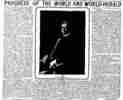
Gilbert M. Hitchcock.
We are all prone to overestimate the importance of the things we do; publishers are apt in the same way to exaggerate the effects produced by their newspapers. For that reason my partiality for the World-Herald perhaps disqualifies me from fairly judging the effects of its labors and its struggles. The World-Herald, however, like all newspapers of any size, is the product not of one man or of one mind, but of a large number and, being only one of these, I feel less hesitation in speaking of World-Herald achievements. I can especially excuse myself because for a decade of the most critical period and most marked success the editorial direction was in the hands of Mr. Metcalfe.
Perhaps the most far-reaching influence of the World-Herald has been in political struggles. When the Evening World and the Morning Herald were united as one newspaper in 1889 no one would have been so rash as to predict that any party or any combination of parties could wrest Nebraska from republican control; yet largely through the influence and by means of exertions of the World-Herald, Mr. Bryan was elected to congress in 1890 and again in 1892. Largely through the influence and by the great exertions of the World-Herald, as has been already stated, James E. Boyd, the democratic candidate, was elected governor of Nebraska. Largely, also, through the influence of the World-Herald a great coalition of democrats and populists was formed under the name of fusion, which swept the state in several successive elections. In this way were elected several governors and minor state officers, several state legislatures, one United States senator, half of the congressmen of Nebraska and even a majority of the supreme court of the state. This arrangement made it possible for Bryan to take the state away from McKinley in 1896, and, although this political wve has subsided and Nebraska has again returned to the republican fold, it is not too much to say that a very material change in the political sentiment of the state has been brought about.
I shall not undertake to enumerate what this newspaper has accomplished in promoting the business interests and developing the city and state. These labors have only been such as any newspaper should perform that fulfills its duty to its constituents. Perhaps I ought to say a word about some of the men and women who on the World-Herald have earned and enjoyed a wide reputation. As I look back to the early days of the Evening World I recalled a man whose dialogue humor gave to the paper a national reputation. In appearance, Foster (for that was his name) was a poor, forlorn creature, with a struggling remnant of what had been a red beard, with a gaunt and haggard countenance and with an emaciated body. In the presence of anyone he was ill at ease and timid, taciturn in conversation and retiring in disposition; but his dialogue humor, which for a number of years appeared regularly in this newspaper, was quoted throughout the length and breadth of the land and gave to the Evening World a national reputation as a funny paper. He is dead and gone a number of years ago. Many people will recall R. B. Peattie and Elia W. Peattie, his wife. Mr. Peattie, as managing editor of the World-Herald, introduced a number of metropolitan ideas in Omaha journalism, but it was Mrs. Peattie who became best known to the people of this city and state because of her brilliant and original work upon the paper. They left the World-Herald for a wider field, and Mrs. Peattie has, a writer of magazine stories, at the present time a wide reputation. More also will recall Carl Smith, that odd and erratic genius whos funny stories in the World-Herald often made the whole town laugh in chorus. Carl Smith afterward attained prominence in Chicago and came to an untimely end in accidental drowning. Fred Nye, now of New York, and Mrs. Kinkaid, now of Milwaukee, established high reputations. Then there was Will Manpin, whose work, covering a number of years on the World-Herald, gave him a state reputation, which he still enjoys and is still adding to in another field. Then quite recently there was E. O. Mayfield, writer of children's stories under the name of Rex M., and not only a writer of children's stories, but, in fact, inventor of a system of children amusement.
This by no means completes the list. Many others could be mentioned, not all of whom were so well known to the readers of the World-Herald, but whose work upon the World Herald was important and valuable.
I believe it is proper for me to say, without disparagement of other newspapers or other newspaper staffs, that at the present time no paper in the west has a staff of able or stronger men than the World Herald.
It has been my belief that the success and popularity of a newspaper depends largely on the character and caliber of the men who do the work on the paper--not only the writing of editorials and the directing of editorial policy, but that the high trade must be maintained in the sporting department, in the political department, in the commercial and in every other branch of reportorial work, and I think I am not overstating the case when I say that the men and women employed upon the World-Herald are the pick of the state, and that in the whole west not an equally strong staff can be found on a paper of this size.
The business growth of the World-Herald has been considerable, taking into account the competition that had to be met and the field in which it had to grow. During the year recently closed the average circulation of the Daily and Sunday World-Herald per day was 34,862 copies. The World-Herald uses over three tons of bank paper per day and gives employment to over 100 people, besides hundreds of correspondents and many carriers. It circulates over a wide field and enjoys a national reputation. It carries a larger amount of Omaha advertising than any other paper and guarantees to return to users of its want ads twice as many answers as any other paper in Omaha. It does a business of almost $900 per day, and it is, in fact, one of the largest business enterprises of the state. When I look back to the small beginning oft eh Evening World in 1885 and compare it to the present proportions of the World Herald; when I recall the fierce struggles and the long, protracted efforts that were necessary to bridge of the past twenty years and bring the enterprise to its present position, I am sometimes surprised as well as gratified at the progress. I certainly would not like to live the life over again. GILBERT M. HITCHCOCK.