
146
and bands were lost in the Agricultural Building.
At the agricultural exhibit the Governor made a few remarks, declaring the exhibit open and regretting the absence of that staunch Nebraskan, the Hon. J. Sterling Morton, Secretary of Agriculture, who had promised to be present but had been detained in Washington by business. Then
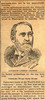
[Drawing] GOVERNOR LORENZO CROUNSE
the formal proceedings for the day were over.
Nebraska Keeps Open House
Nebraska's home at the World's Fair is a "wide-open" house. By that must not be understood an establishment where the guileless are persuaded to "place a trifle on the red," but a big hospitable residence where the stranger is always welcome and all are at liberty to come and go. It is a roomy building, covering 6,000 square feet
147
of ground, with just double that amount of floor space.
To find the Nebraska Building enter the grounds at the Fifty-seventh street gate and cross the bridge. On the left is a squarely built but handsome structure of the Corinthian order of architecture. West and east it is approached by wide porticos with broad step. Up and down these steps pass every day hundreds of Nebraskans, for the Fair is already proving an irresistible attraction to the citizens of the Western State.
The building is equally devoted to the purpose of an exhibit hall and a club-house. The greater part of each of its two floors is occupied by one room. In the lower a large cereal exhibit is made by the counties. Above the ladies of the State have contributed the greater part of the decoration and exhibits.
Nebraska is indebted more to its ladies than its men for interesting exhibits in its State House. Under the active generalship of Mrs. M. Allen Bock of Omaha, their President, they have brought together a remarkable number of well-chosen and tastefully executed articles. Many of these have gone to the furnishing and decoration of the reception room. In this a cherry mantel-piece, carved by Mrs. Nesbit of Lincoln, Neb., for Pawnee county, is noticeable; also an oak table and a hall-rack, carved by Miss Barbour of the State University, for Norfolk and Seward counties. A curtain that hangs before one door is made of corn-grains, colored and strung, in the pattern of the American flag. A frieze of corn puppies around the room is the work of Mrs. Morey of Hastings.
The best exhibit in the whole building is undoubtedly made by the Nebraska Ceramic Club and a few china-painters outside that organization. Special notice should be taken of a portrait by Mrs. Vance Phillips, and vases by Mrs. J. H. Withers and Mrs. Lund. Mrs. Lombard of Fremont makes an individual exhibit which is remarkably rich in design and coloring. Without doubt the china-work in the Nebraska Building will open the eyes of a great many visitors, who would otherwise scarcely believe that some of the best hand-painted china made in America comes from that State.

148
Daily News June 9th/93
Rain-in-the-Face There.
Two swarthy Indians, gay in war paint and feathers, held a levee in the North Dakota building this morning.
Rain-in-the-Face, famous in the annals of Indian fighters, smiled peacefully at all comers, while Curly, the scout, sat beside him gazing stoically at the admiring small boys. A voluble interpreter told the old story of the Custer massacre, where both the Indians figured, and the ore or less noble red men, seemed to enjoy their popularity.
149
Exercises in the Open Air.
The procession moved to the east front of the building, which is just a block from the entrance, and Joseph Garneau, Jr., the executive commissioner for Nebraska, escorted the governor and his party inside. After a brief reception the governor and the rest walked out to the south balcony on the lawn, in front of which “Buffalo Bill's" band was blowing out national airs and the cowboys and Indians were doing antics that delighted the assembled crowds. It was almost a perfect day for an exercise such as Nebraska's people had planned, and they were wise indeed in having it out of doors. Their building could not well have held the crowds in attendance, while there was ample room for them all and fresh air and cooling breezes on the lawn.
After the introductory number by the band Commissioner General Garneau made a brief address of welcome to the assembled guests and turned the building over to Governor Crounse. The governor's address of acceptance and congratulation on behalf of the people of Nebraska was entirely impromptu. He complimented the commissioners on the successful completion of their work and the completeness of the exhibit which they had collected to represent the state and then formally declared the building open, bidding all Nebraskans to consider themselves at home and be welcome and to bring their friends. There was a loud cheer for the governor when he finished his address, and the Nebraskans in the grounds accepted his welcome and did feel at home.
Other brief addresses were made by Congressman W. J. Bryan, Ex-Governor Furnas and others, but they were all limited to five minutes, Nebraskans being fonder of other things than of oratory.
Procession About the Grounds.
At the conclusion of the speeches, which wound up the programme proper, began the procession about the grounds, and this was the feature of the day. Nebraska wanted to show the Infanta Eulalia what western American people looked like in the early days of the country. And they did so. "Buffalo Bill" was the chief figure in the parade. He rode a handsome horse at the head of the whole business, and after him came the military guard escorting the governor and his party, and then the cowboys, and the Indians who held high sway in Nebraska when the state was younger than it is now. It was a great parade, including the highest and most humble people in the state, and they all enjoyed it immensely. It was great fun for the Indians, who always like to get out of their camp and over among the great palaces of Jackson Park. And there were some famous old red faces in the line. Rain-in- the-Face, the warrior who won such a name in the Custer fight; Rocky Bear, young Red Cloud, Plenty Horses, Standing Bear and all the rest of the big fellows were there with their squaws and papooses.
150
Reviewed by the Infanta.
This queer-looking procession marched up past the lagoons to the administration building, where the Spanish infanta was looking out in the court of honor, and passed in review before her. She waved her hand gracefully to them, and the redmen, conscious that some great favor was being shown them though not knowing exactly what is was, cheered vigorously in their peculiar way in return. From the administration building the procession moved over to the agricultural and there dispersed, many of the party going inside to see Nebraska's fine display of the state's principal products.
Nebraska's building is one of the unpretentious ones at the fair. The idea has been to provide a place where residents and the state can drop in to eat their lunches and be at home. The style of the building is colonial. The architect is Henry Voss, of Omaha, and the structure cost $15,000.
State Building Pleasantly Situated.
It is surrounded by trees and shady lawns and as comfortably situated as any state house in the park. Inside the walls are decorated with grains that are grown in the state, woven into pretty designs. In the center of the lower floor is an exhibit of beet sugar, the production of which is a source of great pride to Nebraskans. On the upper floor there is an assembly hall, part of which is curtained off, ordinarily, as a lunch-room. From the platform in the hall Mrs. Caroline W. Brooks, "the greatest butter artist of the world," gave an exhibition of her skill as a butter sculptress after the exercises to-day. She formed the arms and seal of the state and other figures in butter of her own make.
About the walls of the assembly-room are several well-executed pictures in oil and water colors, examples of Nebraska art. The building as a whole is home-like and cheerful and one which Nebraska visitors to the fair will be glad to see.