
121
Chicago Daily News June 3/93.
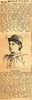
Little Annie Oakley, who is such a remarkable feature of the "Wild West," was once induced to star in a soubrette role of the daring border order. She evinced decided talent in this venture but was managed with rather provincial and very unsuccessful methods. She made a great hit in the part written for her. All her wonderful gift of aim and dead-shot rifle work was made the main attraction of the piece, but she likes the tent show better. She lives at hotels, but has her own private tent at the Cody show most beautifully decorated and comfortable as a parlor. It is carpeted with a cheery red brussels, has lounges, couches, rockers and satin pillows galore. The prairie canvas is ornamented with favorite pictures, stacks of guns, powder flasks, buffalo horns and a thousand relics and souvenirs of her triumphs everywhere. She has casks of delicious wine sent to her from England
(IMAGE) ANNIE OAKLEY.
and though the charming little gunner does not care for the vintage luxuries herself, she is cordial enough to insist upon everybody who calls tasting the harmless and rich English wine. She is a soft-voiced, gentle little lady, with simple manners and brightest intelligence. She tells of her wonderful travels with vivacity that is fresh and breezy as an Indian hunt. She owns houses, lands and bonds in plenty, but is wedded to the exciting life of which she seems to be so charming a part. Rainy days she does the same act as when the sun is out for pleasure. She has a saucy dress of scarlet plush and embroidered buckskins that stand all weathers and she dons this and dances herself over the vast lawn where the soldiers prance, swift as a winged kite. She is a tremendous card in the great show and a delightful woman personally.
122
THE CITIZEN, SATUI
you know, and will not down. This is a poor consolation enough, but it is consolation.
BUFFALO BILL'S EQUINE EXHIBIT.
Buffalo Bill's Wild West exhibition, adjoining the World's Fair grounds, is the paradise of those who wish to behold the poetry of rough riding. There is also some smooth riding, but the rougher kind sways the mighty multitudes that muster in the huge arena ruled by the picturesque frontiersman, who has succeeded in preserving for the eyes of the rising generation stirring realism that cannot exist within the natural years of strong men now living. Colonel Cody has entitled to credit--even gratitude- for this, because, although his exhibition is a thing of profit, no man, woman or child who visits it can deny that the heart-moving spectacle is worth ten times the amount paid for the privilege of beholding it.
The scene, on ordinary days, at the Wild West Coliseum is inspiring enough, but, on extraordinary days, when there is a national holiday, when the sun shines fair, and the breezes blow healthfully, the vast array of humanity that awaits the opening of the exercises, carries the mind back to the days of pagan Rome, when the soil of the arena drank plentifully of the blood of man and brute, "in one red burial blent."
Fortunately there is no vital stream to redden the earth of Buffalo Bill's stamping ground because only friendly rivalry dominates his territory, and "the neighing steed, and flashing blade, and bugle's stirring blast" mean only the semblance of glorious war, although they carry with them all its splendid associations without its gory horrors.
123
In order to fitly appreciate the glorious achievements of progress and civilization on the American continent in testimony of which the great, Columbian Exposition now stands as a monument, it is necessary to consider in contrast the earlier days of American history on the frontier and to know the types and characters of people which Columbus found when he landed. Through the active enterprise and business courage of Col. W. F. Cody and Mr. Nate Salisbury, it is now made possible for all visitors to the World's Fair to see the actual living descendants of the people who, timorous and hesitating, greeted the great discoverer when he first set his feet upon American soil. The Indians who take part in Buffalo Bill's exhibition of the Wild West are not actors in any sense of the word; they present Indian life, customs, mode of warfare and manners, of social amusement as they actually live them at home. That they are now here, living in peaceful, almost fraternal intercourse with the "palefaces," whom they so long regarded as hereditary foes, is due to their recognition of the personal powers, integrity and magnetism of the scout, guide and frontiersman, Col. W. F. Cody (Buffalo Bill). Visitors to the World's Fair can better appreciate the exhibits of science, art, literature and civilization after first seeing the types of people who were the only inhabitants of America when civilization reached out as a conquerer to place the sign of progress on her shores. The Wild West is a most appropriate annex to the World's Fair and should be seen in connection with it. Means of transportation are ample and convenient, as all railroads going south take their passengers to the very gates. Two exhibitions are given daily (Sunday included) at 3 and 8:30 p. m., rain or shine.
A NEW RICHMOND IN THE FIELD.
June 4 sees the ERIE LINES place in service two more trains. Both solid; running through; no change. One to New York, leaving Dearborn station 10:00 a. m. daily; the other goes to Columbus, O., 7:45 p. m. every day. Pullman sleeping-cars on both.--Adv.
Chicago Daily News June 3/93.

124
Chicago Tribune 6/4
The Proposed Cowboy Race.
Mr. John G. Shortall, President of the Humane Society, has addressed the following letter to Mr. Harvey Weir, manager of the proposed cowboy race, which speaks for itself:
CHICAGO, May 27, 1893. - Mr. Harvey Weir, Secretary, Chadron, Neb.-Dear Sir: May I ask your attention to the following law: "Whoever shall be guilty of cruelty to any animal in any of the ways mentioned in this section shall be fined not less than $3 nor more than $200-viz.:
"First-By overloading, overdriving, overworking, cruelly beating, torturing, tormenting, mutilating, or cruelly killing any animal, or causing or knowingly allowing the same to be done."
(Rev. Stat. III. Crim. Code-Chap. 38, Div. 1, Sec. 78.)
See also city ordinances (Chicago, 1890), Sec. 2,199, in which the same law is enacted.
Well - know veterinary surgeons state to me, and will testify if necessary, that it is not possible to make a contest of endurance and speed between horses for fifty miles, much less 700, continuously without the infliction of great suffering upon the contesting animals.
When this fifty miles is increased to 700 it appears to this civilization of ours to be most cruel and intolerable. But when, as it is reported, in the present proposed race from Chadron to Chicago, the result to be attained by the contesting men is a little éclat and $1,500, all this long procession of struggle, agony, and death not only appears most unjustifiable but it clearly demands he enforcement to the uttermost of the laws violated.
Such violation of law being from hour to hour arrest after arrest of the same individual can and will be made. I may also add that all conspirators in and abettors of such violation of the law will be arrested as found and punished equally with the principals.
And now having discussed the legal side, may I venture a word of pleading upon the moral side of the case? The long distance race run last summer between Berlin and Vienna-a matter of, I believe, some 300 miles-in which many noble animals were ridden to death, has aroused a feeling of indignation throughout the civilized world-England, France, America, universally; Germany and Austria as far as they openly dared- and when it was declared in some of the newspapers some months ago that a similar race was contemplated here the protest against it was expressed with most emphatic force. That our country, claiming to lead the way in the humanities, should never be disgraced by such a spectacle- these are the words; and this society has been called upon by nearly every State in the Union to interfere.
Now, I beg of you, gentlemen, to listen to this voice, no matter whether you know it to be right or deem it to be wrong. Give up this race like kind gentlemen and good citizens-it is easy for men who are brave and manly to withdraw from a false position-and come to us, see our great epitome of the civilization of the age in such a way that we can welcome you, shake hands with you, and admire you. Yours truly,
JOHN G. SHORTALL, President Illinois Humane Society.
125
Chicago Herald
June 4, 1893.
from their ranches for this especial visit to the world's fair, and the detachments of cavalry from France, England, Germany and the United States are detailed on special service. At the Wild West may be seen all these different types of international interest, living over, for public enlightenment, each day their lives and duties as they are at home and when on duty. The scenes depicted are real occurrences and the actors are the very people who enacted those scenes. They are not actors hired for the purpose, but are the very people themselves, and are simply repeating in public the acts they have performed in actual life and service. Every railroad going south takes its passengers to the gates, and there are two entrances provided, one at Sixty second street and another at Sixty-third street.