
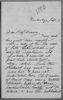
71
1880
Cambridge, Sept. 7
Dear Prof. Bessey,
Your card has just been received. I send a copy of the "sea-weeds of Salt-Lake" which is of slight importance and of which I received at first but about half a dozen copies. [Twice?] then Packard has sent me more but I have not distributed them. The diseases of forest trees was a lecture delivered before the Mass. Horticultural Society and I believe it has been published
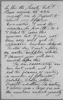
72
by the the Society but I have received no copies myself nor do I expect to receive any. Of Algae exsiccitae, I send the circular for [pass.?] III. no. 4. I hoped to issue this summer but I have not been very well and its appearance has been delayed. The other day I sent a [paper?] on water supplies which I presume you will have received before this.
The Am. Association was here last week and I had the pleasure of meeting a number of botanists, Halsted, Dudley, Arthur, Burrell, and others. The meeting I believe was a large one and the numbers seemed generally
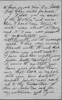
73
to have a good time. On Saturday Prof. Gray sailed for Europe.
I wrote you on recieipt of the "Botany" and since then I have been trying to write more about it. Having read it I am now prepared to congratulate you intelligently on its successful issue. I was very much pleased with it and think it does you great credit. I have read the [cryptogamic?] portion pretty thoroughly and it seems to me that you have gone farther than any text-book in English and you have brought several points more nearly up to the [times?] than is done in [?]. You ask for my criticism and I give
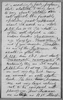
74
it accordingly freely, prefacing that whatever I may have to say about details does not affect the favorable opinion just expressed about the work as a whole
p. 218. lines 20-23. The sheath is often well defined in other orders besides Scytonemaea e.g. [?], Microcoleus, [?] and if your consider [Sirosiphon?] as one of the Scytonemaea the sheath is often thin.
p. 220. lines 1. & 2. How about Macrocystes, Nereocystes, [?] certainly they are not simple.
p. 265 lines 23 et seg. The Fucaceae are not very long lived. Many are annuals or still shorter lived. The true [sic.] Fucaceae are not very large certainly not to be [compared?] with [?]. Few Fucaceae are as long as 10 ft although

75
some are really considerably larger.
268. paragraph (b) The [?] are not related to Fucus but to the Zooporeae. Their zoospores are well known but no zoospores have been found. See also p. 339. Under Zoosporeae you have placed [Ectocorpeae?], [?], [?], & [?], all of which belong to the Phaeosporeae! In what sense do you use the term Phaeosporeae as a subdomain of [Zoopores?] lower down? [Liphonaceae?] [?] included Vaucheria which is oosporic, but where do we find any facts to show that the [Sephonaceae?] as usually understood at present belong to the Oosporeae?
p. 277. You might have said under [?] that [?]