

67
BUFFALO BILL
AT HIS OLD LEAVENWORTH HOME.
Shaking Hands With Scores of His Old Friends- Some Startling Events in His Career Recounted- His Performance Last Night.
Hon. W. F. Cody, better known as "Buffalo Bill," was met at the Continental hotel yesterday afternoon by a TIMES reporter, and a most pleasant conversation ensued.
Mr. Cody was dressed in a blue-tinged suit, with a cut-away coat, and wore his old favorite wide-brimmed, cow-boy hat. He, without any display, wore a heavy gold neck-chain, from which was suspended near his left vest pocket a huge gold horse-shoe, set with diamonds. His scarfpin is a solid old gold representation of a buffalo-head, with diamonds for eyes. His hair is long, hanging down to his shoulders, and is brown, almost dark enought to be called black.
He looks every inch the bold scout who was so vividly pictured by Ned Buntline, but is more of a gentleman than that well known writer gave him credit for; yet he is the same in nearly every respect in appearance as in his boyhood, daring, reckless, whole-souled and generous. He clings to his old-style hat, and when among the boys snaps his fingers and says "what are you going to have?" with the full heartedness for which he was always noted. His purse, which is well filled, is as free as his rifle was when he was a scout, suffering the privations of cold and wet on the plains, when the snapping of a twig or the creaking of a bough made slumber uneasy, and caused a blanket to be cautiously raised to look for a murderous Indian.
The conversation, in substance, was as follows, including interruptions, some of which were of a pleasant nature:
"When did you first arrive in Leavenworth, Mr. Cody?"
"In 1854, I accompanied my father and s ome officers from Fort Leavenworth in a wolf hunt, over the ground where the city now stands. I was a bit of boy then. We 'raised' the wolf in what is now...
(Right Column) ... landmarks were talked of on the old hills where Mr. Cody, as a boy had herded cattle the old post-office site on Delaware street and social affairs, here the Scout with considerable pride, spoke of a visit to his Nebraska ranch by his nephew Willie Goodman, who lives at Valley Falls. "yes" he said "he came to my ranch and staid quite a while, I gave him a gun and a coulple of ponies and started him out. (Willie shook hands with him an hour afterward.)
Resuming his conversation with the reporter he said:
"In 1876, I was imployed as a scout, by Gens. Crook and Terry. I was only thirty-five miles from Gen. Custer's command when he was killed. On the 17th day of July, 1876.
I HAD A DUEL
with Yellow-Hand, on War-Bonnet creek, in Dakota, and killed him. In the spring of 1877, I went into the cattle business, with Maj. Frank North, chief of the Pawnee scouts, and located at North Platte, Nebraska. I am now in the stock and real estate business. I like raising cattle and horses betrer than the stage, and will turn my attention to that branch of business after the next two years."
"You have made money in the theatrical business, have you not?"
"Yes, I have cleared $40,000 a year for five years. I made $56,000 one year."
"Have you much of a stock farm?"
"The firm of Cody & North, has 6,800 head of cattle and 400 head of horses. Our ranche is sixty-five miles northwest of North Platte, Nebraska, on Dismal river. Maj. North attends to the ranch while I am absent in the show business. My family lives at North Platte. I shall play only in the larger cities in the future, and will not go further west than Topeka this trip. I have had a brilliant offer.
TO GO TO EUROPE,
but I contend that a man can make more money in America, than he can any place in the world. I don't play on the stage or do anothing else for the fun of the thing; I work to make mone."
NOTES Mr. Robert Armstrong, who lives in the city, recalled an incident, yesterday afternoon, where he was with a party on Prairie Dog creek, in 1869, and being on the lookout for Indians, came very near firing into a party of soldiers who had Buffalo Bill in company. Just as the rifles were raised to fire the soldiers waved their white handkerchiefs and saved themselves, after which they joined Armstrong's party.
Buffalo Bill buried his favorite horse "Buckskin Joe," at his ranche in Nebraska, not long ago. The horse was twenty-five years old and had been in many an Indian fight.

68
"In 1854, I accompanied my father and some officers from Fort Leavenworth in a wolf hunt, over the ground where the city now stands. I was a bit of a boy then. We 'raised' the wolf in what is now known as Cincinnati, and chased him to Sim Scruggs' mill, where the wolf was killed. Sim didn't like it much, but we got away with the game. Father was then a contractor at the fort, furnishing hay for the government. The wolf chase was only a short time after the bill was introduced which admitted Kansas into the union. Weston, Mo., was a big town then. My Uncle, Elijah Cody, had a big store there. He afterward came to Leavenworth, and, in partnership with a Mr. Apt, had a grocery store on Main and Cherokee streets. My home at that time was in Salt Creek valley, where I lived for a long time. My father died there in 1857, and my mother died there in the old homestead in 1863. They were both buried at Pilot Knob, and I am going with my sisters Sunday,
TO VISIT THEIR GRAVES,
and see that tomb stones are put up. The bodies have been moved twice, but I think I can find the graves. I sent Jim Brown, one of the old-timers, out this afternoon to find the old sexton who buried them. we will all, my sisters and myself, go out to the Knob and find their graves."
Before Mr. Cody could say anything further, a countryman came up to the table where the noted scout and the reporter were sitting, and after looking up and down at the frontiersman asked:"
"Be you Buffler Bill?"
"Yes," Mr. Cody answered.
"I saw Ingins with you to-day."
"Yes."
"Are they real ones?"
"Yes."
"It's the first time I ever saw a real, live Indian. Be you goin' to hold anywhere to-night?:
"Yes; at the opera house."
"It ain't a hall, then?"
"No."
"Will it be with bolted doors?"
"No."
"Be free for everybody?"
"Yes."
The reporter remarker that it would be free for seventy-five cents, or thereabouts, and the scout, with a laughing frown said, "You gave it away. It's the best thing I've seen for many a day."
"I was just looking at your long hair," said the countryman, "and was wonderin' ef you was bill. I'm jest a country feller, and jest about think I'll stay in town to-night and see the show."
"Very well," said Bill.
"I reckon it'll be good- sure enough hair-raisin' and all that?"
(Right column) Buffalo Bill buried his favorite horse "Buckskin Joe," at his ranche in Nebraska, not long ago. The horse was twenty-five years old and had been in many an Indian fight.
The Prairie Waif.
The opera hous was crowded, last evening, with an intelligent audience, who were delighted with Mr. Cody's new play, the "Prairie-Waif."
There is not much in the play that is deep, it being one of "Bill's" wild, harem scarem adventures, with the pathos thrown in by the author, who could have made it much more realistic, expecially as regards the military part of it. "Bill," however, was Bill Cody, and no writer of a play will make him anything else. His rifle shooting during the play was very fine. His duel with Yellow Hand was very exciting, and the rescue of General Brown's daughter, and the appearance of the boy's in blue with the stars and stripes upon the scene made a fine tableau. If ever Jule Keene comes to this part of the country again in the role of a Dutchman he must bring a suspender insurance company with him make an afffidavit to the effect that he won't make people's sides sore any more. His Hans was simply immense and his "Jeremiah," "Woa Jermiah," brought down the house every time. It was for a time guess work as to who made the most fun, Jerry, Hans, or Miss Nellie Lingard, as "Sadie." The Indian dance was true to life. Miss Jennie Gilbert, as Onita, won the hearts of all by her artless manner of acting. Wilson Charles as Captain Russel made many friends. Taking it all together the play, though light, was well received and was very enjoyable. Mr. Cody has many old friends in the city who are pleased with his success.

69
"Sure enough." -and the man went away, after giving him an admiring glance at the long "ha'r" of the scout.
Looks were exchanged between the reporter and Mr. Cody; each repressed a smile, and the conversation continued:
"How many of your relatives will be here to meet you and accompany you to Pilot Knob to-morrow?" the reporter asked.
"Those who are here are my sisters, Mrs. Julia Goodman, of Valley Falls, Mrs. Eliza Meyers, of Jackson county, and Mrs. Nellie Jester, of Jackson county. Mrs. Mary Bradford, who lives in Denver, will not be able to meet with us."
"Will you remain long in the city?"
"We shall all spend several days in the city, visiting old friends. You see, my father was the first settler who crossed the Missouri river to make Kansas his permanent home in 1853."
Mr. Pryzbylowicz, who is an old resident, joined in the conversation, and stated his experience of killing his first deer on the ground where a soap factory stands, in 1852, and talked of his acquaintance with Mr. Cody's father. He mentioned the growth of the city, from the time its first house was built until the present time, and had much to say of its ups and downs.
Mr. Cody, in continuing his conversation with the reporter, said:
"I went to work with Majors & Russell, who were freighters at first, and herded cattle for them all over the hills around the present city. I crossed the plains for them in 1857, and afterward bull-whacked it and rode pony-express for the firm until they failed, in 1861. I then went to work for the government. My mother was then keeping the Valley Grove house, as a hotel, in Salt Creek valley; a house which she kept for a number of years. I was in the Seventh Kansas in '44, and was discharged in 1865.
In 1866 I drove stage, and was married in that year. I had steady employment until the fall of 1872, after which I was made chief of scouts of the department of the Platte. There's where
I FIRST BEGAN
my theatrical life, which I have followed every winter since. The first winter was that of '72-73. In 1872 I organized the Grand Duke Alexis buffalo hunt in Nebraska, and was with the party all along as a guide."
Here, Mr. Thomas Leonard came up to shake hands, having been an old-time friend of Mr. Cody, and a side conversation occurred relating to old times. Visits were planned and old incidents recalled. Old names were brought up, and eagerly enquired for by what we may call the citizen-stranger. The old...
70
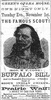
GREEN'S OPERA HOUSE
ONE NIGHT ONLY.
Tuesday Eve., November 1st.
THE FAMOUS SCOUT!
(HON. W. F. CODY) BUFFALO BILL
And his Mammoth Combination. A Genuine Band of SIOUX INDIAN CHIEFS, Buffalo Bill's New Drama,
Prairie Waif! A STORY OF THE FAR WEST.
Reserved seats 75 cents, for sale at Tindolph's. W. F. Cody..................c............Proprietor and Manager Josh. E. Ogden...............................Business Manager