

106
A WORD WITH THE WOMEN
(By Elia W. Peattie)
The women's Easter edition of the Enterprise is very interesting, indeed. It covers a wide range of subjects, and is written simply and unaffectedly, which is saying a good deal, as many of the contributors are novices in the matter of writing for the press. Like the women's edition of the Bee, it lacks humor. Women are too horribly solemn to make up a sheet which will stand every day rending. It's all very well once in a while, and the women certainly display remarkably good sense, use dignified English, and advocate lofty reforms. But they are wearisomely grave. The Enterprise is no more so than every paper issued by women this last twelve month. It is, in many respects above the average of women's papers in interest, for it chronicles the development of a race that a little over a quarter of a century ago was in shackles. The women who write so gracefully and so sincerely, are the descendants of slave-women, who know no form of personal liberty, and whose education depended upon the casual service performed by some little white child who, if his heart moved him, might instruct his nurse in the alphabet. All women in this city should read the Easter edition of the Enterprise. It fills one with a deep optimism, it convinces one that there is no night so dark, it will not see the dawn, no storm so terrible that calm will not follow."
The Chapel of the Carpenter, is the one church, as everybody in this town knows, which has found its way down to the Bottoms. The people, who, by reason of their poverty, are practical outcasts in other places of worship, may kneel here, and worship, free from chagrin, or shyness or sense of being patronized. No Christian work in the city has more reed of preservation. Yet perhaps no work receives less support. There are to be three entertainments at the First Congregational church for the benefit of the chapel. The first lecture was given last night by Mrs. Keysor. The second is also a lecture, and will be given April 11 by Rev A. Holden Byles, on 'The Life and Writings of Charles Kingsley" Mr. Byles enjoyed the friendship of Kingsley, and his lecture will therefore have that charm which attaches to the words of a friend. The last entertainment will be April 20. It is a miscellaneous entertainment called, 'An Evening with Tennyson." Miss Van Gleson, the talented young reader, will recite some of the master's most exquisite poems, Miss Irene Byrne, who has won the reputation of being one of the most brilliant women in the Woman's club, in spite of her youth will have a paper. There will be others to assist, and the songs of Tennyson will be sung.
It is the time for gardening. The yards need taking, the sweet peas ought to be put in. The loose boards in the sidewalk should be nailed in place. The odds and ends which will accumilate over winter, need burning. There is almost no excuse for an untidy yard. It does not require money to make a clean yard. It requires merely energy--which is perhaps, the thing some people have the least of. It does not even need a man. In fact, unless a man be accustomed to manual labor, he is liable to weary sooner of work in the yard than a woman. Any woman can use a rake, a small shovel, a hoe and a hammer and this is the best season of the year to show such skill. Omaha looks untidy enough at best. Its ragged clay banks, in remarkable cheese-shaped projections of dirt, its long bare spaces and, at present, its dirty streets, are distressing enough to view. But at least the yards may be tidied.
A boy and girls bicycle free to the boy or girl who can get the most votes in the World Herald's Piano contest.

107
A WORD WITH THE WOMEN
(By Elia W Peattie)
Next Friday at the department of Current Literature of the Woman's club, Mrs. Francis M Ford will read a paper on 'Current Sociological Literature." This department, of which Mrs. Wegla H H. Tracy is leader, meets at 3:45.
There is a funny story of a London club woman who, when reading Macbeth, paused in confusion and begged that she might substitute a word. The president gave permission, and she read with a clear conscience, "Out, hateful spot." Yet they do say the London women are the most aggressive of new women. Certainly, in some directions, the women have temerity enough. They have at present, so London letters say, an affectation of masculine attire which quite passes anything we have essayed here. They have a hair cut that is absolutely masculine, a coat without darts, linen that is bought at the haberdasher's, and, save for the skirts, a costume which in no way differs from that of men. Theres is no use in scolding about anything of that sort. If the London women want to look like guys, they may. A good many of them always looked that way at any time. In fact, come to think of it, some of them wear feminine garments so badly that it may be just as well if they don masculine ones. On the other hand, some English women have a look of distinction and style which the most dashing American might have difficulty in rivaling. They seem to go to extremes--to be either slovenly or very smart. And there is a woman who says the slovenly ones are the titled ones--and Jeannette Gilder affirms that you can tell a duchess by her bad manners. Miss Gilder may not be accurate, but she is entertaining.
The most exclusive club in London is the Alexandra, to which no one is admitted who has not been presented at court. What a contrast to our club ideas where democracy is the ruling features. The Princess Christian officiates, although the management of the club is under a committee. The Pioneer is a club of 500 members, which has a famous president, Mrs. Massenberg. This club has an exquisite club house, and the pursuits of its members are esthetic, literary and artistic. The Writer's club is in the newspaper district, and is much more democratic, and perhaps much better fun. The Victorian offers such conveniences to out of town members, that it is very popular and large. The Somerville is largely a debating club. The University club is a club home for university women, and some of its members are distinguished. They have a reputation of being very formidable, intellectually. They do say that this club house and many others contain amusements similar to those which men enjoy in their club houses, such as billiard rooms, card rooms, and smoking rooms. If so, the woman's club idea is rapidly degenerating in London. Here, we form our clubs for the propagation of our virtues and not our vices--however small the vices may be, Mutual improvement and enlightenment, is, however, undoubtedly, the main feature of the women's clubs in London, as it is in the clubs in this country.
By the way, they do say the Woman's club of Omaha is getting very, very Calvinistic. It would be too stupid for words if the club should degenerate into commonplaceness. It must have wit, humor, gayety, a dash of bravado, good stirring discussion, or it will become a more tedious school for grown up pupils. It makes one yawn to think of it.
108
A WORD WITH THE WOMEN
(By Elia W. Peattie)
Miss Dora Cady, general secretary of the Young Women's Christian Association, wishes to correct the statement made in this column that "the evangelical test" is applied in their association here. One is heartily glad to make this correction. The 'evangelical test" may do for men, but women of the progressive type are certainly too large and too tender to hem in their Christian work with a barbed wire fence."
Mrs. Clara E Rice of Neligh, Neb, has written the words and music of a song on corn.
Like all great persons, Frances Willard continues to grow. She has concluded and said that she believes poverty to be at the base of temperance as frequently as intemperance is at the base of poverty. Miss Willard is getting now at the root of man's misery. If she dares go deeper than she yet has and speak the truth as she finds it, she may bear a message to the world that is indeed worth bearing. Thus far she has only said: 'Do not." In some finer future she may say do. She has made herself celebrated by her negative philosophy. She has it in her power to make herself immortal by a positive one.
Apropos of Miss Willard's new position the Sioux City Journal says.
Miss Frances E Willard has almost wholly changed her notions of "reform" or perhaps it would be more accurate to say that she has radically changed and even reversed her notion of the direction which reform should take. She probably starts still from the base line of her erroneous conception of human nature and of the limitations of reform. She probably still thinks that radical change can be wrought, suddenly or within a short time, in the mortals of mankind--that if this or that system of society, or some particular form of laws, could be established the sum of evil could be suddenly and immensely reduced; Ignoring the fact, as the best minds see it, that laws and social systems are only the cloths which mankind wears only an expression of the inherent qualities of men. But she no longer, as formerly, fixes her hope on the particular legal method embodied in a law prohibiting the self knowing the extent of the change. For time, and it was not many years ago, when Miss Willard believed, or seemed to believe, that such a law would relieve mankind at least in such a society as that of the United States or of a state separately, of a vast amount of poverty, crime, vice and waste. We say that she seemed so to believe, because she emphasized this point with great energy, and indeed in politics treated it as the paramount one, endeavoring to base a political party on it alone. It was the substance of all her appeals, the objective of all the organized efforts which she championed. It is to be acknowledged with great eloquence, persistence and ability. But now Miss Willard clearly shows that her views have radically changed perhaps without herself knowing the extent of the change. For example she now urges that the term prohibition party be discarded, and the name 'home protection' party adopted in its stead. That this change is significant of far more than a mere matter of tactics is clear from the fact that Miss Willard now proposes a program of remedies in which prohibition of the retail sale of liquor for drink is no longer paramount, but only one among many other remedies. In her recent public utterances she now classes as causes many things which she formerly treated as effects. In several of her recent addresses she has emphasized the point that poverty is at least as important a cause of intemperance as intemperance of poverty, with the suggestion, it would appear, that she is headed towards the view which allots a far wider scope to poverty. She has even indicated her acceptance of the formula of Henry George, and thus has gone from prohibition to poverty and from poverty to the single land tax, to the extent at least of basing her home protection party upon these theories, and upon what other economic and moral tenants nobody knows and perhaps herself could not tell Miss Willard has not abandoned prohibition indeed, for she still insists upon it. But she has abandoned it in the sense in which she held and advocated for many years. She necessarily abandons it in the sense when she accepts alongside of it these other propositions of social and economic reform.

109
A WORD WITH THE WOMEN
(By Elia W. Peattie)
Lena L Wilson, who conducts an interesting column in the Progress, accuses me of being on the fence in regard to the color question which has arisen in the Women's club I am surprised that one of Miss Wilson's race should do me that injustice. I do not wish to see the clubs injured, divided or destroyed by any question - they could certainly be of but little use to any one in such events I recommend patience, and Miss Wilson will learn in time that patience is best I am not on the fence in regard to the color question I make that statement without reserve or qualification I am the daughter of abolitionists, who suffered to the death for their principles, and every extreme of belief which was theirs is mine, though I might not have the courage to do what they did- and certainly may never have the opportunity to do anything sacrificial. But because of all this I am not therefore indifferent to the ideas and prejudices the principles and preferences of other women in the club, who may not agree with me, and who have as much right as I to hold their views I seldom reply to or notice any remark of any adversely critical nature made concerning the work in this column. But Miss Wilson labors under such a misapprehension that I must undeceive her I stand always have stood and always will stand for the breaking down of all race distinctions.
The News-Republic which is published by two very delightful young men who are having a hard time of it, and who are taking their hard time courageously, objects to my remarks about Edghill, the little Western Union boy who rode his wheel till he was worse off than any prize fighter who ever emerged from the ring. The strain he endured was of a more serious sort than that to which prize fighters subject themselves. A number of men saw him during and after the race, and since he has been able to crawl about the streets have sustained this view of the case. I do not know just what the News-Republic said, for I have never seen the News-Republic. I hear, however, that it is rather a clever sheet, and I wish the two excellent young men would send me a copy when they disagree with me Incidentally I wish to remark that no charge is made for this advertisement.
While at this sort of thing, the slate may as well be cleared. An attorney has written me saying that I have been unjust to Mrs. Chapple. No one would be more unwilling than I to be unjust to any woman-especially in an hour of stress and misery. But the attorney and all others who think I may have been unjust are respectfully referred to Mrs. Chapple as evidence on the stand I have more respect for the woman who falls herself, through passion, love or madness than for the wife who will listen to her husband a tale of conspiracy to ruin and defraud another woman, when the wife is to profit by those actions. The attorney who writes claims this is an instance of woman's inhumanity to woman. May not a woman criticise a woman as mem criticise men? This column has always been devoted to the highest interests of women, so far as might be. But it is no question of sex which implies me to resent such an act of despicable weakness. One cannot be deterred from the condemnation of weakness or cruelty because the person guilty of it is a woman.
3000 No. 2 Smith-Premiers sold before they are fairly on the market. The only ball bearing typewriter.
THE RED OAK RACES.
Special Train Via the Burlington Route Tuesday, June 25
Leaves South Omaha 9 a.m. Omaha 9:15 a.m. Reaches Red Oak in time for dinner
Tickets only $2.
The Red Oak meeting promises to be the most exciting of the year $20 000 in prizes. All the famous trotters and pacers of the country will appear.
Get tickets from W.B. Cheek, agent Burlington Route, South Omaha, at the Burlington city office, 1324 Farnam street, or at the Omaha and South Omaha depots.
Send 25c to the World-Herald for a sample package of the World-Herald baseball score cards. The best and most complete card ever issued. We can furnish them in any quantity at 1 cent each postage prepaid to any address.
The enterprising boy gets his fireworks free by getting some friend or neighbor, who does not take the World Herald, to try it for two weeks or more.
OMAHA AT A GLANCE.
Julius Kaikus one of the two brewers at Atkinson who was at federal court a short time ago, has died from an accidental gunshot.
Anna Chapple widow of the murdered W.H. Chapple has applied for letters of administration to be issued to Ferdinand Meyer. The schedule of property shows that W.H. Chapple had no real estate, but was possessed of personal property to the value of $100.
City Treasurer Ellin this morning received $30 550 of canceled short time bonds and coupons which were paid in New York last week. Tomorrow he will ship to Chicago the $197 600 of short time district improvement bonds purchased a few days ago by E.H. Gay & Co.
Articles of incorporation have been fled of the L.E. Roberts Company. The corporation starts with $5 000 capital, divided into shalts of $100 each the business to be conducted is a wholesale retail coal business. The incorporators are L.E. Roberts E.M. Roberts and F. B. Roberts. L. E. Roberts transferred by bill of sale his coal yards and all property inciting to his coal business to the new company.
110
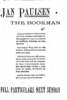
JAN PAULSEN THE BOOKMAN
IN NEXT SUNDAY'S WORLD-HERALD WILL APPEAR THE FIRST INSTALLMENT OF THE PRIZE STORY OF MYSTERY, WRITTEN BY MRS. PEATTIE
THE STORY WILL RUN IN THE SUNDAY WORLD-HERALD DURING JUNE AND JULY.
THE PLOT WILL NOT BE UNRAVELED UNTIL THE LAST CHAPTER, AND THIS WILL NOT BE PUBLISHED TILL WORLD-HERALD READERS HAVE BEEN GIVEN A FEW DAYS TO OFFER SOLUTIONS OF THE MYSTERY.
LARGE PRIZES WILL BE OFFERED FOR THE BEST SOLUTIONS.
FULL PARTICULARS NEXT SUNDAY