
26
30
ORIENTAL WONDERS.
PHENOMENAL PERFORMANCES BY FAMOUS ARABIAN EQUESTRIANS AND ATHLETES.
There are some things in which the Wild East doesn't have to take off its turban to the Wild West, and the renowned troupe of Riffian Arabs right from the scorching sands--with Buffalo Bill's Wild West and Congress of Rough Riders of the World will prove it. Their head to head balancing is a prodigy of equilibristic art, strength and endurance. The nimblest pair of legs could scarce keep abreast of their hand-spring evolutions clear across the great arena. They walk on their hands as though brought up to that kind of locomotion exclusively. They launch themselves in high and hazardous spreads and side-long somersaults over bayonets and
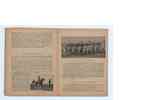
A BAND OF BEDOUIN ARAB ATHLETES.
sword-blades. They tumble as though tossed in the arms of an invisible tornado, and they climb atop one another with their balance and agility of monkeys, until nine of them form a high pyramid, of which one herculean son of the Prophet is the sole base. Meanwhile, and in fact all the while, the sage Dervish of the tribe is making a human tee-to-tum of his respected self, and rotating more rapidly than the double screws of an Atlantic liner. So rapidly and continously does he whirl around with extended arms, that unless he is iron hooped, it is a wonder that he does not burst all to pieces and strew the Oriental scene with santified fragments.
31
THE BUCKING BRONCO.
A PRODUCT OF NATURE, NOT OF EDUCATION.
Did you ever see a bucking circus horse? Emphatically no! Why not? Simply because if he were a bucker he would not only be utterly useless, but positively dangerous in the ring. The horse is naturally an exceedingly timid and suspicious animal, and in breaking him even to harness and saddle use, the trainer must keep these traits constantly in mind. Consider the limited repertory of even the best trained circus horse of any school. He can be taught to do some surprising and pleasing tricks, but there is to him a danger line beyond which neither cajolery nor force can induce him to go. He can no more be taught to "buck" than can a kangaroo to play on a key bugle. No animal can be taught to injure or kill itself, and least of all the horse; the instinct of self-preservation forbids, and no trainer can overcome that power. It would be equally preposterous to assume that any amount of compensation could induce any man in the possession of his senses to train an animal espressly to injure him. There is not a day in the season but that from one to half a dozen cowboys are laid up in hospital as a result of their battles royal with the bucking broncos, while every one of them daily receives maulings, shake-ups and bruises that would invalid men of less rugged physique and Spartan endurance.
Like every other unique frontier, national and international feature with Buffalo Bill's Wild West, the bucking broncos are genuine, from start to finish. They are natural, irreclaimable fighter, and their savage and reckless efforts to throw their riders cannot be corrected. They may be temporarily conquered after a prolonged and often dangerous struggle, requiring extraordinary agility, skill and courage on the part of their riders, but wuth every effort to mount comes a renewal of the contest between stubbornness and instinct on the other side and brains and nerve on the other, and in it the nobler
27
32
animal does not always win the spars. In the performances of the bucking broncos and their cowboy riders it will be noticed that, among all the quadrupedal concentrations of chain lightning no two resort the same tactics of defense. One will permit himself to be saddled and mounted before letting out the pent-up devilry with which his hide is stuffed. Another will quietly submit to be saddled, but that is his limit of sufferance. To still another the very sight of a saddle is a signal of war. This one will start off humping his back like a mad cat, and landing stiffly on all fours with the force of a pile-driver. That one will lie down and stubbornly refuse to budge. Still another will rear and fall backwards with such reckless fury as to sometimes beat out his brains. A fourth will kick, strike or bite, or all this and more too, with a savage viciousness rendering him more dangerous to a tyro than would be a hungry lion. And these are but sample illustrations among innumerable insane efforts to escape the ignomy of bearing burdens. It some instances it will be noted that the bucker seems intent upon injuring his rider only; in others, that he aims to disable himself as well, and, again, that he is frantically bent upon commiting suicide. He is a great natural actor in an equine and equestrian specialty, so full of fiery and furious vim that it is well worth seeing a score of times, and never loses intense interest.
THE VAQUERO OF THE SOUTHWEST.
Between the "cow-boy" and the "vaquero" there is only a slight line of demarcation. The one is usually an American, injured from boyhood to the excitements and hardships of his life, and the other represents in his blood the stock of the Mexican, or it may be of the half-breed.
In their work, the methods of the two are similar, and to a certain extent the name is true of their associations. Your genuine vaquero, however, is generally, when off duty, more of a dandy in the style and get-up of his attire than his careless and impetuous compeer. He is fond of gaudy clothes, and when you see him riding well mounted into a frontier town, the first thought of an average man is that a circus has broken loose in the neighborhood, and this is one of the performers. The familiar broad-brimmed sombrero covers his head; a rich jacket, embroidered by his sweetheart, perhaps envelopes his shapely shoulders; a sash of blue or red silk is wrapped around his waist, from which protrude a pair of revolvers; and buckskin trousers, slit from the knee to the foot, and ornamented with rows of brass or silver buttons, complete his attire, save that enormous spurs, with jingling pendants, are fastened to the boots, and announce in no uncertain sound the presence of the beau ideal vaquero in full dress.
His saddle is of the pure Mexican type, with high pommel, whereon hangs the inevitable lariat, which in his hands is almost as certain as a rifle shot.
Ordinarily he is a peaceful young fellow, but when the whiskey is present in undue proportions he is a good individual to avoid. Like the cow-boy, he is brave, nimble, careless of his own life, and reckless when occassion requires, of those of other people. At heart he is not bad. The dependance on himself which his calling demands, the dangers to which he is not slow in exhibiting the fact that he possesses it, in a sufficient degree at least for his own protection. True types of this peculiar class, seen nowhere else than on the plains, will be among the attractions of the show; and the men will illustrate the methods of their lives in connection with the pursuit and catching of animals, together, with the superb horsemanship which his characteristic of their training.
MEXICAN LASSOO THROWER.
33
PROF. SWEENEY AND HIS FAMOUS COWBOY BAND.
"A MERITORIOUS MUSICAL FEATURE." --London Times.
Not the least interesting and popular adjunct of the Wild West entertainment is the music furnished by the famous Cow-boy Band. This band has always taken a prominent place with the organization, and has received the highest praise from educated musicians, as well as the public, in all parts of the world. It consists of thirty-six cow-boy musicians, each of whom would be considered a soloist on his own instrument, and when combined and playing together under the capable direction of Mr. William Sweeney, their leader, they make music that compels the admiration of the masses. They give a concert before each performance, and incidental music that is a source of pleasure to all who hear it, and are daily greeted with rounds of applause. This band has been the recipient of commendations from nearly all the musical connoisseurs and leaders and members of the finest bands in Europe, Lieut. Dan Godfrey, the leader of the famous Grenadier Guards Band, having presented Mr. Sweeney, after a six months' engagement, in the gardens connected with the Wild West in London, with a solid gold cornet, at the same time saying that the thirty-six members of the Cow-boy Band would produce more good music than any band he had ever heard with even double the number of musicians. For thirty minutes prior to the entertainment this band will give selections of both classical and popular music.
SOUTH AMERICAN GAUCHOS AT THE "WILD WEST."
The latest addition to BUFFALO BILL'S "Wild West" makes the sixth delegation to the "Congress of the Rough Riders of the World," which MESSRS CODY and SALSBURY have orgnized in order to present the different schools of horsemanship the world.
Having seen the performances of the Cow-boy, the Indian, the Vaquero, and, lastly of the Cossacks of the Caucasian line, our appetites are considerable whetted at the prospect of seeing how the wild life on the South American pampas contrasts with theirs.
To the student of human progress, of racial peculiarities, of national characteristics, the Gauchos are a subject of investigation as remarkable as anything modern history has to show.
28
THE BATTLE OF SAND JUAN HILL.
A REALISTIC WAR SPECTACLE OF COLOSSAL SCALE.
Realistic reproduction of this battle which will for ever remain famous in the history of wars, will be one of the features of the programme of Buffalo Bill's Wild West and Congress of Rough Riders of the World.
The central figures of the battle were the now immortal regiment known as Roosevelt's Rough Riders, commanded by the present ruler of America and borrowing the name "Rough Riders" first coined by Col. Cody for his exhibition. It was officially known as the first regiment of volunteer cavalry. It was enlisted when the United States, in response to the call of humanity, determined that Cuba should be free from the goring thraldom of Spain.
The battle of San Juan Hill was the military companion piece to the naval battle of Santiago, and when it fell Spanish rule over the City of Santiago likewise fell. It was mainly made up of the class of scouts and trappers with which Buffalo Bill's Wild West has made the civilized world familiar; many of whom went from its arena to the larger one of the war in Cuba, and have again returned to it, bringing large accession of their intrepid comrades and scores of their broncos, to give additional interest and verisimilitude to the introduction of a lifelike, effective and vivid facsimile of the crowning and conclusive incident in
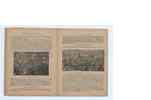
FAMOUS FIGHT OF SAN JUAN
where, to the utter amazement of the military world and in valiant reversal of all accepted tactical authorities, a thin line of infantry, unsupported by artillery, charged upon and routed a superior force, strongly entrenched on a difficult eminence behind artillery protected breastworks and armed with the dreaded Mauser and smokeless powder. An important factor, too, in the successful presentation of this spectacle is the fact that both Colonel Cody and Mr. Nate Salsbury are war veterans, thoroughly familiar, through severe experience, with the war in its sternest practical features, and fully competent to manage the large number of men required and utilized, to the plain untilled reality of actual war.
A SCENARIO OF THE SPECTACLE
The events associated with the battle of San Juan will be presented in two scenes, in the first of which the bivouac of the troops on the road to San Juan the night before the battle will be shown.
THE INVADING AMERICAN FORCES,
composed of the artillery representing Grimes' Battery, the mule pack train carrying ammunition, the U. S. Regulars. Roosevelt's Rough Riders, the 71st Infantry, the Cuban scouts and guides to seen at sunset, at the conclusion of a desperately hard day's match over rough and jungle-chocked trails, under the blistering rays of a tropical sun, moving into the encampment selected for a resting place, on the night preceding the morrow's grim work. The various commade take up positions assigned to them, and to the spectator, the bivouac presents a warlike scene of disciplined bustle and preparation. All the scenes incident to the bivouac are faithfully depicted. At length
"Night wanes; the vapors, 'round the mountain curled, Melt into morn and light awakes the world."
the sharp rattle of the reveille arouses the camp to preparation for the onward march, and the scene closes with the advance of the army toward the stronghold of San Juan.
THE ROUGH RIDERS; IMMORTAL CHARGE.
The second scene reveals the regiments already named, massed in the forks of the trial at the foot of San Juan Hill, a most exact and effective representation and reproduction of which is introduced, showing the blockhouse, the rifle pits, and the natural and apparently insurmountable difficulties the Americans were obliged to encounter and over and apparently insurmountable difficulties the Americans were obliged to encounter and overcome in their final and victorious assault. From the fancied impregnability of their position, the superior Spanish force is seen pouring an incessant torrent of shrapnel and Mauser bullets into the exposed ranks. Casting theories, dictums, and doubts to the winds, contemptuously fearless of conspicuous exposure, with splendid intrepidity, assuming and divining that what must be done can be done. Colonel Theodore B. Roosevelt of the Rough Riders presses to the foot of the death-swept hill and calling yell of admiration and approval as the up and at the fortress foe. There is a frantic yell of admiration and approval as the soldiers spring from their coming position of utter helplessness and follow him and the flag. The Spaniards cannot believe that so small a force would dare an assault so forlorn of all hope. They erroneously infer that an army is charging close behind it, and as it breathlessly comes closely on for a hand-to-hand death grapple, they pale, they flinch, and at last, they turn and fly in panic. Their gold and crimson emblem is torn from the ramparts and America's "Old Glory" steams on the breeze, triumphant in its place--their defenses are turned against themselves, and Santiago is doomed.
29
36
THE CROWNING DAY IN COLONEL CODY'S LIFE.
NEBRASKA'S OVATION TO HER FAMOUS SON AT THE GREAT OMAHA TRANS-MISSISSIPPI EXPOSITION.
In 1883, the year of its organization and upon a much less comprehensive and colossal scale than it has since attained, Colonel Cody presented his now world-famous "Wild West" at Omaha. Fifteen years later, on the 31st day of August, 1898, and on the same spot previously occupied by his arena, he again appeared, and this time as the invited and honored guest of the State of Nebraska and of the great Trans-Mississippi Exposition. There were gathered to enthusiastically and proudly welcome him some thirty thousand people, including the most prominent officials and political leaders of Nebraska and her representative pioneers and business men. Although within the period of a decade and a half his name had grown to be a household word in every land, he had become the most widely known and lionized man of his generation, had met with continuous ovations from applauding millions in both Europe and America, in which the mightiest of rulers, the most renowned of soldiers, the most distinguished of statesmen and diplomats, the first of savants, and the beauty, wealth, power and culture of the world had participated, yet him "Cody Day" was infinitely and inexpressibly the most gloriously gratifying triumph of his memorable life, involving the highest compliment ever paid by any sovereign, state, community or association to a private citizen.
At eleven o'clock on the morning of that red-letter day, Colonel Cody, leading his "Congress of Rough Riders of the World," and accompanied by the reception committee and guests of honor in carriages, reached the main entrance to the Exposition, where he was received by General Manager Clarkson and a delegation of one hundred and fifty mounted chiefs and warriors from the Indian encampment. As the brilliant cavalcade filed into the open space before the grand stand where the official reception was to be held it was greeted with prolonged and vociferous cheers from the vast assemblage overflowing the plaza and every adjacent vantage point of view. When Colonel Cody dismounted and ascended the platform there was a mighty roar of welcome, at the conclusion of which General Manager Clarkson addressed him as follows:
"Mr. Cody, it is a source of great regret to the President of this Exposition that official duties prevent his presence here this morning, and in his behalf he has asked me to give you a most cordial welcome to these Exposition ground. It is extremely fitting, sir, that you should have such a tesimonial as this, here, at the very starting point of your earliest career, and as a man who has presented to all parts of American and to foreign countries the customs of the West, and given it a place beside the great Congress of all nations, we bid you a most cordial welcome here, sire, and assure you that your success in life throughout your career is merited and deserved. (Applause.) I will now introduce Governor Holcomb of the State of Nebraska, who will give you a welcome."
A CAREER WATCHED WITH PERSONAL INTEREST.
In the course of an eloquent tribute, the Governor said; "The large numbers that have gathered here testify to the interest that we of Nebraska feel in you and in the great enterprise which you have carried on so successfully and so creditably throughout the entire world. We have watched with personal interest your career and your movements, and it is a source, I know, of personal pleasure to a large number of citizens, return again and make a triumphal entry into the metropolitan city of the State and into this great Exposition that has sprung up here in the last few months. It is fitting, it seems to me, that you should come here at this time, represented as you are by these people from all countries. This entertainment and exhibition which you give, which has been denominated and known as a Wild West show, is an entertainment started and having its inception on Nebraska soil many years ago, begun by a Nebraskan who, in his early manhood, came into the State in its earlier years. when it was indeed a wild and western State, and few persons, perhaps, were in this entire western country, this magnificent domain that has developed as no other country under the sun has developed in the last quarter of a century. In your earlier days, Colonel Cody throughout this western country, you knew what the Wild West was, and yet you have seen it gradually subdued by the civilizing influence of mankind, until we have to-day a civilization, not as you give it, showing what which existed a quarter of century ago, but a civilization embracing all that is best for mankind. I daresay we witness here to-day what, perhaps, we will never again witness in the State of Nebraska, or in the western part of our grand United States. We see here representatives of so many people of so many different countries; we may never again see so many different peoples assembled together as we witness here to-day-the representatives of the original aboriginal tribes of these Unites States, two dozen or more of those who, in years gone by, inhabited these broad prairies, chased the buffalo and the deer undisturbed, who have been going further and further toward the setting sun, until to-day we see them here under such circumstances as we now witness. It is an inspiring, an instructive, an educational scene, and we draw lessons from it and appreciate the cause of it. There is a constant change and evolution in the progress of human society, and it more firmly impresses itself upon our minds when we witness this gathering. I extend to you, Colonel Cody, on behalf of the people of the State of Nebraska, your own State, a most cordial welcome on your return to our borders." (Great applause.)
In introducing the next speaker, General Clarkson said: "Here is
THE FATHER OF THEM ALL.
Alexander Majors, connected with the very earliest history of Nebraska, and the business father of Colonel Cody."
Mr. Majors was given a reception only second in enthusiasm to that which was accorded the hero of the day as he grasped Colonel Cody's hand and turned to speak of the man from the intimate acquaintance of a life-time. He said:
"Gentlemen and my boy, Colonel Cody (laughter)-Can I say a few words of welcome? Friend Creighton and I came down here together to-day and he thought I was not equal to the occasion at this time, but I am going to do the best for you that I can. Give me your hand, Colonel. Gentlemen, forty-four years ago this day this fine-looking physical specimen of manhood was brought to me by his mother- a little boy nine years old-and little did I think at that time that the little boy that was standing before me, asking for employment of some kind by which I could afford to pay his mother a little money for his services, was going to be a boy of such destiny as he has turned out to be. (Applause.) In this country we have great men; we have great men at Washington; we have men who are famous as politicians in this country; we have great statesmen; we have had Jackson and Clay, and we had a Lincoln. We have men great in agriculture and in stock growing, and in the manufacturing business, who have made great names for themselves, who have stood high in the nation, We had a Barnum in the show business. Next, and even greater and higher, we have a Cody. (Tremendous applause.) He, gentlemen, stands not at the head of the showmen of the United States of American, but of the world. (Great applause,) Little did I think this, gentlemen, at the time this little boy came to me, standing straight as an arrow; and he came to me and looked me in the face, you know, and I said to me partner, 'We will take this little boy-Mr. Russell was standing by my side - and we will pay him a man's wages because he can ride a pony just as well as a man can.' He was lighter and could do just the same service, just as good service of that kind, when he was a little boy, just nine years old. I remember when we paid him $25 for his first month's work; he was paid
30
in half dollars, and he got fiftly of them. He tied them up in his little handkerchief, and when he got home he untied the handkerchief and spread it all over the table." (Laughter.)
Colonel Cody-"I have been spreading it ever since."
Mr. Majors-"And he is still spreading it. Now, gentlemen, this is an occasion when a man does not want to hold people long. I could say so much to you on any other occasion, when there are not tens of thousands of people waiting and anxious to see the wind-up of this thing.
"This occasion can never happen on this globe again. The same number of people and the same conditions and circumstances never will occur here on earth again. This is the biggest thing I ever saw, and I was at the World's Fair, and I have been at the expositions in London, in Edinburgh, Scotland and in New York. Bless your precious life, Colonel Cody." (Applause.)
SENATOR THURSTON'S ELOQUENT TRIBUTE.
The closing address of welcome was amde by Senator Thurston, who said: "Colonel Cody, My Fellow Citizens: I will only attempt to add another welcome to our friend, Colonel Cody, and I will make it in language as simple as our welcome is sincere. Colonel Cody, this i your day. (Applause.) Thi i your exposition. (Applause.) This is your city (Applause,) and we all rejoice that Nebraska is your State. (Great applause.) You have carried the fame of our country and of our State all over the civilized world; you have been received and honored by Princes, by Emperors and by Kings; and, Cody, jthe titled women of the courts of the nations of the world have been captivated by you charm of manner and your splendid manhood. (Cries of "Good!" "Good!") (Applause.) You are known wherever you go, abroad and in the United States, as Colonel Cody, the best representative of the great and progressive West. But here you have a better title. It is one that has grown up in the hears of your fellow citizens, and the title we give you is 'Our Bill.' (Prolonged applause.) You stand here to-day in the midst of a wonderful assembly. Here are representatives of the heroic and daring characters of most of the nations of the world; you are entitled to this honor, and especially entitled to it here. This people know you as a man who has carried this demonstration of yours at home and abroad; you have not been a showman in the common snese of the word; you have been a grand national and international educator of men. (Applause.) You have furnished a demonstration of the possibilities of your won country that has advanced us in the opinion of the world. But we who are here with you for a third, or more than a third, of a century, we remember you more dearly and tenderly than the others do, for we remember that when these representatives of the aborigines were attempting to hold their own against the onward tide of civilization, the settler and the hardy pioneer, the women and the children, always felt safe whenever Cody rode along the frontier, and he was their protector and defender. (Great aplause.) Cody, this is your home. You live in the hearts of the people of our State. God bless you, and keep you, and prosper you in your splendid work."
COLONEL CODY'S RESPONSE.
Another hurricane burst of cheers greeted Colonel Cody as he advanced to the front of the platform to reply to these felicitations, and he was so deeply moved that at first his voice well nigh failed him. As soon as he could regain composture he said:
"You cannot expect me to make adequate response for the honor which you have bestowed upon me to-day. You have overwhelmed my speaking faculties, for I cannot corral enough ideas to even attempt a coherent reply to the honors which you have accorded me.
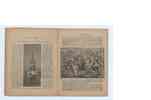
Image caption first page: "JOHNNY BURKE NO NECK." Found on the Battlefield of Wounded Knee after the annihilation of Big Foot's band.
"How little I dreamed in the long ago that the lonely path of the scout and the ponyexpress rider would lead me to the place to which you have assigned me to-day. And here, near the banks of the mighty Missouri, which flows onward to the sea, my thoughts revert to the early days of my manhood, when I looked across this rushing tide toward the East, to the Atlantic, where then I supposed that all men were rich and all women happy. My friends, that day has come and gone, and I stand among you a witness that nowhere in the broad univers are men richer in manly integrity and women happier in their domestic kingdom than in our own Nebraska, (Great applause.)
"I have sought fortune in many lands, but wherever i have wandered that flag of our beloved State has been unfurled to every breeze. From the Platte to the Danube, from the Tiber to the Clyde, the emblem of our sovereign State has always floated over the Wild West. (Applause.) Time goes on and brings with it new duties and responsibilities, but we old men, we men who are called 'old-timers,' cannot forget the trials and tribulations that we had to encounter while paving the path for civilization and national prosperity.
"The whistle of the locomotive has drowned the howl of the coyote, the barb-wire fence has narrowed the range of the cow-puncher, but no material evidence of prosperity can obliterate our contribution to Nebraska's imperial progress. (Applause.)
"Gentlemen of the Directory, I will not assume to comment upon what you have done to make this exposition the peer of all that have gone before. For abler testimony than I can offer has sped on electric wings to the uttermost parts of the earth that what you have done in the interests of Nebraska has been well done. (Applause.)
"Through your kindness to-day I have tasted the sweetest fruit that grows on ambition's tree, and if you will extend that kindness and let me fall back into the ranks, those rear ranks, as a high private in those ranks, that will be honor enough for me. (Applause.)
"Now, will you extend that kindness and let me call upon the Wild West, the Congress of Rough Riders of the World, to voice their appreciation for the kindness that you have extended to them to day?"
At the signal of Colonel Cody the Wild West then gave three ringing cheers for Nebraska and the Trans-Mississippi Exposition. Their band followed with "The Red, White and Blue," and at the last note of the melody the McCook band played the "Star Spangled Banner," and the Wild West fell into line for the parade through the grounds, headed by Colonel Cody, mounted upon the splendid chestnut horse, Duke, presented to him by General Miles soon after the battle of Wounded Knee. At the Administration Arch the cavalcade was reviewed by the members of the Executive Committee of the Exposition.
1890-1902
THE WAVE OF PROGRESS AT THE FOOTHILLS OF THE ROCKIES.
AN OLD SEA-THE BIG HORN BASIN.
Ages ago in the North-West corner of the State of Wyoming there was an inland sea, where now there is really a valley, but which, on account of its being completely encircled by four mountain ranges, has been aptly termed "a basin."
From its past and even present fame as a game country and the prominence of that King of the Cliffs, the "Big Horn Sheep," it has been known to the explorer, the trapper, the hunter, the geologist, the historian, the geographer and the mapmaker, as the BIG HORN BASIN. This valley on account of its inaccessibility, remained until a few years ago in its
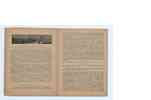
Image caption second page: 1890-INDIAN TEPEE.
1892-RANCHER'S DUG-OUT.