
46
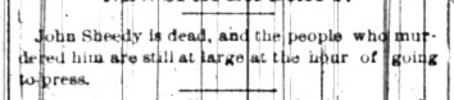
John Sheedy is dead, and the people who murdered him are still at large at the hour of going to-press.
47
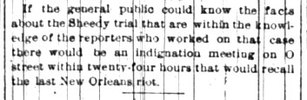
If the general public could know the facts about the Sheedy trial that are within the knowledge of the reporters who worked on that case there would be an indignation meeting on O street within twenty-four hours that would recall the last New Orleans riot.

48
ECHOES OF THE GREAT CASE
UNCLE BIGGERSTAFF GOES HOME IN ANGER
Judge Wier Encounters Considerable Opposition in Obtaining a Reduced Fee.
Did John Sheedy Leave a Will and If so, Where is It? -Monday Didn't Pine to Become a Freak at 85 a Day.
An Undercurrent of Events The great Sheedy trial is over, and the accused have been restored to all rights enjoyed by then prior to the mighty storm of suspicion which so nearly engulfed them, but it will be many weeks ere the Sheedy case releases its grasp upon the public as the leading topic of interest. In fact discussion of its many peculiar features was more animated yesterday, if per chance not quite so general, than upon any day during the heat of the exciting trial. The resignation of Mrs. Sheedy as administratix of her interests in the Sheedy estate and the appointment of S. M. Melick as her successor, the departure for his Idaho home of Mr. W. B. Biggerstaff. Mrs. Sheedy's uncle, in anger, and the similar departure of Judge Weir of the same place in a similar frame of mind, all furnished fruitful topics for discussion to those who were cognizant of the facts.
It is known that Judge Weir was brought here from Boise City by Biggerstaff to participate in the defense of his niece. It was also known during the trial to those who were upon the inside that the utmost harmony did not prevail at all times between the local attorneys in the case and the distinguished jurist from the far west, and that his splendid and dignified argument of the law applicable to the situation came very near never being delivered. After the case was closed and the accused were liberated Judge Weir who had declared his intention of returning home at once, delayed his departure until Saturday, and then until Sunday, and again until yesterday. During the forenoon yesterday it was learned that Judge Weir had not succeeded in effecting a settlement with Mrs. Sheedy and the newly chosen administrator of her estate for his fees. It is said that Judge Weir came to Lincoln on a promis from Mrs. Sheedy's uncle of a $5,000 fee. There was a protest against the payment of any such amount, hence the delay in settling. On Sunday Judge Weir consulted local counsel and gave Mrs. Sheedy and Mr. Melick, who has not yet been appointed administrator but was duly clothed with an appointment as her attorney in fact, until 10 a.m. to-day to settle. At that hour a compromise was effected whereby Judge Weir was to accept $1,500 as his fee, $500 of which was to be paid in cash and the balance with Mr. Melick's personal note for $1,000. This was to be paid ere 2 p.m. and Judge Weir and Mr. Biggerstaff expected to depart on the 2:40 p.m. train. But they didn't secure the stuff until later, and departed on the train at 4:30. Before they departed, however, Uncle Biggerstaff repaired to the rooms occupied by Mrs. Sheedy and her sisters and [?] his hands of any further relationship with them. It is said that the parting was of a most unfriendly nature and that Mr. Biggerstaff denounced his nieces with a severity that was hardly consistent with his recent solicitude in behalf of Mrs. Sheedy, disclaiming all relationship with her. It is said that he has been to great expense in this case, and is quoted as having said that it cost him several thousand dollars individually. Certain is that a number of those whose testimony in behalf of the defense has led to the most profound suspicion on the part of the state have dogged the footsteps of "old man Biggerstaff all during the trial, and were clinging to him all day yesterday like sick kittens to a hot brick, even to the very moment of his departure. It is suspected that some of them are not entiraly satisfied with the course of events since the verdict was reached.
A friend of Mrs. Sheedy says in relating to the disagreement between her and her uncle, and a friend who is amply qualified to know the facts, that Mr. Biggerstaff and Judge Weir presented a bill not only for $5,000 but largely in excels of that amount, which was deemed exorbitant. It is also said that Mr. Biggerstaff first suggested to Mr. Melick and Mrs. Sheedy the propriety of the former becoming her financial adviser, so that her right would not be trodden upon, and that the uncle has, therefore, no just ground for complaining because Mr. Melick first used the pruning knife on his own (the uncle's) claim. The friend also claims that Mr. Biggerstaff never promised Judge Weir a $5,000 fee, and if he did he had no right to do so.
Be these facts as they may, Mr. Biggerstaff claims that he did so promis and that he will be required to make good the amount out of his own pocket. These facts may account for som pretty outspoken opinions on the part of the alleged "kind old uncle" on the subject of Mrs. Sheedy's guiltlessness.
Meantime Messrs. Stearns and Strode are secure, their mortgage for $12,500 on the estate having been filled, it is claimed, not a moment too soon, as there was an alleged scheme upon the part of the old uncle and a local attorney to beat them out of it by transferring all of Mrs. Sheedy's estate to the uncle ere the mortgage was filed. To the credit of Mrs. Sheedy be it said that she declined to become a party to this project. Rumor has it, and a rumor that claims to be authentic, that $2,000 of the $12,500 go to Monday McFarland's attorneys for keeping him off the stand. The attorneys for Monday deny this rumor, as they would undoubtedly do if it were true, just as they would deny a client's guilt if it were apparent to everyone.
It is known that in keeping Monday from turning state's evidence and taking the witness stand consisted one of the very biggest jobs undertaken by that branch of the defense. One of them is reported to have told several people that required their constant attention to keep Monday from giving the story away again. There is a pretty reliable story to the effect that Monday did unburden himself in the jail to a fellow prisoner named Davis, and that Colonel Billingsley, learning that he had so done, took steps at once to get Davis into quarters where he was not likely to be encountered by the state. Davis had been sentenced to the penitentiary for forgery, and the time for his removal to the pen was near at hand. Billingsley hastened it by discovering that there was a big jail-breaking project on foot and that Davis was the leader of it. Davis was removed without further ado ere he had an opportunity to "blab."
Did Sheedy Write a Will?
There was a wild-eyed, whiskered rumor afloat yesterday to the effect that the late John Sheedy's will had been found, and that he had left all his property to his wife. It was only a rumor, as no one could be found who knew anything of it, not even among Mrs. Sheedy's friends. It is true that Mrs. Sheedy has always suspected that her husband did leave a will, but she never learned anything as to its whereabouts. It is said that her friends suspect that it is locked up in a safe in the office of Lincoln lawyer. It is related that Sheedy indicated to friend shortly before his death that he had taken that precaution, and in view of the ill-feeling he knew to exist against him it is reasonable to suppose that he had. It is claimed that some time before Sheedy's final taking off a friend suggested that he ought to make a will and fix it so that Mary would be secure in case of his death, and that Sheedy replied that he had fixed all that long ago.
Meantime it is intimated that in case the Sheedy heirs desire to do so, the widow's interest in the estate may be considerably depreciated. There is a question entertained among attorneys as to the constitutionality of the Nebraska law giving to a widow without issue one-half of the estate of her dead husband. Then again it is a question as to whether or not an acquital on the charge of murder would be taken as proof positive in a civil case to deprive her of any share whatever in the estate. If, as has been claimed by the defense, this is a matter of dollars and cents with the Sheedy heirs, further trouble may be anticipated by Mrs. Sheedy ere she can rest secure in the possession of so much of the estate as has been saved out of the wreck. There is no denying that serious inroads have been made upon it, and if all the rumors which are backed by consistent appearances were given credence, a dozen reputations would be blackened.
Mr. Hall and Mr. Burr.
It is well known that Mr. L. C. Burr was somewhat aggrieved at the reference made to him by the state's councel in connection with his testimony in the case, and speaking of the matter yesterday to a JOURNAL representative Mr. Hall remarked:
"Will, I was perhaps somewhat hasty in speaking of Mr. Burr as I did, but he is an attorney and ought to know that such an utterance was not made with a view of damaging him. I certainly had no ill will against him and my remark was designed simply to offset the effect of his testimony in the minds of the jury. It was due to my zeal in behalf of the state and certainly not to any disrespect to Mr. Burr."
Didn't Want to Be a Freak.
Just after his acquittal Monday McFarland was approached by an agent of the musee circuit and asked to enter into an angagement to cover a circuit, but he was too anxions to get out of this section of country. Therefore when he was offered $5 a day to go to Omaha, he replied that they couldn't get him over there for $500 a day.
49
MELICK WILL ADMINISTER
IN BEHALF OF THE ESTATE OF MRS.SHEEDY
Colonel Philpott Wants a Fee for Monday's Defense - The Mortgage Filed.
Bipdett Sues Burlington - Mrs.Hoverymoss Talks Nack to Her Husband - Call of the Docket in County Court.
Mrs. Sheedy's Administrator:
The following interesting document was filed in probate court yesterday:
"Mrs. Mary Sheedy, having been hereto fore appointed administrator to administer the estate of John Sheedy, deceased, jointly with John Fitzgerald, does here by resign as an administratix and ask the appointment of Samuel M. Melick as administrator to represent her interests in said state, as the widow of the said John Sheedy, deceased, upon his qualifying and giving bond as required by law."
Mr.Melick gave bond on the sum of $5,000, with John H. McClay as security and was appointed as per request.
James C. McHaffie has filed a claim for $50 against the Sheedy estate for painting papering, repairs, and coal for steam heating at the Hotel Mack, including $80 for one street lamp bought of John Sheedy, which belonged to W. W. Carder.
The Mortgage given by Mrs.Sheedy to her attorneys, Mess s. Stearns & Strode, for their serviced, has been placed on file. It is a mortgage for $12,300 upon lot 5 and 6 in block 40, lot 7 in block 9 of Kinney's O street addition and lot F. subdivision of lots 5 and 6 in block 41. The [?] instrument was filed May 25.
50
JUROR NOTION NOT GUILTY
OF PERJURY IN THE GREATEST SHEEDY CASE
The Witnesses Who Made Those Famous Affidavits Afflicted Wtih Poor Memories.
None of Them Could Swear That Norton Had Ever Expressed as Opinion as to the Guilt or Innocense of Monday McFarland or Mary Sheedy
The Last Act is the Great Farce.
The last thunders in the great Sheedy murder case reverberated in Justice Cochran's court yesterday afternoon for a time and then finally died away forever. It was the occasion of the preliminary examination of Albert B. Norton, the juror who was so summarily fired from the jury box when it developed that he had at divers times expressed an opinion in relation to the guilt and innocence of Monday McFarland and Mary Sheedy. It will be remembered that County Attorney Snell, acting in accordance with Judge Field's instructions, immediately filed an information in Justice Cochran's court, charging Norton with perjury. Norton furnished bail for his appearance and retained R. J. Greene to defend. When the case came up for hearing yesterday afternoon the court room was crowded with spectators whose interest in anything pertaining to the Sheedy case was still as intense as ever.
The first witness called was O. A. Mullen, court reporter for Judge Field, who read his report of Norton's voice dire examination. Following is the substance of examination:
"Have you formed or expressed any opinion as to the guilt or innocence of the defendants charged with the murder of John Sheedy?"
"I have not."
"Have you any conscientious scruples about returning a verdict of guilty where the death penalty attaches?"
"No sir, I have not."
"Would you refuse to return a verdict of guilty on purely circumstantial evidence, where such evidence excluded every reasonable hypothesis except that of the defendants?"
"It would depend a good deal whether the evidence was strong enough. If it was strong enough to exclude every reasonable hypothesis except that of guilt. I would be bound to give the person the benefit of the doubt anyway."
"You would give him that anyway?"
"Yes, sir."
"If the evidence was sufficient to satisfy you beyond a reasonable doubt, if it was purely circumstantial, would you return a verdict of guilty?"
"I think I would."
"Would circumstantial evidence convince you?"
"Yes sir, I think it would to a certain extent."
"Heave you, or not, any conscientious scrupies against returning a verdict of guilty where the death penalty attaches on purely circumstantial evidence which excludes every reasonable hypothesis except that of the guilt of the defendants."
"No sir, I have not."
Cross-examined by Mr. Stearns:
"I believe you said you had not any opinion touching the guilt or innocence of the defendants?"
"No, I have no."
"Did you talk to anyone who pretended to know the facts?"
"No, I heard it talked as a matter of conversation."
"You never formed any opinion at all touching the guilt or innocence of the defendants?"
"No."
"Do you know any reason why you could not now render a fair and impartial verdict under the law and evidence?"
"I don't."
"Have you any bias or prejudice for or against these defendants or either of them?"
"Not the least."
"Could you presume them innocent until proven guilty?"
"I should, certainly."
"Does the fact that an information has been tied changing them with the crime of murder make any impression, or influence or bias your mind one way or the other, so as to prevent you giving them a fair trial."
"It does not."
"Have you read what purported to be the testimony in the case?"
"I didn't read much of it. I was away from home to work when it happened. I used to get little sketches, coming home on Saturday."
"Was that newspaper statements or evidence at the preliminary trial?"
"Newspaper reports."
"Not any evidence?"
"No."
"You didn't hear or read any of the evidence given relating to this case?"
"No."
"Where was you; away from home?"
"Five miles north and west of where I lived. I was building a house at that time."
"Did they take any paper there?"
"Yes, I believe they took the Farmers' Almanac, a weekly one."
"You didn't see what purported to be evidence?"
"No, they didn't get them. They generally came to the post-office on Saturday, the same day I came home."
"State whether you have read anything about the alleged confession of one of these defendants."
"No, never saw it to my knowledge."
W. A. Tarbell, a grain merchant of Davey was sworn and testified that shortly after the publication of McFarland's confession, Norton came into his office and read an account of the case in the Omaha [Ber?]. After reading a short time Norton exclaimed: "Mrs. Sheedy will be cleared and the hanged."
Philip Opp, a hardware merchant, was called and testified that he had heard Norton say while at Harkson's store that the d--d ought to be hanged," and that "Mrs. Sheedy is guilty, too."
E. R. Sizer, clerk of the district court, was called and testified that Norton was summoned, sworn and examined as a juror in the cause of the State of Nebraska against Monday McFarland and Mary Sheedy.
A. Harkson, postmaster at Davey, testified that Norton came into his store one morning after the Sheedy murder and made the remark that "Mrs. Sheedy will be cleared but the would be hanged."
C. W. Corry, school teacher at Davey, was sworn and testified that he had heard Norton declare that he believed the would be hanged, and also that the story about McFarland having criminal relations with Mrs. Sheedy was untrue.
G. A. Sawyer was the next witness called. He swore that on May 1 he and Norton had drove from Davey to Lincoln together and had engaged in a conversation about the Sheedy case; that Norton said he had been subpoenaed as a juror in the case and was going to get on the jury as there "was $500 in it;" that Norton rode back to Davey with witness and that on the way had stated that a certain man told him there was $500 in the Sheedy case and by G--d he was going to have it; that witness had further said that the Sheedy's were going to "convict that woman and get the Sheedy estate."
The state closed and Norton was called to the stand to testify on his own behalf.
He sympathetically denied having ever formed or expressed an opinion touching the guilt or innocence of Mrs. Sheedy or Monday McFarland. He admitted having read some accounts of the case, but denied having either read any of the testimony adduced at the preliminary examination or Monday's confession. He had told Sawyer he was going to serve on the jury us there was $2 a day in it, but never said he was going to have $500 out of the case. He had said that some of lawyers were going to have $500 out of the case. He had said that some of the lawyers were going to make $500 out of the case and had remarked to Sawyer that he wished he could make $500.
At the conclusion of Norton's testimony Attorney Green filed a motion to dismiss the case, in support of which he had advanced the following propositions:
In opening his argument Greene said he did not behave that any court or any spectator who listened to the testimony in this case could not help but be driven to the irresistible conclusion that there had been no offense shown or pretended to be shown by the prosecution. He contended that the information was incomplete, preposterous and silly; that no court would sustain a conviction upon such an information. That the words upon which perjury was predicated were not alleged to be either true or false; that the complaint failed utterly to allege that the perjury was in a matter material to the issue. That the evidence was utterly insufficient. That no witness had testified that Norton had expressed an opinion to him. That the worst that could be said against the defendant was that he was intelligent enough to read the newspapers and honest enough to not deny it, even when charged with perjury under the oath of the county attorney. Greene concluded by declaring that it is a well established proposition of law that the testimony of the defendant in perjury cases cannot be overcome by the testimony of any single witness, but that more than the testimony of one witness is necessary to constitute a preponderance of the testimony.
County Attorney Snell evidently realized that his case was rather weak and accordingly only spoke about five minutes, drawing principally upon the fact that Judge Field had instructed him to file the information against NOrton.
In announcing his decision Judge Cochran declared that the evidence introduced by the state was weak and introduced by the state was weak and insufficient and that no jury would ever convict Norton on it. He did not, therefore, feel it his duty to bind the defendant over and put the county to a large expense for nothing, and consequently, he would discharge Norton.
GRANT GETS JUDGMENT FOR THE AMOUNT.
What it Costs the City to Grade in Front of a Man's Property.
Mrs. Josephine Steven's Damage Suit Against the Lincoln Street Railway Company Tried to a Jury in District Court
Grant Gets a Judgment
After a trial lasting through the greater part of two days that case of Patrick J. Grant against the city for damages to his property on Ninth and M streets, came to a close at noon yesterday, when the jury brought in a verdict for plaintiff for $500.
Suit for Personal Damages
The case of Mrs. Josephine Stevens against the Lincoln Street Railway company for $5,000 personal damages was begun before Judge Tibbets yesterday. Mrs. Stevens claims that something over a year ago she alighted from a street car awhile it was in motion and received personal injuries equivalent to the above sum. She claims that the car jerked suddenly and threw her down, while the company claims that she got off while the car was in motion. Mr. Burr appeared for the plaintiff and Mr. Deweese for the defendence.
Equity Doeker.
The following cases were disposed of yesterday by Judge Chapman:
Mutual Benefit the Insurance Company vs. T. E. Miller et al. court finds due planting $1,186.97, which is first lien on the northeast quarter of section 11-10-12; also finds due the First National bank $2,282,90, which is a second lien on the northeast quarter of section 11-10-12; the northeast quarter of section 26-12-6, and a second lien of the southeast quarter of section 22-19-08; that the Security Investment company holds a first lien on the latter quarter, which it does not week to foreclose in this action; decree of foreclosure and sale ordered.
John Fitzgerald for himself and all other stockholders of the Fitzgerald & Mallory Construction Company vs. The Fitzgerald & Mallor Construction Company and the Missouri Pacific Railway Company; set for trial June.
A. H. Weit & Co. vs. W. B. Barnes and Thomas L. McNeil; court finds due plaintiff on account for lumber and material $318.40, and that he is entitled to a lien upon lot 24of block 26 in the first addition to West Lincoln; decree of foreclosure and order of sale.
Capital City Planting Mills vs. Abbie P. Tiffany et. al.; court finds due plaintiff $148.99; decree of foreclosure and order of sale of lots 3 and 4 in block 7, East Lincoln.
Badger Lumber [?] vs. Joseph H. Turner et. al.: court finds due plaintiff $508.80; also finds due George $66.58, M. L. Trester $24,64 and R. S. Young $25.23; decree of foreclosure and order of sale.
Clark & Leonard investment company vs. Sara A. Batta et. al.; court finds due plaintiff $781.52 to Charles Hammond $8,202.70; also finds that the mortgage of the Clark & Leonard investment company for $6,500 is a first lien and that of Hammond second; decree of foreclosure and order of sale.
Motion Docket
The following entries were made yesterday on the motion docket:
State of Nebraska vs. Monday McFarland and Mary Sheedy; motion for order allowing attorney a fees to L. W. Billingsley as one of the attorneys defending Monday McFarland.
John Smith vs. J. H. Foxworthy; motion to confirm sale of real estate.
George E. Badow vs. Charles H. Johnson et al; motion to make G. W. Buster party defendant.
D. L. Brace vs. H. W. Pynchon; motions in two cases to confirm sales, order deeds, to D. L. Brace and put him in possession.
Isaiah Hlae vs. Samuel McClay, administrator of the estate of H. C. Malone, deceased; death of plaintiff suggested and motion to revive judgment in the name of Sarah M. Hale, administratri x of the estate of Isaiah Hale.
Lay Calf.
The calf of the [?] docket for to-day is as follows:
Peer vs. Leavitt.
Spellman vs. Lincoln Rapid Transit Company.
Lew is vs. German Fire Insurance Company.
Mohr vs. Bauer et al.
Kennard vs. Fitzgerald.
Heiskell vs. Brace.
Cahn vs. C., B., [?]
Fitzgerald vs. Baydwin.
Fitzgerald vs. Meyers.
Moore vs. Ferguson.