

266
THAT VITAL THING, DEBT
Mrs. Peattie Discourses on It in Connection With Mortgage Statistics.
What the Figures Tell of the Movements and Emotions of the People-The Sowing of 1887 in Nebraska.
It is a difficult thing to make the mortgaged indebtedness of a country intersting or simple reading. Yet there is no subject which more nearly concerns the happiness of men and women than this. For in proportion as men enjoy the fruits of their labors, are they free men. No man is free who must give the results of his toil to another man. If this fact had always been fully appreciated by Americans, they would not perhaps have reached a point where the present financial depression became an inevitable thing. If they, had been more patient in earning and less eager to borrow , if they had developed resources, instead of speculating in possibilities, they would not now, so many of them find themselves hemmed in by a wall of debt. For men build barriers of debt so high that never while life lasts, can they surmount them. And they are too often prone to aquire these debts recklessly in the hope opf large success, and then, when they fail to meet the drain they have put upon themselves, to find fault with the system which permitted them to commit such an error. On the other hand, there are circumstances which compel a man to become a borrower, And these conditions arise, primarily from the system of land and money which obtains here. But not to go into questions so large, and concerning which there are so many differences of opinion, It may be interesting to those who are themselves struggling under the burden which borrowed money imposed to know something of the condition of the people, in this respect, all over our beautiful but much suffering country. Among the extra census bulletins are some which deal with the statistics of farms, homes and mortgages, and which represent a new departure on the part of our government. Mr. Robert P. Porter, chief of the census bureau says: "It is, I believe , the first time a government has ever attempted to invade for startical purposes the realm of private indebtedness." He gives some idea of the labor involved in this extraordinary investigation in the following sentence: "The employment of a small army of 2,50 special agents and clerks to make an abstract of every mortgage placed on record in every county of the United States for the last ten years has attracted attention to the dangers of these incumbrances, to the alarming extent to which usury is practiced, and to the defectiveness of these records in all parts of the country. The agents of the census office have, as a matter of fact, overhauled the records in every state and territory. They have traveled on horseback and on foot through the most sparsely settled districts of our vast domain in search of mortgages, and have done their work so industriously and so thoroughly that we now have on file in Washington, as a result of their labor, the abstracts of about 9,000.000 mortgages" It would be impossible in the space of such an article as this to deal with all of the states of the union. Therefore it may be best simply to use Mr. Porter's figure as they refer to states which topographically, or naturally, or in products, or manner of people, greatly contrast with one another. In a letter accompanying his report to the secretary of the interior Mr. Porter says concerning this state: "The real estate mortgage business of Nebraska during the ten years 1880-1890 is represented by 837,872 mortgages made to secure a debt of $274,808.858. Of this debt 48.44 per cent remained unpaid January 1, 1890. Nearly one-third (81.90 per cent) of the existing debt is on village and city lots, and the principal portion of this is in the couties of Douglas and Lancaster, containing, respectively, the cities of Omaha and Lincoln. In Douglas county the existing debt is $27,064, 041 of which 87.60 percent is on lots. In Lancaster county the existing debt is 80,172,266, of which 64.97 per cent is on lots. In some of the more prominent characteristics of its real estate mortgage indebtedness Nebraska occupies a place between Kansas on one hand and Iowa and Illinois on the other. The per capita indebtedness of these four states is as follows: Kansas...9170 Nebraska...126 Iowa...104 Illinois...100 Existing mortgages cover 14,085,200 acres in Nebraska and these are 58.13 per cent of the total number of taled acres in the state. This is lower than the Kansas percentage and higher than the Iowa and Illinois percentages, as is shown below: Kansas...61.55 per cent Nebraska...58.13 per cent Iowa...40.93 per cent Illinois...80.78 per cent Again, Nebraska occupies an intermediate place in proportion that the debt on acre tracts bears to the estimated true value of the acre tracts that secure it. The proportions for the four states shown are by the following percentages: Kansas...47.53 per cent Nebraska...44.47 per cent Illinois...48.13 per cent Iowa...38.85 per cent Mr. Porter points out fact which in very much to the credit of Nebraska, and that is that the cause for mortgages almost invariably is improvements and purchase, In short, they represent growth and activity, and in no way decay or a-running behind. They show on the whole, the consciousness of strength, not weakness. At the same time, there is not a doubt about many of them having been incurred under protest. This is particularly the case in the farming districts, where the need for securing agricultural implements of the expensive sort, the occasional failure of crops, and the other exigencies of agricultural implements of the expensive sort, the occasional failure of crops, and the other exigencies of agricultural life have compelled farmers to assume second mortgages, frequently at usurious raics of interest. Yet it is noticeable, and I cannot refrain from calling particular attentionto the fact that a very large percentage of the mortgages are on town and city lots. Whereas it is very well known that it is not city men who speak much of the oppression entailled by the mortgage but almost universally such complaints come from the farmer. This may be because of the dull and isolated nature of American farm life, and the fact that the farmer and his family have few amusements to divert their minds from their monetary difficulties. They are forced by the nature of circumstances to concentrate their attention upon themselves. There is also this to be taken into consideration in pallaition of the loud complaints of the farmer, and that is that his living comes directly from the ground, and he, therefore, attaches more importance to the undivided ownership of it than does the man in town, who, deriving his living from other means, thinks of the ground as his accumulation over and above. The comparison of the mortgages upon farms and upon town lots in interesting. As quoted from the census bulliten they are as follows: "Mortgages on Acres-On acre tracts, including all farms a debt of 3181.429.021 was placed during the ten years. Which is 06.18 per cent of the total amount for acres and lots, and this was represented by 225,420 mortgages, or 06.72 per cent of the total number. A debt of 37,588,582 was placed on acres in 1680, and this increased to $26,213,154 in 1887; the amount in 1888 was $21,000, 914 in 1889, $25,401,455. The increase of 1880 over 1880 was 284.95 per cent. In 1880 14,109 mortgages on acres were made in 1889, 29,012 mortgages." It is by the way of peculiar interst to note the effect which the year 1887 had upon Nebraska. That was a climax year of the state. The large number of mortgages incurred that year show the immigration which brought to Nebraska and to Omaha the memorable "boom," which may or may not have been a piece of good fortune. But to return to the subject of: "Mortgages on Lois-A debt of $92,939,837 was placed on lots during the last decade, or 83 87 per cent of the total amount of acres and lots and this was represented by 112,446 mortgages or 83.28 per cent of the total number. The annual increase of the debt on lots is more marked than the increase of the debt on acres. In 1880 the incurred lot debt was 81,790,008, and the yearly increase was constant to 821,154,983 increase was constant to $21,154,983 in 1887 the amount was $16,728,953 in 1888, and $19,680,095 in 1880 or an increase in the last year of 999.78 per cent of the amount of 1880. The mortgages on lots made in 1880 numbered 8,419 in 1889 19,629." Concerning the mortgaging as to counties the report says: "By far the leading county in amount of mortgaging done during the ten years is Douglas county, with a population of 168,008. and containing the city of Omaha, whose population is 140,452 an increase of 919.73 per cent over that of 1890, In this county 82,603 mortgages were made during the decade to secure a debt of $52,942.667. The number and amount of these mortgages are chiefly chargeable to lots, the number of mortgages on lots being 31,303 and their amount $40,530,009. The annually incurred lot debt was $323,499 in 1880, $1,475,811 in 1884, $2,758,506 in 1885. $7,623,418 in 1886 $12,285,969 in 1887, $8,725,813 in 1888 and $10,044,084 in 1889. From 1880 to 1889 the annually incurred debt increased 1,818.63 per cent. This will, of course be considered a sign of activity-of the enornous increase of human interest and confidence in the state. Whether it is prosperity or not each person must decide for himself. It represents the structure of civilization. It may be builded upon the rock or the sand. That is a matter of opinion. It stands for credit. And the business of the world could not so they say be conducted without credit. Yet it is the contraction of credit and nothing else which can make possible such a panic as the one from which we are now suffering. However, this is anything aside3. There is a general idea abroad that it is the west alone which so suffers from mortgages. and we are apt to think of ourselves as the victims of eastern capital. We might occassionally be frank and admit tht if eastern capital has got in here it is because it was saught for. All sorts of inducements have been offered to it and are still being offered. And the money loaned by eastern capitalists has usually been in large amounts for a fixed, legal, and as custom goes, reasonably rate of interest. The usury has generally proceeded from men among us, and very frequently from farmers who have become money loaners and who loan small amounts of money on short time and monthly interest. Or in cities such as Omaha and Lincoln, it has been the local money sharks who have pushed men to the wall menaced them with the fatal chattel mortgage and very frequently from farmers who have become money loaners, and drained the blood from men's bodies by absorbing the fruits of their toil from day to day. The east is mercanary enough -no doubt about that. But at the present time when certain ill-advised persons appear to be in a semi-seditious frame of mind, it is as well to remember the truth about these things. And approve of that, the condition of Massachusetts will be worth taking into consideration. The following is quoted: "During the ten years 1880-1890, 250,222 real estate mortgages were made in the state of Massachusetts, representing an incurred indebtedness of $308,455,550. The debt remaining in force January 1, 1890, is $323,277.608, secured by 178,202 mortgages, and of this debt $42,441,247 incumbers 920,313 acres and $280,836,421 incumbers 132,683 lots. The mortgage movement of the ten years, which has been an increasing one without interuption, began with an incurred debt of $28,176,183 in 1880 and ended with $75,526,344 in 1880, an increase of 168.05 per cent, while the population increased 23.57 per cent during the same time. During the decade a real estate mortgage debt of $193,635,825 was incurred in suffolk, county, which contains the city of Boston, and the existing debt in that county is $123,784,037. In eight of the fouteen counties the existing debt is more than $10,000,000 each." Although Massachusetts is so old that we of the west are apt to think of it as being well established in all ways, it is in fact given to new ventures. Boston has felt a tremendous acceleration of business during the last ten years, and particularly during the last five years. The stream of immigration flowing through this country has made its way through Massachusetts, and the drift of this new population lies upon the old Puritan subsiratum. The large number of manufacturies, with their operatives receiving steady salaries has caused a desire for homes, and this is another thing which has had its effect in accelerating what Mr. Porter calls the mortgage movement." Besides, Boston has been undergoing a transition. The parts of town which used to be most desireable are so no longer, and the moving of those who wish to be in the best kept locality , and the subsquent building of new homes is another of the causes. But above all, undoubtedly, the reason lies in the rapid development of business which is the result of an impetus that came to Boston a few years ago, and which is winning for it a reputation of commercial activity which does something toward compensating for its waning reputation as the literary center of the country. For that is a reputation which is rapidly being transferred to New York. The quotations of the figures concerning debt and ownership of land in Georgia will furnish one more contrast, and will show how all parts of the country are struggling along under the same burden. Mr. Porter says: "In regard to farms in Georgia, the conclusion is that 58.10 per cent of the farm families hire and 41.90 per cent own the farms culivated by them; that 9.88 per cent of the farm owning families own subject to incumbrances, and that 96.62 per cent own free of incumbrance. Among 100 farm families fifty-eight hire their farms one owns with incumbrance. On the owned farms of this state there are liens amounting to $1,697,500 which is 41.89 per cent of their value, and this debt bears interest at the rate of 8.83 per cent making the average, annual interest 857 to each family. Each owned and incumbered farm, on the average is worth $1,627, and is subject to a debt of $681. "The corresonding facts for homes are that 79.00 per cent of the home families hire and 21.00 per cent own their home owning families own free of incumbrance and 2.78 per cent with incumbrance and 2.78 per cent with incumbrance. In 100 home families on the average,79 hire their homes, I owns with incumbrance. The debt on owned homes aggregates 1,051,754, or 42.59 per cent of their value, and hears interest at the average amount of interest to each home averages $80. An average debt of $1,020 incumbers each home which has the average value of $2,396." At the conclusion of this report is a significant sentence. It is this "Real estate purchased and improvements, when not associated with other objects, caused 33.60, per cent of the farm families of the state to incure 87.00 per cent of the farm debt and 61.71 per cent of the home families to incur 57.90 per cent of the home debt." It resolves itself, therefore, to a very large extent, into a struggle for the ownership of land. For the price of land is so disproportionately high as compared with the average income of a man that it must be, at best, an exceedingly difficult thing for a man of the ordinary term of life, with no start in the way of money and the current expenses of a growing family, to acquire for himself enough of the ground of the earth to live on. One might be reconciled to this if it appeared to be natural. But it is not so. It is natural that a man should assume the ownership of the product of his hands. But the earth is the product of God. And the first owner was nothing but the man who was strongest and who helped himself to the most. But plainly put, how is a periodical panic avoidable, no matter what the monetary system, when so large a proportion of mankind is paying interest in order to hold the possession of land? In short, where debt exists upon conditions so false, contraction of credit cannot but cause a panic. And when this is complicated by two vital influences, both in a fluctuating condition, money and the tariff, it takes both patriotism and hope to make one see beyond the dreary puerile financial worries of the present into the time when men shall have discovered what the true conditions are which surround freeman. Elia W. Peattie.
REAL ESTATE TRANSFERS. The following real estate transfers fleed for record are reported for the WORLD HERALD from the office of the Globe Loan and Truet company, at southwest corner of Sixteenth and Dodge streets: Herman Kountrs et al to United Real Estate and Trust company, undivided lots 8 to 11, 21 and 24 block 3: lots 1 to 8 to 38 clock 4, lots 1 to 58, block 5 lots 1 7 to 14, 16, 17 20, 23, 24, 26 block 6 lots 22 to 26 block 12 , lots 1 to 21, 24, to 26 block 12 lots 2 12 to 24 block 23 lots 1 to4 , 6, 7, 11 to 13, to 21 23 to 26 block 14 Druid Hill, tax lot 31 in 4-15-18 w.d Herman Kountze to same same wd.. Herman Koutse et al to same undivided of 37a in north part of nw, 10-15-18, w.d. Same to Luthe Kountze et al, undivided 74 of stine w.d Herman Kountze et al to United Real Estate and Trust company, undivided lots 1 to 4 , 9 to 18 block 19s lots 1 to 5, block 19s lots 1 to 5, block 20, Highland w.d. Same to same, undivided lots 3,2, and 3, in 3-14 w.d Same to same undivided of same w.d. Same to same undivided 1-6 of in tax lots 9 in nw ne 15-15 18 w.d Same to same, undiverse or same w.d. H.W. AlClare and wife to same, undivided same w.d Herman Kountze et al to same. 18 acres in tax lots 6 in 21/2 in 27-15-13 Same to Herman Kountze, undive 1/4 iots 1 to 1 block 18 Smith's add w.d. Nicholaus Cherek and wife to G.S. Mock 31/2 Mack 3/12 lot 23, Burr Oak, w.d... Omalis and Fidelity Loan and Trust company to John Chaplin, blocks 183, 15, 190 and 199 and lots 1 to 20, block 95 Florence w.d. Joseph Deviers, to R.M. DaViera, lot 19 block 4, junction view terrace, w.d. Cathne Kountze to Horman Kountize oval, undive 1/4 lots 3 to 11 83 and 24. block 3 lots 1 to 83 block 4 lots 1 to 88, block 5, lots 1 7 to 14 , 15, 17, 20, 21, 24, and 25 block 6 lots 21 to 26 block 11 lots 1 to 21, 24, 25, to 26 block 12 lots 2 12 to 24, block 13 lots 1 to 4, 6, 7, 11, to 13, 16, to 21, 23, to 26, block 14, Druid Hill, tax lot 31 in 4-15, 13, q c d Same to same undivide of 37 acres in 9th Same to same, undivide lots 1 to 4, 9 to 16, block 19 lots 1 to 6 block 20 highland q c d... Same to same ; and lots 1 to 3 in block 2, 45 1/2 in no 3 and 21 1/2 in ne 3-14-15 a.d Same to same 61/2 in tax lot 9 in nw no 15-15-13 a d Same to same : 18a in tax lot 6 in 31/2 lot q Herman Kouptze et al... excutors to United States Real Estate and Trust company, and 3 to 11 2d and 24 block 3 lots 1 to 88 block 4 lots 1 to 88 block 5 lots 1,7, to 14, 16, 17, 20, 23, 24 and 26 block 6 lots 22 to 26 block 11 lots 1 to 21 24 to 23 block 12 lots 2 13 to 24 block 13 lots 1 to 4,6,7,11, to 13 16 to 21 to 26 block 14 Druid Hill, tax lots 31 in 4-14-13 d Same to same und 1/2 Total amount of transfers...$181,281
REPUBLICAN CITY CONVENTION. The republican electors of the city of Omaha, Douglas county, Nebraska are hereby called to meet in convention at Washington hall, in the city of Omaha, on Saturday, October 7, 1803 at 2 oclock p.m. for the purpose of placing in nomination candidates for the following officers, to wit. Mayor, comptroller, city, clerk city, treasurer, police judge, blue councilman-at-large five members of board of education, and transact such other business as may properly come before it. The representation in said convention shall be for each ward nine delogates and it is recommended that no proxious be allowed. The primaries to choose delegates shall be held Friday, October 6, 1803 from 12 oclock noon to 7 oclock p.m. at the following places. First ward, 1018 South Tenth street. Second ward, 1328 South Sixteenth street. Third ward 106 South Twolfth street. Fourth ward, booth 17th and Dodge street. Fifth Ward, booth Sixteenth and board streets. Sixth ward, Twenty-sixth and Lake, club room. Seventh ward, booth, poppleton and Park avenues. Eighth ward 2300 Cuming street. Ninth ward booth Twenty-ninth avenue and Fernam street. Charles F. Beindorff, Chairman. W.A. Messick, Secretary. HE USED A RAZOR. Deputy United States Marshal Liddfard yesterday brought in Charles Buris, a colored soldier at Fort Robinson, charged with using a razor with intent to kill.
267
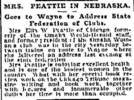
MRS. PEATTIE IN NEBRASKA.
Goes to Wayne to Address State Federation of Clubs.
Mrs. Ella W. Peattie of Chicago formerly of the Omaha World-Herald staff, and former president of the Omaha Women's Club was in the city yesterday between [?] en route to Wayne where she delivered an address last evening at the state federation.
Mrs. Peattie is enjoying excellent health and is one of the busiest women in the country. What with her special book review [?] on the Chicago Tribue magazine writing and book work, together with lectures and innumerable other duties her is more than occupied.

268
RAISES THE AGE OF CONSENT
Benedict's Measure Comes Up and Is Finally Recommended for Passage.
Amended to Protect Men from Blackmail at the Instigation of Unchaste Women.
Eloquent Appeal Made by the Member Who Introduced the Bill -- Political Gossip From the State Capital.
Special Dispatch to the World-Herald.
Lincoln, Neb., March 18. -- The gallery of the house was crowded with men and women this morning. The occasion was the special order for the consideration of house roll 348, Benedict's bill to raise the age of consent to 18 years.
Benedict of Douglas moved to go into committee of the whole. This was carried and McNitt of Webster took the chair.
Chapman of Saline offered an amendment to increase from 18 years to 21 years the age of the man who is to be held responsible.
Benedict opposed Chapman's amendment. The gentleman from Douglas said he had a petition signed by 3,000 women of Lincoln praying for the passage of this bill, and he held one end of this petition while [Jine?] Allan carried the other end over the heads of the members to the other side of the room.
Mr. Benedict said: "Mr. Chairman: I do not believe it will be necessary that any argument should be made to convince the members of this house that this bill should become a law. I cannot believe that any member of this house will oppose so just a measure. The age of 'legal consent' now upon our stature books is 15 years. No one will pretend to say that this is right or just. What does an innocent, confiding child of 15 years know of wrong? When the devil in human form whispers in her ear his damnable lies, she trusts him, believes him. Finally the poisonous fangs sink deep into the heart of that trusting child, her ruin is accomplished, a home made desolate, another soul crying to God for justice. A child of 15 years is only beginning to observe and study, and knows nothing of wrong. It follows then that such a child's judgment cannot be trusted. Men therefore do not entrust business affair not allow children of this age to marry and yet they are credited with sufficient judgment to decide that which pertains to their viatl and eternal welfare. This is a question of right or wrong: not a question of law.
THE CLASS AFFECTED. "Who are the people that will be injured if this bill becames a law? Is it the God-fearing, law-abiding people all over this fair land of ours, or is it the lecherous scoundrels whose name is a stench in the nostrils of all decent people? Does it work an injustice upon anyone who seeks to lead a virtuous, upright life? No, the only one who trembles at this law is that devil in human form who roams the earth seeking out some fair young girl to gratify his hellish lust. When she appeals to him for protection he laughs in her face and casts her from him. He walks out into the bright sunshine glorying in his strength and manly beauty to be received with open arms by fashionable society, petted and feted, and he goes on seeking new victims. Society may frown and shrug its shoulders fora time, but soon forgets or says he is unly sowing his wild oats."
"But you ask what becomes of this young, confiding girl, more 'sinned against than sinning.' Is she received with open arms by this same society? No, not one friend left on earth, except, perhaps, a sorrowing mother or father, crushed, hearbroken and despairing, she knows not where to lay her head. Thrust aside or trampled upon, she seeks to hide her shame by going still further down the way to perdition. She joins the mad whirl and is soon lost to sight in that cesspool of iniquity, the brothel, or maddened with her shame she seeks relief by plunking into the black eddying waters. With one last cry she is engulfed, her soul wings its way to that God who has said he would 'temper the winds to the shorn lamb.' This is no fanciful or overdrawn picture. This is occurring every day and we are doing nothing to prevent it, unless we pass this bill, just as it is drawn.
DOLLARS TO SOULS. "A few days ago what is known as the oleomargarine bill was passed by this house and the reasons given by the great many for voting for it were that so many petitions had been sent in, that they dared not vote against it. Petitions praying for the passage of this bill have been presented nearly every day signed by thousands of our best citizens from all over the state. Gentlemen, do you think more of a dollar than you do of a human soul? Can you consistently give heed to one petition and ignore the other? I hope and believe you will not.
"You ask for argument? Go into the streets of any city in all this broad land, and as night comes down you will see the cunning temper walking stealthily along the street seeking to beguile the unwary into her lair to ruin them as she herself was ruined. She was once an innocent, artless child. Who made her what she is? Man's villainy.
"You ask for argument? Go with me to Milford, and see there the helpless girls with despairing, weeping eyes, deserted, friendless. Some praying for death to to relieve them of their awful shame.
"You ask for argument? Go to the brothel and see there the pained cheek and hear the hollow, mirthless laugh, and ask that erring one if she wants this enacted into a law.
"You ask for argument? Go with me to that vine-clad cottage, as the shades of evening fall. A light is in the window. Step inside the door and you will see a gray-haired mother on her knees in prayer. With streaming eyes she prays to that God who has said: 'Not a sparrow shall fall to the ground without our Father's notice.' She prays for the return of her erring child, who has wandered from her loving arms. Ask her if she wants this bill enacted into a law.
MEASURE IN HIGH FAVOR. "Go with me into the street and see that father who with bowed head and trembling limbs seeks up and down for his lost child. They will all tell you that with all the women and good men of this state this bill is in high favor, and I speak in behalf of the mather and the wives and the sisters of Nebraska when I ask that this bill be recommended for passage."
Mr. Benedict's speech was greeted with great applause, the women in the gallery being, particularly demonstrative.
Chapman of Saline said he offered his amendment in good faith, as he thought the age of the man should be raised.
'Roddy of Otoe favored the bill. He spoke the great earnestness. He said that he wanted to give some protection to the girls. "Mr. Chairman," said Roddy, "I could forgive the man who would cut my daughter's throat, but the man who would bring my daughter to shame I would take his life, so help me God." (Applause.)
Chapman's amendment was defeated.
Casper of Butler said that he wanted to protect the young girls, but he wanted the law so framed as not to assist the blackmailer. He offered an amendment providing that this law should not apply to females who had dealings with different men. Benedict opposed Capser's amendment. Casper said this was a difficult bill to frame. The bill should be amended with great care.
Sutton of Douglas said he had an amendment that was drawn by a Lincoln clergyman. It was similar to Casper's amendment, and he favored the latter. Sutton's amendment merely added the world "virgin" before the word "female," and thus provided that only those who were "virgin females" could be protected by this law.
TO PREVENT BLACKMAIL. Burns of Lancaster wanted to know what would happen if a girl under 18 was an inmate of a bawdy house. Would her guests be liable to go to the penitentiary. Burns said he wanted this bill framed along the lines of common sense. He wanted to look out for the boys as well as the girls, and did not want designing women to use this law as a club for blackmail.
Munger of Lancaster wanted to know if the bill was intended to also protect the depraved female under the age of 18 years.
McNitt of Webster left the chair long enough to say that the opposition to this bill was trying to make a law to [?] the exception rather than the rule. He spoke with his usual force in favor of the measure.
Roddy of Otoe said he did not care if the bill did hit the frequenters of bady houses. "Let such characters take care of themselves or be branded," said Roody.
Conaway of York spoke in favor of the bill.
[Miles?] of Saline also championed it, and said that if the bill would strike a death blow to the social evil he would say "amen."
Casper said Rutton's amendment was better than his and he 'obtained leave to substitute the Sutton amendment.
Cramb of Jefferson said he feared the word "virgin" would open up the opportunities for bad men to attack by perjured testimony the reputation of unfortunate young girls.
COMPARE FAMILIES. Benedict and Burns of Lancaster became entangled in a heated cross fire. Benedict asked Burns how many boy's he had.
"Four boys and four girls," proudly responded Burns. In response to a similar query from Burns, Benedict replied that he had two girls.
Thomas of Hamilton defended the bill.
Speaker Richards made a strong speech for the bill. He said that some day the man prostitute will suffer just as much as the woman prostitute. He said it was rare that a good man was made the subject of blackmail.
Cole of Hitchcook made an earnest speech in favor of the bill.
Davies of Cass, always eloquent, spoke with charming candor. Some of the women in the galleries did not appear to become enthusiastic over Davies' thrusts, but when he concluded with one of his well-rounded periods, he was accorded great applause. Davies said he favored this bill. He wanted to throw every possible safeguard about the girls. But in making amendments to this bill he wanted also to protect the girl who had reformed. A girl under 18 may have fallen and might reform, and after that reform she would be protected under this law. He said he spoke to the criticisms of many women of today. That as a rule, women were the worst foes of the fallen women. There were women who would pass a fallen woman by despising her and ignoring her, and not making a practical effort to rescue her and then hurry to church and drop down before the altar in a silk dress and pray God to rescue fallen women. He was in hearty sympathy with practical efforts as represented by this bill.
TRIBUTE TO MRS. PEATTIE. He paid a fine tribute to Mrs. Peattie, to whom he referred as "That noble woman whose splendid articles in the World-Herald have done so much good for humanity." And he associated with Mrs. Peattie the many good women who were themselves willing to help a fallen women rise without asking God to do all the rescuing.
Robinson of Lancaster in opposing the bill made the "hot observation" that "nature, not statute, fixes the age of consent."
Ricketts made a strong speech in defense of the bill. He detailed some of his experience as a physician among the fallen women and he scored a number of strong points for the measure.
Casper said there had been a good deal of sentimental push on the subject. He related an instance in David City where the girl was notoriously bad, and one young man was selected as the lamb for the slaughter. That young man was sent to prison, and during the trial of the case the conduct of the girl was notoriously bad. He wanted the bill so changed as to meet instances like this.
Johnston of Douglas spoke in favor of the bill. Finally as a compromise an amendment by Bee of Furnas was adopted. This provided, "No female who is notoriously unchaste or is married shall be included in the provisions of this act."
Chapman of Saline wanted to amend by providing that complaint must be filed within forty-eight hours after the offense has been committed. This was defeated.
The committee arose and the house adopted the report.
The house took a recess until 2 o'clock.
GRAVE OVERSIGHT. During the noon hour it was discovered that Bee's amendment was so tacked on to the bill that if it became a law, a man could not be held for rape on any married woman or unchaste woman who was either under or over 18 years of age.
At the afternoon session the house reconsidered the vote by which the report on the age of consent bill was adopted and again went into committee of the whole on that bill.
Great difficulty was experienced in amending the bill so as to meet all requirements. It was first proposed to amend the bill by providing that the clause relating to females under the age of 18 should not refer to those who had "previously became notoriously unchaste, or had been previously married."
Rhodes of Vally opposed this amendment. He said he wanted the law so arranged that girls under the age of 18 years should be protected under all circumstances. He thought the man who would have dealings with a child with or without consent, in a brothel or out of it, should be held accountable and should be shown no mercy.
Griffith of Adams wanted to recommend the bill as originally introduced and without amendment.
Burns of Lancaster sent up an amendment that would make this clause read thus: "If any male person of the age of 18 years or upward shall carnally know or abuse any female child under the age of 18 years with her consent, unless such person shall have become unchaste in character and is over the age of 15 years, every such person so offending shall be deemed guilty of a rape, etc."
Davies of Cass objected to this on the ground that it did not protect the reformed girl. He wanted this changed so as to read: "Unless such person shall be of notoriously unchaste character, etc."
This he said would require that the girl must be "notoriously" unchaste at the time of the committing of the act, and would protect the girl who had reformed. Davies suggestion was accepted and the bill as amended was recommended to pass.
BILL AS AMENDED. The bill as amended is as follows:
Be it enacted by the legislature of Nebraska: That section 13 of the criminal code, being section 5588 of the consolidated statutes, is hereby amended to read as follows:
Section 1. If any person shall have carnal knowledge of any other woman or female child than his daughter or sister as aforesaid forcibly and against her will, or if any male person of the age of 18 years or upward shall carnally know or abuse any female under the age of 18 years, with her consent, unless such person shall be of notoriously unchaste character and is over the age of 15 years, every such person so offending shall be deemed guilty of a rape and shall be imprisoned in the penitentiary not more than twenty nor less than three years.
Sec. 2 Said original section 12 of the criminal code of the state of Nebraska, being section 5588 of the consolidated statutes, is hereby repealed.
House Roll 568, Rickett's bill to suppress mob violence, was considered. The bill provides that counties shall be held pecuniarily responsible to persons who are injured or killed at the hands of a mob. The bill was recommended to pass.
House roll 434 was considered. This is Munger's bill to permit foreign corporations to issue diplomas and to confer degrees of honor. The bill was recommended to pass.
WATSON'S MEASURE. Senate file No. 1 was considered. This is the Watson bill relating to South Omaha and other cities of that class. Harrison of the Hall offered the amendments referred to in another column.
Griffith of Adams said that under the present law it required a vote of the people to change from one class to the other, but this bill provided that the mayor could do this. He was opposed to the bill. Harrison of Hall moved to report the bill for passage. Sutton of Douglas seconded the motion. Griffith moved to indefinitely postpone the bill. Sutton said he had been opposed to the bill, but with the amendments offered by Harrison he had no objections to the passage of the bill. The bill was recommended to pass.
Senate fil 173 was called up by Harrison, but objection was made and the bill went over.
Senate files relating to constitutional amendments were considered as follows:
Senate file 271, providing for the investment of the permanent educational funds, was recommended to pass.
Senate file 273, providing for the fixing the salaries of state officers, was recommended to pass.
Senate file 274, providing for the merging of teh government of cities of the metropolitan class and the government of the counties wherein such cities are located. Sutton of Douglas objected and the bill was laid over for awhile.
Senate file 275, providing for a verdict in civil cases by two-thirds of the jury, was recommended to pass.
Senate file 276, giving the legislature power to create an appellate court, was recommended to pass.
Senate file 279, providing for five judges of the supreme court, was recommended to pass.
ROW OVER VOTERS. Senate Die 280, providing for an educational qualification for voters, was considered and then there was trouble.
This proposed constitutional amendment relates to "male citizens." A motion was made to strike out the word "male." The vote on this stood yeas 32, nays 33. The friends of woman suffrage wanted to discuss the bill a while longer, but their opponents moved to recommend the bill to pass. This was defeated by a vote of 31 yeas and 34 nays. Suter of Antelope proposed to amend by providing "any male or female citizen," but the chair ruled it out of order on the ground that practically the same ques had been voted down.
Barry of Greely moved to indefinitely postpone the bill. The vote on this stood: Yeas, 34; nays, 33. Chairman McNitt said he would vote in the negative, and added that the vote being a tie the motion was lost.
McNitt had ruled that a motion to recommend the bill to pass could not be again made at the sitting, so in order to save the proposed constitutional amendment, a motion was made and adopted to report progress on the bill and ask leave to sit again. When the committee of the whole reported to the house, the friends of the measure moved to amend the report by providing that the bill he recommended to pass, but the motion was lost. The report of the committee of the whole was then adopted.
WANTED A RULE ENFORCED. At this juncture Hairgrove of Clay called for the enforcement of rule 19, which prohibits smoking. The speaker ignored the demand, though Hairgrove several times called for the enforcement of the rule. Finally the speaker said: "There are some things that must be overlooked. The sergeant-at-arms will enforce rule 19, and I will say that if the gentleman from Clay will observe the rules a little more closely, he will be in line with other members. We will have a strict enforcement of rules hereafter, and the gentleman from Clay must observe them."
Hairgrove retorted that he would do his part.
A resolution was adopted to give the Grand Army the use of a room for headquarters in the [aisle?] house.
House roll 309 was made special order for Tuesday afternoon at 4 o'clock.
Thomas of Hamilton made an effort to advance his liquor license option bill, but consent was refused.
Adjourned until Monday morning at 10 o'clock.
At the close of the session the speaker and Mr. Hairgrove met and exchanged compliments. Both gentlemen were decidedly "warm under the collar," and as each has an abundance of grit, there is prospect for fun in the near future.
SENATE PROCEEDINGS.
Australian Ballot Law Amendments Will Come Up Monday. Special Dispatch to the World-Herald.
Lincoln, Neb., March 16. -- The senate was called to order by the lieutenant governor at 10 o'clock.
On motion of Senator Rathbun the senate went into committee of the whole, with Senator Campbell in the chair, for the consideration of senate file 392 and house roll 387.
The first named is Sprecher's bill to abolish the office of county attorney and return to the old system of district attorneys. Senators Stewart and Sprecher, in advocacy of the passage of the bill, declared that the rule seemed to be, under the county attorney system, to elect the poorest lawyers to be found. A list of ex-county attorneys in the senate included Senators Pope, Hitchcock, Lindsay and Sloan. Senator Sprecher explained that those gentlemen were bright exceptions to the usual run of county attorneys.
Senator Noyes amendment to allow the Omaha district to have four assistant district attorneys was accepted, and the bill was recommended to pass.
House roll 387 was then, under a suspension of the rules, read in part the third time. It being apparent that there were not enough senators present to pass the bill with the emergency clause, the further reading was postponed.
All bills relating to amendments of the Australian ballot law were made special order for Monday at 2 p. m.
On motion of Senator Wright his two insurance bills, senate files 98 and 132, were ordered engrossed for third reading. These bills have never been discussed in committee of the whole and there was strong objection made at the time to this advancement of these measures.
The senate adjourned until Monday at 2 p. m.
CAME NEAR HANGING HIM.
Watson Tells Why He Fathered the Anti-Hanging Bill. Special Dispatch to the World-Herald.
Lincoln, Neb., March 16. -- In the house, with which branch of the legislature now rests the fate of the bill abolishing capital punishment, the fight is being vigorously waged by the friends and opponents of the change. Both sides are gathering their forces for the final struggle. The friends of the bill express confidence in the result, and its opponents are claiming that there will be a close vote.
Senator Watson, who has since his first term in the legislature been an earnest advocate of all bills on this line, was asked today when and why he came to adopt his opinion that the death penalty should be abolished. The answer in effect was this:
The why is because of the conviction.

269
THE FOUNTAIN OF YOUTH
A ROMANCE OF THE SUPERNATURAL By Mrs. Elia W Peattie.
CHAPTER I I am no dreamer. I am not sentimental. I have been educated to be severely accurate. My grandfather was a professor of higher mathematics in a well known eastern university. My father was also an instructor in the exact sciences. I was educated in the west, and, having been graduated with-out honors, calmly faced the fact that there was very little use in the world for a dull young man who had chosen to call himself an ethnographer - or at least a student of ethnography. My friends wanted me to write a book on this subject in which I thought I was interested. As I had no knowledge which was not second hand, and no theories which were not some other man's, this was completely absurd.
Living in St. Paul as I did, I found no lack of opportunity for pursuing my favorite [reflections?], for there are races of men in plenty at that place, but ethnography like many other subjects, is a study which is pleasantest confined to the leaves of a book in a quiet library. What cause had I to be practically interested in the origin of my laundryman, of my bookmaker, and of my waiter? None. Abstractly, the race question was interesting. Concretely it was stupid. In short, I was a fool. I was in earnest about nothing. My boasted common sense and accuracy, my power of concentrating my mind on one thing to the exclusion of others which had been thought so fine an attribute at college and my disdain of the pleasures of other young men, began to seem very [pool?] things indeed.
I got so last that I would have bartered that huge library left me by my scientific and lugubrious ancestors, and all the learnings which I was supposed to have accumulated, for the cheap ability to enjoy myself for one hour in the hearty way that other young fellows enjoyed themselves. In my desperation I even thought of throwing ancestral precedent to the winds, and engaging myself as a salesmen in a dry goods store and experimenting with the simple pleasures of half holidays and lunches in the corner restaurant.
It will be seen that I was rather a poor fellow. I prefer to make this plain at the outset that I may appear as I am - the historian of certain events, and not the hero of adventures.
It is necessary though disagreeable, for me to tell a few facts about myself. They are not amusing facts. Having passed my early boyhood in a great library which was guiltless of fiction, and my later years in school under the supervision of a number of very grave and thorough old gentlemen. I had no experiences which were not associated with the school or my quiet home. I was not acquainted with life, with amusement, with women of any sort or degree, or with speculation in any form, except intellectual speculation in line more scientific than sentimental. By sentimental I mean political, ethical, and religious. These things, being matters of opinion, prejudice, or passion, had no interest for me.
Unfortunately I had a little money - which effectively threw cold water over what slight ambition I might naturally stand possessed of. This is the mental portrait of myself - Hilbert I Shadwin, aged 25. My physical portrait I cannot give I have never been able to make out what sort of a man I was in appearance, and as my acquaintances have preserved a unanimous silence on the subject I must suppose that they also have found it difficult to note any individuality in me.
Most expectedly, and just when I had come to consider myself absolutely useless, a use was found for me. I was invited by the government of the United States, at the suggestion of some influential friends, to go south and count the Seminole Indians. Counting in this case, meant something about their present habits of [?] their dispositions, their outlook and their general condition. I took fresh heart at once and thought with disdain of the white goods counter and half-holidays and determined to justify my family name by doing something worthy of it.
I reflected that I might not find something original to write about. My faint desire to prepare a work on the cave-dwellers of North America vanished and I determined to employ that practical sense which I had often been told I possessed - perhaps because I could be accredited with nothing better - and put my foot on the first ladder of a reputable career.
That is how I found myself at St. Augustine at the Hotel Ponce de Leon, smoking from a lofty balcony upon a scene of such luxuriant beauty as my northern eyes had never seen even in dreams. Is it necessary for me to describe that remarkable place, with its courts, its Spanish architecture, its mountains, its wonderful grays of ground and wall and wharf, its peculiar cosmopolitan life or its atmosphere of exquisite indolence? In a way St. Augustine is like Saratoga. At least one meets with a most remarkable collection of celebrities there. Not that I knew any of them. I knew no one. I knew nothing but the wharves, by the green water, the palmettos, the indigo skies of the night, the heavy perfume of the Magnolia. They were all new to me. They were intoxicating. At first I fought against the languor and the enticement of it all. It did not seem in accordance with my new resolutions. But in time the beauty was too much for me. I let my dreams of ambition float splendidly through a brain that was becoming intoxicated with beauty - with novelty- with the sudden-found joy of real living.
I was obliged to wait where I was for several days, for I had been requested to go southward in the company of an engineer corps, which was to survey a part of the Everglades adjoining the Big Cypress.
At the old Spanish fort I fell in with a gentleman who was afterward to become a firm friend. Perhaps you have never been at the Spanish fort and do not know the feeling one has as he walks through the labyrinth of dark and moldy passages, nor the sensation of disgust and almost fear that one has when he is left alone for a moment in the dungeon. A place so solitary and so terrible in its gloom that it seems impossible that men living in it kept their reason. I became so interested in the place, and so fascinated with the rain of reflections summoned by the dark chambers and the wild shadows jumping up and down in the flicker of the torches that suddenly I found myself alone and the guide and party with whom I had come quite out of sight. At first I thought to stand still, and wait for the return of the party, then remembering that I had spoken with no one, and that probably my existence had not been noticed. I concluded that it would be best for me to go on in the hope of finding some passage that should bring mee to safety, to daylight. I wandered for several moments and was on the point of [bellowing?] for help when I stumbled upon a form in the darkness.
"Sir," cried a voice indignantly.
"I beg your pardon," I said taking off my hat though we were in profound darkness.
"I should say so," said the voice.
"Now that we have met," I said very politely - for I had not then enough experience with the word to realize the value of rudeness - "perhaps you can tell me the way out."
"I can do nothing of the sort, sir! Do you suppose I am walking around in this hell's own hole for pleasure?"
"I see my mistake sir," I apologized, "I beg your pardon."
"I'm glad you can even see a mistake sir" [?] interrupted my companion, " for I'll swear I could not see the devil himself if he were to appear."
I began to get irritated.
"You seem to have a very intimate acquaintance with the lower legions," I said. "It is likely to become more intimate," retorted the voice.
"I hope your remarks are not personal," said I, tartly.
"My dear sir," responded the voice in protest, "nothing is further from my thought. It's just my way, sir, nothing more I assure you. I am always getting myself in hell's own hole with my darned foolishness. Shake hands, sir" I had a good deal of difficulty in finding his hand, but after the two of us had plunged around in the gloom for a few moments I received the gentleman's hand in the region of my left lung. He apologized, our palms met, and we were friends.
"I would like to give you a card, sir," said my friend.
I should be very much pleased. Under the circumstances, you might give it to me verbally." He did. His name was Thomas Bridges. His occupation was a difficult one - he was engaged in killing time. Apparently he was not a dead shot at it.
"Speaking fo the devil," he cried, suddenly, " there he comes!" It looked as if he was right. A towering figure, which seemed to fill the passage, and to [lap?] over on the wall above, came down the long vista of blackness toward us surrounded by radiations of dim fire. It was a guide with a torch. he seemed surprised at finding that there were two of us.
"I remember you," he said to my companion, "but I [hain't?] no rekulection of t other." I was not hurt. It was what I had expected.
You have done me a service already" said I. My companion looked me over by the light of the torch.
"Huh" said he, concluding the survey. "I'd just as soon do you another. Shake hands again." This time we did it without embarrassment. And I thought I had never seen such a peculiar or such a friendly young man. We were not sorry to get out of the cave and to return to the luxurious surroundings of the hotel. We dined together and I told him what my mission was. He listened attentively.
"I'm going with you," he announced.
"But, my dear fellow," I [?] "you'll never be able to kill time down there. From all I hear you are more likely to kill yourself with breakbone fever."
"That will suit me better," he said sullenly. I saw it would be indelicate to make a reply. His remark had evidently aroused an unhappy train to thought for he did not speak to me the rest of the evening, but sat staring up at the stars, and listening to the metallic stirring of the foliage in the court til he shook hands and made his way to his room.
The next morning there arrived from New York the corps of engineers which I had been expecting. The chief had the advantage of me by not more than five years. I was disappointed at finding him so young. I was shy with young men. Bridges was the first fellow of my own age that I had ever felt comfortable with. But then it did not matter how old Bridges was. His individuality would have been the same whether he was 16 or 60. I am sure I should have been struck with him under any circumstances.
This young engineer was very elegant- much more elegant than there was any occasion for, I thought. He forced me into all sorts of elaborations of manner. But he had no effect on Bridges.
"I should get in hell's own hole," he confided in me, "if I tried all the sort of thing" - meaning Bryan's fine flourishes.
"I shouldn't wonder if he is a nincompoop," I said to Bridges.
"No, there you're wrong," he said, thoughtfully, "He may be a gentleman, but he is not a nincompoop."
"I hope," I said rather coldly, "that you don't think it requires any apology for one to be a gentleman?"
"Well," he returned," I don't know I'm one myself, in a way. At least my folks haven't done anything for three generations and I guess that makes a gentleman of me. And I have always been apologizing to every one I've ever met with, for encumbering the earth."
It is always impossible to tell whether Bridges is a guying man or not. I was saved a reply by the appearance of Paul Bryan, the engineer. He was as handsome a fellow as I ever laid eyes on. In height he lacked a quarter of an inch of six feet. His legs and arms were fine enough to be cut in marble. His face was severe, calm and rather massive. His eyes were gray, his voice was rich, his tone incisive, and his carriage commanding. It was easy to see that the twenty men under him recognized a leader in him.
He bowed to first one and then the other of us. At this Bridges sniffed the air.
"If it suits your convenience, Mr Shadwin," he said to me, "we will leave tomorrow morning, immediately after breakfast."
"I am at your disposal Mr. Bryan"
"You are on no account to inconvenience yourself." he protested.
"But I have no plans." I returned, somewhat impatiently.
"I hope I am going to be invited," broke in Bridges, "for I certainly intend going."
"An invitation is superfluous," gravely returned the engineer, "you will be perfectly welcome. And," he hesitated and flushed, "and -I hope that we are going to be very good friends." He lifted his hat again and hurried out. We looked at each other -Bridges and I- and smiled.
"Why, he's not a pig after all," cried I.
"I tried to dislike him," Bridges confessed,"but there was something in him that made me fell if a man were in hell's own hole and Bryan was by, he would help him out."
The next morning we started - twenty-two of us. We were all young fellows, and were anxious to get the most out of everything, so that we weren't well on our way before we became conscious of a decided and very gratifying esprit de corps. Bridges was the gayest of the party, ostensibly, and yet he said to me as we ate together "If I get the breakbone fever I shan't care a-tarnation!". And he was silent for ten minutes after he had made this remark. Bridges didn't look like a man with a secret sorrow. But then, it is difficult to judge a man's soul by an outward sign, and it is possible that even a man with a big nose, such as Bridges carries around with him, may have the soul of a Romeo.
By say or night, a journey through Florida is wonderful. it is mysterious. Above all, it is melancholy. The pine lands of the north are gayety itself compared with the pine lands of the south. Bryan's merry fellows kept up noise enough, but when we dashed through one of those cypress groves where the trees loomed gray as ghosts and black shadows hung over the vistas like shrouds, I had to go away by myself and give up to the feeling of settles, but not distressful gloom. Once I caught Bryan's eyes fixed on me with a flush, and we did not speak. But

270
THROUGH FRENCH OPTICS
A Critical View of the American People by Paul Bourget.
The Analytical Race Specialist Tells What He Thinks of Us After Twenty Days' Inspection
Some Criticisms of His View by Mrs. Peattie - We Are Children, but We Are Glad of It.
We have been viewed and reviewed - we Americans, by any number of foreign visitors. Some of them have been foolish, shallow and provincial, some have been honest, earnest, and even profound. A great many have babbled nothings and bored us to the verge of extinction. Some of them have been simply stupid, and have taken the bad manners of foreign immigrants, finding hospital in this country, as the standard of American manners.
But the other day a great observer of men came among us, and viewed us as he had viewed many other people, from the point of view of Race. Since "Cosmopolis" was written, Paul Bourget has stood identified with the question of Race -the great modern delineator and discriminator of [?] -the man who reads humans as the Egyptologist reads hieroglyphs. His facile and scholarly genius has become identified with this question, and it is, therefore, with profound interest that one reads what he has to say about the American race, that new, yet very individual thing, which yesterday was not, and which today embodies so large a part of the best energy and pride in the world.
For it is in fact that while other nations grown languid, sated and overcultivated, so that patriotism has degenerated in them into a vanity or disappeared altogether into a vague cosmopolitism, that in America the sentiment strengthens and grows, bracing itself as foes to its principles appear, growing defiant as philosophers threaten its overthrow, and asserting itself passionately with the vehemence of youth and of faith.
All this is a part of the involuntary and spontaneous effort of the American race to create, formulate and cement itself. Indeed, we have cast the mold, and given it free, strong lines. It is hardening now. and by and by we will take it out of the mold. It will be finished. Time will behold it, and will begin its work upon it. It will mellow it, beautify it, and, presently, begin to weaken it. The ravages will become apparent. And the disintegration will come - home many centuries from now?
But never mind.
That is altogether another, a different story.
M. Bourgel's first impressions of American, on leaving the steamer, appear to have been that we are rather terrible. He certainly considers us astonishing. We gave his nerves a tingle - even a shock. And it must be admitted that we are horribly noisy and brutal in our business life. To be sure, he enjoyed the harbor, it would be hard to forgive anyone who did not enjoy the harbor of New York.
"On the morning of the seventh day we come in sight of New York - a summer's morning, burning and veiled. We were not able to enter yesterday, and I am glad of it, before the inconceivable picture of this arrival. The steamer is mounting the mouth of Hudson, which forms the harbor for the great town, with a movement as gentle as it had been rapid twenty-four hours ago. This sensation would be worth the voyage alone, so unexpected and profound is it. The enormous estuary shivers and ripples, stirred by the last throbbings of the Atlantic, and, on these two banks, as far as the eye can reach, on the right where New York spreads itself our, on the left where Jersey City swarms, indefinitely, interminable, it is a series of short wooden jetties, broad and covered in. Names are written on them, here that of a railroad company, then of a shipping company, then of another railroad company, and of another shipping company, and continuously also from each of these jetties a ferryboat starts out or arrives in, carrying away or emitting passengers by the hundreds, dozens of carriages with horses harnessed to them, entire trains full of goods. I count five or six of those ferry-boats, then fifteen, then twenty. Enormous, overhanging the green water with their two decks painted in white and brown, they go beating the heavy waters with their iron wheels, and at their summit a gigantic swing beam regulates their uniform movement they go, encountering one another, pushing up against each other, without doing any harm, so steady is their speed, with their appearance of colossal, laborious animals, each performing its task with a conscientious safety."
As for the city itself, he paid that the tribute of being very much surprised at it.
"The two towns, on the right and on the left, continue to extend themselves beyond what you could dream of. Leaning out on the New York side, I can distinguish some very small houses, an ocean of low constructions whence emerge, like islands with abrupt cliffs, buildings of brick so boldly colossal that even from here their height is crushing to the eye. I count the stories above the line of roofs. One of them has ten, another twelve. Another is unfinished. A hollow framework of iron is outlined against the sky, a project of six such stories stop of eight others already built.
"Gigantic, colossal, immoderate, unbridled, words fall to equal that apparition, that landscape in which the enormous mouth of the river [?] as frame to a development of human energy greater than itself. Having reached this intensity of collective efforts that energy becomes an element of nature. History adds to that impression, in order to redouble it, the indisputable bluntness of figures. In 1624, not much more than 250 years ago, the Indians sold to a Westphalian the point of this island of Manhattan. He founded the town, which is there now. The poetry of democracy, and there is really one, lies in those rushes of popular vitality wherein the individual disappears, where the separate effort is but as a note of nothing in an immense concert. It is certainly not the Parthenon, that little temple on a little bill where the Greeks have fixed their ideal; only so much material as was indispensable and spiritual essence sufficient to animate the whole, even to the smallest atom, with measure and harmony; but it is the dark and violent poetry of the modern world which gives you a tragic shiver, so much voluntary and furious humanity holds in a horizon like that of this morning, and it is the same every day!"
Bourget's first mingling with Americans at Castle Garden undeniably gave him a shock. But it seems that his friends had led him to expect as much. Indeed, he tells of one young Frenchman who came here armed with letters of introduction, and all that would have made his visit entertaining. Yet, five days after landing, he took a steamer for home.
"I was not able to stand the blow," was the only reply he made his astonished parents.
Bourget says: "That blow in landing is certainly a severe one to a Frenchman accustomed to that administrative order, the slowness of which one abuses so much when obliged to submit to it, but which we regret when we find ourselves in an Angle-Saxon crowd, where the struggle for life has already its humble and painful symbol in the struggle for the baggage as soon as the boat arrives at the [?].
"An immense shed, crowded with people going and coming, shoving and knocking up against one; gigantic policemen, with huge stomachs protruding from under their belts, who hold themselves in that crowd as columns against which it shall break; custom house officers in unbuttoned uniforms, for it is warm, whose checks are swollen out with a quid, and who expectorate long jets of brown saliva over the floor where the boxes are to be placed; those boxes just arrived and thrown over with a jerk amind the expressmen who offer their checks; carpenters with chisels and hammers to undo and nail up the cases, the arms of employee in the open cases turning and turning over the linen and dresses with the roughness of people in a hurry; then those trunks no sooner closed and 'checked' than they are seized by porters and buried down at the risk of being broken along a sloping plank into the lower floor. A strong smell of human sweat permeates everything. There you have the entrance into the big American city. It was as brutal and as rapid as a boxing feint."
Of course Bourget permits himself to be entertained with all the paraphernalia of our civilization. He is almost irritated at the national genius for ingenuity, and considers the endless contrivances for the saving of time and energy as childish. He can, however, and does, understand a bath tub with hot and cold water, and looks upon that as a more reasonable refinement. He is distressed, also, as might have been expected, about our apparent lack of time.
"At what o'clock does one love?" he cries. "At what o'clock does one die? At what o'clock does one think? At what o'clock, in short, is one a man-- 'nothing but a man'--as old Faust cried--and not a work machine in motion?"
He is exercised for fear we will never even find time to grow roses. He thinks people look too self-centered. He complains because they appear to be engaged with inward thought, instead of being interested and amused by their neighbors. But in all this he finds, as well he may, a nervous and triumphant energy which belongs and only could belong to a race which is young and strong and independent.
So, to pass over all these observations of tricks of living and his comments upon the splendor of the surroundings of the rich, and the prodigality of all, and the rush, assertion, love of display, and candor, let us get at what he seems to consider the salient point.
He is writing of the set at Newport, our "coterie of millionaires," and says: "As the wealthy classes in America have no kind of influence over the elections, the ambitious politician has nothing to do in society. There is no 'institut' here to give te vogue of a wordly coterie which can lead a writer or an artist. Neither is there a center whence literary reputations radiate and which is condensed in a few salons. The girls only exceptionally receive marriage portions, so that the fortune hunters chiefly consist in strangers ruined and with titles, who generally disappear after a season. They feel too soon that old Europe is still the surest ground for that kind of speculation, as on the other hand the morals of the country seem good in the main and that an acknowledged 'liaison' is here a phenomenon, this social life cannot either serve as a screen to the complications of passional life. Reduced in that way to its proper basis, it develops itself more and more exaggeratedly toward gorgeousness and public entertainments, and as everywhere some real food and a positive occupation are necessary to such vigorous activities, this society life ends here at least by turning entirely towards sport. So again, what logically should be a fault becomes a principle of health, so true is it that among the strong races everything develops into force, even frivolity and vanity, while among the people who are getting old even culture and delicacy only end in sickness and corruption.
"How do they amuse themselves?"
"I have amused myself in order to answer that question with a certain amount of precision by following almost hour by hour and for several days the use which some of those women make of their time who are called here 'leaders of society.' I transcribe one of the sketches thus obtained, taking it among twenty others. They are almost all similar by the physiological strength which the display, the taste for out of door life and for exercise, and this way of amusing themselves explains why the ladies of society, instead of being debilitated and having faded complexions and that 'old glove' look, as a cruel humorist put it, like their sisters in all the large cities of Europe, retain on the contrary the freshness of their skins, that suppleness of movement and their vital force. They are aware of it and they are proud of it.
"What pleases me," said one of them, "in considering that I am an American is to know that I belong to a fine and healthy race."
"They do not modify their criticism as regards the Parisiennes. I hear one deploring the change of one of her fellow countrywomen who has married a Frenchman: "She was so robust, with such a good complexion, and now she has become thin and worn, quite sallow," and they laugh in saying such things, and when the dentist has worked there he has put in gold, which shines with such new brilliancy that it no longer has the appearance of an infirmity!"
In another place, in describing a game of tennis, Bourget says:
"At a certain moment one of the young players who has just hit the ball calls one of the attendants to clean the India-rubber, sole of his shoe, which has become encrusted with mud. He contrives during this commonplace operation to assume an attitude so graceful that I can understand a young girl exclaiming, 'Oh! how I wish he would win! He is so nice looking!" a naive exclamation in which the profound admiration of the American woman for looks, for that physical beauty, considered after the pagan fashion. It goes so far, that admiration, that one of the most celebrated athletes in the United States gathers in his box, after the representation in which he has taken part, the women of the best society, and, with the torso naked, gives them a lecture about his body, a conference on musculature. The photograph of that torso, muscular, in fact, like that in the Vatican which old Michael Angelo's hands caressed, is sold in all the shops, and more than one amongst those fair spectators of the tennis [?] one in her little drawing room. 'There are people who consider that very indecent, said one of those women in showing me that singular document of her independence of ideas. I do not. It is a Greek thing, that is all.' "
It is certain that Americans will read this with some vanity. For there have been times when, taking the word of others for it, they have been led to think themselves an enervated race. They have consented to think this in spite of the fact that a larger proportion of their children live than the children of any other nation, in spite of the fact that a larger proportion of their children live than the children of any other nation, in spite of the fact that they are more temperate than the English or Irish, more pure of life than the French, less given to suicide than the Germans, less subject to madness than the Scandinavians, seldom afflicted with indolence like the Italians. All these troubles of brain and body, the result of national hysteria or national vice, appear here in the minimum. Our vices, like our virtues, come from an excess of energy. In very many cases it takes the form of greed. We are accumulators. We do to mean to be merciless, but there are times when some among us approach it. But the strength is there--it has always been there. It has been a torrent that flowed on, from state to state, subduing half a world, and civilizing it till it mocked the civilization of other countries. Nothing in the development of the world has been so tremendous. Nothing has involved such an outburst of intellectual daring and creativeness. Nothing has required such physical courage, such foregoing of sentiment, ease, love of home, caution, and personal indulgence. In another sense, this magnificent exploit of the Americans, which in 200 years has subjugated a wilderness of the mightiest sort, has been supremely selfish. But it has been a selfishness so colossal that it attained dignity, and even heroism.
Weak? No. We never have been. True, some, presuming on their restless ambition, have worn themselves out and fall under the curse of prostrated nerves. But these have served as object lessons, and the man of affairs knows where to put a period to his work now. He cultivates amusement with the same passionate interest that he cultivates business. He compares his son with the son of his neighbor, from physical standards as well as mental ones. He wants his daughters large and beautiful as well as his sons. And a part of the life of almost every home is in the interest in physical sports of some sort or other.
What M. Bourget has to say about our conversation is also interesting, and, though we may not like it, it is true.
"There is in the conversation of the American, and, above all, of the American woman, a second feature which saves from pedantry and stiffness. That feature is their vivacity. There is in their slightest remark a profound flavor of reality, and also in the movement as in the gesture. Never anything abstract or vague; always those words which point, those terms which betray experience. Also they have in no degree that notion of personal effacement which gives a more brilliant varnish to politeness, but which diminishes all the individuality of conversation. They never hesitate to speak of themselves and to recall their voyages, their adventures--what they call, to put it exactly, their experiences. They easily gain by it, having little wit of speech, what one might call the wit of things, a picturesqueness of delivery, which produces an original, novel humor when they mix it with gayety. Here again you may feel beneath the rich woman, like beneath the lavish man, the people quite near. You will also feel this in a certain general naivete of conversation.
"Equivocal insinuations are totally eliminated, and the gossip is rarely of a cruel kind. Mockery is constant, but a mockery which does not tear to pieces. It is carried on above all means of gay anecdotes. The individual features of a character are its main objects. Then follow the social errors, the [?] in taste in the pursuit of celebrities or titled people. These last generally come from Europe, and they prove that the passage from the new world to the old has the habitual result of drawing forth the defects of the Americans instead of correcting them.
"At home in his birthplace he is more simple, more cordial, and, all things considered, when you hear him speak you respect him, you find him good-natured, as they say, without much hatred, without much envy and so easily amused. Forain and to me, after having spent a few days at Newport:
" 'They are children.' "
There were never truer words spoken. It is difficult to prove that they are true. But any American who has known the feeling of intense entertainment upon talking with a cultivated foreigner will perceive what is meant. The flavor of foreign conversation is very sweet to most of us. We listen to it, fascinated. We perceive in it something that our best learning, our most honest efforts, our amiability, frankness and experience will not give us. We are, in fact, naive, simple direct--or, if subtle, it is with a transparent subtlety. The complex mental makeup of the foreigner therefore baffles and diverts us. And, by acknowledging this superior mental adeptness, we confess our own simplicity. It is nothing to be ashamed of. It is, in fact, one of the characteristics of the new race. It belongs to youth. It comes from the necessity of dealing with things directly. It is the result of seeing things themselves, as they are, and not in seeing the ideas about things. It shows personal contact with labor, with difficulties, with detail, with law-making, with school building. It stands for all that is the antithesis of idleness. It is the antipodes of aristocracy--that is, of decay. It is the heart and soul of a democracy.
M. Bourget is a genius. True, he might have health better with us if a good many of us who are not millionaires could have shown him our home life. But he has done exceedingly well as it is, and we are obliged to him.
All of which is another sign of our simplicity. For if we were a more developed nation we would be outraged at this scrutiny. We would rise up to cast out the man who approached us with a microscope in his hand to examine us as if we were disease-bearing [animaculm?]. But being what we are, a simple race, more or less spectacular, given to viewing ourselves from an objective point of view, we consent to be examined, and are almost as delighted as the scientist when a spot is discovered on back or belly different from that of any other of our tiny tribe. Yes we, the new race, are conscious of our newness. We make a boast of it. For man must make a boast of something. And since we are debarred of all legends of antiquity may we not have new tales of prowess--tales of lands and seas subdued? Of many races moulded into one? Of a passionate attempt at government which is so near the ideal that poor human nature only found its balance by abusing and debasing every principle of it? Have we not higher mountains, larger inconsistencies, bigger buildings, finer ships, more steam and electricity, more beauty and energy--yes, even more refinement and delicacy--than any other nation? Aye, verily, we have found a way to heap excess on everything. We are extremists. We gorge ourselves, whether it be with money, power, splendor or refinement.
We are children!
But it will be just so much longer for us to live!
So, here's to you, Paul Bourget! Perceiver! Genius! We drink your health with the assumption and the gaiety of youth. For it is wonderful to be young! ELIA W. PEATTIE.
THE DIAMOND NECKLACE
Sunday morning two young men sat in the smoking room of a cozy apartment. Outside the snow was falling silently in great blue white flakes.
On the [?] his tail and legs ornamented with tufts of curly black hair, his body shaved in the approved fashion, a poodle slumbered peacefully, and Floyd Taller, the owner of the premises, altered in a smoking jacket of a horsey plaid, was [?] in an easy chair, his slippered feet stretched toward the fire. His companion, Arthur Van Stade, had been his greatest friend at college, and this was their first meeting in three years. Van Stade had been in India killing big game, and had barely escaped having the tables turned, as a large scar across one cheek testified, according to Kate Field's Washington. Taller had stayed at home, but to him had come the greater change. As he expressed it, he was a "settled down, old married man with a family"-which meant that he had the sweetest little wife in the world and a tiny [mite?] of [?] and white humanity, known in the house as a baby.
"That's a rather fine dog you have there, Arthur," said Van Sade, turning to the poodle and lazily looking over the sleeping animal.
"Well, I should think so," replied Taller. "I don't suppose you will believe me when I tell you that when he came into my possession he was worth no less than $1,000. The spring after you went away," he went on, "having finished my college course I went over to the other side for the London season. I went to London, and in London I stayed long after the time allotted to that city had expired. It was there I met Edith. In six weeks we were engaged. The remainder of the season I passed in Scotland with the family of my fiance. They had planned to go to Nic when the cold weather came on, and of course, I determined to go with them. We went as far as Paris together, but at the last moment I was detained in that city for a few days, and was obliged to allow the rest of the party to proceed without me, promising to join them in a week at most.
"I had run short of funds and the remittance expected from my father had not arrived. This I did not consider necessary to explain to Edith and her family. I said vaguely that business kept me in Paris. Four days after their departure the letter from my father had arrived. He had heard of my engagement, and, to my satisfaction, approved of it. Besides the amount expected he sent an additional $1,000, with which he instructed me to buy a suitable present for Edith. If the modest diamond I had bought her for our engagement had been my only gift, I was pleased and gratified with my father's generous present.
"The following morning I started out in search of something for my dear girl, whom I should be with the very next day. I visited all the leading jewelry stores on the Avenue del Opera and and was so confused by the glittering array of games spread out to [?] the American dollar from wealthy travelers that I could decide on nothing. My $1,000, which had seemed so much, now appeared ridiculously small and I had almost despaired of finding anything worthy of my beloved when my eyes fell upon an extremely beautiful necklace, consisting of two rows of pearls caught together at intervals by small diamond clasps. It lay in a velvet case of azure blue and the moment I saw it I decided that it was just what I wanted.
"I asked the price.
" 'Five thousand francs, monsieur,' replied the salesman.
"Exactly the sum I had to spend! I bought it without a moment's hesitation. The little blue box was about to be wrapped up when the salesman discovered some imperfection in the clasp. He was profuse in his apologies and said that it would be repaired and ready for me the following morning. I explained that this would not do, as I was to leave the city on the night express for Nice. After a moment's hesitation the jeweler promised that I should have it at 6 o'clock, without fail.
"As I was leaving the store I noticed a woman standing by my side; it would be more correct to say that I noticed a beautiful white hand with long tapering fingers, on one of which was a diamond of unusual size and brilliancy. In her hand was a small jeweled watch, and as I was leaving the counter I caught a few words spoken in a peculiarly musical voice. I was too full of the thought of Edith's happiness on receiving my gift even to glance at the woman's face; and long before I had reached the sidewalk she was forgotten.
At 6 o'clock I returned, and, true to his promise, the man had the necklace ready for me. Placing it in the inside pocket of my coat, I left the store and had just time to complete a few remaining arrangements before going to the station. I bought a first-class ticket and tipped the guard, after giving him to understand in my very best French that I did not want him to put other passengers in my compartment. I tucked my traveling rug around my knees, opened a French novel, when the door was opened and a woman hurriedly entered the compartment and took the seat next to the window on the other side of the car. I glance at my unwelcome companion. She was dressed in mourning of the richest material and in perfect taste. As I was noticing these details something by her side that I had at first taken for a fur cape moved. It proved to be a black French poodle, and as he sat up and turned his head toward me I saw that around his neck he wore a broad silver collar, from which [?] a peculiar heart-shaped padlock.
"Turning my novel I soon forgot the intruders, nor did I again think of them until perhaps half an hour afterward, when I was startled by feeling something cold and wet pressed against my hand. It was the poodle's nose. He had crawled across the seat and was evidently desirous of making my acquaintance.
"Chico, come here!" exclaimed a singularly familiar voice.
"The dog paid no attention to his mistress, but wagged his tail contentedly as I stroked his curly head.
"You must excuse the dog, sir,' said my companion. 'He is a great pet and expects everyone to notice him. I am afraid he will annoy you.'
"I protested that he would not, and added that I was fond of dogs, poodles in particular. Perhaps my answer was due in part to the fact that the woman was young and beaitufl. I had only that minute become aware of this, the