
46
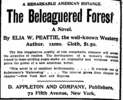
A REMARKABLE AMERICAN ROMANCE.
The Beleaguered Forest
A Novel.
By ELIA W. PEATTIE, the well-known Western Author. 12mo. Cloth, $1.50.
The fine imaginative quality of this remarkable romance will arrest the attention of readers. The development of a woman's character traced in these striking pages shows an originality and vividness which prove the power of a new American writer.
"This novel is of excellent workmanship..... It reminds one of Sudermann's 'Katzensteg.'... The interest grows from chapter to chapter." --New York Mail and Express.
D. APPLETON AND COMPANY, Publishers, 72 Fifth Avenue, New York.
47
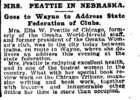
MRS. PEATTIE IN NEBRASKA.
Goes to Wayne to Address State Federation of Clubs.
Mrs. Elia W. Peattie of Chicago, formerly of the Omaha World-Herald staff, and former president of the Omaha Woman's club, was in the city today between trains, en route to Wayne, where she delivers an address this evening at the state federation.
Mrs. Peattie is enjoying excellent health, and is one of the busiest women in the country. What with her special book review work on the Chicago Tribune, magazine writing and book work, together with lectures and innumerable other duties her time is more than occupied.

48
INTEREST CENTERS IN ELECTION OF OFFICERS
Proceedings of Yesterday's Session --Mrs. Peattie Arrives and Is Accorded Pleasant Reception.
Delegates of State Federation of Woman's Clubs Now Involved in Club Politics.
Special Dispatch to the World-Herald. Wayne, Neb., Oct. 9. --The morning session of the convention of Woman's clubs was opened by President Mrs. Draper Smith and was devoted to reports of clubs of which forty-one were represented and eighty-three delegates present.
Reports indicated especially gratifying work in club extension, library making and civic and art studies.
In the reports Mrs. McKillup of Seward scored a decided success in rhyme; Stanton reported a young woman's club; North Bend a handsome woman's club, and Plattsmouth admitted asking the assistance of the men in carrying out literary work, while the Genoa club coyly declared they were said to run the town.
Mrs. Draper Smith declares the development of chid nature to be the paramount object of club work.
Mrs. Heller of Omaha is here in the interest of help for kindergarten work among negro children, claiming the race problem will be solved when we train the younger members into rounded character as kindergarten education alone does.
Mrs. Etta R. Holmes of Kearney is arousing much interest in industrial reformatory work.
The greatest interest centers in the coming election of officers. This year's force are deservedly popular. Their efforts in the direction of economy and simple business methods have been greatly appreciated. There is talk of having an early election, as many prominent women leave before Friday morning.
Omaha delegates are all in and many visitors with them, among whom are Mrs. Hoobler, Mrs. Heller, Mrs. Keysor, Miss Margaret McCarthy, Mrs. Damon, Miss Laura Gregg and Mrs. Pratt.
Mrs. Hall of Lincoln has a fine display of pictures in the lecture room of the Presbyterian church, where the meetings are held, among them being some fine work by local artists.
Wayne people have displayed artistic taste and talent in the decoration of their homes and business houses. The decorations are in the white and yellow club colors. The citizens of the town seem inspired by the one impulse of hospitality.
Upon the opening of the afternoon session at 2 o'clock, Mrs. Towne of Omaha moved that each club belonging to the federation be requested to give an entertainment and devote proceeds to the help of southern kindergartens. The motion carried and club delegates were instructed to consult with their clubs and report to Mrs. Heller, who has the matter in charge.
Last year's unfinished business was then taken up and the amendment making the presidents of federated clubs the nominating committee carried.
The amendment making annual dues of clubs of fifty or under $3 instead of $2 was carried. Upon objection the vote was reconsidered.
The art session, with Mrs. Hall of Lincoln in the chair, was much enjoyed. Mrs. A. W. Field of Lincoln had a fine paper on "Benefits Derived from the Study of Art." Mrs. Jennie Keysor of Omaha spoke earnestly on "Art Study in Woman's clubs" and explained her outline of art study for clubs.
Interesting papers were read by Mrs. Morey of Hastings on "American Potteries," and Miss Butterfield of Omaha on "American Pottery at the Pan-American Exhibition." Mrs. Belle Perfect of Omaha spoke on "Western Potteries" and Mrs. Fuller of Ashland on "Public Influence on Ceramic Workers."
The federation voted a special business session at the close of meeting. The amendment to increase the annual dues from $2 to $3 was passed to go into effect one year hence. To relieve present lack of funds a voluntary contribution of $1 from each club in the state federation will be asked, thus doing away with a per capita tax.
A motion was carried to instruct the nominating committee to report the ballot after the close of the Thursday morning session that the vote might be taken at the afternoon session, enabling the convention to close Thursday evening.
A reception to the federation was held in the evening at the beautiful home of Mrs. John T. Bresslor, president of the Wayne federation. Receiving with Mr. and Mrs. Bressler, were the guests of honor, Mrs. Elia W. Peattie of Chicago and Miss Margaret J. Evans, vice presidents of the general federation, also the officers of the state federation and the presidents of the federated clubs. The house was profusely decorated with American Beauty roses, palms and ferns. The Wayne Mandolin club discoursed sweet music and the Wayne Juvenile club served dainty refreshments. The costumes and women were unusually beautiful. Mrs. Parkhurst of Chicago accompanied Mrs. Peattie and assisted in receiving.
49
MRS. DRAPER SMITH OF OMAHA IS PRESIDENT
State Federation of Woman's Clubs Elect Her to Act for the Coming Year
Mrs. Elia W. Lebingier of This City Is Corresponding Secretary - Mrs. Peattie's Talk.
Special Dispatch to the World-Herald.
Wayne, Neb., Oct. 10-The following Woman's club federation officers have been declared elected from the ensuing year.
President Mrs. Draper Smith, Omaha; vice president, Mrs. Wunnue Durland, Norfolk; recording secretary, Miss Ninette Mcarn, Fremont; corresponding secretary. Mrs. Ella W. Lobingler, Omaha ; treasurer, Mrs. George Cross, Fairbury; auditor, Mrs. H. M. Bushnell, Lincoln: librarian. Mrs. Belle M. Stoutenbrough, Plattsmouth.
The convention convened in special business session at 10:30. The vote was taken at once. While waiting for the count, greetings were read from the Iowa federation. The report of the committee on library extension was then read by the chairman. Mrs. Stoutenborough, who stated that the library bill originated by the federation was passed by the state legislature creating a state library board and that this is the first state having such a bill originated by women in which the women have no representative on the board.
Mrs. Stoutenbrough also read a request from the Stat university that the library of the federation be turned over to them. A motion was made to that effect and after spirited discussion carried.
ON HOUSE ECONOMICS.
The department of household economics then took charge of the meeting. Mrs. Baker of Norfolk presiding. She gave a report of the house economic work in the state, indicating great interest and giving great credit to Mrs. MacMurcphy and Mrs. Pugh for inspiration and assistance. An excellent program was carried out by Mrs. Stuele of Fairbury. Mrs. McMillan of Norfolk and Prof. Rosa Bouton of Lincoln.
Business was then resumed and the following delegates elected to attend the biennial which meets in Los Angles next July: Mrs. Mathewson of Wakefield, Mrs. Bushnell of Lincoln, Mrs. Cross of Fairbury, Mrs. Stoutenbrough of Plattsmouth, Mrs. Pile of Wayne, Mrs. Langworthy of Seward, Mrs. Draper Smith of Omaha and Mrs. Burland of Norfolk.
The new officers were inaugurated amid great enthusiasm.
At the evening session Rev. C. S. Harrison of York delivered an able address on the "Practical and Aesthetic Value of Forestry," after which Mrs. Elia W. Peattie of Chicago was introduced and held the audience in delighted interest for an hour.
MRS. PEATTIE'S PAPER
Mrs. Peattie's paper had for its subject "The Trend of Americal Social Life," and it deals with society in the general, rather than its specific and fashionable sense.
The inability of the country to sustain its ideals of equality was touched upon and the different forces that work for democracy were considered. Mrs. Peattie said American social life started out with the postulate and all men were born free and equal, and to this there is only one objection: that it is not true. In the boyhood of the nation we believed it; now in the period of swaggering adolescence we have discovered that there a number of persons who are not equal to tough we have of course yet to find any to whom we are not equal. That dull discovery remains no doubt for the lack-luster days of our national maturity.
A number of humorous anecdotes followed, illustrating the speaker's meaning concerning the servant class. Mrs. Peattie said "We say down in the cities that the servant class is quite established and demarked nowadays but we are wrong. No servant class has yet been established in America which is content to remain such. There are always ways down which the most menial may look and at the end of which arise palaces of dreams." Concerning caste the speaker said an English lady visiting the country for the first time asked me the other day if it was true that we had not caste, American caste, I said is something like the mist on the mountain side-it looks as if it were there when you see it from a distance, but as you draw closer to it it becomes impalpable, or can be felt only by a slight chill which pervades your body but to which you presently become accustomed."
TYRANNY OF EQUALITY.
Mrs. Peattie called the tendency of trades unions the "tyranny of equality." She said women did not gravitate towards these unions because they are distinctively individual. She said "America is the friendliest nation in the world; the American spirit is in league to protect the country fro caste. There being no entail on property, a man must have ingenuity and industry to keep properly earned fro him by his father."
The speaker said: "We Americans do not want a settled social life: we have it puzzling and progressive like euchre." The speaker declared the faults of America were those of youth which is perhaps its own apology. It was because of our youth that our Columbian exposition excelled in beauty the expositions of older countries. We were humble before beauty; knelt at her feet; asked her blessing. She said our flag was run up first above the city of Pekin after the siege--not because we had any right before the other powers, but because our boys thought it would be good to have it first. That the exuberance of our youth hurried us into our late wars.
Mrs. Peattie made a plea to club women for loyalty to each other and to the great work before them to avoid criticism of each other and work together for the end in view. Mrs. Peattie said in conclusion the American is an optimist; gay, bright and fucile of intellect, yet not a scholar; oratorical and eager, but seldom profound. A man of action, the captain of commerce; the inventor but above all the world's jack of all trades who whistles defiantly as he works. In society he is prodigal, hospitable, inclusive, slightly timid, a trifle bored, not unscornful of etiquette and not beyond the notion if he be an honest and intelligent man, he of necessity, be a gentleman.
Thus closed the seventh annual convention of Nebraska Federation of Woman's clubs.
MORNING SESSION
The convention convened this morning at 9:30 in business session to consider the report of library committees and consider the Louisiana Purchase memorial. Owling to the rain and a meeting of state presidents as a committee to nominate officers, the meeting was small and Mrs. Storutenborough, having the library report asked for postponement, as the matter was of such importance, which was granted to her.
The report of the Louisiana Purchase memorial was read by Mrs. Jayne. Nebraska women were asked to assist in erecting somewhere in the Mississippi valley a memorial to suitably commemorate the purchase and the growth and work of the state comprised in the purchase. Suggestions were offered by the committee, which met at Kansas City, for that purpose. After some discussion all matters pertaining to the memorial were referred to the nominating committee, composed of the presidents of the clubs belonging to the federation.
The constitution committee reported several by-laws covering necessary changes relating to the new amendments taking effect next year.
Mrs. Smith then reminded the federation that this convention elected the delegates to the next biennial meeting of the general federation at Los Angeles next spring. One matter to come before that convention would be whether representation in the biennial conventions shall be by state federation or by clubs.
After a little discussion of this matter it was left to later meetings and Mrs. Peattie, the guest of honor, who arrived last night, was asked by the president to speak to the convention. She came to the platform amid cheers and waving of handkerchiefs.
Mrs. Peattie congratulated the convention on its work in the direction of public libraries. She also indicated some preference for representation at the general federation of clubs, instead of state federations, as that would have a tendency to strengthen and develop inexperienced women, instead of fostering the opposite tendency, to which state federation representation rendered us liable that of sending the same strong, capable women year after year.
She also touched broadly on the question of colored representation. Mrs. Peattie's remarks were roundly applauded.
PAPERS PRESENTED.
The session was then turned over to the program committee, which gave an excellent program on industrial subjects, with Mrs. Amanda M. Edwards presiding. Papers were read by Nellie Elizabeth Cady of St. Pail on the Girl's Industrial school at Geneva and other state institutions by Mrs. Elizabeth Sisson, Norfolk, on the Nebraska Industrial home at Milford: by Mrs. M. D. Carey of Seward on "Women and Children as Employes;" by Etta R. Holmes of Kearny on the "George Junior Republic." Mrs. Presson of Milford being absent, Mrs. Snow of Columbus read her excellent paper on "Parental Schools and Courts for Juvenile Offenders."
A special business meeting was then held at the close of the program to receive the report of the nominating committee.
BIG MEMORIAL TO M'KINLEY. Plans Made for Raising $1,500,000 by Popular Subscription.
Cleveland, O., Oct. 10.--The trustees recently appointed by President Roosevelt for the National McKinley Monument association met here today and organized by electing the following officers: President, William R. Day, Canton, O., vice president, M. A. Hanna, Cleveland; treasurer, Myron T. Herrick, Cleveland; secretary, Ryerson Ritchie, Cleveland.
The headquarters of the association will be located at Canton. It is proposed to raise about $1,500,000 by popular subscription to build a marble memorial at Canton in honor of the late president.
Real Estate Transfers.
The following real estate transfers have been filed with the register of deeds: F. H. Gains and wife to M. H
Hawes, e80 feet, lot 8 and e68 feet of s9 feet, lot 7, block 3, sub-div of J. J. Redick's add, wd ................. $21,000
J. W. Shaw and wife to J. W. Munn, e80 feet of w1/2 of e1/2 of n1/2 block Z, Shinn's 3d add, wd ........ 2,000
Star Coal, company to William Byrne, lot 10, block, 10, in 2d add to Mount Douglas, wd.............. 1,250
C. M. Christiansen et al. to J. Gosch, lots 7 to 10, block 5 Millard, wd ............................................... 500
M. D. M. Malchion et al. to H. G. J. Lehman, e190 feet lot 15, block 5, Kountze & R.'s add, wd............... 1
B. C. Williams to J. A. Canning, lot 7, block 1, Reed's 1st add, wd. 1
Stephen Chomic and wife to Joseph and Mary Tom, n1/2 lot 18, block 1, Brown park, wd .......................... 800
Jesse Lowe and wife to Crane compasy, w68 feet, lots 5 and 6, block 188, Omaha, w d ............................. 80,000
F. T. Murphy to J. C. Barnard, lot 16, Nelson add, q c d ................... 1
G. G. Quincy et al. executor ey al., to F. B Barnes, lits 11 and 12, Briggs' place, d ............................... 1,190
Frank Thompson, executor, to J. C. Barnard, e1/2 of a128 1/2 feet of w180 feet lot 3, Bartlett add, d ............. 675
Sherif to Union Investment company, e50 feet of w150 feet of n1/2 lot 7, block 3, Orchard Hill, d .............. 1,876
Total amount of transfers .............. $59,394

50
WESTERN ART ASSOCIATION
Commendable Progress Made By Omaha Artists in Two Years.
Some of the Things They Have Learned to Avoid - The Features of the Present Exhibit.
Two years ago the Western art association gave its first exhibition of pictures. From the standpoint of a connoisseur that exhibition was pitiably poor. From the standpoint of a thinker it was remarkable. It was in short the birth of art in Omaha. For reasons art in this case is not spelled with a capital A. Art indeed, was at that time a very scrubby infant, with no hair to speak of on its head and a tendency to look cross eyed. Since then art has developed finely. It is still an infant, but it has dispensed with the go-cart. There are not only audible articulations to be heard from it, but it actually has a few ideas of its own and the courage and ability to express them. To drop this metaphorical vein, which savors rather too much of the nursing bottle, it can be candidly said in good, uncompromising English that anyone who visited that first exhibit two years ago cannot help but feel pleasurable surprise in looking at the display of pictures which the Western art association now has hung on the walls of a commodious room on the first floor of the New York like building.
This, the second autumnal exhibit of the association, was opened last evening to the public, with an array of pictures, which, at first glance, the observer perceives to be numerically strong. The numbers on the pictures were not all adjusted, nor were the catalogues prepared. owing to delays in the arrivals of the pictures, caused by the recent severe storm. Therefore comment upon them must necessarily be superficial in this issue of the paper.
One thing, however, was apparent. There were fewer copies than of any previous exhibition. Copies there were--too many of them-- but for the most part they were hung together so that they did not masquerade as originals. It was also noticeable that a number of pictures, which had been made familiar by being hung at the last display, were again on the walls. This is really a mistake on the part of an artist, unless the work be very excellent indeed, for it should be remembered that a picture exhibit is devised to amuse the public and not the artist. And it does not amuse the public to look at an indifferent picture two seasons running.
If there is anything which the World-Herald, has reiterated with tireless patience it is the artistic benefits of looking at things and painting them as they are. These copies of copies, these plagiarisms in sky and field and pen, which bear the stamp of Switzerland, France and Holland, which artists continue to inflict upon a patriotic American public, are an insult to the appreciation of that public and a significant comment upon the absence of creative faculty in the artists who paint them. Only second to these are the ideal sketches which it has been the fashion of certain immature artists to send forth from their studies. Now, an ideality is an improvement upon nature. Humility is the handmaid of art, and the humble man would hardly venture to improve upon nature. Perhaps that is why real artists seldom idealize. For it is the novice who is arrogant and who, being unable to paint nature, paints what he can, and by calling it "ideal" condescendingly invites nature to live up to it.
It is, therefore, gratifying to observe that truth appears to have aroused more interest in the breasts of the members of the Western art association. A number of them perceive that an honest idea crudely expressed is more valuable, from an artistic standpoint, than a borrowed idea expressed with more artistic fluency - if that word may be used. It is, in short, better to express in hesitation and many pletorial stammerings a Nebraska landscape as it really is than to utter fifty Irish lakes and German peasants in calcimine blue dresses, as some other men says they are.
To learn to think and to learn to see these are quite as necessary to the artist as to learn to draw. There are a number of artists who, apparently, have not considered the last accomplishment a valuable accessory of artistic success, and on the other hand there are certain pictures in which the drawing seems to obtrude itself, as do the bones of an emaciated horse. It is very much more agreeable to say these things in a general way than in a specific one. So many of the artists of Omaha represent so much honesty of endeavor, so much sacrificial industry and truly high hope, that to speak adversely of their work, even in the kindest spirit, is anything but a pleasure.
One of the pictures most original and graphic is by Charles Craig of Colorado, or at least that appears to be the name on the canvas. It is a stretch of snow covered plains, surmounted by that vast that sky which those familiar with the plains know well. Its heavy clouds hold the promise of other snow storms and the wind, wet and cold, makes itself felt by a hundred signs. The grey air seems disturbed by it; the denuded trees that mark the invisible streams shiver under it, and in melancholy tile go a band of Indians cringing beneath it. The desolation of the scene reaches its climax in these Indians. Yet they are not obtruded on the notice. The composition, in fact, is harmonious, and so is the conception. The plains is the subject of the picture and the Indians are a feature of these plains. Their staunch little ponies, their cadaverous dogs, their gay blankets, their bare, black heads with the characteristic pose, form an excellent study. It is truth, in short. Any plainsman would pay tribute to this truth. Mr. Craig-if Craig indeed be the artist's name-is a valuable addition to the Western art association, for he is a man who sees with his own eyes and not with the eyes of some other man.
Another picture not far from this that impresses one as being honest, is a group of cows nibbling a spring meadow. This is by Borglum, the young artist, who, under the patronage of Mr. Lininger, has recently gone to Europe. The cows themselves would not recommend themselves as excellent to an animal painter, but the treatment of the meadow is bold. When a strong American sunshines on an American meadow it makes a certain shade of green that France and England seldom has. Because English and French artists are not acquainted with those greens, they naturally have not painted them. And because they have not painted them, Americans have also restrained them. Americans have also refrained from painting them. There was once an artist in Chicago, named Annie Shaw, who had the courage to paint American woods and fields as they really were. The public =, which had not the ability to observe, held its sides and laughed. But in time, some one who knew a good thing said Annie Shaw was a great artist in embryo. And so she was. But she died, poor girl! Perhaps it was her punishment for having dared top paint American greens.
Today the gallery will be quite in readiness, and no doubt Omaha will feel much interested. Certainly this exhibit deserves warm indorsement. This evening the members of the Western art association are invited to be present to meet such artists as come from other towns,. and particularly Mr. John of Chicago. A.W. Peattie.
Entirely Too Straight. A Preacher Removes His Children From "Saloon Supported Schools." At the board of education last night notice was received from John A. Henderson, pastor of the Park Avenue United Presbyterian church, that he had taken his children from the tuition of the schools "which is paid for by the revenue from the legalized saloon." He explained: "I can afford to pay for the education of my children, but I cannot afford to be a partaker of the profits of the saloon business, which everyone must be who has children in the schools or who is a teacher there." The message was received with levity.
Contractor Partridge said that from what he would learn the four-room building on the high school grounds would not be built this year, and he therefore asked the return of his $100 certified check, given as his guarantee to fulfill the contract; granted.
City Treasurer Rush reported funds as follows: General, $76,061.60; sinking, $8,786.03; site and building $10,288.46.
Ex-Secretary Piper called attention to the fact that several school lots had been advertised for sale for taxes. Secretary Conoyer stated that steps had been taken toward having the taxes cancelled.
A stove was ordered placed in the high school gymnasium, as the steam heating plant cannot supply it. A report was asked on a new site for Sherman school. John Rowe was given the contract for putting in the furnaces of Walnut Hill school.
McConnell stated that it was desired to open the department of theory and practice - otherwise the normal school- next Monday, and teachers were elected. Mrs. Grace R. Sudborough was elected principal. Miss Helen L. Wyckoff and Miss Emma R. Rugh were elected training teachers. The second teacher is not to be assigned until her services are needed. The normal school will be held at Pleasant school.
Police Court Notes. A List of Sinners Who Did Not Keep the Sabbath. "Well, John, you've evidently had a bat tie." remarked Judge Helsley as John Welch, four yards of muslin and a strong smell of iodoform faced the bench. Welch denied the fact, although appearances were decidedly against him, and he was sent below to await the appearance of the arresting officer. Jim Francy was more candid, however, and admitted that he had tried to pulverize his opponent. and was muleted to the tune of $3 with the usual court trimmings.
Jim McCarty, a vicious looking nomad, was given thirty days in order to keep his hands off other people's property. William Dally fared a little better, his time being but fifteen days. R. Riden, who broke huge chunks out of the Sabbath peace by disorderly conduct, was asked to contribute $18.50 to the fire fund, and being unable to liquidate, was hauled to the county jail to spend days out of the cold.
What The Wicked Did. Records of Misdeeds Which Marred Omaha's Peace Last Month. The city jail record for the month of October shows 754 arrests. Of these 176 were drunkenness, eighty-nine for drunkenness and disorderly conduct, sixty-two for fighting, ninety-five suspicious, characters twenty for petit larceny and burglary, one for highway robbery. eight for grand larceny and the remaining for diverse other offenses.
Nine of the prisoners were under 16 years of age. Of males there were 688 and of females sixty-six. Amount of money taken from and returned to prisoners was $2,230.80. The amount of stolen property reported at station was $1,206 and the amount recovered $788, Convictions in police court numbered 338, and dismissals 421.
Muldoon's Poor Trade. A Real Estate Investment Which Has Caused a Man's Arrest. On October 28 Thomas Muldoon filed a complaint in police court charging R.W Frakes and his wife, Jessie Frakes, with obtaining money under false pretenses.
Muldoon said that Frakes and his wife had represented to him that they owned property in Union County, Iowa, which was clear, with the exception of a mortgage of $800. Muldoon was induced to exchange a horse, buggy and harness rod $25 in money for a deed to this property. He afterward found that Frakes had no interest whatever in the property, and made the complaint. Frakes was out of the city at the time, but when he returned last night Detective Ellis was waiting for him, and he is now confined in the city jail.
More Pensylvania Roads. Two Short Line Companies Secure Charters to Build. Harrisburg, Pa Nov. 10 special the state department today granted charters to two railroad companies. One is the State Line railroad company, extending from the New York and P state line near its intersection with the Genesee river, southerly to Perryville, a distance of two miles in the county of Potter. The capital of the road is $20,000.
The other is the Erie and Shenango railroad. It will be seven miles long, from a junction of the New York, Chicago & St. Louis railroad near Girard, Erie county, to a junction with the Pittsburg, Shenango and Lake Erie railroad near Cramsville and the capital is $100,00.
Again in View. The BridgeTarriff that works Against Omaha's Trade. The board of trade held a short meeting last evening. The question of the five cent toll which is chared on all Nebraska freight which is shipped into Iowa was brought up, and the president will appoint a special committee of five to investigate it and appeal to the interstate commerce commission if necessary. The extra charge makes a difference of 5 per cent in favor of Iowa manufacturers, and has been in force about a year and a half.
British Grain Markets. London, Nov. 10. The Mark Lane Express says: Both the supplies of and demand for England wheats have lessened and prices are firm. In several provincial markets prices have advanced 6d. Foreign markets are steady. Arrivals of American and Indian are larger than expected and lightly weakened selling.
Corn, oats, and barley show a tendency to advance. Today English wheats were firmly held Foreign was quiet on all but the best whites, on which a 6d reduction was offered in order to effect sales. Flour is steady. Corn is 6d higher. Barley and oats are firm.
Governor Hill To Give Thanks Albany, N.Y., Nov. 10.--[Special.] Governor Hill has appointed Thursday, November 27, a day of thanksgiving.