
181
JUDY, OR THE LONDON SERIO-COMIC JOURNAL. MAY 18, 1887.
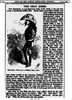
THE ONLY JONES. THE theatrical, or non-theatrical topic of the week, I am not sure which, is decidedly Buffalo Bill. Never before was a Bill so billed, and never within the memory of the ordinary hum-drum home-brewed native of the wide-world of London was the word buffalo so often repeated. I recollect when a boy at school at Richmond (Good gracious! that's a long while ago, too!), first becoming interested in the existence of buffaloes by reading a thrilling article in a sixpenny monthly magazine of Albert Smith's, called "A Ride on a Buffalo Bull." It was written by Captain Mayne Reid and shortly afterwards published in three volume form in his "Scalp Hunters." What a thrilling description was that and how it made my boyheart beat then! Can it now, forty years later, have lost all its charm for boys if 1887? I can hardly think so as I lay down the book I have just been re-reading it in the same old book. I noticed that the buffaloes were rather tamish at the American Exhibition at Earl's Court, last Monday week, which disappointed me; but otherwise it is a brave show, and in many respects very curious and new. I, however, can hardly fancy, judging from how the weather has so far been, that we are going to have a sultry summer, and so Bill won't be any more serious rival to the Theatres Royal than the other exhibitions at Kensington, even supposing they really took away any business at all. Anyhow, a good many thousands ought, and will, of course, go and see the attractive entertainment. And what do you think has been most talked about by the lady spectators the first day of the Show? Bill? No. Red Shirt? No. Miss Oakley, Miss Smith, or the Cowboys? Not at all. Do you give it up? Why, the Indian girls who ride astride.
THE BILL - YES; AND A STRONG BILL, TOO!
182
COWBOYS AND BUFFALO BILL.
WHEN Colonel the Hon. William F. Cody, better known as Buffalo BIll, was asked a short time since as to his opinions regarding cowboys, he waxed almost indignant because of the ignorance of the average Englishman concerning those "unique specimens of humanity," as he characterised them. But it is hardly to be expected that English people, or indeed any of the "offsprings of an effete civilisation" (again to quote the redoubtable ex-scout) in this antiquated Eastern world, should have a very high opinion of a class of men of whom they seldom hear, except when their deeds of violence and their wild debaucheries are chronicled in the newspapers of their own country, and are telegraphed to the newspapers of this hemisphere. Said Colonel Cody, " The cowboy is not a blackguard; nay more, he is in nine cases out of ten better than his fellows. He has certain attributes that commend him to creation. He is manly, generous, and brave. He is not merely a create of impulse, but uses the gifts given him by his Maker with a discretion which might be copied by more of us. I speak after years of study, resulting in a conviction which nothing can shake." Now, without in any way desiring to shake Buffalo Bill's sincere conviction, it is only fair to the Eastern public to say that the principal information they possess concerning the cowboys of Western American has been of a kind calculated to throw considerable doubt upon his statements. Whenever any mention has been made in English newspapers of these "heroes of the prairie," it has invariably been culled from the newspapers published in the United States, and has, therefore, been relied upon as correct. A drunken frolic in Denver city, or in Kansas city, or in Colorado city, or in Austin, Texas ending in bloodshed with sudden and violent death to more than two or three people, these are the usual reports, and always the belligerent and irritating parties have been "cowboys." A train on its way, by Omaha and Utah, to San Francisco, stopped and boarded, the passenger frightened and occasionally robbed or maltreated, and always by "cowboys." A small frontier town nocturnally visited, its inhabitant awakened in affright and made the victimes of practical jokes in the way of exhibitions of marvellous skill.