
96
LLOYD'S WEEKLY LONDON NEWSPAPER.
OPENING OF THE AMERICAN EXHIBITION.
BUFFALO BILL'S WILD WEST.
The Exhibition of the Arts, Inventions, Manufactures, Products, and Resources of the United States was opened on Monday afternoon at West Brompton. The proceedings were begun in the main transept at half-past three o'clock by a performance of "Hail! Columbia" by the Grenadier Guards band ; after which Archdeacon Farrar, of Westminster, led the company in prayer. The band played "God Save the Queen," after which Lord Ronald Gower, on behalf of the English council, delivered an address of welcome to the American guests. This council, he said, consisted of about 1,000 leading Englishmen in all walks of life, animated by the common purpose of showing a strong regard and affection for America and Americans. He expressed the hope that this exhibition might be a new bond of amity between England and America. The president of the exhibition, Colonel Henry Russell, [returned?] thanks for this welcome and for the encouragement given to the Americans in their efforts to make a fair show of Yankee industries. Mr. John R Whitley, director-general of the exhibition, explained [that?] it had been organised and developed solely by private initiative. The "Star-spangled Banner" and "Rule Britannia" having been sung by Mdlle. Lilian [Nordina?] amid great enthusiasm, Colonel Russell, as president of the exhibition, started the machinery, proclaimed the exhibition open, and expressed a hope that it might prove another strong link in that chain, sometimes strained but never to be broken, which bound the United States to Old England. "Yankee Doodle" was next performed by the band, after which the assembly proceeded to witness the performance of Buffalo Bill's "Wild West," the branch of the exhibition which will have most attraction for the public.
Whatever may be thought concerning the other sections of the exhibition, there must be a unanimous opinion of the picturesqueness of "America's National Entertainment" (so styled on the programme)- Buffalo Bill's Wild West. As a mere show the display of cowboys, scouts, Indians, and horses is exciting and attractive ; but it is something more. These men and women are not merely trained circus people ; they represent nobody but themselves and their own life in the Wild West. Colonel Cody (Buffalo Bill) is a large ranche owner at North Platte, Nebraska, and as scout, soldier, huntsman, and rancher has achieved a high reputation for himself all over the States. His Indians are actual red men who have not always engaged in mimic fights, but scalped and fought in desperate earnest. But it was purely as a show that the 25,000 people, on Monday, who only just filled the capacious structure, regarded them-and a very picturesque show it was in their estimation. After Mr. Levy had played the "Star-spangled Banner" on the cornet, there dashed into the large ring, with a circuit of one-third of a mile, the whole of Buffalo Bill's troupe, a motley crowd of Indians, Mexicans, and cowboys-all gaily dressed and superbly mounted. The intrepid horsemen, in their feathers and beads and mantles and war paint, raced round the ring at headlong speed ; they urged on their wild career at a breakneck pace, halting in an instant and as suddenly as they started. On they came, with a mad rush and a whirling gallop. Mexicans in all the extravagance of velvet and silk ; Indians painted and tattoed in every imaginable colour ; cowboys in sashes and corduroy ; laughing girls in coloured habits. As they took up position in admirable order, the sun, which had been very shy up to that moment, came out brilliantly and suddenly, lighting up this varied and fantastic picture, to the delight of everybody. There was a cheer from the crowd and a yell from the tribes as "Red Shirt" reined in his horse in front of his men. There was another cheer as Sergeant Bate, the standard-bearer, advanced-an old favourite in England, who some years ago carried the stars and stripes from the Land's-end to Gretna-green, that honour might be paid to the American flag ; but the loudest cheer of all awaited Buffalo Bill himself, who, tossing out his culrs and waving his wide hat in the air, copleted this stirring picture. The brilliant horsemen vanished as quickly as they came. A word of command, a shout, and, in a seond, Indians, cowboys, girls, beads, feathers, striped mantles, and war-paint had disappeared. They rode as if they had been born on horseback, and as if nothing could upset them. The programme consisted of two distinct features, one dramatic, the other dexterous. One showed life as it was in the "Wild West" before civilisation had altered the condition of things, and the other exhibited feats in shooting and athletic exercises with which the music-hall stage is not wholly unfamiliar. The more dramatic scenes were necessarily very much alike in character. They included the actual representation of an attack by Indians on an emigrant train, on the famous Deadwood stage-coach, and on an outlying and deserted settler's cabin. The result was the same in every case. The Indians succeeded for a time, but were ultimately repulsed by the brave cowboys, headed by the indefatigable Buffalo Bill ; rifles and revolvers were fired with rapidity on either side, there was a scamper, a rush and a skirmish, and the fancifully-attired Indians were supposed to be left dead on the field. Of the three dramatic scenes, the attack on the Deadwood coach was the best, and in order to heighten the illusion, four visitors, including Lord Ronald Gower, took scouts [?] and braved the mimic attack and the powder of the hostile Indians. Riding on the top of the coach was John Nelson (Indianised Cha-[Sha?]-Sha-na-po-ge-o) who was responsible, the "orator" informed us, for polygamy in America, inasmuch as he guided Birgham Young and the Mormons across the then "Great Desert" to the site of the present Salt Lake City. Captain Fred Mathews, a famous American whip, held the reins. Amongst the skilled in arms of precision, a very popular performance was given by Miss Annie Oakley, of "wing shooting." There were races round the ring of every imaginable kind ; races by pony express ; races by Indian lads on barebacked ponies ; races for the young ladies in the orthodox riding habits ; races for "Mexican thoroughbreds," as the "orator" facetiously styled some patient jackasses, whose original cost he informed us was four shillings a dozen. Next, however, to the groups and processions, was the comical exhibition of bucking ponies and fiendishly obstinate mules. The difficulties of the cowboys in mounting and the worse difficuclties of maintaining their seats whilst the animals reared, kicked, and plunged, caused infinite amusement. A buffalo hunt was pictured by a number of these animals being driven round the ring and made the target of a quantity of blank firing. Buffalo Bill contributed two solo performances-wielding in remarkable manner a bull whip of astounding dimensions, which he made to crack like the boom of cannon, and also firing at glass balls whilst riding.
97
THE ERA
SATURDAY, MAY 14, 1887.
THE WILD WEST SHOW. As we took our places in one of the little boxes which edge the arena in the grounds of the American Exhibition where Buffalo Bill's Wild West Show is given, we could not help being struck with the effctiveness of the scene before us. The size of the enclosure was one element of the impressiveness of the coup d'oeil, and this was cleverly increased by the picturesque scenery which inclosed half of the circle. For the illusion to have been as perfect for those in the lower tiers and seats as it was for those plaved above them, the canvas should have been carried up high enough to conceal the neighbouring houses, and for the pictorial sky to have blended with the real one; but this is a mere detail, and to attain perfection would doubless have entailed considerable extra expense. Certainly no one thought of crticising the background minutely when at the edge of the ash-covered circle in the centre were drawn up on parade the whole strength of the Wild West company. there were the various tribes of Indians in their war-paint and feathers, the Mexicans, the ladies, and the cowboys, and a fine array they made, with the chiefs of each tribe, the renowned Sergeant Bates, the equally celebrated Buffalo Bill, the stalwart Buck Taylo, and others who were introduced by Mr. Frank Richmond, who, from the top of an elevated platform, described the show as it proceeded. The post of a lecturer is no sinecure when such a vast area has to be filled by the voive of the speaker; but Mr. Richmond made every sentence distintly heard, and the interesting information conveyed by him in a mellow and decidedly audible voice was one of the most agreeable features of the performance. Few, perhaps, of the audience would have remembered, without the notification of the lecturer, the history of the pony Express, one of the most romantic in the annals of intercommunication, or have enjoyed fully the exposition by one of the leading cowboys of the way in which the mails were carried. The emigrant train, which next wended its way across the arena with its teams of oxen and mules, its acient waggons, and their burden of families and household goods, to be attacked by a tribe of redskins, who were soon repulsed by the ever-ready cowboys, was an equally interesting resurrection of a method of peopling the soil practised even now in the remoter regions of the West, though the redskins, we believe, are pretty well confined nowadays to the Indian territory, and are reduced to, at least, an outward "freindliness." The next sensation was created by Miss Annie Oakley, who did some wonderful things with her rifle. Miss Oakley is of petite figure, and only just twenty years old. One of her most remarkable feats was that of standing twenty feet from her gun, running and catching it up, and, with a double shot, hitting two clay pigeons, right and left. A more difficult trick even than this was throwing up two balls with one hand, and knocking them both to pieces, and performing the same feat casting the articles backwards over her head. Miss Oakley's performance was a decided hit, and she was loudly applauded.
98
QUEEN, THE LADY'S NEWSPAPER.
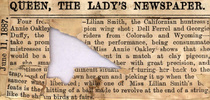
Four from... - Lillian Smith, the Californian huntress ; Annie Okaley.... pion wing shot ; Dell Ferrel and Georgie Duffy, the .... riders from Colorado and Wyoming - take a prom.... in the performance, being consummate mistressess in... Miss Annie Oakley shows that she would be a .... nt in a match at clay pigeons, as she sma... ther with great precision, and ...time u ...difficult situation of turing her back to the trap and of... own her gun and picking it up when the ... saucer was liberated ; while one of Miss Lillain Smith's b... feats is the hitting of a ball to revolve at the end of a string, like the ... birds at fairs.
99
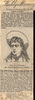
Weekly Mercury Birmingham, Saturday, May 14, 1887. "Little Sure-Shot." Miss Anna Oakley, the celebrated wing shot, of whom we give a picture, gives an exhibition of her skill with the rifle. The great Indiana chief "Sitting Bull," after seeing her shoot at St. Paul's, Minnesota, adopted her in the Sioux tribe, giving her the name of "Mazza-Cow-Ah-Pazzo," or "Little Sure-Shot." At one of her shooting contests, near Cincinnati, out of 5,000 glass balls thrown from traps, at 15 yards rise, she broke 4,772. She is also a splendid horse-woman.
Miss Anna Oakley, The Champion Markswoman of America.
The, extraordinary skill in rifle shooting dis-played by the two young American girls (one only fifteen years old) will interest those who have a taste for firearms. For myself, I was glad to get beyond the sound of the sharp crack and accompanying applause that told "another bullet had found its billet." I have a righteous horror of all firearms, be it said, and am never quite easy even when they are not charged. Miss Annie Oakley, the elder of these rival crack shots, won the admiration of the Comtesse de Paris, who was with the Prince and Princess of Wales when they visited the "Wild West Show." By no means abashed in the presence of Royalty, tho fair Republican presented
100
THE TOPICAL TIMES
SATURDAY, MAY 21st, 1887.
LONDON: 18, CATHERINE-STREET, STRAND, W.C.
It was early on Thursday morning when I ventured into the enclosure at Earl's Cout which had been annexed by the American peopl, and now forms one of the numerous States of the Union. Wherever the eye reaches, the Stars and Stripes are to be seen fluttering in the breeze, and the collection of Americans embraces samples from every one of the older States. "Lo, the poor Indian," is to be seen, in all his glory of paint, in addition to the citizens of America, of all shades and hues -- for in the Western Republic it must be known that all males over the age of twent-one are entitiles to vote unless they be natice and to the manner born. English, Germans, French, Italians, Spaniards, Portuguese, Africans, all may become bona-fide citizens of the country, but not the redman from whom it was wrested. A paternal government gives him a blankets, settles him on land beyond the confines of civilisation, which he may call his home, unless gold be found in it -- in which case he must surrender it to the noble white man -- makes it a penal offence to sell him firewater, and then considers it has treated him handsomely. As I enter the sacred precincts of West Kensington, I am subject to a rigid examination, but having proved my innocence of any evil intent, am allowed to proceed on my way unmolested. In the arena is a crowd of men busily engaged in smoothing the surface broken up by the hoofs of the horses which last night madly careered over it. On every hand are to be heard the busy notes of preparation for the coming "show." As I enter the camp, I find that there are already numerous visitors, who are wandering about, reading the names painted on the tents of the members of he company, and staring with open eyes into the tents. hoping fo a sight of their owners. As I pass her tent I see Miss Lilian Oakley, the "shootist," sitting coposedly at the entrance of her canvas dwelling house thinking probably of her Western home and the folks she left behind her to cross the billowy Atlantic for the purpose of giving us exhibitions of her proweess with the rifle.