
SCR00007.054
THE NEW YORK CLIPPER
THE FRANK QUEEN PUBLISHING CO. (Lim [?]
PUBLISHERS.
BENJAMIN GARNO, Manage [?]
SATURDAY, M [?]
And now it is Annie Oakley of the [?] Wild West Show who seems to have been [?] complimented [?] by royalty in England. She [?] from the Prince and Princess of Wales.
SCR00007.056
THE METROPOLITAN The Local Lounger.
Oh, come to the West, love! oh, come there with me, and—well, we'll have an American cocktail, and look at the trophy of back teeth, St. Jacobs Oil monument, and alligator-tooth jewellery, and other scientific exhibits. But these interesting and national tributes are of small account when compared with the interesting proceedings of Buffalo Bill and his merry and clever companions. While the City Fathers were being presented to a Sovereign, I went on to the "Billeries," and glad I was to do so, for the sensation was novel, and I got a good place, while I saw many who came in later wandering about helplessly. From the Earl's-court Station you get a good view of the boni-fide buffaloes, and also the camp or wigwams of some of the Indians. But on this day it was quite enough at first to view the vast audience, concentrated in a building holding some twenty thousand people, and some of them were people, for cooped up in what are called boxes, but are really pens, were some of the cream of the fasionable, the artistic, and theatrical world. Lords and ladies abounded, together with leading artists and actors, and not least, pretty acresses. The fashions were very noticeable—bonnets and hats were very pronounced. The hats are tall, but the bonnets are trying to catch them up, and so, instead of growing sideways, they now go up to a point in front, and leave the back hair to do any duty of protecting the head of the wearer from exposure to the weather. Dresses there were of all colours, a few of the æsthetic kind, all loose everywhere, with either a frill of the washed-out material round the neck, or a superior border of discoloured lace, and the wearers looking as if they were very superior people indeed; others, more sensible, I think, availed themselves of the pretty new light cashmere and woollen plaids, or pretty loose jackets with one button at top, or well-fitting covert coats of light cloth. Altogether the show of beauty and fashion was a fine one.
One novelty I refer to the Architect of the Corporation, Sir Horace Jones, and that is, that an American called the "Orator," with a not particularly loud voice, and standing out in the open air a long distance from the covered enclosure could be heard distinctly anywhere in the building. Get leave of absence from your absorbing duties, Mr. Architect, and go to the Wild West for a month to study this strange problem, and then, perhaps, some method may be adopted by which people in the gallery of the Court of Common Council may hear a few words spoken by the honourable the members of the Court.
The show is good, novel, and interesting. Buffalo Bill is picturesque and clever. Annie Oakley, as a shot, is more than clever; her performances partake of genius, and when she missed at first to break two glass balls thrown up in the air at the same time, she having her back to the balls, and obliged to take up the rifle from the ground, the orator's remark of "She can dew it," cause rounds of applause; and she did it—in fact, her performance is perfectly marvellous. Then the grand assembly of the tribes of Indians, with their mocassins, their feathers and warpaint, is very picturesque. Somebody at my elbow called attention to the likeness of one of these braves to Mr. Jex, of Billingsgate; but I feel sure they are genuine Indians, although the voice of the West Ham legislator is nearly as muscial as some of the painted warriors'.
Of course, one will go again, to see the races and the "Deadwood Coach" and the taking of the log-hut, &c., &c.; but I think the first set of quadrilles might be left out. It was the only thing that brought the mind back to the ordinary circus.
SCR00007.057
Miss Annie Oakley showed that she would be a formidable opponent in a match at clay pigeons, as she smashed one after another with great precision, and sometimes under the difficult situation of turning her back to the trap, and of laying down her gun and picking it up when the clay saucer was liberated. With the rifle Miss Lillian Smith, the "California Girl," also showed great skill, her best feat being the hitting of a ball made to revolve at the end of a string, like the sham birds at fairs. Pigeon shooters and others may be interested in learning that both of these ladies, as well as Buffalo Bill himself, use the Schultze powder.
SCR00007.058
Weekly Mercury
Birmingham, Saturday, May 14, 1887.
"LITTLE SURE-SHOT."
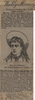
Miss Anna Oakley, the celebrated wing shot, of whom we give a picture, gives an exhibition of her skill with the rifle.T he great Indian chief "Sitting Bull," after seeing her shoot at St. Paul's, Minnesota, adopted her in the Sioux tribe, giving her the name of "Mazza-Cow-Ah-Pazzo," or "Little Sure-Shot." At one of her shooting contests, near Cincinnati, out of 5,000 glass balls thrown from traps, at 15 yards rise, she broke 4,772. She is also a spendid horsewoman.
Miss Anna Oakley,
The Champion Markswoman of America.
The extraordinary skill in rifle shooting displayed by the two young American girls (one only fifteen years old) will interest those who have a taste for firearms. For myself, I was glad to get beyond the sound of the sharp crack and accompanying applause that told "another bullet had found its billet." I have a righteous horror of all firearms, be it said, and am never quite easy even when they are not charged. Miss Annie Oakley, the elder of these rival crack shots, won the admiration of the Comtesse de Paris, who was with the Prince and Princess of Wales when they visited the "Wild West Show." By no means abashed in the presence of Royalty, the fair Republican presented
SCR00007.059
THE
TOPICAL TIMES
SATURDAY, MAY 21st, 1887.
LONDON: 18, CATHERINE-STREET, STRAND, W.C.
It was early on Thursday morning when I ventured into the enclosure at Earl's Court, which has been annexed by the American people, and now forms one of the numerous States of the Union. Wherever the eye reaches, the Stars and Stripes are to be seen fluttering in the breeze, and the collection of Americans embraces samples from every one of the older States. "Lo, the poor Indian," is to be seen, in all his glory of paint, in addition to the citizens of America, of all shades and hues—for in the Western Republic it must be known that all males over the age of twenty-one are entitled to vote unless they be native and to the manner born. English, Germans, French, Indians, Spaniards, Portuguese, Africans, all may become bonâ-fide citizens of the country, but not the redman from whom it was wrested. A paternal government gives him a blanket, settles him on land beyond the confines of civilization, which he may call his home, unless gold be found in it—in which case he must surrender it to the noble white man—makes it a penal offence to sell him firewater, and then considers it has treated him handsomely.
As I enter the sacred precincts of West Kensington, I am subject to a rigid examination, but having proved my innocence of any evil intent, am allowed to proceed on my way unmolested. In the arena is a crowd of men busily engaged in smoothing the surface broken up by the hoofs of the horses which last night madly careered over it. On every hand are to be heard the busy notes of preparation for the coming "show." As I enter the camp, I find that there are already numerous visitors, who are wandering about, reading the names painted on the tents of the members of the company, and staring with open eyes into the tents, hoping for a sight of their owners. As I pass her tent I see Miss Lilian Oakley, the "shootist," sitting composedly at the entrance of her canvas dwelling-house, thinking probably of her Western home and the folks she left behind her to cross the billowy Atlantic for the purpose of giving us exhibitions of her prowess with the rifle.