
SCR00007.181
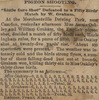
PIGEON SHOOTING.
"Little Sure Shot" Defeated in a Fifty Birds'
Match by W. Graham.
At the Merchantville Driving Park, near Camden, yesterday afternoon Miss Annie Oakley and William Graham, the English pigeon shot, decided a match of fifty birds each, Hurlingham rules, for a purse of $200. Miss Oakley shot at twenty-five yards' rise. About 400 sportsmen were present. The weather was intensely cold and the birds strong flyers, a number of them falling dead just out of bounds. Graham won, killing thirty-six to Miss Oakley's thirty-three birds.
The summary is as follows:
Miss Oakley-0, 2, 0, 2, 1, 0, 2, 1, 0, 0, 2, 0, 2, 1, 0, 0, 0, 2, 1, 1, 1, 1, 0, 1, 0, 2, 1, 1, 0, 1, 0, 1, 1, 0, 2, 1, 0, 1, 0, 2, 1, 1, 0, 1, 1, 1, 1, 1, 2, 1.--Total, 33.
W. Graham-0, 1, 1, 1, 0, 1, 1, 1, 0, 1, 1, 0, 2, 1, 0, 2, 1, 1, 1, 0, 1, 1, 1, 1, 0, 2, 1, 1, 1, 1, 0, 0, 1, 0, 1, 1, 0, 1, 2, 1, 1, 2, 0, 1, 1, 0, 1, 1, 1, 0.-Total, 36.
Referee, Frank Kleinz.
SCR00007.183
October 15, 1887
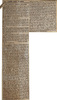
LAND AND WATER.
MISS OAKLEYS'S PIGEON SHOOTING.
Sir,—In reply to your editorial note contained in your issue of the 8th inst., respecting the match for this lady to kill thirty-five birds out of fifty of the very best blue rock pigeons at 25 yards rise, shooting with the 20-bore breech-loading hammerless gun, with 2 1/2drs. of powder and 3/4oz. of shot, you suggest "there is a certain amount of cruelty in shooting pigeons at the distnce of 25 yards with so light a gun and charge. It is a fine performance from a gunnery point of view, doubtless, but it involves the principle of shooting at birds which rise at too great a distance to be killed every time, even with the most perfect aim. At 15 or 20 yards rise, Miss Oakley would only have missed when she did not hold straight. At 25 yards the case is different. No such charge is powerful enough to kill with certainty at such a distance."
I certainly fail to see where the element of cruelty can suggest itself to you, inasmuch as her score of forty-one kills out of fifty birds shot at, clearly demonstrates to my mind the splendid killing powers of these guns and the loads used therefrom, and I have pleasure in saying it was the general remark of those present at the match, how very few birds moved on being shot, they having been killed so clean; whereby the dog had no trouble in retrieving the birds, picking them up where they fell.
The distance of 25 yards was fixed as being a fair handicap, assuming that this lady had been shooting against a competitor using a gun with 4drs. of powder and 1 1/4oz. shot with a 12-bore pigeon gun, standing at 29 or 30 yards; and, from my experience in the witnessing of pigeon matches, I do not think there are many gentlemen who face the traps who could beat this lady's score, or even equal it.
To enable you to witness that what I write is correct, I have the pleasure to invite you to be present at my private shooting ground on Tuesday morning, the 11th, at 8 30 a.m., when Miss Annie Oakley has made an appointment for the purpose of practising with these 20-bore guns under precisely the same conditions as before, when I hope we may be able to prove to you that there is no more cruelty than where the killing of live birds by shooting them takes place daily in all parts of the world.
CHARLES LANCASTER.
151, New Bond-street, W.
[This event was courteously put off until Wednesday morning to suit our engagements. At 10 30 we arrived at Mr. Lancaster's ground, Miss Oakley being already on the spot and ready to commence operations against as good a sample of blue rocks as Lincolnshire can produce. We may say at once that Mr. Charles Lancaster has built Miss Oakley a pair of guns out of which as fine as possible shooting can be obtained as with anything of equal weight and giving as little recoil. This latter item has been the difficulty with which Mr. Lancaster has had to contend in building guns for a agirls of eight stones weight. To say that Miss Oakley can use these weapons is merely to repeat what has been said a hundred times; she is an extremely beautiful shot, and does extreme justice to her guns, which are decidedly suitable to her figure and weight. Having said so much, we have only to explain our remarks of last week by an appeal to the admitted fairness of the handicap principle, and our observations of the shooting confirm our opinion that 25 yards is not the equivalent distance which places these guns on a fair fooring with 12-bores carrying 1 1/4ozs. of shot and any amount of powder which can be got into a 3-inch case. Who would for a moment believe that the gigantic frames of Captain Bogardus or Dr. Carver behind 5drs. of powder and 1 1/4ozs. of shot have no greater command thatn 6 yards above 2 1/2drs. of powder and 3/4oz. of shot? We freely admit that the little charge is good enough for the first barrel, which is certain death to the pigeon if some accidents do happen to all shooters, and for this reason the handicap should be based upon the second barrel. Before the shooting began we asked Mr. Charles Lancaster how soon Miss Oakley got in the second barrel, and his replay was within twenty yards of the birds flight. This statement, we believe, to be as near the mark as it is possible to get. This 20 yards added to the previous 25 yards demands a second barrel, which, if held straight, is certain death to a pigeon at 45 yards, in order to avoid the certainty of wounded birds. The opinion we expressed last week was based upon our belief that 2 1/2drs. and 3/4oz. of any shot could not be made certain death to a pigeon at that distance by any known system of boring, simply because the shot must be too scattered if large enough to give the necessary penetration to effect certain sudden death at such a distance. If this view was correct, the 25 yards handicap was unfair to the lady, to the birds and also to the gun. We took every precaution of satisfying ourselved on this head. With the consent of Miss Oakley and Mr. Lancaster, we saw the gun plated at that distance with No. 6 shot, and our readers will be able to judge for themselves whether the result was good enough for the purpose. The right barrel gave 126 No. 6 pellets in the 30in. circle, at 45 yards, and the left, under similar conditions, 119 pellets. Miss Oakley, whose good shooting was chronicled in these columns by Mr. Lancaster last week, commenced by killing eight consecutive blue rocks, and the ninth and tenth were both heavily struck, one of which was afterwards gathered out of bounds. The eleventh got away withoug being hit, as far as we could see; the twelfth was killed by the first shot; thirteenth hit; fourteenth got away, hit hard; fifteenth killed with second barrel; and sixteenth hit. Of these last four misses two were gathered only just out of bounds. The formal score stands as follows, the asterisk denoting the use of a second barrel:—
Miss A. Oakley, 25yds. 1 1* 1* 1* 1 1 1* 1* 0 0—0 1* 0 0 1* 0
One of the second barrels was unnecessary, and three of the misses were gathered just out of bounds. We may say that we do not think Miss Oakley was off her bird with both barrels, except on one occasion in the sixteen shots, and, consequently, if the second barrel had been equal to the distance, she would have killed fifteen out of sixteen. We have since received a letter from Mr. Charles Lancaster pressing us to mention that we, at the request of himself, tested the little weapon at half-a-dozen blue rocks. The shorness of the stock of the lady's gun and the 2lb. pull of the trigger, gave us no chance to do the shooting of the gun any justice, and we wonder, therefore, that Mr. Lancaster should wish our very poor performance mentioned. Before starting to shoot, we threw up the gun once or twice, and found great difficulty in taking any sort of sight, and therefore decided to snap at the birds. This we had to give up after the first shot, for both the bird and ourselves were quite unconscious of the direction of the charges. The next four we killed perfectly dead with the first barrel, and the ladies' 2lb. pull-off defeated our efforts at the sixth bird coming overhead, as the light pull made us shoot before enough swinging in front had been effected. It will be seen that our shooting throws no light on the question at issue, as it only goes to show the effectiveness of the first barrel, which no one has ever doubted for the range at which a first barrel is required. In our opinion, farily handicapped at twenty yards, the little American lady might give Bogardus and Carver a lesson not only in shooting pigeons, but in preferring a London gun to the makers patronised by those shooting giants. Miss Oakley is, by the way, the first American performer in this country who has patronised an old-established London firm, and the result has been that she has packer her American guns back to the place from whence they came.
SCR00007.184
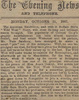
The Evening News
AND TELEPHONE
MONDAY, OCTOBER 31, 1887.
The American Exhibition, and with it Buffalo Bill's "Wild West" Show, will close its long and brilliant season to-night. The popularity of Colonel Cody's graphic entertainment has been almost unprecedented, and that astute Westerner and his partner, Mr. Nate Salsbury, have managed to make a smart "pile" out of the enterprise. Well, no one begrudges them that, for they have given the Britishers good and full value for their money up to the last. The Wild West will make tracks to-morrow for Birmingham, and afterwards go on to Manchester. By the way, the show, when it winds up its career at Brompton to-night, will lose one of its principal attractions in the person of Miss Annie Oakley, who severs her connection with the Wild West voluntarily. Miss Oakley means to go in for a somewhat prolonged rest, after which we shall probably see her in London again in a different kind of entertainment. This week she goes down to Shropshire to join a shooting and hunting party at the house of a country magnate. Afterwards she intends visiting various places on the Continent. Little Sure Shot's personal urbanity, as well as her wonderful skill in her profession, will ensure her a warm welcome whenever she may decide to turn her footsteps Londonwards once more. Her loss to the Wild West Show will be a serious one.
SCR00007.185
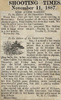
SHOOTING TIMES. November 11, 1887.
MISS ANNIE OAKLEY.
To the Editor of the Shooting Times.
Dear Sir,—Just got back from game shooting in Shrewsbury. Rainy weather all the time, but killed plenty of game. Miss Oakley has done fine work. We leave in a few hours for the Continent.
The "E.C." Powder Co. presented Miss Oakley with a large silver tea-pot.—Hoping to see you in a few months. Frank C. Butler. November 5th.
To the Editor of the Shooting Times.
Sir,—I noticed a few weeks ago in someof the sporting papers that a question had arisen as to whether the above lady could perform on English game in the same manner as she does on pigeons, glass balls, &c, in her exhibition shooting.
Miss Oakley was shooting with me on Wednesday, Thursday, and Friday last, and during those days she killed pheasants, partridges, hares, and snipe, her shooting being wonderfully clean; the wretched state of the weather prevented her getting a shot at grouse, but, judging from her shooting at the other game, there is little doubt that they would have stood but a poor chance before her.
Not only did Miss Oakley in this, I understand, her first English game shooting, prove herself an exceptionally good shot, but also a plucky walker over very heavy ground.
She carried one of the splendid pair of 20-bores, built for her by Mr. Charles Lancaster, the killing powers of which in her hands seemed quite equal to any 12-bore. W. R. C. Clarke.
Shewsbury.
SCR00007.186
LEDGER AND TRANSCRIPT. Philadelphia, Saturday, Dec. 1, 1888 SPORTS AT LONG BRANCH.
[SPECIAL TO THE PUBLIC LEDGER.] LONG BRANCH, Nov. 29. - The Long Branch Athletic Association celebrated Thanksgiv ing Day by the opening of their new grounds, Elkwood Park, the prospective ri val of Monmouth Park, by a number of in teresting sporting events.
After the formal announcement of the opening by Ex-Sheriff George W. Brown, of Long Branch, the President of the Associa tion, there was a pigeon-shooting contest between Miss Annie Oakley, late of Buffalo Bill's Wild West Combination, and Mr. Phillip Daly, Jr., of Long Branch.
The conditions were 25 yards rise, Monoco rules, Miss Oakley to shoot at 50 birds and and Mr. Daly to shoot at 55 birds, for a prize of a handsome gold medal. Miss Oak ley used a six pound Lancaster gun, 1 ounce shot and three drahms of powder. Mr. Daly used a nine pound Smith gun, and 1 1/4 ounces of shot and four drahms of powder. The following is the score in detail: Oakley - 1 1 1 1 1 1 1 1 1 0 1 1 1 1 1 1 1 0 1 1 1 1 1 1 1 1 0 1 1 0 1 1 1 1 1 1 0 0 1 1 1 1 1 1 1 1 1 1 0 0 - Killed, 43; missed, 7; total, 50. Daly, Jr., 1 1 0 1 1 1 1 1 0 1 1 0 1 1 0 1 1 1 1 1 1 1 1 0 1 1 1 0 1 1 1 1 1 0 1 1 1 1 1 1 1 1 1 1 1 1 1 1 1 1 1- Killed, 43; missed, 7; total, 50. Mr. Daly thus wobn by one bird without his five bird allowance. Messrs. Coopers and Van Dyke were the trappers. At the con- clusion of the match, Miss Oakley chal lenged the winner to shoot at 75 birds, same boundry and rules, for $250, match to take place on Christmas day, on the same grounds.
This was accepted and a forfeit put up. At the same time Mr. Phillip Daly, Sr., made an open challenge to match his son against the world for $2500, same handicap and con ditions as in to-day's-contest .
The next event was a half-mile running race, open to all amateura in the country, Prize, gold badge. There were three entries. George Lutz won, and Lewis Williams came in second. Time, 2.58.
New came a half-mile running race, open to all amateurs in the State. Prize, gold badge. There were four entriesm viz.: Wil son, Gleason, Murphy, Dowling, Wilson finished first and Gleason second. Time, 2.35.
For the half-mile running race, open to professionals of the State, prize n golf medal, there were eight entries, only two of whom finished. These were Micharl Gerrity and William Buxion. Gerrity won in 2.60
Although the weather was unpropitious for so outdoor meeting fully 2000 people were in attendance, and for the condition of the grounds the line made in the several races is regarded by exper judges as being ex ceptionally good. The same can be said of the shoot, as the lowering clouds and haze that hung over the grounds made perfect shooting almost an impossibility.