
22
22
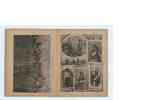
JOHNNIE BAKER--THE YOUNG MARKSMAN.
Johnnie Baker was born at O'Fallon's Bluffs, on the banks of the South Platte River, in Western Nebraska, in the year 1870. His father is the well-known "Old Lew Baker, the ranchman," and was the owner of Lew Baker's O'Fallon's Bluff Ranch, in itsday an important landmark. This place was one of the most noted on the great overland trial--the scenes, incidents, Indian attacks, etc., belonging to exhaustive pages in the early history of that, in old times, exposed and dangerous section. Here Johnnie's babyhood was passed in unconscious proximity to dangers seldom courted by the most sturdy, and his first "bug-a-boo" was not of the material imagining, but an existing fact, continually threatening in the shape of the heartless, savage Sioux. Cradled amid such pioneer surroundings, and handled on the knees of all the most celebrated frontiersman, the genuine old buckskin trappers--the first frontier invaders--his childhood witnessed the declining flories of the buffalo hunter's paradise (it being the heart of their domain), and the advent of his superior, "the long horn of Texas," and his necessary companion, "the Cow-boy."
The appearance of these brave, generous, self-sacrificing rough riders of the plain, literally living in the saddle, enduring exposure, hunger,risk of health and life as a duty to the employer, gave him his first communion with society beyond the sod cabin threshold, and impressed his mind, as well as directed his aspirations, to an emulation of the manly qualities necessary to be ranked a true American Cow-boy.
When the Pony Express, the Stage Coach, and the wagon-trains were supplanted by the steam horse, Baker's station became useless, and "Old Lew" removed bag and baggage to North Platte, a little town of magical railroad growth. Here he built a fine house, which became the headquarters of the "old-timers," and many a tenderfoot can remember the thrilling incidents related of "life on the trail"--a life that now belongs alone to history and to romance--while "Old Lew" dispensed hospitality like a prince. But the ways of "city life," a too big heart, of which the "shiftless, genial affinities" and rounder took due advantage, caused his former prosperity to be a remembrance only, and Johnnie set to work manfully for one of his age, to lend a helping hand. Perfectly at home in the saddle, he was never content unless with some cow-boy outfit, or at MR. CODY'S (whose homestead, extensive horse and cattle ranches, are near), where his active spirit found congenial associations, until he became recognized as "BUFFALO BILL'S boy." In the winter months he occasionally went to school, and being an apt scholar, has a fair education. MR. CODY, on organizing his distinctly American exhibition, could not leave little Johnnie out. He can be seen every day with the Wild West, mounted on his fiery little mustang, riding, roping, shooting--repeating on the mimic scene his own experiences, and the boyhood life of his elder, more famed associates.
Through perseverance and his aptness for learning he has become a most valuable assistant to Colonel CODY, so much so that he is now Arenic Director, looking after all matters pertaining to the Exhibition, and has shown himself to be thoroughly familiar in the art of conducting the entire entertainment without an interruption. He is an admirable stage manager, and it is to him that the care of the large army of men is assigned.
JOHNNIE BAKER AND HIS WINCHESTER.
23
WESTERN BOYS AND GIRLS IN VIRGINIA REEL ON HORSEBACK.
When the young blood of the frontiers of Virginia, Kentucky and Maryland swept like a human wave into the new territories of Ohio, Indiana, Illinois, Iowa, etc., the dug-out, the tent and the cabin were the mansions of the sturdy pioneers. Full of life and vigor, the emigrants found their great recreation in the sports and pastimes connected with the instruments essential to their new environments, such as the rifle, the shooting contest, turkey meets, and the horse for transportation, husbandry, and at times for revelry. The fact that in the aforesaid residences on the old frontier there were few spacious ball-rooms, and that the contracted floors on the pioneer log-cabin "offered hardly room enough to swing a cat," no doubt inspired the idea of the outdoor dance, which is now represented in Buffalo Bill's Wild West by a Virginia Rell on Horseback. From the Heights of classic Olympus, Terpischore may well gaze in wild-eyed wonder at a measure wildly new to her engagement list--a lively and most picturesque dance, in which gallant cowboys, graceful Western girls and smart bronchos participate. "Places, all !" shouts the leader, and to the music of the Cowboy band, the air of the lively old-fashioned Virginia Reel, the squares are formed and away go the riders and horses in all the rollicking and intricate figures of that popular dance, the long hair and bright curls of the riders streaming on the breeze, and the alert hoofs of the spirited broncos keeping perfect time to the popular tune. "After all the ball is over" the lightest-footed praise belle among the spectators settles back and exclaims: "Well, did you ever [?] Why polo isn't in it," and the boys and girls adjourn for refreshments and gossip into the little cabin, which were once landmarks for what are now farm mansions and town-sites.
WHEN THE SCHOONERS ROLLED OUT OF ST. JOE.
From the Denver Post.
[?] exciting old [?] are but memories now, When the pop of the bull[?]'s whip Sharply rang [?] the Wild West had scarce for the prow Of Progression's great oncoming ship, And but few now remain of that dust-begrimed host Who had nerve in the dim long ago To fight and if need [?] to die at their post When the schooners rolled out of St. Joe.
In the dust of the valley great serpentine trains Rolled from civilization's last gate. And slowly [?] onward toward the great plains Where the [?] men were lying in wait. But every [?] whacker trudged bravely along, Feeling never a fear of the foe- Their heavy whips cracked to the voicings of song As the schooners rolled out of St. Joe.
23
THE RIFLE AS AN AID TO CIVILIZATION
There is a trite saying that "the pen is mightier than the sword." It is an equally true one that the bullet is the pioneer of civilization, for it has gone hand in hand with the axe that cleared the forest, and with the family Bible and school book. Deadly as has been its mission in one sense, it has been merciful in another; for without the rifle-ball America would not be to-day in the possession of a free and united country, and mighty in its strength.
And so has it been in the history of all people, from the time when David slew Foliath, down through the long line of ages, until in modern times science has substituted for the stone from David's sling the terrible missiles that now decided the fate of nations. It is not, therefore, so harsh as expression as it seems to be at first sight, that it is indeed the bullet which has been the forefunner of growth and development.
It is in the Far West of America, however, and along its frontier, that the rifle has found its greatest use and become a part of the person and the household of the venturesome settler, the guide, the scout, and the soldier; for nowhere else in Christendom is it so much and so frequently a neccessity for the preservation of life, and the defence of home and property. It is there, too, among the hunters on the plains and in the Rocky Mountains, that one sees the perfection of that skill in marksmanship that has become the wonder of those who are not accustomed to the daily use of weapons. Yet if it were not possessed - if there were not the quick eye, the sure aim, coolness in the moment of extreme danger, whether threatened by man or beast - life in that section would be of little value, and a man's home anything but a safe abiding place.
There are exceptional cases of men like "Buffalo Bill," Major North, and others, whose names are more or less familiar among the mighty hunters of the West, who excel in the use of rifle and pistol, and to which, time and time again, they and those around them have owed their lives. And they are the worthy successors of a long line of marksmen whose names are also "familiar as household words." Who does not recall David Crockett and his death-dealing rifle in teh Alamo? Daniel Boone, of Kentucky, and the heroic exploits that have been written concerning them in the early pages of their country's history?
It is to the end that the people of the East, or rather those who are not acquinted with the rough life of the border and especially that portion of it in which the rifle plays so important a part, may personally witness some of teh feats of Western men, that MESSRS. CODY & CO. have determined to introduce in their "great realistic pictures of Western life" a series of shooting exhibitions. The manner in which buffaloes are hunted, the exciting chase at close quarters, the splendidly trained horses who participate in the chase, the hunt for elk, the stealthy devices of Indians in capturing the fleet-footed animals - all these will be illustrated in a manner that has never been witnessed East of the Mississippi River - Buell's Life on the Plains.
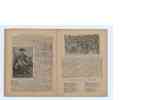
AN HISTORICAL COACH OF TEH DEADWOOD LINE.
THE INDIANS' ATTACK ON WHICH WILL BE REPRESENTED IN "BUFFALO BILL'S" WILD WEST, AND ALSO ITS RESCUE BY TEH SOUTS AND PLAINSMEN.
The people of Great Britian, like those of the Eastern States of the Union, regard the west as the region of romance and adventure. And, in truth, its history abounds with thrilling incidents and surprising changes. Every inch of that beautiful country has been won from a cruel and savage foe by danger and conflict. In the terrible wars of teh border, which marked the early years of the Western settlements, the men sigualized themselves by performing prodigies of valor, while the women, in their heroic courage and endurance, afforded a splendid example of devotion and self-sacrifice. The history of the wagon trains and stage coaches that preseeded the railway is written all over with blood, and the story of suffering and disaster, often as it has been repeated, is only known in all of its horrid details of the bold frontiersmen who, as scouts and rangers, penetrated the strongholds of the Indians, and, backed by the gallant men of the army, became the avant couriers of Western civilization and the terror of the red man.
Among the most stirring episodes in the life of the Western pioneer are those connected with the opening of new lines of travel, for it is here, among the trails and canyons where lurk the desperadoes of both races, that he is brought face to face with danger in its deadliest forms. No better illustration of the fact is furnished than in the history of the famous DEADWOOD COACH, the scarred and weather-beaten veteran of the original "star route" line
of stages, established at a time when it was worth a man's life to sit on its box and journey from one end of its destination to the other. The accompanying picture affords an idea of the old relic, and it is because of its many associations with his own life that it has been purchased by "BUFFALO BILL" and added to the attractions of his "GREAT REALISTIC EXHIBITION OF WESTERN LIFE."
It will be observed that it is a heavily built Concord stage, and is intended for a team of six horses. The body is swung on a pair of heavily leather underbraces, and has the usual thick "perches," "jacks" and brakes belonging to such a vehicle. It has a large leather "boot" behind and another at the driver's foot-board. The coach was intended to seat twenty-one men - the driver and two men heside him, twelve inside, and the other six on top. As it now stands, the leather blinds of the windows are worn, the paint is faded, and it has a battered and travel-stained aspect that tells the story of hardship and adventure. Its trips began in 1875, when the owners were Messrs, Gilmore, Salsbury & Co. Luke Voorhees is the present manager. The route was between Cheyenne and Deadwood, via Fort Laramie, Rawhide Buttes, Hat or War Bonnet Creek, the place where "BUFFALO BILL," killed the Indian Chief, "Yellow Hand," on July 17, 1876, Cheyenne River, Red Canyon, and Custer. Owing to the long distance and dangers, the drivers were always chosen for their coolness, courage and skill.
[IMAGE]
THE OLD STAGE COACH.
In its first season the dangerous places on the route were Buffalo Gap, Lame Johnny Creek, Red Canyon, and Squaw Gap, all of which were made famous by scenes of slaughter and the devilry of the banditti. Conspicuous among the latter were "Curley" Grimes, who was killed at Hogan's Ranch; "Peg Legged" Bradley, Bill Price, who was killed on the Cheyenne River; "Dunk" Blackburn, who is now in the Nebraska State Prison, and others of the same class, representing the most fearless of the road agents of the West.
On the occasion of the first attack the driver, John Slaughter, a son of the present marshal of Cheyenne, was shot to pieces with buckshot. He fell to the ground and the team ran away, escaping with the passengers and mail, and safely reached Greely's Station. This occurred at White Wood Canyon. Slaughter's body was recovered, brought to Deadwood, and thence carried to Cheyenne, where it is now buried. The old coach here received its "baptism of fire," and during the ensuting summer passed through a variety of similar experiences, being frequently attacked. One of the most terrific of these raids was made by the Sioux Indians but the assult was successfully repelled although the two leading horses were killed. Several commerical travellers next suffered from a successful ambush, on which occasion a Mr. Liehman, of Chicago, was killed, and his companion shot through the shoulder.
When "BUFFALO BILL," returned from his scout with Gen. Crook, in 1876, he rode in this self-same stage, bringing with him the scalps of several of the Indians whom he had met. When afterwards he learned that it had been attacked and abandoned, and was lying neglected on the plains, he organized a party, and starting on the trail, rescued and brought the vehicle into camp.
24
25
With the sentiment that attaches to a man whose life has been identified with the excitement of the Far West, the scout has now secured the coach from Col. Voorhees, the manager of the Black Hill stage line, and hereafter it will play a different role in its history from that of inviting murder and being the tomb of its passengers. And yet the "Deadwood Coach" will play no small part in the entertainment that has been organized by "BUFFALO BILL" and partner for the purpose of representing some of the most startling realities of Western life, in a vivid representation of one of the Indian and road agents' combined attacks.
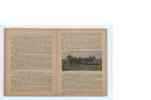
A GROUP OF BUFFALO BILL'S WILD WEST COWBOYS NOW.
THE PASSING OF THE COW-BOY.
Until the advent of Buffalo Bill's Wild West introduced the Cow-boy to the world at large, the great majority of people had altogether wrong notinos about him. This was due chiefly to the misrepresentations of the cheap romances and the rroneous articles which had appeared from time to time in Eastern magazines and periodicals, which made a sort of "half horse, half alligator," character of him, and clothed him in a garb of absurdity and misconception. That civilized life, to which his calling necessarily made him largely a stranger, has, since Colonel Cody coazed him from the plains, grown to justly regard him as a singularly interesting fellow, and ordinarily a very brave, quiet and unassuming one, generous to a fault, and a fast friend under all circumstances. It does not take him long to evidence in the great Wild West arena that he possess the qualities of courage, clear-headedness, agility and endurance, which are abolsutely necessary in the business from which his title is gained. In the pursuit of that business he is called upon to undergo the most severe hardships which can fall to the lot of any man, and he is schooled to bear them with admirable and uncomplaining fortitude. Rising at three o'clock in the morning, riding all day at top speed and taking all sorts of chances, without regard to life or limb, he has little time for tomfoolery or lawless carousing. Bad food, little sleep, constant anxiety and exhausting work soon undermine the strongest constitution, and at forty years of age, and often much sooner, rough, hard lines in his face tell the story with a plainness not to be mistaken.
27
TWO NOTED WAR HORSES
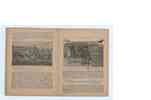
GEN. NELSON A. MILES AND COL. W.F. CODY AT AN OUTPOST, PINE RIDGE CAMPAIGN, 1891.
The hundreds of horses from different countries and of different strains employed by Buffalo Bill's Wild West in transportation, parade and exhibition, collectively form a living attraction, full of nobility, beauty, intelligence, fire and fleetness, while in the great gathering are individual steeds full worthy of more than passing inspection and mention. Among these are included "Knickerbocker" and "Lancer," which Colonel Cody sent with the army to Puerto Rico for his own use in the event of his being called to the front by General Miles, and which were the only horses accompanying the invading forces that were returned to American soil, as the following note from General Miles to Colonel Cody shows:
"My DEAR CODY: "Your horses are now in Washington, all right. You did not come to Puerto Rico, therefore I rode them myself, and they are the only horses brought back to America. "NELSON A. MILES.".
Regular army officers who had served with General Miles in the Indian campaigns, had given him the reputation of being the hardest rider in the service. "He can cover more ground than any other man in the army and be fresh as a daisy at the end," they told the troopers in Puerto Rico, and an escort of thirty-seven of them, whom he rode to a finish and nearly out of their saddles during a prolonged tour of inspection, sorely conceded that he was truly a Rough Rider par excellence. "Knickerbocker," a powerful plucky gray, was just the mount required by such a horseman, and carried him triumphantly through more arduous work of the campaign; "Lancer," a beautiful sorrel of less weight and stamina, being reserved for lighter service.
25
ORIGIN OF THE NAME "ROUGH RIDERS."
Colonel Theodore Roosevelt says: "Wood and I were speedily commissioned as Colonel and Lieutenant-Colonel of the First United States Volunteer Cavalry. This was the official title of the regiment, but for some reason or other the public promptly christened us the 'Rough Riders.' At first we fought against the use of the terms, but to no purpose; and when finally, the Generals of Division and Brigade began to write in formal communications aboyt our regiment as the 'Rough Riders,' we adopted the term ourselves."
The name was one with which the public had become familiar, and in a way fascinated, through its adoptation some years agao by Col. W. F. Cody-"Buffalo Bill"-to designate precisely the class of frontiersmen associated with his Wild West Exhibition, which, as Colonel Roosevelt himself remarks,"made up the bild of the regiment and give it its peculiar character." The term was gradually widened to include the Cossack, Arabian, Mexican, South American, trooper and other free, fearless equestrians, now marshalled under the leadership of the greatest horseman of them all. Millions of people have grown to understand, fully appreciate, and unboundedly admire that title and what it stands for, and its transference to the First U. S. V. Cavalry was not only a deserveed compliment, byt an honourable designation, whose admirable fitness was at once and universally recognised. Colonel Cody first introduced the name "Rough Riders," to the American public. The manner in which Colonal Roosevelt subsequently introduced it to the Spaniards has made it historically immortal. Col. Cody will now popularize it in a peaceful manner in Great Britain.
Image Caption first page: COL., THEODORE B. ROOSEVELT
A DISTINGUISHED AUTHOR'S TRIBUTE
Buffalo Bill's Wild West increased its roster of horsemen in London in 1892 by the adition of the Russian Cossacks and South American Gauchos. The following year they added the genuine furloughed soldiers of the 7th United States Cavalry, Veteran French Chasseurs, English Lancers, German Cuirassers with the Russians, Mexicans, Cowboys and United States Artillerymen. As history rendered them interesting, a band of Filipino insurgents, squad of Porto Ricoians and wounded natice Cuban Patriots found a place in this organization, together with a detachment of Hungarian Ciskos, in fact, anti-dating, what has new become world's history, at the World's Fair in Chicago in 1893, the English, American, German, French, and Russian soldiers and their flags assembled together in amity in the Wild West Arena as they afterwards fought side by side in China at the battle of Tientsin and other points which resulted in the eventual rescue of Pekin. The public of the United States were thereby taught a lesson and made familiar with types of mankind that would have cost years of travel to accomplish. It was this minging of flags and representations of races and nations so very aptly alluded to by Mr. Opie Reid the popular author, journalist and novelist. who thus expresses himself in the Chicago Post after mingling in the company and being touched by the amiability and respect of these different men for each other.
"If man's greatest study is man, of what worth has Buffalo Bill been to the student? Strip him of romance, of history, and regard him simply as a collector of the human species, and then note the distance he advances beyond any 'showman'. When Barnum gathered wild beasts from the dark corners of the earth, wise men applauded, for they declared that he had brought home to every child the truth of natural history.
"And what has Buffalo Bill done? He has opened a great school of anthropology, and not only wisdom but royalty has been forced to applaud. Surely his entertainment is the greatest that the world has ever seen, and could it have been possible in the vigorous days of Rome; had this mammoth play been enacted in the neighborhood jof the Eternal City, the school boy of all nations would to-day translate its wonders into his mother tongue. Morse has made th two worlds tough the tips of their fingers together. Cody had made the warriors of all nations join hands. Who but this man has conceived so fantastic a play?
"In one act we see the Indian with his origin shrouded in history's mysterious fog; the cowboy, nerve-strung product of the new world; the American soldier, the dark Mexican, the glittering soldier of Germany, the impulsive dragoon, and that strange, swift spirit from the plains of Russia, the Cossack-marvellous, theatrical display, a drama with scarcely a word-Europe, Asia, Africa, America in panoramic whirl, and yet individualized as though they had never left their own country.
"Buffalo Bill has taught the knowing world a lesson. It was a bold thing to undertake, but this man from the West did it. There often arises a man who makes the world think, but how few have made the world stare? In the years to come, when Cody has passed away, hundreds of imitators will arise to scramble and strive for a semblance of his marvellous force, bu the cannot be approached, for History has marked him as one of her children, Columbus discovered America. The centuries rolled one upon another and a man from the Western plains completed the discoverer's work and brought a band of Indians to Rome."
Image Caption second page: A GROUP OF COL., ROOSEVELT'S ROUGH RIDERS, NOW WITH BUFFALO BILL.