
36
28 ORIGIN OF THE NAME "ROUGH RIDERS."
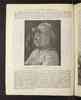
Colonel Theodore Roosevelt says: "Wood and I were speedily commissioned as Colonel and Lieutenant-Colonel of the First United States Volunteer Cavalry. This was the official title of the regiment, but for some reason or other the public promptly christened us when, finally, the Generals of Division and Brigade began to write in formanl communications about our regiment as the 'Rough Riders,' we adopted the term ourselves."
COL. THEODORE R. ROOSEVELT LEADING HIS "ROUGH RIDERS" IN THE FAMOUS CHARGE AT SAN JUAN, '98.
The "some reason or other" for calling his regiment "Rough Riders," regarding which Colonel Roosevelt seems to be in doubt, is so readily found and explained that his failure to discover it is really surprising. The name is one with which the public has become familiar, and in a way fascinated, through its adoption some years ago by Col. W. F. Cody–"Buffalo Bill"–to designate precisely the class of frontiersmen associated with his Wild West Exhibition, which, as Colonel Roosevelt himself remarks, "made up the bulk of the regiment and gave it its peculiar character." The term was gradually widened to include the Cossack, Arabian, Mexican, South American, trooper and other free, fearless equestrians, now marshaled under the leadership of the greatest horseman of them all. Millions of people had grown to understand, fully appreciate, and unboundedly admire that title and what it stands for, and its transference to the First U. S. V. Cavalry was not only a deserved compliment, but an honorable designation, whose admirable fitness was at once and universally recognized. Colonel Cody first introduced the name "Rough Riders" to the American public. The manner in which Colonel Roosevelt subsequently introduced it to the Spaniards has made it historically immortal.
37
29
BUFFALO BILL AND THE BULLFIGHTERS.
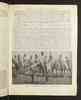
Colonel Cody had a little war of his own with the Spaniards before Dewey, Sampson, Miles, Roosevelt and the rest took a hand in the grim game. It happened when he was in Barcelona, Spain, with his Wild West. One evening after the performance he got into his carriage, drove to the various newspaper offices and had this liberal offer appended to his advertisements :
"I will wager any amount that the people in my show can lasso and ride any bull in Spain."
He didn't think it necessary to tell his interpreter of this, and went home to bed. He was stopping at the House of Four Nations, which was built in a square and had a large, beautiful court in the centre. What subsequently occurred we will let the Colonel tell in his own langauge :
"Very early the next morning my interpreter and agent came rushing into my room, crying :
" 'Get up! Get up! Dress at once; they are going to kill you!'
"Who? I asked.
" 'The bullfighters,' they answered breathlessly. 'Peep into the court below at the maddened mob.'
"I did, and by jiminy, it was a sight ! The court was jammed with men as mad as so many mad bulls, and they were flying here, there and everywhere, threatening to tear me limb from limb. I dressed leisurely and put a Colt's revolver in my hip pocket–just to keep me company, you know–and then I went downstairs. I got the interpreter to ask them what they meant. Thier spokesman demanded to know why I had put such an insult to them in the papers, and at that every matador of 'em brandished a morning paper. I told them that I had merely made that wager, and was ready to stick to it. Then they asked me how much I would wager. Now the people of Spain are distressingly poor, so I offered to bet 200,000 pesetas, for I knew they couldn't cover it. This crazed them, and they tried to get at me. In the meantime my agent had gone for the American Consul and police officers to protect me and quell the riot, and I saw I had to talk for time. I began to drop, offering 175,000 pesetas, and I had to go down to 50,000, and was losing wind when the Consul and officials arrived. The Consul saw that there was blood on the face of the moon, and he and the police advised me to withdraw my challenge. The bullfighters told them that I had attempted to ruin the national sport and had grossly insulted them; that they had to make the people believe that these bulls were very fierce, and that no one in the world could capture and ride them but themselves, or else the sport would die an ignominious death, so I withdrew my wager. But I had to have the police protectoin during the rest of my stay in Spain."
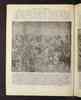
A GROUP OF COL. ROOSEVELT'S ROUGH RIDERS, NOW WITH BUFFALO BILL
38
30 ORIENTAL WONDERS.
PHENOMINAL PERFORMANCES BY FAMOUS ARABIAN EQUESTRIANS AND ATHLETES.
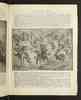
There are some things in which the Wild East doesn't have to take off its turban to the Wild West, and the renowned troupe of Riffian Arabs–right from the scorching sands–with Buffalo Bill's Wild West and Congress of Rough Riders of strength and endurance. The nimblest pair of legs could scarce keep abreast of their hand-spring evolutions clear across the great arena. They walk on their hands as though brought up to that kind of locomotion exclusively. They launch themselves in high and hazardous spreads and side-long somersaults over bayonets and sword blades. They tumble as though tossed in the arms of an invisible tornado, and they climb atop of one another with the balance and agility of monkeys, until nine of them form a high pyramid, of which one herculean son of the Prophet is the sole base. Meanwhile, and in fact all the while, the sage Dervish of the tribe is making a human teetotum of his respected self, and rotating more rapidly than the double screws of an Atlantic liner. So rapidly and continuously does he whirl around with extended arms that, unless he is iron-hooped, it is a wonder that he does not burst all to pieces and strew the Oriental scene with sanctified fragments.
39
31 THE BUCKING BRONCO.
APRODUCT OF NATURE, NOT OF EDUCATION.
Did you ever see a bucking circus horse? Emphatically no! Why not? Simply because if he were a bucker he would not only be utterly useless, but positively dangerous in the ring. The horse is naturally an exceedingly timid and suspicious animal, and in breaking him even to harness and saddle use the trainer must keep these traits constantly in mind. Consider the limited repertory and even the best trained circus horse of any school. He can be taught to do something surprising and pleasing tricks, but there is to him a danger line beyond which neither cajolery nor force can induce him to go. He can no more be taught to "buck" than can a kangeroo to play on a key bugle. No animal can be taught to injure or kill itself, and least of all the horse ; the instinct of self-preservarion forbids, and no trainer can overcome that power. It would be equally preposterous to assume that any amount of compensation could induce any man in the possession of his senses to train an animal expressly to injure him. There is not a day in the season but that from one to half a dozen cowboys are laid up in hospital as a result of their battles royal with the bucking broncos, while every one of them daily receives maulings, shake-ups and brusies that would invalid men of less rugged physique and Spartan endurance. Like every other unique frontier, national and international feature with Buffalo Bill's Wild West, the bucking broncos are genuine, from start to finish. They are natural, irreclaimable fighters, and their savage and reckless efforts to throw their riders cannot be corrected. They may be temporarily conquered after a prolonged and often dangerous struggle, requiring extraordinary agility, skill and courage on the part of their riders, but with every effort to mount comes a renewal of the contest between stubbornness and instinct on the one side and brains and nerve on the other, and in it the nobler
40
32
animal does not always win the spurs. In the performances of the bucking broncos and their cowboy riders it will be noticed that, among all the quadrupedal concentrations of chain lightning no two resort to the same tactics of defense. One will permit himself to be saddled and mounted before letting out the pent-up deviltry with which his hide is stuffed. Another will quietly submit to being saddled, but that is his limit of sufferance. To still another the very sight of a saddle is a signal of war. This one will start off hump ing his back like a mad cat, and landing stiffly on all fours with the force of a pile-driver. That one will lie down and stubbornly refuse to budge. Still another will rear and fall back wards with such reckless fury as to sometimes beat out his brains. A fourth will kick, strike or bite, or all this and more too, with a savage viciousness rendering him more dangerous to a tyro than would be a hungry lion. And these are but sample illustrations among innumer able insane efforts to escape the ignominy of bearing burdens. In some instances it will be noted that the bucker seems intent upon injuring his rider only; in others, that he aims to disable himself as well, and, that he is frantically bent upon committing suicide. He is a great natural actor in an equine and equestrian specialty, so full of fiery and furious vim that it is well worth seeing a score of times, and never loses intense interest.
THE VAQUERO OF THE SOUTHWEST.
Between the "cow-boy" and the "vaquero" there is only a slight line of demarcation. The one is usually an American, injured from boyhood to the excitements and hardships of his life, and the other represents in his blood the stock of the Mexican, or it may be of the half-breed.
In their work, the methods of the two are similar, and to a certain extent the same is true of their association. Your genuine vaquero, however, is generally, when off duty, more of a dandy in the style and get-up of his attire than his careless and impetuous com peer. He is fond of gaudy clothes and when you see him riding well mounted into a frontier town, the first thought of an Eastern man is that a circus has broken loose in the neighbor hood, and this is one of the performers. The familiar broad-brimmed sombrero covers his head; a rich jacket, embroidered by his sweetheart, perhaps, envelopes his shapely shoulders; a sash of blue or red silk is wrapped around his waist, from which protrude a pair of revolvers; and buckskin trousers, slit from the knee to the foot, and ornamented with rows of brass or silver buttons, complete his attire, save that enormous spurs, with jingling pendants are fastened to the boots, and announce in no uncertain sound the presence of the beau ideal vaquero in full dress.
His saddle is of the pure Mexican type, with high pommel, whereon hangs the inev itable lariat, which in his hands is almost as certain as a rifle shot.
Ordinarily he is a peaceful young fellow, but when the whiskey is present in undue propor tions he is a good individual to avoid. Like the cow-boy, he is brave, nimble, careless of his own life, and reckless of other people. At heart he is not bad. The dependence on himself which his calling demands, the dangers to which his is subjected while on duty, all compel a sturdy self-reliance, and he is not slow in exhibiting the fact that he possesses it, in a sufficient degree at least for his own protection. True types of this peculiar class, seen nowhere else than on the plains, will be among the at tractions of the show; and the men will il lustrate the methods of their lives in connec tion with the pursuit and catching of ani mals, together with the superb horseman ship which is characteristic of their training.