
31
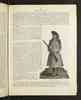
23 Annie Oakley
This celebrated girl shot was born in Woodland, Ohio. Ever since a toddling child she has had an inherent love for fire-arms and hunting, and a tthe age of ten she, as often as ammunition was obtainable, would smuggle her brother's musket and steal into the woods where ame at the time was plentiful. Naturally, she was a good shot, and came home well supplied with game. At the age of twelve she was presented with a light, muzzle-loading shotgun, and also a breech-loading rifle. With the shot-gun she improved rapidly, and became such a fine shot that she rarely missed a quail or a pheasant, and at the age of fourteen she had paid off a mortgag on her mother's homestead with money earned from the game and skin shot and trapped by herself alone--while her aim with rifle was so true that she was debarred from entering in the turkey matches which were the popular holiday amusement in that part of the countrary.
Then came a local reputation; and with improved fire-arms she attracted wider attention, and for the past several years she has been shooting before the public with great success, and although she has many times beaten all records, like the modest little girl she is she never uses the word Champion in connection with her name. "Sitting Bull," the great Indian Chief, after seeing her shoot in St. Paul, Minn., dopted her into the sioux tribe, giving her the name of "WatanyaCicilla."
The First two years before the public she devoted to Rifle and Pistol Shooting, and there is very little in that line she has not accomplished. At Tiffin, Ohio, she once shot a ten cent piece held between the thumb and forefinger of an attendant at a distance of 30 feet. In April, 1884, she attempted to beat the best record made at balls thrown in the air--the best record was 984, made by Dr Ruth. Miss Oakley used a Stevens' 22 cal. rifle and broke 943. In February, 1885, she attempted the feat of shooting 5,000 balls in one day, loading the gun herself. In this feat she used three 16-gauge hammer guns; the balls were thrown from three traps 15 yards rise; out of the 5,000 shot at, she broke 4,772; on the second thousand she only missed 16, making the best 1,000 ball record, 984. Besides the thousands of exhibitions she has given in Europe and America, she has shot in over fifty matches and tournaments, winning forty-one prizes; her collection of medals and fire-arms, all of which have been won or presented to her, is considered one of the finest in the owrld.
Miss Oakley is also an accomplished equestrienne, and her succes with the public has been greatly enhanced by the fact that in dress, style and execution she is as original as she is attractive.
Many people have an idea that the exhibition shot is only good as such, and that in a match or competition against the professional pideon shot the exhibition shot would stand a chance of winning. This may apply to some, but not to Annie Oakley, as was clearly proven by her clever work at Interstate Park, New York during the past year.
32
24 The rifle as an aid to civilization
There is a trite saying that "the pen is mightier than the sword." It is an equally trie one that the bullet is the pioneer of civilization, for it has gone hand in hand with the axe that cleared the forest, and with the family Bible and school book. Deadly has has been its mission in one sense, it has been merciful in another; for without the rifle-ball we of America would not be to-day in the possession of a free and united country, and mighty in our strength.
And so has it been in the history of all people, from the time when David slew Goliath down through the long line of ages, until in modern times science has substituted for the stone from David's sling the terrible missiles that now decide the fate of nations. It is not, therefore, so harsh an expression as it seems to be at first sight, that it is indeed the bullet which has been the forerunner of growth and development.
It is in the Far West of America, however, and along our frontier, that the rifle has found its greatest use and become a part of the person and the household of the venturesome settler, the guide , the scout, and the soldier; for nowhere else in Christendom is to so much and so frequently a necessity for the preservation, and the defense of home and property. It is here, too, among the hunters on the plains and in the Rocky Mountains, that one sees the perfection of that skill in markmanship that has become the wonder of those who are not accustmed to the daily use of weapons. Yet if it were not possessed--if there were not the quick eye, the sure aim, coolness in the moment of extreme danger, whether threatened by man or beast--life in that section would be of little value, and a man's home anything but a safe abiding place.
There are exceptional cases of men like "Buffalo Bill," Major North, and others, whose names are more or less familiar among the mighy hunters of the West, who excel in the use of rifle and pistol, and to which time and time again, they and those around them have owed their lives. And they are the worthy sucessors of a long line of marksmen whose names are also "familiar as household words." Who does not recall David Crockett and his death-dealing rifle in the Alamo? Daniel Boone, of Kentucky, and the heroic exploits that have been written concerning them in the early pages of our country's history?
It is to the end that the people of the East, or rather those who are not acquainted with the rough life of the border and especially that portion of it in which the rifle plays so important a part, may personally witness some of the feats of Western men, that Messrs Cody & Co. have determined the splendidly trained horses who participate in the chase, the hunt for clk, the stealthy devices of Indians in capturing the fleet-footed animals--all these will be illistrated in a manner that has never been witnessed East of the Mississipppi River.--Buell's Life on the Plains.
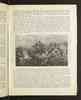
A Historical Coach of the Deadwood Line
The Indians' Attack on which will be represented in "Buffalo Bill's" wild west, and also its rescue by the scouts and plainsmen.
The People of the Eastern States of the Union are accustomed to regard the West as the region of romance and adventure. And, in truth its history abounds with thrilling incidents and surprising changes. Every inch of that beautiful country has been won from a cruel and savage foe by danger and conflict. In the terrible wars of the border, which marked the early years of the Wesrern settlements, the men signalized themselves by performing prodigies of valor, while the women, in their heroic courage and endurance, afforded a splendid example of devotion and self sacrifice. The history of the wagon trains and stage coaches that preceded the railway is written all over with blood, and the story of suffering and disaster, often as it has been repeated, is only known in all of its horrid details to the bold frontiersmen who, as scouts and rangers penetrated the strongholds of the Indians, and, backed by the gallant men of the army, became the avant couriers of Western Civilization and the terror of the red man.
Among the most stirring episodes in the life of the Western pioneer are those connected with the opening of new lines of travel, for it is here, among the trails and canons where lurk the desperadoes of both races, that he is brought face to face with danger in its deadliest forms. No better illustration of this fact is furnished than in the history of the famous Deadwood Coach, the scarred and weather-beaten veteren of the original "star route" line
33
25
of stages, established at a time when it was worth a man's life to sit on its box and journey from one end of its destination to the other. The accompanying picture affords an idea of the old relic, and it is because of its many associations with his own life that it has been purchased by "Buffalo Bill" and added to the attraction of his "Great Realistic Exhibition of Western Life."
It will be observed that it is heavily built Concord stage and is intended for a team of six horses. The body is swung on a pair of heavy leather underbraces, and has the usual thick "perches," "jacks" and brakes belonging to such a vehicle. It has a large leather "boot" behind, and another at the driver's foot-board. The coach was intended to seat twenty-one men--the driver and two men beside him, twelve inside and the other six on top. As it now stands, the leather blinds of the windows are worn, the paint is faded, and it has a battered and travel-stained aspect that tells the story of hardship and adventure. Its trips began in 1875, when the owneers were Messers, Gilmore, Salsbury & Co. Luke Voorhees is the present manager. The route was between Cheyenne and Deadwood, via Fort Laramie, Rawhide Buttes, Hat or War Bonnet Creek, the place where "Buffalo Bill" killed the Indian Chief, " Yelow Hand," on July 17, 1876, Cheyenne River, Red Canyin, and Custer. Owing to the long distance and dangers, the drivers were always chosen for their coolness, courage and skill.
In its first season, the the dangerous places on the route were Buffalo Gap, Lame Johnny Creek, Red Canyon, and Squaw Gap, all of which were made famous by scenes of slaughter and the deviltry of the banditti. Conspicuous among the latter were "Curley" Grimes, who was killed at Hogan's Ranch; "Peg Legged" Bradley, Bill Price, who was killed on the Cheyenne River; "Dunk" Blackburn, who is now in the Nebraska State Prison, and others of the same class, representing the most fearless of the road agents of the West.
On the occasion of the first attack the driver, John Slaughter, a son of the present marshal of Cheyenne, was shot to pieces with buckshot. He fell to the ground and the team ran away, escaping with the apssengers and mail, and safely reached Greeley's station. This occurred at White Wood Canyon. Slaughter's body was recovered, brought to Deadwood, and thence carried to Cheyenne, were it is now buried. The old coach here received its "baptism of fire," and during the ensuing summer passed through a variety of similar experiences, being frequently attached. One of the most terrific of these raids was made by the Sioux Indians, but the assault was successfully repelled, although the two leading horses were killed. Several commercial travelers next suffered from a successful ambush, on which
34
26
occasion a Mr. Liebman, of Chicago, was killed, and his companion shot through the shoulder.
When "BUFFALO BILL" returned from his scout with Gen. Crook, in 1876, he rode in the self-same stage, bringing with him the scalps of several of the Indians whom he had met. When afterwards he learned that it had been attacked and abandoned, and was lying neglected on the plains, he organized a party, and starting on the trail, rescued and brought the vehicle into camp.
With the sentiment that attaches to a man whose life has been identified with the excitement of the Far West, the scout has now secured the coach from Col. Voorhees, the manager of the Black Hills stage line, and hereafter it will play a different role in its history from that of inviting murder and being the tomb of its passengers. And yet the "Deadwood Coach" will play no small part in the entertain ment that has been organized by "BUFFALO BILL" and partner for the purpose of representing some of the most startling realities of Western life, in a vivid representation of one of the Indian and road agents' combined attacks.
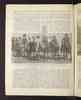
A GROUP OF BUFFALO BILL'S WILD WEST COW-BOYS.
THE PASSING OF THE COW-BOY.
Until the advent of Buffalo Bill's Wild West introduced the Cow-boy to the world at large, the great majority of people had altogether wrong notions about him. This was due chiefly to the misrepresentations of the cheap romances and the erroneous articles which had appeared from time to time in Eastern magazines and periodicals, which made a sort of "half horse, half alligator" character of him, and clothed him in a garb of absurdity and misconception. That civilized life to which his calling necessarily made him largely a stranger has, since Colonel Cody coaxed him from the plains, grown to justly regard him as a singularly interesting fellow, and ordinarily a very brave, quiet and unassuming one; generous to a fault, and a fast friend under all circumstances. It does not take him long to evidence in the great Wild West arena that he possesses the qualities of courage, clear headedness, agility and endurance, which are absolutely necessary in the business from which his title is gained. In the pursuit of that business he is called upon to undergo the most severe hardships which can fall to the lot of any man, and he is schooled to bear them with admirable and uncomplaining fortitude. Rising at three o'clock in the morning, riding
35
27
all day at top speed and taking all sorts of chances, without regard to life or limb, he has little time for tomfoolery or lawless carousing. Bad food, little sleep, constant anxiety and exhausting work soon undermind the strongest constitution, and at forty years of age, and often much sooner, rough, hard lines ins his face tell the story with plainness not to be mistake.
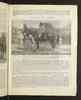
TWO NOTED WAR HORSES.
GEN. MILES AND COL. MAUS RIDING BUFFALO BILL'S WESTERN WAR HORSES AT PORTO RICO (FROM PHOTO TAKEN ON THE FIELD, AUGUST 30, 1898.)
The hundreds of horses from different countries and of different strains empl;oyed by Buffalo Bill's Wild West in transportation, parade and exhibition, collectively, form a living attractoin, full of nobility, beauty, intelligence, fire and fleetness, while in the great gathering are individual steeds full worthy of more than passing inspection and mention. Among these are included "Knickerbocker" and "Lancer," which Colonel Cody sent with the army to Porto Rico for his own use in the event of his being called to the front by General Miles and which were the only horses accompanying the invading forces that were returned to American soil, as the following note from General Miles to Colonel Miles to Colonel Cody shows: "MY DEAR CODY:
"Your horses are now in Washington, all right. You did not come to Porto Rico, therefore I rode them myself, and they are the only horses brought back to America. "NELSON A. MILES."
Regular army officers who had served with General Miles in the Indian campaigns had given him the reputation of being the hardest rider in the service. "He can cover more ground than any other man in the army and be fresh as a daisy at the end," they told the troopers in Porto Rico, and an escort of thirty-seven of them, who he rode to finish and nearly out of their saddles during a prolonged tour of inspection, sorely conceded that he was truly a Rough Rider par excellence. "Knickerbocker," a powerful, plucky gray, was just the amount required by such a horseman, and carried him triumphantly through the more arduous work of the campaign; "Lancer," a beautiful sorrel of less weight and stamina, being reserved for lighter service.