
36
22
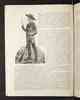
(Picture) JOHNNIE BAKER.
An interchange of opinions with COL. CODY disclosed a similar intention, so that to the fertile brains of MESSRS. CODY and SALSBURY we are indebted for the first conjuring-up of this novel project. They spoke of it years ago, and SALSBURY went to Europe to see if it would be advisable to take such a show on the Continent. Meanwhile, with MR. SALSBURY'S knowledge, "BUFFALO BILL" started the enterprise to see if it could be made successful in this country. Last year's experiences were proof that it could, and now all hands will join in getting up a "Wild West" show that will be remarkable in all respects. ________
JOHNNIE BAKE--THE YOUNG MARKSMAN.
Johnnie Baker was born at O'Fallon's Bluffs, on the banks of the South Platte River, in Western Nebraska, in the year 1870. His father is the well-known "Old Lew Baker, the ranchman," and was the owner of Lew Baker's O'Fallon's Bluff Ranch, in its day an important lankmark. This place was one of the most noted on the great overland trail--the scenes, indidents, Indian attacks, etc., belonging to exhaustive pages in the early history of that, in old times, exposed and dangerous section. Here Johnnie's babyhood was passed in unconscious proximity to dangers seldom courted by the most sturdy, and his first "bug-a-boo" was not of the maternal imagining, but an existing fact, continually threatening in the shape of the hearless, savage Sioux. Cradled amid such pioneer surroundings, and dandled on the kneews of all the most celebrated frontiersmen, the genuine old buckskin trappers--the first frontier invaders--his childhood witnessed the declining glories of the buffalo hunter's paradise (it being the heart of their domain), and the advent of his superior, "the long horn of Texas," and his necessary companion, "The Cow-boy."
The appearance of these brave, generous, free-hearted, self-sacrificing rough riders of the plains, literally living in the saddle, enduring exposure, hunger, risk of health and life as a duty to the employer, gave him his first communion with society beyond the sod cabin threshold, and impressed his mind, as well as directed his aspirations, to an emulation of the manly qualities necessary to be ranked a true American Cow-boy.
When the Pony Express, the Stage Coach, and the wagon-trains were supplanted by the steam-hourse, Baker's station became uselss, and "Old Lew" removed bag and baggage to North Platte, a little town of magical railroad growth. Here he built a fine house, which became the headquarters of the "old-timers," and many a tenderfoot can remember the thrilling incidents related of "life on the trail"--a life that now belongs alone to history and to romance--while Old Lew dispensed hospitality like a prince. But the ways of "city life," a too big heart, of which the "shiftless, genial affinities" and rounders took due advantage, caused his former prosperity to be a rememberance only, and Johnnie set two work manually for one of his age, to lend a helping hand. Perfectly at home in the saddle, he was never content unless with some cow-boy outfit, or at MR. CODY'S (whose homestead, externsive horse and cattle ranches, are near), where his active spirit found congenial associations, until he became recognized as "BUFFALLO BILL'S boy." In the winter months he occasionally went to school, and being an apt scholar, has a fair education. MR. CODY, on organizing his distinctly American exhibition, could not leave little Johnnie out. He can be seen every day with the Wild

37
23
West, mounted on his fiery little mustang, riding, roping, shooting--repeating on the mimic scene his own experiences, and the boyhood life of his elder, more famed associates; and any boy of his own age who can excel him in shooting, riding, and lassoing can "break every man in the outfit," as there are none who will not risk their pile on "THE COW-BOY KID." ________
ANNIE OAKLEY.
This celebrated Girl Shot was born at Woodland, Ohio. Ever since a toddling child she had had an inherent love for fire-arms and hunting, and at the age of the she, as often as ammunition was obtainable, would smuggle her borther's musket and steal into the woods where game at that time was plentiful. Naturally, she was a good shot, and came home well supplied with game. At the age of twelve she was presented with a light, muzzle-loading shot-gun, and also a breech-loading rifle. With the shot-gun she improved rapidly, and became such a fine shot that she rarely missed a quail or pheasant, and at the age of fourteen she had paid off a mortgage on her mother's homestead with money earned from the game and skins shot and trapped by herself alone--while her aim with rifle was so true that she was debarred from entering in the turkey matches which were the popular holiday amusement in that part of the country.
Then came a local reputation; and with improved fire-arms she attracted wider attention, and for the past several years she has been shooting before the public with great success, and athough she has many times beaten all records, like the modest little girl she is she never uses the word Champion in connection with her name. "SITTING BULL," the great Indian Chief, after seeing her shoot in St. Paul, Minn., adopted her into the Sioux tribe, giving her the name of "WATANYA CICILLA," or "LITTLE SURE SHOT."
The first two years before the public she devoted to Rifle and Pistol Shooting, and there is very little in that line she has not accomplished. At Tiffin, Ohio, she once shot a tencent piece held between the thumb and fore-finger of an attendant at a distance of 30 feet. In April, 1884, she attempted to beat the best record made at balls thrown in the air--the best record was 984 made by Dr. Ruth. MISS OAKLEY used a Stevens' 22 cal. rifle and broke 943. In February, 1885, she attempted the feat of shooting 5,00 balls in one day, loading the gun herself. In this feat she used three 16-gauge hammer guns; the balls were thrown from three traps 15 yards rise; out of the 5,000 shot at, she broke 4,772; on the second thousand she only missed 16, making the best 1,000 ball record, 984. Besides the thousands of exhibitions she has given in Europe and America, she has shot in over fity matches and tournaments, winning forty-one prizes; her collection of medals and fire-arms, all of which have been won or presented to her, is considered one of the finest in the world.
MISS OAKLEY is also an accomplished equestrienne, and her success with the public has been greatly enhanced by the fact that in dress, style and executions he is as original as she is attractive.
(Picture) ANNIE OAKLEY.
38
24
THE RIFLE AS AN AID TO CIVILIZATION.
There is a trite saying that "the pen is mightier than the sword." It is an equally true one that the bullet is the pioneer of civilization, for it has gone hand in hand with the axe that cleared the forest, and with the family Bible and school book. Deadly as has been its mission in one sense, it has been merciful in another; for without the rifle-ball we of America would not be to-day in the possession of a free and united country, and mighty in our strength.
And so has it been in the history of all people, from the time when David slew Goliath, down through the long line of ages, until in modern times science has substituted for the stone from David's sling the terrible missiles that now decide the fate of nations. It is not, therefore, so harsh an expression as it seems to be at first sight, that it is indeed the bullet which has been the forerunner of growth and development.
It is in the Far West of America, however, and along our frontier, that the rifle has found its greatest use and become a part of the person and the household of the venturesome settler, the guide, the scout, and the soldier; for nowhere else in Christendom is it so much and so frequently a necessity for the preservation of life, and the defense of home and property. It is her, too, among the hunters on the plains and in the Rocky Mountains, that one sees the perfection of that skill in marksmanship that has become the wonder of those who are not accustomed to the daily use of weapons. Yes if it were not possessed--if there were not the quick eye, the sure aim, coolness in the moment of extreme danger, whether threatened by man or beast--life in that section would be of little value, and a man's home anything but a safe abiding place.
There are exceptional cases of men like "Buffalo Bill," Major North, and others, whose names are more or less familiar among the mighty hunters of the West, who excel in the use of rifle and pistol, and to which, time and time again, they and those around them have owed their lives. And they are the worthy successors of a long line of marksmen whose names are also "familiar as household words." Who does not recall David Crockett and his death-dealing rifle in the Alamo? Daniel Boone, of Kentucky, and the heroic exploits that have been written concerning them in the early pages of our country's history?
It is to the end that the people of the East, or rather those who are not acquainted with the rough life of the border and especially that portion of it in which the rifle plays so important a part, may personally witness some of the feats of the Western life "a series of shooting exhibitions. The manner in which buffaloes are hunted, the exciting chase at close quarters, the splendidly trained horses who participate in the chase, the hunt for elk, the stealthy devices of Indians in capturing the fleet-footed animals - all these will be illustrated in a manner that has never been witnessed East of the Mississippi River. - Buell's Life on the Plains.
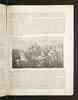
AN HISTORICAL COACH OF THE DEADWOOD LINE,
THE INDIANS ATTACK ON WHICH WILL BE REPRESENTED IN "BUFFALO BILL'S" WILD WEST, AND ALSO ITS RESCUE BY THE SCOUTS AND PLAINSMEN.
The people of the Eastern States of the Union are accustomed to regard the West as the region of romance and adventure. And, in truth, its history abounds with thrilling incidents and surprising changes. Every inch of that beautiful country has been won from a cruel savage foe by danger and conflict. In the terrible wars of the border, which marked the early years of the Western settlements, the men signalized themselves by performing prodigies of valor, while the women, in their heroic courage and endurance, afforded a splendid example of devotion and self-sacrifice. The history of the wagon trains and stage coaches that preceded the railway is written all over with blood, and the story of suffering and disaster, often as it has been repeated, is only known in all of its horrid details to the bold frontiersmen who, as scouts and rangers, penetrated the strongholds of the Indians, and, backed by the gallant men of the army, became the avant couriers of Western civilization and the terror of the red man.
Among the most stirring episodes in the life of the Western pioneer are those connected with the opening of new lines of travel, for it is here, among the traits and canons where lurk the desperadoes of both races, that he is brought face to face with danger in its deadliest forms. No better illustration of this fact is furnished than in the history of the famous DEADWOOD COACH, the scarred and weather-beaten veteran of the original "star route" line
39
25 of stages, established at a time when it was worth a man's life to sit on its box and journey from one end of its destination to the other. The accompanying picture affords an idea of the old relic, and it is because of its many associations with his own life that it has been purchased by "BUFFALO BILL" and added to the attractions of his "GREAT REALISTIC EXHIBITION OF WESTERN LIFE."
It will be observed that it is a heavily built Concord stage and is intended for a team of six horses. The body is swung on a pair of heavy leather underbraces, and has the usual thick "perches," "jacks" and brakes belonging to such a vehicile. It has a large leather "boot" behind, and another at the driver's foot-board. The coach was intended to seat twenty-one men - the driver and two men beside him, twelve inside the other six on top. As it now stands, the leather blinds of the windows are worn, the paint is faded, and it has a battered and travel-stained aspect that tells the story of hardship and adventure. Its trips began in 1875, when the owners were Messrs, Filmore, Salsbury & Co. Luke Voorhees is the present manager. This route was between Cheyenne and Deadwood, via Fort Laramie, Rawhide Buttes, Hat or War Bonnet Creek, the place where "BUFFALO BILL" killed the Indian Chief, "Yellow Hand," on July 17, 1876, Cheyenne River, Red Canyon, and Custer. Owing to the long distance and dangers, the drivers were always chosen for their coolness, courage and skill.
In its first season the dangerous places on the route were Buffalo Gap, Lame Johny Creek, Red Canyon, and Squaw Gap, all of which were made famous by scenes of slaughter and the deviltry of the banditti. Conspicuous among the latter were "Curley" Grimes, who was killed at Hogan's Ranch; "Peg Legged" Bradley, Bill Price, who was killed on the Cheyenne River; "Dunk" Blackburn, who is now in the Nebraska State Prison, and others of the same class, representing the most fearless of the road agents of the West.
On the occassion of the first attack the driver, John Slaughter, a son of the present marshal of Cheyenne, was shot to pieces with buckshot. He feel to the ground and the team ran away, escaping with the passengers and mail, and safely reached Greely's Station. This occured at White Wood Canyon. Slaughter's body was recovered, brought to Deadwood, and thence carried to Cheyenne, where it is now buried. The old coach here received its "baptism of fire," and during the ensuing summer passed through a variety of similar experiences, being frequently attacked. One of the most terrific of these raids was made by the Sioux Indians, but the assault was successfully repelled, although the two leading the horses were killed. Several commerical travelers next suffered from a successful ambush, on which
40
26 occasion a Mr. Liebamn, of Chicago, was killed, and his companion shot through the shoulder.
After this stormy period it was fitted up as a treasure coach, and naturally became an object of renewed interest to the robbers; but owing to the strong force of what are known as "shotgun messengers," who accompanied the coach, it was a long time before the bandits succeeded in accomplishing their purpose. Among the most prominent of these messengers were Scott Davis, a splendid scout, and one of the self-appointed undertakers of many of the lawless characters of the neighbord; Boone May, one of the best pistol shots in the Rocky Mountain regions, who killed Bill Price in the streets of Deadwood, together with "Curley" Grimes, one of the road agents; Jim May, a worthy brother - a twin in courage if not in birth. Few men have had more desperate encounters than he, and the transgressors of the law have had many an occasion to feel the results of his keen eye and strong arms whenever it has become necessary to face men who are prepared to "die with their boots on." Still another of these border heroes (for such they may be justly termed) is Gail Hill, now the deputy sheriff of Deadwood, and his frequent companion was Jesse Brown, an old-time Indian fighter, who has a record of incident and adventure that would make a book. These men constituted a sextette of as brave fellows as could be found on the frontier, and their names are all well known in that country.
At last, however, some of them came to grief. The bandits themselves were old fighters. The shrewdeness of one party was offset by that of the other, and on an unlucky day the celebrated Cold Spring tragedy occured. The station had been captured, and the road agents secretly occupied the place. The stage arrived in its usual manner, and without suspicion of danger the driver, Gene Barnett, halted at the stable door. An instant afterward a volley was delivered that killed Hughey Stevenson, sent the buckshot through the body of Gail Hill, and dangerously wounded two others of the guards. The bandits then captured the outfit, amounting to some sixty thousand dollars in gold.
On another occasion the coach was attacked, and, when the driver was killed, saved by a woman - Martha Canary, better known at the present time in the wild history of the frontier as "Calamity Jane." Amid the fire of the attack, she seized the lines, and, whipping up the team, safely brought the coach to her destination.
When "Buffalo Bill" returned from his scout with Gen. Crook, in 1876, he rode in this self-same stage, bringing with him the scalps of several of the Indians whom he had met. When afterwards he learned that it had been attacked and abandoned, and was lying neglected on the plains, he organized a party, and starting on the trail, rescued and brought the vehicle into camp.
With the sentiment that attaches to a man whose life has been identified with the excitement of the Faw West, the scout has now secured the coach from Col. Voorhees, the manager of the Black Hills stage line, and herefter it will play a different role in its history form that of inviting murder and being the tomb of its passagengers. And yet the "Deadwood Coach" will play no small part in the entertainment that has been organized by "BUFFALO BILL" and partner for the purpose of representing some of the most startling realities of Western life, in a vivid representation of one of the Indian and road agents' combined attacks.
THE COW-BOYS. Among the many features of the Wild West not the least attractive will be the advent in the East of a band of veritable "cow-boys," a class without whose aid the great grazing pampas of the West would be valueless, and the Eastern necessities of the table, the tan-yard, and the factory would be meager. These will be the genuine cattle-herders of a reputable trade, and not the later misnomers of "the road," who, in assuming an honored title, have tarnished it in the East, while being in fact the cow-boys' greatest foe, the thieving, criminal "rustler." To Wilkes' Spirit of March, the editor is indebted for a just tribute and description of the American ranchman:
"THE COW-BOY,- The cow-boy! How often spoken of, how falsely imagined, how greatly despised (where not known), how little understood! I've been there considerable. How sneeringly referred to, and how little appreciated, although his title has been gained by the possession of many of the noblest qualities that form the romantic hero of the poet, novelist, and historian; the plainsman and the scout. What a school it has been for the latter! As 'tall oaks from little acorns grow,' the cow-boy serves a purpose, and often develops into the most celebrated ranchman, guide, cattle-king, Indian-fighter, and dashing ranger. How