
26
12 other country in the world. Her pioneers are fast passing away. A few years more and the great struggle for possession will be ended, and generations will settle down to enjoy the homes their fathers located and fenced in for them. Then will come the picture maker–he who, with pen, pencil, and panel, can tell the story as he understands it. Then millions will read and look at what the pioneer did and what the historian related, wishing on the whole that they could have been there to have seen the original. These are some of the thoughts to crowd in upon us as we view the great living picture that the HON. WM. F. CODY ("BUFFALO BILL") gives at the Wild West Exhibition, which every man, woman, and child the world over should see and study as a realistic fact.
We see audiences of thousands each night–statesmen, artists, military men, teachers, workers, musicians, business men, politicians, artisans, mechanics and others who desire to know as much as possible of the history of America.
We see "BUFFALO BILL," the last of the six greatest scouts this country has ever known, viz., BOONE, CROCKETT, CARSON, BRIDGER, "WILD BILL," and "BUFFALO BILL,"–to our mind the greatest and most remarkable of all–a man whom this country will never duplicate. A nonesuch to the credit of Nature, the world and the mental and physical material of which he was formed, as one made to do a certain great work. A man in the prime of life, who, from the age of ten years, has fought fate and all adverse circumstances, and never to a loss. A man who is a man ; as a scout ; as a pioneer ; as a Government officer ; as an Indian fighter ; as a mighty hunter ; as a man of honor, and of more than ordinary skill and courage, commanding admiration–deserving of recognition as a great character in American history. A natural man of the highest order.–Editorial, New York Democrat, June 5, 1886.
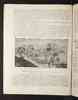
OLD TIME CAMP IN THE WILD WEST ; OR, ON THE PLATTE IN 1857. –––
BUFFALO BILL AT HOME–HIS GREAT SUCCESS ABROAD.
(From the North Platte Telegraph, 1884.)
"North Platte should be congratulated on the possession of a citizen whose prominence or position is not bounded by his township, his county, or his State, but whose name is a household word, whose pictures are familiar, and whose character is known not only throughout the nation, but has adorned pages and interested the readers of foreign works and publications. We allude to our fellow-citizen, Hon. Wm. F. Cody, whose sobriquet of Buffalo Bill' represents a popularity only bounded by the area of American territory, and to which we, who live by his own fireside, may testify his worthy possession and the modesty of its wearing. His late return from a successful presentation to the East of some of the animated daily scenes and incidents that go to form the passing history of the 'Wild West' should be
27
13 noted, as are events of importance, as it marks a new era in the history of amusements: -for originality, adherence to truth in 'holding the mirror up to Nature,' and a fidelity to fact that is the 'true aim of art.' The reception accorded to his 'show that is not a show, but an illustration,' in the cultured cities of the East, notably Boston, Chicago, Newport, New York, Philadelphia, Cincinnati, and Cleveland, must be gratifying to all in North Platte; in fact, in Nebraska, where in the incipiency of the scheme, over a year ago, he demonstrated by courage, pluck, and perseverance, its feasibility by its introduction in the festivities of our national birthday celebration, and on the following natal day presented it on the shores of the Atlantic, to the plandits of over 25,000 delighted Bostonians. The magnitude of the undertaking the minutiae necessary to organizing, the bringing together from all points the best marksmen in the world, securing admirable and fitting representatives of the cattle trade, getting wild buffalo, elk steers, mules, ponies, specimens of the red terrors of the prairie, and other features of interest known only to the pampas of the West- necessitating special trains of cars for transportaion, and driving the strange cavalcade through confined Washington Street, Boston in six weeks after leaving the Platte- was an accomplishment that stamps Cody as a wonder in energy, and gained for him the admiration and encomiums of the entire press of the East, recognition from the elite of American society, encouragement from representatives of education and the indorsement of his methods by the S. P. C. A. and its noted president, Professor Henry Berg.
___
MAVERICK JOE. BY NATHAN KIRK GRIGGS. From Lyrics of the Larist.
Don't know Of Maverick Joe, That buster of broncos in chief. And who, As every one knew, Waxed rich as a Maverick thief?
It's strange, Out here on the range, That you haven't known of his name, Nor heard How ranchers were stirred Because of his Maverick fame.
Well, then, I'll whisper again, That tale of the cow and her kid, Altho', Thought Maverick Joe, The trick was a corker they did.
Out West, With lucre unblest, He rangled for others a year, While budge, As well you may judge, Occasion'ly offered him cheer.
One day, With poker the play That game by no tenderfoot learned I hear He rustled a steer, That wasn't quite honestly earned.
And then, He built him aden, Way out where the punchers were few, And there, Tho' not by the square, He soon to a cattle-king grew.
'Twas queer How often that steer Raised calves for his Maverick "X" (cross). Tho' now, I'm bound to allow, His gain was some other one's loss.
One noon, Alone about June, A Maverick daisy he saw The best, And one that he guessed He'd own by the Maverick law.
And so He rastled it low, And gave it a touch of his brand, Then smiled, For fortune beguiled, That happiest chump in the land.
Next morn, As sure as I'm born, It chanced that a round-up begun, And then, Some blundering men Caught on to the caper he'd done.
For now, They circled a cow, One bearing a "{square shape}" (square) on her side, That bawled, And motherly called At sight of his Maverick pride.
The kid Then bellowed and slid, And hackled right in for a meal; And-well, It's idle to tell The feelings he couldn't conceal.
Tho' caught, He swore it was bought, Where never a seller was nigh; But all, Tho' praising his gall, Yet reckoned no cattle would lie.
And thus, That ornery cuss Got "cinched" on account of that pair; Because, By cattlemen's laws, A "X" shouldn't tackle a "{square}."
___
THE PAWNEES ASTONISHED
W. F. CODY, although having established his right to the title of "BUFFALO BILL" for years before, had not had opportunity to convince the Pawnees of the justice of his claim previous to the time of the following incident. A short while previously a band of marauding red skin renegades from that nation, while on a stealing excursion near Ellsworth, had occasion to regret their temerity, and cause to remember him to the extent of three killed, which fact for a time resulted in an enmity that needed something out of the usual run to establish him in their favor. While on a military expedition, under Gen. E. A. Carr, upon
28
14
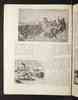
(Picture) HUNTING THE BISON.
the Republican, he met Major North and the Pawnee scouts. One day a herd of buffalo were descried, and CODY desired to join in the hunt. The Indians objected, telling the Major, "The white talker would only scare them away." Seventy-three Indians attacked the herd and killed twenty-three. Later in the day another herd was discovered, and Major North insisted that the white chief have a chance to prove his skill. After much grumbling they acquiesced grudgingly, and with ill-concealed smiles of derision consented to be spectators. Judge of their surprise when CODY charged the herd, and single-handed and alone fairly amazed them by killing forty-eight buffaloes in fifty minutes, thus forever gaining their admiration and a firm friendship that has since often accrued to his benefit.
COLONEL ROYALL'S WAGONS.
Once, upon the South Fork of the Solomon, Col. Royall ordered CODY to kill some buffalo that were in sight to feed his men, but declined to send his wagons until assured of the game. Bill rounded the herd, and, getting them in a line for camp, drove them in and killed seven near headquarters; or, as the Colonel afterward laughingly remarked, "furnishing grub and his own transportation."
THE BOW AND ARROW.
The bow is the natural weapon of the wild tribes of the West. Previous to the introduction of firearms it was the weapon supreme of every savage's outfit--in fact, his principal dependence, backed by personal skill in its use, for sustenance for himself and his pappooses. It still retains its favor, as it is not alwasy safe to rely on the white man's mechanism, as in case of lack of ammunition or
(Picture) RUNNING GAME TO CAMP.
29
15
deranged lock or trigger, time and location prevent its being "mended." As a weapon of economy it is also to be commended, as the hunting arrow is made so that the rear shoulders of the long, tapering blade slope backward, thus facilitating its withdrawal from the wounded game. On the other hand, in the war arrow, the rear shoulders slope forward, forming barbs, as it is intended to remain and eventually kill. The possession, therefore, of firearms has not affected the Indian's love of this reliable weapon of the chase, which, being his first childish plaything, is still, no matter how well armed or how rich he may be, an indispendable possession. At short distances it is a terribly effective arm, and the Indian expert can seize five to ten arrows in his left hand, and dispatch them with such rapidity that the last one will be on its flight before the first one touches the ground. In close quarters they prefer to rely on it to depending on the rifle, as it can be of deadly force at from thirty to forty yards, and creating a bad wound at much greater distance. In buffalo hunting, where the horseman can approach near, it is invaluable and economic, and is often buried to the feathers. "Two Lance," an Indian chief, during the Grand Duke's hunt, sent an arrow clear through a bison, Alexis retaining the light-winged messenger of death as a souvenir of his hunt on the American Plains.
THE BUFFALO.
The buffalo is the true bison of the ancients. It is distinguished by an elevated stature, measuring six to seven feet at the shoulders, and ten to twelve feet from nose to tail. Many are under the impression that the buffalo was never an inhabitant of any country save ours. Their bones have been discovered in the superficial strata of temperate Europe; they were common in Germany inthe eighth century. Primitive man in America found this animal his principal means of subsistence, while to pioneers, hunteres, emigrants, settlers and railroad builders this fast disappearing monarch of the plains was invaluable. MESSRS, CODY & CO. have a herd of healthy specimens of this hardy bovine in connection with their instructive exhibition, "The Wild West," rendered interesting as the last of their kind.
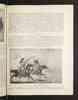
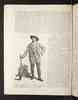
(Picture) A PRACTICAL "ALL-ROUND SHOT."
In contradistinction of the may so-called "fancy shots" that have for years been before the public, "BUFFALO BILL" is what may be termed a "practical marksman," and
30
16
where that expression's full meaning is understood he is looked upon as a marvelous "all-round shot." That is, a man of deadly aim in any emergency, with any weapon--a small Derringer, a Colt's, a shot-gun, a carbine, a blunderbuss, or a rifle--at any foe, red or white; at any game--chicken, jack-rabbit, antelope, deer, buffalo, bear, or elf; at the swiftest bird or soaring eagle; on foot, in any position; on horseback, at any speed. To be such a marksman is only the result of years of necessity for exercising the faculties of instantaneous measurement of distance, acuteness of vision--in fact, an eagle eye and iron nerves--to think quick, to resolve, to fire, to kill. As a hunter these gifts have rendered him famous and gained him plaudits from admiring officers, noblemen, sportsmen and competitors in the chase, and compelled the respect and fear of his implacable Indian foes. That he exists to-day is the result of the training that enables a man in the most startling exigency to command himself, and to meet the circumstances face to face, whatever they may be, and achieve by cool precision deserved victory in the field, and embellish history with deeds of heroism. MR. CODY will give an exhibition of his ability by shooting objects thrown in the air while galloping at full speed, executing difficulties that would receive commendation if accomplished on foot, and which can only be fully appreciated by those who have attempted the feat while experiencing a rapid pace when occupying "a seat in the saddle."
CODY SAVES "WILD BILL."
After a very long march, full of hardships and suffering, Gen. Penrose's camp was found on the Palodora in a most distracted condition. Gen. Carr's arrival was none too soon, as the famished men were sustaining life on the last carcasses of their draught animals. In a few weeks Black Kettle's depredations necessitated a pursuit. . . . The consolidated command discovered the Indians on the Cimarron, and a terrific battle ensued. . . . In this fight "BUFFALO BILL" and "WILD BILL" did almost the work of a regiment; braver men never went into an action, both fighting as though they were invulnerable. In the fury and rout which followed the first charge, "WILD BILL" gave chase to Black Kettle, head chief of the Cheyennes, overtook and engaged the fleeing red warrior, stabbing him to death. But the accomplishment of this heroic action would have cost him his own life had not "BUFFALO BILL" ridden with impetuous daring into they very midst of fully fifty Indians, who had surrounded "WILD BILL," intent on either his capture or death. The two daring and intrepid scouts plunged furiously into the midst of the Indians, each with a revolver in either hand, and literally carved their way through the surging mass of red-skins, leaving a furrow of dead Indians in their wake. Such fighting, such riding, and such marvelous intrepidity combined, were doubtless never equaled, and if but this act alone were credited to the valor of "WILD BILL" and "BUFFALO BILL," their names would deserve inscription on Fame's enduring monument.--Buell's History.