
16
14
{picture}
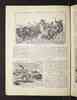
HUNTING THE BISON.
the Republican, he met Major North and the Pawnee scouts. One day a herd of buffalo were descried, and Cody desired to join in the hunt. The Indians objected, telling the Major, "The white talked would only scare them away." Seventy-three Indians attacked the herd and killed twenty-three. Later in the day another herd was discovered, and Major North insisted that the white chief have a chance to prove his skill. After much grumbling, they acquiesced grudgingly, and with ill-concealed smiles of derision consented to be spectators. Judge of their surprise when Cody charged the herd, and single-handed and alone fairly amazed them by killing forty-eight buffalo in fifty minutes, thus forever gaining their admiration and a firm friendship that has since often accrued to his benefit.
COLONEL ROYAL'S WAGONS.
Once upon the South Fork of the Solomon, Col, Royall ordered Cody to kill some buffalo that were in sight to feed his men, but declined to send his wagons until assured of the game. Bill rounded the herd, and, getting them in a line for camp, drove them in and killed seven near headquarters; or, as the Colonel afterward laughingly remarked, "furnishing grub and his own transportation."
THE BOW AND ARROW.
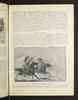
The bow is the natural weapon of the wild tribes of the West. Previous to the introduction of firearms it was the weapon supreme of every savage's outfit - in fact, his principal dependence, backed by personal skill in its use, for sustenance for himself and his pappooses. It still retains its favor, as it is not always safe to rely on the white man's mechanism, as in case of lack of ammunition or
RUNNING GAME TO CAMP.
17
15
deranged lock or trigger, time and location prevent it being "mended." As a weapon of economy it is also to be commended, as the hunting arrow is made so that the rear shoulders of the long, tapering blade slope backward, thus facilitating its withdrawal from the wounded game. On the other hand, in the war arrow, the rear shoulders slope forward, forming barbs, as it is intended to remain and eventually kill. The possession, therefore, of firearms has not affected the Indian's love of this reliable weapon of the chase, which, being his first childish plaything, is still, no matter how well armed or how rich he may be, an indispensable possession. At short distances it is a terribly effective arm, and the Indian expert can seize five to ten arrows in his left hand, and dispatch them with such rapidity that the last one will be on its flight before the first one touches the ground. In close quarters they prefer to rely on it to depending on the rifle, as it can be of deadly force at from thirty to forty yards, and creating a bad wound at much greater distance. In buffalo hunting, where the horseman can approach near, it is invaluable and economic, and is often buried to the feathers. "Two Lance," an Indian chief, during the Grand Duke's hunt, sent an arrow clear through a bison, Alexis retaining the light-winged messenger of death as a souvenir of his hunt on the American Plains.
THE BUFFALO.
The buffalo is the true bison of the ancients. It is distinguished by an elevated stature, measuring six to seven feet at the shoulders, and ten to twelve feet from nose to tail. Many are under the impression that the buffalo was never an inhabitant of any country save ours. Their bones have been discovered in the superficial strata of temperate Europe; they were common in Germany in the eighth century. Primitive man in America found this animal his principal means of subsistence, while to pioneers, hunters, emigrants, settlers and railroad builders this fast disappearing monarch of the plains was invaluable. Messrs, CODY & Co. have a herd of healthy specimens of this hardy bovine in connection with their instructive exhibition, "The Wild West," rendered interesting as the last of their kind.
A PRACTICAL "ALL-ROUND SHOT."
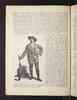
In contradiction to the many so-called "fancy shots" that have for years been before the public, "Buffalo Bill" is what may be termed a "practical marksman," and
18
16
where that expression's full meaning is understood, he is looked on as a marvelous "all-round shot." That is, a man of deadly aim in any emergency, with any weapon - a small Derringer, a Colt's, a shot-fun, a carbine, a blunderbus, or a rifle - at any foe, red or white; at any game - chicken, jack-rabbit, antelope, deer, buffalo, bear, or elk; at the swiftest bird or soaring eagle; on foot, in any position; on horseback, at any speed. To be such a marksman is only the result of years of necessity for exercising the faculties of instantaneous measurement of distance, acuteness of vision - in fact, an eagle eye and iron nerves - to think quick, to resolve, to fire, to kill. As a hunter these gifts have rendered him famous and gained him plaudits from admiring officers, noblemen, sportsmen, and competitors in the chase, and compelled the respect and fear of his implacable Indian foes. That he exists today is the result of the training that enables a man in the most startling exigency to command himself, and to meet the circumstances face to face, whatever they may be, and achieve, by cool precision, deserved victory in the field, and embellish history with deeds of heroism. Mr. Cody will give an exhibition of his ability by shooting objects thrown in the air while galloping at full speed, executing difficulties that would receive commendation if accomplished on foot, and which can only be fully appreciated by those who have attempted the feat while experiencing a rapid pace when occupying "a seat in the saddle."
CODY SAVES "WILD BILL."
After a very long march, full of hardships and suffering, Gen. Penrose's camp was found on the Palodora in a most distracted condition. Gen. Carr's arrival was none too soon, as the famished men were sustaining life on the last carcasses of their draught animals. In a few weeks Black Kettle's depredations necessitated a pursuit, . . . The consolidated command discovered the Indians on the Cimarron, and a terrific battle ensued. . . . In this fight "Buffalo Bill" and "Wild Bill" did almost the work of a regiment; braver men never went into an action, both fighting as though they were invulnerable. In the fury and rout which followed the first charge, "Wild Bill" gave chase to Black Kettle, head chief of the Cheyennes, overtook and engaged the fleeing red warrior, stabbing him to death. But the accomplishment of this heroic action would have cost him his own life had not "Buffalo Bill" ridden with impetuous daring into the very midst of fully fifty Indians, who had surrounded "Wild Bill," intent on either his capture or death. The two daring and intrepid scouts plunged furiously into the midst of the Indians, each with a revolver in either hand, and literally carved their way through the surging mass of redskins, leaving a furrow of dead Indians in their wake. Such fighting, such riding, and such marvelous intrepidity combined, were doubtless never equaled, and if but this act alone were credited to the valor of "Wild Bill" and Buffalo Bill, their names would deserve inscription on Fame's enduring monument. - Buell's History.
19
LETTERS OF COMMENDATION FROM PROMINENT MILITARY MEN. FROM AN OLD COMMANDER. {COPY}
5th Avenue Hotel, New York, June 29, 1887
Hon. Wm. F. Cody, London, England.
Dear Cody :- In common with all your countrymen, I want to let you know that I am not only gratified, but proud of your management and general behavior; so far as I can make out you have been modest, graceful, and dignified in all you have doen to illustrate the history of civilization on this Continent during the past century.
I am especially pleased with the graceful and pretty compliment paid you by the Princess of Wales, who rode in the Deadwood Coach while it was attacked by the Indians and rescued by the Cowboys. Such things did occur in our days, and may never again.
As near as I can estimate there were in 1865 about nine and a half of millions of buffaloes on the plains between the Missouri River and the Rocky Mountains; all are now gone - killed for their meant, their skins and bones.
This seems like desecration cruelty, and murder, yet they have been replaced by twice as many neat cattle. At that date there were about 165,000 Pawnees, Sioux, Cheyennes, Kansas, and Arapahoes, who depended on these buffaloes for their yearly food. They, too, are gone, and have been replaced by twice of thrice as any white men and women, who have made the earth to blossom as the rose, adn who can be counted, taxed, and governed by the laws of nature and civilization. This change has been salutary, and will go on to the end. You have caught on epoch of the world's history ; have illustrated it in teh very ehart of the modern world - London, and I want you to feel that on this side the water we appreciate it. This drama must end days, years and centuries follow fast, even the drama of civilization must have an end.
All I aim to accomplish on this sheet of paper is to assure you that I fully recognize your work and that the presence of the Queen, the beautiful Princess of Wales, the Prince, and British publich, are marks of favor which reflect beack on America sparks of light which illuminate many a house a cabin in the land where once you guided me honeslty faithfully in 1865-6 from Fort Riley to Kearney in Kansas and Nebraska. Sincerely you friend, W. T. SHERAMAN>
20
18
NEW YORK, December 28, 1886.
COL. WM. F. CODY: DEAR SIR, - Recalling the many facts that came to me while I was Adjutant-General of the Division of the Missouri, under General Sheridan, bearing upon your efficiency, fidelity, and daring as a guide and scout over the country west of the Missouri River and east of the Rocky Mountains, I take pleasure in observing your success in depicting in the East the early life of the West. Very truly yours, JAMES B. FRY, Assistant Adjutant-General, Brevet Major-General, U.S.A.
HEADQUARTERS ARMY OF THE UNITED STATES, WASHINGTON, D. C. January 7, 1887.
COL. WM. F. CODY was a scout, and served in my command on the Western frontier for many years. He was always ready for duty, and was a cool, brave man, with unimpeachable character. I take pleasure in commending him for the many services he has rendered to the Army, whose respect he enjoys for his many qualities. P. H. SHERIDAN, Lieutenant-General.
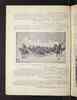
BUFFALO BILL GUIDING GENERAL SHERIDAN'S RELIEF TRAIN IN WINTER, 1868.
UNITED STATES MILITARY ACADEMY, WEST POINT, N. Y., January 11, 1887.
I have known W. F. Cody (Buffalo Bill) for many years. He is a Western man of the best type, combining those qualities of enterprise, daring, good sense, and physical endurance which made him the superior of any scout I ever knew. He was cool and capable when surrounded by dangers, and his reports were always free from exaggeration. He is a gentleman in that better sense of the word which implies character, and he may be depended on under all circumstances. I wish him success. W. MERRITT, Brevet Major-General, U. S. A., Late Major-General Volunteers.
OMAHA, NEB., January 7, 1887.
HON. WM. F. CODY: DEAR SIR, - I take great pleasure in testifying to the very efficient service rendered by you "as a scout," in the campaign against the Sioux Indians, during the year 1876. Also, that I have witnessed your Wild West Exhibition. I consider it the most realistic performance of the kind I have ever seen. Very sincerely, your obedient servant, GEORGE CROOK, Brigadier-General, U. S. A.