
11
9
be counted on the figures. The services which these men are called on to perform are so important and valuable that the officer who benefits by them is sure to give the fullest credit, and men honored in official reports come to be great men on the frontier. Fremont's reports made Kit Carson a renowned man. Custer immortalized California Joe, Custer, Merritt, and Carr made William F. Cody (Buffalo Bill) a plains celebrity 'UNTIL TIME SHALL BE NO MORE'. A LEGISLATOR-- The late Phocian Howard journalistically records the fact: "We were present in the Nebraska Legislature when Mr. Cody's resignation was read, and knowing his practical qualities, his through knowledge of important questions then demanding attention in border legislation, his acquaintance with the Indian problem-- the savage's deadly foe in battle, their generous friend in peace-- great was our disappointment in his refusing to continue in their generous in political life, choosing to be, what he really is, a true 'Knight of the Plains'. On the frontier, even there his name a household word, deserdly is the famous scout popular throughout the land, standing, as he has, a leader among the manly pioneer barriers between civilization and savagery, risking all that the "Star of Empire might force its westward way". We know Bill Cody well having been with him in three campaigns amoung the Indians, the last being the memorable Custer campaign under Cook on the Big Horn against the Sutting Bull Sioux and we bear kind witness that Buffalo Bill is the idol of the army and frontiersmen and the dread and terror of the war-bonneted Indian. At the last session of the Nebraska Legislature he received a large complimentary vote for United States Senator.
A PEN PICTURE-- Curtis Guild, proprietor and editor of the Conservative Commercial Balletin, Boston writes-- "Raised on the frontier, he has passed through every grade, and won fame in each line while to be proficient in one bring celebrity sufficient to pratify most ambitions. That it is he holds supremacy in fact, and received from his associates an adoration superpassing even his public popularity. Visitors to the camp, early the other morning, found him joining in every frolic, game and contest, with each and all generally excelling; in shooting, in running, in jumping, in trials of strength, feats of agility, horsemanship, handling the ribbons behind four or six, riding the vicious mustang, manipulating the revolver, etc, tackling each specialist, and coming to the front with a generous modesty admired by the defeated. "No lover of the human race, no man with an eye for the picturesque, but must have enjoyed the very sight of those pioneers of civilization. Never was a finer picture of American manhood presented than when Buffalo Bill stepped out to show the capabilities of the Western teamster's whip. Tall beyond the lot of ordinary mortals traight as an arrow, not an ounce of useless flesh upon his limbs, but every muscle firm and hard as the sinews of a stag, with the frank, kindly eye of a devoted friend, and a natural coartly grace of manner which would become a marshal of France, Buffalo Bill is from spur to sombrero one of the finest types of manhood, this continent has ever produced. THose who had expected to meet a different class of men must have been pleasantly surprised in these genuine sons of the plains, every one of whom was stamped with the natural easy grace and courtesy of manner which marks the man who is born a gentleman. AS AN EDUCATOR.-- The nationally known Brick Pomeroy thus writes:-- "One of the pronounced positive, strong men of the West is Hon. W. F. Cody, of Nebraska, known quite generally the world over as "Buffalo Bill". A sturdy generous positive character who as hunter guide, scout, Government officer, member of the Legislature and gentleman, rises to the equal of every emergency into which his way is opened or directed. Quick to think and to act, cool in all cases of pleasure or extreme danger; versatile in his genius; broad and liberal in his ideas; progressive in his mentality, he can no more keep still or settle down into a routine work incidental to office or farm life, than an eagle can thrive in a cage. "The true Western man is free, fearless, generous, and chivalrous. Of this class, Hon. W. F Cody, "Buffalo Bill', is a bright representative. As a part of his rushing career he has brought together material for what he correctly terms a Wild West Exhibitation. I should call it a exhibition, but to give people in the East a correct representation of life on the plains, and the incidental life of the hardy, brave, intelligent pioneers, who are the first to blaze the way to the future homes and greatness of America. He knows the worth and sturdiness of true Western character, and as a lover of his country, wishes to present as many facts as possible to the public, so that those who will, can see actual pictures of life in the West, brought to the East for the inspection and education of the public. "Buffalo Bill" has brough the Wild West to the doors of the East. There is more of real life, of genuine interest, of positive education in this startling exhibition, than I have ever before seen, and it is as true to nature and life as it really is with those who are smoothing the way..

12
10
millions to follow. All of this imaginary Romeo and Juliet business sinks to utter insignificance in compared to the drama of existence as is here so well enacted, and all the operas in the world appear like pretty playthings for emasculated children by the side of the setting of reality, and the music of the frontier as so faithfully and extensively presented, and so cleverly managed by this incomparable representative of Western pluck, coolness, bravery, independence, and generosity. Western life, they would know more and think better of the genuine men of the West. "I wish there were more progressive educators like Wm. F. Cody in this world. "He deserves well for his efforts to pleace and to instruct in matters important to America, and incidents that are passing away never more to return." Could a man now living have stood on the shore of the Red Seas, and witnessed the passage of the children of Israel and the struggle of Pharoah and his hosts, what a sight he would have seen, and how interested would be those to whom he related the story. Could the man who stood on the shore to see Washington and his soldiers cross the Delaware have lived till now to tell the story, what crowds he would have to listen. How interesting would be the story of a man, if he were now living, that had witnessed the landing of Columbus on the shores of the New World; or the story of one of the hardy English Puritans who took passage on the "Mayflower," and landed on the rockbound coast of New England. So, too, of the angel who has seen the far West become tame and dotted under advancing civilizations, and the pioneers fought their way westward into desert and jungle. What a story he can relate as to the making of that history. And what a history American has, to be sure! From the mouth of the Hudson River to the shores of the Pacific, men, women, and children have conquered the wilderness by going to the front and staying there. Not by crowding into cities and living as do worms, by crawling through each other and devouring the leavings. Since the railroad gave its aid to pioneering, America is making history faster than any other country in the world. Her pioneers are fast passing away. A few years more and the great struggle for possession will be ended, and generations will settle down to enjoy the hoems their fathers located and fenced in for them. Then will come the picture maker. He who, with pen, pencil, and panel, can tell the story as he understands it. Then millions will read and look at with the pioneer did and what the historian related, wishing the while that they could have been there to have seen the original. These are of the thoughts to crowd in upon us as we review the great living pictures that the HON. Wm. F. CODY ("BUFFALO BILL") gives at the Wild West Exhibition, which every man, woman and child the world over should see and study as a realistic fact. We see audiences of thousands each night–statesmen, arists, military men, teachers, workers, musicians, business men, politicians, artisans, mechanics, and others who desire to know as much as possible of the history of America. We see "BUFFALO BILL," the last of the six greatest scouts this country has every known, viz., BOONE, CROCKETT, CARSON, BRIDGER, "WILD BILL," and "BUFFALO BILL," and to our

13
11
mind the greatest and most remarkable of all--a man whom this country will never duplicate. A nonesuch to the credit of Nature, the world, and the mental and physical material of which he was formed, as one made to do a certain great work. A man in the prime of life, who, from the age of ten years, has fought fate and all adverse circumstances, and never to a loss. A man who is a man; as a scout; as a pioneer; as a Government officer; as an Indian fighter; as a mighty hunter; as a man of honor, and of more than ordinary skill and courage commanding admiration--deserving of recognition as a great character in American history. A natural man of the highest order.--Editorial, New York Democrat, June 5, 1886.
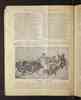
OLD TIME CAMP IN THE WILD WEST; OR ON THE PLATTE IN 1857.
BUFFALO BILL AT HOME.--His GREAT SUCCESS ABROAD.
"North Platte should be congratulated on the possession of a citizen whose prominence or position is not bounded by his township, his country, or his State, but whose name is a household word, whose pictures are familiar, and whose character is known, not only throughout the nation, but has adorned pages, and interested the readers of foreign works and publications. We allude to our fellow citizens, Hon. W. F. Cody, whose sobriquet of 'Buffalo Bill' represents popularity only bounded by the area of American territory, and to which we, who live by his own fireside, may testify his worthy possession and to the modesty of its wearing. His late return from a successful presentation to the East of some the animated daily scenes and incidents that go to from the passing history of 'The Wild West' should be noted, as are events of importance, as it makes a new era in the history of 'The Wild West' should be noted, as are events of importance, as it the mirror up to Nature,' and fidelity to the fact that is the 'true aim of art.' The reception accorded to his 'show that is not a show, but an illustration,' in the cultured cities of the East, notably Boston, Chicago, Newport, New York, Philadelphia, Cincinnati, and Cleveland, must be gratifying to all in North Platte, in fact in Nebraska, where, in the incipiency of the scheme, over a year ago, he demonstrated by courage, pluck and perseverance, its feasibility by its introduction in the festivities of our national birthday celebration, and on the following natal day presented it on the shores of the Atlantic, to the plaudits of over 25,000 delighted Bostonians. The magnitude of the undertaking, the minute necessary to organizing, the bringing together from all points the best marksmen in the world, securing admirable and fitting representatives of the cattle trade, getting wild buffalo, elk, steers, mules, ponies, specimens of the red terror of the prairie, and other features of interest known only to the pampas of the West, necessitating special trains of cars for transportation, and driving the strange cavalcade through confined Washington Street, Boston, in six weeks after leaving the Platte, was an accomplishment that stamps Cody as a wonder in energy, and gained for him the admiration and encomiums from the entire press of the East, recognition from the elite of American society, encouragement from representatives of education, and the endorsement of his methods by the S. P. C. A. and its noted president, Professor Henery Berg." --North Platte Telegraph, 1884.
14
12
CODY'S CORRAL OR THE SCOUTS AND THE SIOUX.
By "BECKSIN SAM."
A mount0inclosed Valley, close sprinkled with fair flowers,
Asif a shattered rainbow had fallen there in showers;
Bright-plumaged birds were warbling their songs among the trees,
Or fluttering their tiny wings win the cooling western breeze,
The cottonwoods, by mountain's base, on every side high tower,
And the dreamy haze in silence marks the sleepy noontide hour.
East, south, and north, to meet the clouds the lofty mounts arise,
Guarding this little valley--a wild Western Paradise.
Pure and untrampled as it looks this lovely flower-strewn sod-
One scarce would think that e'er, by man, had such a sward been trod;
But yonder, see those wild mustangs by lariat held in check,
Tearing up the fairest flora, which fairies might bedeck:
And, near a campfire's smoke, we see men standing all around-
Tis strange, for from them has not come a single word or sound.
Standing by cottonwood, with arms close-folded on his breast,
Garing with his eagle eyes up to the mountain's crest,
Tail and commanding is his form, and graceful in his mien;
As fair in face, as noble, has seldom here been seen.
A score or more of frontiersmen recline upon the ground,
But starting soon upon their feet, by sudden snort and hound!
A horse has sure been frightened by strange scent on the breeze,
And glances now by all are cast beneath the towering trees.
A quiet sign their leader gives, and mustangs are now are brought;
And, by swift-circling lasso, a loose one fast is caught.
Then thundering round the mountain's dark adamantine side.
A hundred hideous, painted, and fierce Sioux warriors ride;
While, from their throats, the well-known and horrible death-knell
The wild blood-curdling war-whoop, and the fierce and fiendish yell,
Strikes the ears of all, now ready to fight, and even to die.
In the mount-inclosed valley, beneath that blood-red sky I
Now rings throughout the open, on all sides clear and shrill.
The dreaded battle-cry of him whom men call Buffalo Bill!
On, like a whirlwind, then dash--the brave scouts of the plains,
Their rifle-barrels soft-carest by mustang's flying manes.
On, like an avalanche, they sweep through the fall prairie grass;
Down, fast upon them, swooping, the dread and savage mass!
Wild yells of fierce bravado crime and taints of deep despair;
While through the battle-smoke there flaunts each feathered tuff of hair,
And loudly rings the war-cry of fearless Buffalo Bill;
And loudly rings the savage yells, which make the blood run chill!
The gurgling death cry mingles with the mustang's shrillest scream
And the sound of dull and sodden falls and bowie's brightest gleam.
At length there slowly rises the smoke from heaps of slain.
Whose wild war-cries will never more ring on the air again.
Then, painting and bespattered from the showers of foam and blood,
The scouts have once more halted 'neath the shady cottonwood.
In haste, they are re-loading, and preparing for a sally,
While the scattered foe, now desperate, are yelling the valley.
Again are heard revolvers, with their rattling, sharp report;
Again the scouts are seen to charge down on that wild cohort
Sioux fall around, like dead reeds, when fiercest northern blow,
And rapid sink in the death before there hated pale-face foe!
Sad, smothered now is music from the mountain's rippling rill.
But wild hurrahs instead are heard from our brave Buffalo Bill,
Who, through the thickest carnage charged ever in the van,
And cheered faint hearts around him, since first, the fight began
Deeply demoralized, the Sioux fly fast with bated breath.
And glances cast of terror along that vale of death;
While the victors quickly dismounted and looking all around.
On their dead and mangled enemies, whose courses stewed the ground
"I had sworn I would avenge them"--were the words of Buffalo Bill-
"The mothers and their infants they slew at Medicine Hill,
Our work is done--done nobly--I looked for that from you;
Boys, when a cause is just, you need but stand firm and true,
--Bradie's Weekly
A stirring life picture of a battle between the whites and Indians, showing the facts a mode of warfare of each, will be given by the skilled members of both races in "BUFFALO BILL" representation of scenes in the Wild West.
THE PAWNEES ASTONISHED.
W. F. CODY, although having established his right to the title of "BUFFALO BILL" for years before, had not had the opportunity to convince the Pawnees of the justice of the claim previous to the time of the following incident. A short will previously a band of marauding red-skin renegades from that nation, while on a stealing excursion near Ellsworth, had occasion to regret their temerity, and cause to remember him to the extent of three killed, which fact for a time.
15
13
resulted in an enmity that needed something out of the usual run to establish him in their favor. While on a miliary expedition, under Gen. E. A. Carr, upon the Republican, he met Major North and the Pawnee scouts. One day a herd of buffalo were described, and CODY desired to join in the hunt. The Indians objected, telling the Major, "The white talker would only scare them away." Seventy-three Indians attacked the herd and killed twenty-three. Later in the day another herd was discovered, and Major North insisted that the white chief have a chance to prove his skill. After much grumbling, they acquiesced grudgingly, and with ill-concealed smiles of derision consented to be spectators. Judge of their surprise when CODY charged the herd, and single-handed and alon fairly amazed them by killing forty-eight buffalo in fifty minutes, thus forever gaining their admiration and a firm friendship that has since often accrued to his benefit.
COLONEL ROYALL'S WAGONS.
Once upon the South Fork of the SOlomon, Col. Royall ordered CODY to kill some buffalo that were in sight to feed his men, but declined to send his wagons until assured of the game. Bill rounded the herd, and , getting them in a line for camp, drove them in and killed seven near headquarters; or, as the Colonel afterward laughingly remarked, "furnishing grub and his own transportation."
THE BOW AND ARROW.
The bow is the natural weapon of the wild tribes or the West. Previous to the introduction of fire-arms, it was the weapon supreme of every savage's outfit--in fact, his principal dependence, backed by personal skill in its use, for sustenance for himself and his pappooses. It still retains its favor, as it is not always safe to rely on the white man's mechanism, as in case of lack of ammunition or deranged case of lock or trigger, time and location prevent its being "mended." As a weapon of economy, it is also to be commended, as the hunting arrow is made so that the rear shoulders of the long, tapering blade slope backward, thus facilitating its withdrawal from the wounded game. On the other hand, in the war arrow, the rear shoulders slope forward, forming barbs, as it is intended to remain and eventually kill. The possession, therefore, of firearms has not affected the Indian's love of this reliable weapon of the chase, which being his first childish plaything, is still, no matter how well armed or how rich he may be, an indispensable possession. At short distances it is a terribly effective arm, and the Indian expert can seize five to ten arrows in his left hand, and dispatch the ground. In close quarters they prefer to rely on it to depending on the rifle, as it can be of deadly force at from thirty to forty yards, and creating a bad wound at much greater distance. In buffalo hunting, where the horseman can approach near, it is invaluable and economic, and is often buried to the feathers. "Two Lance," an Indian chief, during the Grand Duke's hunt, sent an arrow clear through a bison, Alexis retaining the light-winged messenger of death as a souvenir of his hunt on the American Plains.
THE BUFFALO.
The buffalo is the true bison of the ancients. It is distinguished by an elevated stature, measuring six to seven feet at the shoulders, and ten to twelve feet from nose to tail. Many are under the impression that the buffalo was never an inhabitant of any country save ours. Their bones have been discovered in the superficial strata of temperate Europe; they were common in Germany in the eight century. Primitive man in America found this animal his principal means of subsistence, while to pioneers, hunters, emigrants, settlers, and the railroad builders this fast disappearing monarch of the plains was invaluable. MESSRS. CODY & CO. have a herd of healthy specimens of this hardy bovine in connection with their instructive exhibition, "The Wild West," rendered interesting as the last of their kind.