
36
York, Delaware, and Pennsylvania: then, for good measure, throw in the whole of the six New England States, - and the area of all these States combined will not equal that of the great State of Texas. It extends over ten degrees of latitude, and from the sixteenth to the thirtieth degree of longitude west from Washington. It has more than two hundred and fifty counties; some of the largest - Tom Green or Crockett, or instance - are each as large as the State of Massachusetts.
France has a population of 175 to the square mile; at that rate, Texas could support a population of 48,000,000. Great Britain has a 260 inhabitants to the square mile; at that rate, Texas could support 70,000,000 people.
Within her borders can be found an immense variety of products. The soil is probably the most fertile and productive in the known world. Cotton, corn, sugar-cane, barely, and almost all the known cereals, grow side by side with the fruits of the tropics and the hardy plants of the more northern regions.
The United States are thirty-eight in number, and nine territories not yet admitted.
WHITE BEAVER.
[From Hereos of the Plains.]
The life of White Beaver, (Dr. D. Frank Powell) bears all the colors and shades of an idyllic romance; his character stands out upon the canvas of human eccentricities in striking originality, and finds never its counterpart, save in stories of knight errantry, when hearts, names, and titles were the prizes bestowed for daring deeds evolved from generous sentiments. His has been the tenor of uneven ways, with characteristics as variable as the gifts in Pandora's box. A born plainsman, with the rough, rugged marks or wild and checkered incident, and yet a mind that feeds on fancy, builds images or refinement, and looks out through the windows of his soul upon visions of purity and fields elysian. A reckless adventurer on the boundless prairies, and yet in elegant society as amiable as a school-girl in the ball-room; evidencing the polish of an aristocrat, and a cultured mind that shines with vigorous lustre where learning displays itself. A friend to be valued most in direst extremity, and an enemy with implacable, insatiable, and revengeful animosities. In short, he is a singular combination of opposites, and yet the good in him so predominates over his passions that no one has more valuable friendships and associations than these strange complexities attract to him. He is an ideal hero, the image which rises before the ecstatic vision of a romancer, and he impresses himself upon the millions who know his reputation as a brave and chivalrous gentleman.
A description of White Beaver is not difficult to give, because of his striking features; those who see him once are so impressed with his bearing that his image is never forgotten. He is almost six feet in height, of large frame, and giant muscular development; a full round face, set off by a Grecian nose, a handsome mouth, and black eyes of penetrating brilliancy. His hair is long, and hangs over his shoulders in raven ringlets. In action he is marvelously quick, always decisive, and his endurance almost equals that of a steam engine. His appearance is that of a resolute, high-toned gentleman, conscious of his power, and yet his deference, I may say amiability, attracts everyone to him. He is, in short, one of the handsomest as well as most powerful men among the many great heroes of the plains.
In addition to his other qualifications peculiarly fitting him for a life on the plains, he is an expert pistol and rifle shot; in fact, there are perhaps not a half-dozen persons in the United States who are his superiors; his precision is not so great now as it once was, for the reason that during the past three or four years he has had but very little practice, but even now he would be regarded an expert among the most skillful. For dead-centre shooting at stationary objects he never had a superior; his eyesight is more acute than an eagle's, which enables him to distinguish and hit the head of a pin ten paces distant, and this shot he can perform now nine times out of ten. Any of his office employees will hold a copper cent between their fingers and let him shoot it out at ten paces, so great is their confidence in his skill; he also shoots through finger-rings held in the same manner. One very pretty fancy shot he does is splitting a bullet on a knife-blade, so exactly dividing it that the two parts will strike in a given mark; he also suspends objects by a hair, and at ten paces cuts the hair, which of course he cannot see, but shoots by judgment. Several persons have told me that they have seen him shoot a fish line in two while it was being dragged swiftly through the water.
White Beaver and Buffalo Bill have been bosom friends and fellow-plainsmen since boyhood. History records no love between two men greater than that of those two foster brothers.
THE INDIANS AT HOME.
The winter camp is regarded by the Indian himself as his true home. The excitement of war, of hunting, of constant movement, is over, and he is now to settle down to a period of almost complete insection. Experienced warriors have been sent to all the streams most loved by the tribe, and to make a thorough examination of all the country. When all have returned a council is held. The reports of the scouts are heard, and they are closely questioned as to shelter, wood, water, and grass or cotton-wood for the ponies. As each locality has its champions, the council sometimes debates the momentous question for days, once in a while even sending other warriors to examine a favorite stream, about which, however, there is now a difference of opinion.
It is not now a question of room for a compact camp, but of the shelter furnished by the bluffs on each side of the stream, of the amount of timber and wooded tickets along its valley, of the sufficiency of grass or cottonwood to keep the ponies alive.
When the stream has finally been selected, all go together. There is now no sort of attempt at order. The lodges of the followers of a chief may be scattered for miles, each taking advantage of the sheltered nooks, formed by thickets or bluffs. Here is a single teepe is stuck away in a little corner, so hidden that one might pass within a few yards without seeing it; there two or three find room and shelter, there again bluffs, and thickets, and bend of stream all favoring, a dozen find comfortable lodgment. The great questions with each Indian are, shelter, convenience, and feed for the ponies, and these questions are paramount, though the desire to keep as near to each other as possible is apparent through all.
According, therefore, to the nature of the stream, its bluffs and tickets, and level valley, will a winter camp be compact or scattered. One winter a camp of one hundred and fifty lodges will occupy scarce a mile; another winter it may be extended four, five, or even six miles along the stream. Sometimes several friendly tribes occupy the same stream, making an immense camp.

37
(IMAGE)
To Indians at peace, and with food in plenty, the winter camp is a scene of constant enjoyment. After the varying excitements, the successes and vicissitudes, the constant labors of many months, the prospect of the winter's peace and rest, with its home life and home pleasures, comes like a soothing balm to all.
To those of the warriors who have passed the age of passionate excitement (who have reached to "whistage" of their English-speaking contemporaries), this season brings the full enjoyment of those pleasures and excitements yet left to them in life. Their days are spent in gambling, their long winter evenings in endless repetitions of stories of their wonderful performances in days gone by, and their nights in the sound sweet sleep vounchsafed only to easy consciences.
The women also have a good time. No more taking down and putting up the teepe; no more packing and unpacking the ponies. To bring the wood and water, do the little cooking, to attend to the ponies, and possibly to dress a few skins, is all the labor devolved upon them.
To the younger of both sexes, whether married or single, this season brings unending excitement and pleasure. Now is the time for dances and feasts, for visits and frolics, and merry makings of all kinds, and for this time the "story-teller" has prepared and rehearsed his most marvelous recitals. Above all, it is the season for love making "love rules the camp" and now is women's opportunity.
Without literature without music or painting as arts, without further study of nature than is necessary for the safety of the needs of their daily life, with no knowledge or care for politics or finance, or the thousand questions of social or other science, that disturb and perplex the minds of civilized people, and with reasoning faculties little superior to instict, there is among Indians no such thing as conversation as we understand it. There is plenty of talk, but no interchange of ideas, no expression and comparison of views and beliefs, except on the most commonplace topics. Half a dozen old sages will be slitting around, quietly and gravely passing the pipe, and apparently engaged in important discussion. Nine times out of ten their talk is the merest campt tattle, or about a tray horse, or sick colt, or where one killed a deer, or another saw a buffalo-track. All serious questions of war and chase are reserved for discussion in the council lodge.
During the pleasant months he has constantly the healthy stimulus of active life; during the winter he is either in a state of lethargy, or of undue excitement. During the day, in the winter season, the men gamble or sleep; the women work or idle as suits each: but the moment it gets dark everybody is on the "qui vive", ready for any fun that presents itself. A few beats on a tom-tom bring all the inmates of the neighboring lodges; a dance or gambling bout is soon inaugurated, and oftentimes kept up until nearly morning.
The unsufficiency and uncertainty of human happiness has been the theme of eloquent writers of all ages. Every man's happiness is lodged in his own nature, and is, to a certain extent at least, independent of his external circumstances and surroundings. These primitive people demonstrate the general correctness of this theory, for they are habitually and universally happy people. They thoroughly enjoy the present, make no worry over the possibilities of the future, and "never cry over spilt milk". It may be arguied that their apparent happiness is only insensibility, the happiness of the mere animal whose animal desires are satisfied. It may be so, I simply state facts; other may draw conclusions. The indians is proud, sentitive, quick-tempered, easily wounded, easily excited, but though utterly unforgiving, he never broods. This is the whole secret of his happiness.
In spite of the fact that the wives are mere property, the domestic life of the Indian will bear comparison with that of average civilized communities. The husband, as a rule, is kind; ruling, but with no harshness. The wives are generally faithful, obedient, and industrious. The children are spoiled, and a nuisance to all red visitors. Fortunately, the white man, the "bug-a-boo" of their baby days, is yet such an object of terror as to keep them at a respectful distance. Among themselves, the members of the family are perfectly easy and unrestrained. It is extremely rare that there is any quarreling among the women.
(36)
38
There is no such thing as nervousness in either sex. Living in but the one room, they are from babyhood accustomed to what would be unbearable annoyance to whites. The head of the lodge comes back tired from a hunt, throws himself down on a bed, and goes fast to sleep, though his two or three wives chatter around and his children tumble all over him. Everybody in the lodge seems to do just as he or she pleases, and this seems no annoyance to anybody else.
Unlike her civilized sister, the Indian woman, "in her hour of greatest need," does not need any one. She would be shocked at the idea of having a man doctor. In pleasant weather, the expectant mother betakes herself hours she returns with the baby in its cradle on her back, and goes about her usual duties as if nothing had happened.
Preparations for war or the chase occupy such hours of the winter encampment as the noble red man can spare from gambling, love-making, and personal adornment.
Each Indian must make for himself everything which he cannot procure by barter, and the opportunities for barter of the more common necessities are very few, the Indians not having even yet conceived the idea of making any articles for sale among themselves.
The saddle requires much time and care in its construction. Some Indians can never learn to make one, consequently this is more an article of barter than anything commonly made by Indians.
No single article varies so much in make and value as the bridle. The bit is always purchased, and is of every pattern, from the plain snaffle to the complicated contrivance of the Mexicans. The bridle of one Indian may be a mere headstall of raw-hide attached to the bit, but without frontlet or throat latch, and with reins of the same material, the whole not worth a dollar; that of another may be so collaborated by patient labor, and so garnished with silver, as to be worth hundred dollars.
The Southern Indians have learned from the Mexicans the art of plaiting horsehair, and much of their work is very artistic and beautiful, besides being wonderfully serviceable. A small smooth stick of one-fourth of an inch in diameter is the mould over which the hair is plaited. When finished, the stick is withdrawn. The hair used is previously dyed of different colors, and it is so woven as to present pretty patterns. The hair, not being very strong, is used for the head-stall; the reins, which require strength, are plaited solid, but in the same pattern, showing both skill, taste, and fitness.
The name "lariat" (Spanish, riata) is applied by all frontiersmen and Indians to the rope or cord used for picketing or fastening their horses while grazing, and also to the thong used for catching wild animals - the lasso. They are the same, with a very great difference. The lasso may be used for picketing a horse, but the rope with which a horse is ordinarily picketed would never be of use as a lasso.
A good riata (lasso) requires a great deal of labor and patient care. It is sometimes made of plaited hair from the manes and tails of horses, but these are not common, except where wild horses are plenty, one such riata requiring the hair of not less than twenty horses. It is generally made of raw hide of buffalo or domestic cattle, freed from hair, cut into narrow strips, and plaited with infinite patience and care, so as to be perfectly round and smooth. Such a riata, though costing less money than that of hair, in infinitely superior. It is smooth, round, heavy, runs easily and quickly to noose, and is as strong as a cable. Those tribes, as the Utes, who are unable to procure beef or buffalo skins, make beautiful lariats of thin strips of buckskin plaited together; but as these are used only for securing their horses they are usually plaited flat.
To make these articles is all that the male Indian "finds to do" in his ordinary winter life. Without occupation, without literature, without thought, how he can persuade himself to continue to exist can be explained only on the hypothesis that he is a natural "club man," or a more animal.
"From rosy morn to dewy eve" there is always work for the Indian woman. Fortunately for her, the "aboriginal inhabitants" have as yet discovered no means of making a light sufficient to work by at night. It is true they beg or buy a few candles from military posts, or traders, but these are sacredly preserved for dances and grand occasions.
But slave as she is, I doubt if she could be forced to work after dark, even if she had light. Custom, which holds her in so many inexorable bonds, comes to her aid in this case. In every tribe, night is the woman's right, and no matter how urgent the work which occupies her during the daylight, the moment that dark comes, she bedecks herself in her best finery, and stands at the door of the lodge, her ear strained for the first beat of the tom-tom, which summons her to where she is for then once queen and ruler.
There was formerly one exception to this immunity from night work, but it has gone with the buffalo. At the time of the "great fall hunt," there was no rest nor excuse for her. She must work at any and all hours. If the herds were moving, the success of the hunt might depend on the rapidity with which the women performed their work on a batch of dead buffalo. These animals spoil very quickly if not disemboweled, and though the hunters tried to regulate the daily kill by the ability of the squaws to "clean up" after them, they could not, in nature of things, always do so.
When the buffalo was dead the man's work was done. It was woman's work to skin and cut up the dead animal; and oftentimes when the men were exceptionally fortunate, the women were obliged to work hard and fast all night long before the task was finished.
The meat, cut as closely as possible from the bones, is tied up in the skin, and packed to camp on the ponies.
The skins are spread, flesh-side upward, on a level piece of ground, small slits are cut in the edges of the skin, and it is tightly stretched and fastened down by wooden pegs driven through the slits in the ground. The meat is cut into thin flakes and placed upon poles or scaffolds to dry in the sun.
All this work must be done, as it were, instantly, for if the skin is allowed to dry unstretched, it can be never be made use of as a robe, and the meat spoils if not "jerked" within a few hours.
This lively work lasts but a few weeks, and is looked upon by the workers themselves pretty much in the same way as notable civilized housewives look upon the early house-cleaning, very disagreeable, but very enjoyable. The real work begins when, the hunt being over, the band has gone into its winter quarters, for then must the women begin and utilize "the crop."
Some of the thickest bull's hides are placed to soak in water, in which is mixed wood ashes, or some natural alkali. This takes the hair off. This skin is then cut into the required shape, and stretched on a form, on which it is allowed to dry, when it not only retains its shape, but becomes almost as hard as iron. These boxes are of various shapes and sizes, some made like huge pocket-books, others like trunks. All are called "parfleche."
As soon as these parfleches or trunks are ready for use, the now thoroughly dry meat is pounded to powder between two stones. About two inches of this powdered meat is placed in the bottom of parfleche, and melted fat is lightly poured over it. Then another layer of meat is served in the same way, and so until the trunk is full. It is kept hot until the entire mass is thoroughly saturated. When cold, the parfleches are closed and tightly tied up. The contents, so prepared, will keep in good condition for several years. Probably the best feature of the process is that nothing is lost, the flesh of only and tough animals being, after this treatment, so (37)
39
nearly as good a that of young that few persons can tell the difference. This is the true Indian bread, and is used as bread when they have fresh meat. Boiled, it makes a soup very nutritious. So long as the Indian has this dried meat and pemmican he is entirely independent of all other food. Of late years, all the beef issued to the Indians no reservations, and not needed for immediate consumption, is treated in this way.
The dressing of skins is the next work. The thickest hides are put in soak of alkali, for materials for making shields, saddles, riatas, etc. Hides for making or repairing lodges are treated in the same way but, after the hair has been removed, they are reduced in thickness, made pliable, and most frequently soaked.
Deer, antelope, and other thin skins are beautifully prepared for clothing, the hair being always removed. Some of these skins are so worked down that they are almost as thin and white as cotton cloth.
But the crowning process is the preparation of a buffalo robe. The skin of even the youngest and fattest cow is in its natural condition, much too thick for use, being unwieldy and lacking pliability. This thickness must be reduced at least one-half, and the skin at the same time made soft and pliable. When the stretched skin has become dry and hard from the action of the sun, the woman goes to work upon it with a small implement, shaped somewhat like a carpenter's adze. It has a short handle of wood or elk-horn, tied on with rawhide, and is used with one hand. These tools are heir-looms in families, and greatly prized. It is exceedingly difficult to obtain one, especially one with an elk-horn handle, the Indians valuing them above price. With this tool the woman chips at the hardest skin, cutting off a thin shaving at every blow. The skill in the whole process consists in so directing and tempering the blows as to cut the skin, yet not cut too deep, and in finally obtaining a uniform thickness and perfectly smooth and even inner surface. To render the skin soft and pliable, the chipping is stopped every little while, and the chipped surface smeared with brains of buffalo, which are thoroughly rubbed in with a smooth stone.
When very great care and delicacy are required, the skin is stretched vertically on a frame of poles. It is claimed that the chipping process can be much more perfectly performed on a skin stretched in this way than on one stretched on the uneven and unyielding ground, but the latter is used for all common robes, because it is the easiest.
When thinning and softening process is completed the robe is taken out of its frame, trimmed, and sometimes smoked. It is now ready for use. It is a long and tedious process, and no one but an Indian would go through it.
But all this, though harder work, is the mere commencement of the long and patient labor which the loving wife bestows on the robe which the husband is to use on dress occasions. The whole inner surface is frequently covered with designs beautifully worked with porcupine quills, or grasses dyed in various colors. Sometimes the embellishments are paintings. Many elegant robes have taken a year to finish.
Every animal brought into the camp brings work for the squaw. The buck comes in with a deer and drops it at the door. The squaw skins it, cuts up and preserves the meat, dresses the skin and fashions it into garments for some member of the family. Until within a very few years the needle was a piece of sharpened bone; the thread a fibre of sinew. These are yet used in the ornamentation of robes, but almost all the ordinary sewing is done with civilized appliances.
All Indians are excessively fond of bead-work, and not only the clothing, moccasins, gun-covers, quivers, knife sheaths, and tobacco pouches, but every little bag or ornament is convered with this work. Many of the designs are pretty and artistic. In stringing the beads for this work an ordinary needle is used; but in every case, except for articles made for sale, the thread used is sinew.
Only a few years ago the foregoing description of the ordinary employments of Indians was true to the letter for almost every tribe west of the Missouri and east of the Rocky Mountains. It is yet true for momst of them, but some few have taken, within these few years, long steps on the "white man's road," and the occupations of both men and women of those tribes will not conform to this description.
The life in the winter encampment has scarcely been changed in any particular, but with the earliest spring come evidences of activity, a desire to get away, not attributable, as in the "good old time," to plans of forays for scalps and plunder, but to the desire of each head of a lodge or band to reach before any one else does the particular spot on which he has fixed for his location for the summer. No sooner has be reached it than all hands, men, women, and children, fall to work as if the whole thing were a delightful frolic.
The last five years, more than any twenty preceding them, have convinced the wild Indians of the utter futility of their warfare against the United States Government. One and all, they are thoroughly whipped; and their contests in the future will be the acts of predatory parties (for which the Indians at large are no more responsible than is the Government of the United States for the acts of highwaymen in the Black Hills, or train-robbers in Missouri), or a deliberate determination of the bands and tribes to die fighting rather than by the slow torture of starvation to which the Government condemns them.
But the buffalo is gone, so also nearly all the other large game on which the Indians depended for food. They are confined to comparatively restricted reservations, and completely surrounded by whites. They are more perfectly aware of the stringency of their situation than any white man can possibly be, for they daily feel its pressure.
With no chance of success in war, with no possibility of providing food for themselves, they thoroughly comprehend that their only hope for the future is in Government aid, grazing cattle, and tilling the soil.
They do not like it, of course; it would be unnatural if they did. They accept it as the dire alternative against starvation.
Does any one labor for the sake of labor? A man who spaded up a field simply to give himself labor would be considered a fit subject for the lunatic asylum.
Labor is the curse on Adam, and, however necessary and ennobling, is not an end but a means. We labor for money, for ambition, for health, for anything except for labor itself.
Basing arguments on the Indian contempt for work, many men in and out of Congress talk eloquent nonsense of the impossibility of ever bringing him to agricultural pursuits. The average Indian has no more hatred of labor, as such, than the average white man. Neither will labor unless an object is to be attained. Both will labor rather than starve. Heretofore the Indian could confortably support himself in his usual and preferred life, without labor; and there being no other incentive, he would have only proved himself an idiot had he worked without an object.
But now, with the abundant acres of land that his white conquerors, with great justice, have alloted to him in the shape of reservations, with no opportunity to think of the excitement, honor, and glory of battle, his life is changed. He now finds that fences are to be made, ground broken up, seed planted, and the peerless warrior, with "an eye like an eagle," whose name a few short years ago was a terror, and whose swoop was destruction, must learn to handle the plow, and follow in fact, what he has often claimed in desire and spirit to follow, "the white man's road."
(38)
40
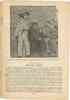
Arizona John (J.M. Burke), Broncho Bill (Interpreter), Red Shirt (Sioux Chief), Julia Nelson(Sioux Girl).
INDIANS' NAMES.
While the Indian has very little idea of the origin of Creation, he has traditions as regards the origin of families Some believe that people are the result of intercourse of some God, or Spirit, with animals, birds, fish, or reptile, and the representation of that bird or reptile becomes the "coat of arms" of the family. The skin is carefully stuffed and ornamented, tied to the staff, and greatly respected, sometimes being put up in from of the door or planted on the top of a pole on the grave of the head of the fmaily when he dies.
This symbol of honor and ancestry is used by him as a signature. The Indian boy may be named by the family or have a nickname from his associates, and when he grows up to be a warrior, he then, as it were, is baptized, and has the right to change his name according to his success in war or chase. The name taken generally represents some event in which he has taken a prominent part, some exploit that he had accomplished, some animal he had killed in a chase in which he was pre-eminently successful.
Thus a warrior who, brought to bay, has beaten off his enemies, names himself the "Standing Bull"; another who makes a dash on a camp or village, and carries off a women or child, calls himself the "Eagle"; yet another, who goes off alone, and prowling about the enemy's camp, returns with stories or evidence of successful rapine, names himself "Lone Wolf." The paint used on all these expenditions has more or less potent influence on the "medicine," and he does not forget its efficacy; consequently many names indicate not only the action, but the color of his paint. The most common names, therefore, among Indians, are those indicating scene animals or material object as a sort of surname, while the color with which he has bedecked himself furnishes the first or what we would call the Christian name, as "Yellow Bear" "White Eagle," "Black Beaver," "Red Dog." ect., ect.
But these changes of name, though gratifying to his own vanity, are not always accepted by his companions, or the tribe generally. Even the most renowned warriors cannot always control the disposition to ridicule or nickname, which the Indians possess in a remarkable degree, and however he may name himself, he is likely to be addressed, known, and spoken of by the people of the tribe by an entirely different name.
Any personal defect, deformity of character, or casual incident furnishing ground for a good story, is eagerly