
31
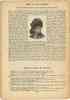
MISS LILLIAN T. SMITH, The California Girl, and Champion Rifle Shot,
Was born at Coleville, Mono County, Cal., in the fall of 1871; is, consequently, only past her sixteenth year. Born in a county where game was plenty, and good marksmanship as highly thought of as excellence in any particular accomplishment in the older localities of our variously-constituted country, her childhood was passed amid an atmosphere well calculated to develop that precocious skill that has astonished the Pacific coast, and rendered her famous throughout the land. Horsemanship there being so nearly allied to the cradle- in fact, having been often carried in babyhood on the pommel of the saddle- it is little to be wondered at that she commenced horseback-riding as soon as she could sit one, and while on foot still "a toddler," mounted she was an infantile expert. At six years of age she had a bow-gun, and would kill birds easily, and at seven expressed herself as dissatisfied with "dolls," and wanted a "little rifle." When nine years old her father bought her a Ballard rifle, twenty-two calibre, weight seven pounds (which she uses yet), with which, after a little practice and instruction, she, on her first foray, mounted on her little pony, bagged two cotton-tails, three jack-rabbits, and two quails. From this out her enthusiasm was such, that after her studies were over, she spent her leisure time with horse, dog, and gun, on the surrounding ranges hunting, and generally bringing home a plentiful supply of game. On her father accompanying her to a lagoon near the San Joaquin River in Merced County, when ducks were plentiful, he was greatly astonished by her killing forty redheads and mallards, mostly on the wing. On another occasion, when on a camping excursion in Santa Cruz County, hearing her dog bark in a canon, and thinking he had "treed a squirrel, sure," she mounted her mustang, and on her return amazed the campers and surprised her mother by depositing at her feet a very large wildcat that she had shot on the limb of a high redwood tree, hitting it squarely in the heart. The admiring campers on their return proclaimed through publications her remarkable feats, and at a party given in her honor christened her the champion "California Huntress." Her fame spread throughout the "Golden State," and her father was induced to present her to the public of San Francisco, where, in July, 1881, she gave seven successful receptions at Woodward gardens- her marvelous accuracy and extreme youth creating the greatest sensation, winning for her a host of admirers and many compliments from those who, before seeing, had been incredulous. After a short practice of shooting glass-balls thrown from the hand, she made a score of 823 successive shots without a miss, and out of 500 breaking 495.
Miss Lillian, owing to the opportunities in that section, has made her reputation in practical shooting, such as a Turkey shoot, at Hollister, San Benito County, in the holidays of 1883, where at 150 yards she killed so many turkeys she was set back 200 yards, but her dexterity at that distance being equally destructive, the managers arranged with her "to drop out and give the boys a chance at the turkeys, too." Being invited to a mud-hut shoot, at 50-175 yards, according to the accessibility of the marshy ground, she, in one-half hour, bagged fifty, receiving a valuable prize. July 4, 1883, at Hollister, distance 30 feet, at a swinging-bell target, with a one-inch center, she scored 200 bells, with a Ballard rifle, in fifteen minutes; and on July 23rd, at Dunn's Ranch, near San Filipe, she killed six dozen doves in two hours with a rifle. October 25, 1883, at a meeting of the Colusa Gun Club, she was induced to try her skill at live pgs thrown from three plunge traps, with a 10-pound shot-gun, 10 gauge, 2 drams powder, 1/2 ounce shot, and scored ten out of twelve, resulting in the club having the manufacturers at Meridan, Conn., present her, as a testimonial, a 12-gauge Parker shot-gun. This remarkable little lady has shot successfully in tournaments with various gun clubs on the coast, matches with such noted shots as Geo. I Kingsley, Crittendon Robinson, John Kerrigan, taking two valuable prizes, the special prize given by Philo Jacoby, President of the Schuetzen Rifle Club, San Francisco, March 15, 1885. She will appear daily with the Wild West.
_________________________ INDIAN NAMES OF STATE. Massachusetts, from the Indian language, signifying the country about the great hills. Connecticut was Mohegan, spelled originally Quon-eh-ta-cut, signifying "a long river." Florida gets its name from Kasquad de Flores, or "Feast of the Flowers." Alabama comes from an Indian word, signifying "the land of rest." Mississippi derived its name from that of the great river, which is in the Natchez tongue, "The Father of Waters." Arkansas is derived from the word Kansas, "smoky waters," with the French prefix of "ark," a bow. Tennessee is an Indian name, meaning "The river with a big bend." Kentucky, also, is an Indian name, "Kin-tuk-ae," signifying "at the head of the river." Ohio is the Shawnee name for "The beautiful river." Michigan's name was derived from the lake, the Indian name for fish-weir or trap, which the shape of the lake suggested. Indiana's name came from that of the Indians. Illinois' name is derived from the Indian word "Illini" (men) and the French affix "ois," making "Tribe of men." Wisconsin's name is said to be the Indian name for a wild, rushing channel. Missouri is also an Indian name for "muddy," having reference to the muddiness of the Missouri River. Kansas is an Indian word for "smoky water." Iowa signifies, in the Indian language, "The drowsy ones"; and Minnesota, "A cloudy water."
(30)
32
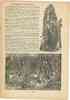
AN INDIAN'S RELIGION.
The Indian is as religious as the most devout Christian, and lays as much stress of form as a Ritualist. He believes in two Gods, equals in wisdom and power.
One is the Good God. His function is to aid the Indian in all his undertakings, to heap benefits upon him, to deliver his enemy into his hands, to protect his from danger, pain, privation. He directs the successful bullet, whether against an enemy against the "beasts of the field." He provides all the good and pleasurable things in life. Warmth, food, joy, success in love, distiction in war, all come from him.
The other is the Bad God. He is always the enemy of each individual red man, and exerts to the utmost all his powers of harm against him. From him proceed all the disasters, misfortunes, privations, and discomforts of life. All pain, suffering, cold, disease, the deadly bullet, defeat, wounds, and death.
The action of these two Gods is not in any way influenced by questions of abstract right or morality as we understand them.
The Good God assists in everything he wishes or proposes to do. If it is to steal a horse or the wife of a friend, to kill another Indian or raid a settlement, it is to the Good God to whom he turns for countenance, and by his assistance accomplishes his purpose.
Every thwarted thought or desire is attributed to the influence of the Bad God.
He belives not an hour passes without a struggle between these two Gods on his personal account.
The Indian firmly believes in immortality, and life after death, but the power of these Gods does not extend to it. They influence only in this life, and the Indian's condition after death does not depend either on his own conduct while living, or on the will of either of the Gods.
All peccadilloes and crimes bring, or do not bring, their punishment in this world, and, whatever their character in life, the souls of all Indians reach, unless debarred by accident, a paradise called by them "Happy Hunting Grounds."
There are two ways in which an Indian's soul can be prevented from reaching this paradise. One method is by strangulation. The Indian believes the soul escapes from the body by the mouth, which opens of itself at the moment of dissolution to allow a free passage. In case of strangulation, either by deisign or even accident, the soul can never escape, but remains with or hovering near the remains, even after complete decomposition.
As the soul is always conscious of its isolation and its exclusion from the joys of paradise, this death has perculiar terros, and
33
he infinitely prefers to suffer at the stake, with all the tortures that ingenuity can devise, than die by hanging. The other eternal disaster is by scalping the head of the dead body. This annihilation; the soul ceases to exist. This accounts for eagerness of Indians to scalp all their enemies and the care they take to avoid being scalped themselves. Not unfrequently Indians do not scalp slain enemies, believing that each person killed by them, not scalped will be their servant in the next world. It will be found invariably that the slain foe were either very cowardly or very brave. The first he reserves to be his servant because he will have no trouble in managing him, and the last to gratidy his vanity in the future state by having a servant well known as a renowned warrior in this world.
This superstition is the occasion for the display of the most heroic traits of Indian character. Reckless charges are made and desperate chances taken to carry off unscalped the body of a loved chief, a relative, or friend. Numerous instances have occurred where many were killed in vain efforts to recover and carry off worthy of burial. A Homer might find many an Indian hero as worthy of immortal fame as Achilles for this efforts to save the body of his friend, and no Christian missionary ever evinced a more noble indifference to danger, than the savage Indian displays in his efforts to save his friend's soul and ensure a transit to the "Happy Hunting Grounds". -- Vol. Dodge in Our Wild Indians.
(IMAGE)
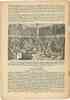
WIth all the attraction in the line of amusements, there seems to be no abatement in the interest manifested by the public in the peculiarities to be found in the daily presentation of the realistic scenes of the "Wild West". Each participant has passed through, in the Far West, all the various acts which they are called upon to represent, and the public are assured that every thing and person is as stated in the programme.
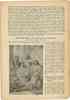
"UATH FRANK" (THE GREAT INDIAN FIGHT AT HORSESHOE) Was born on the banks of the Missouri, and raised at Trader's Point, about eight miles below where now stands the city of Council Bluffs, at a time when the primitive state of that section was almost unmolested. He has followed "the march of empire" in its westward course, and always at the head of the column- riding pony express when a boy from Nebraska City (then the fitting-out depot for "prairie schooner" caravans across the Great Desert) to the Otoe Agency. At the breaking out of the Pike's Peak excitement Frank endured the well-known a vicissitudes attendant on a prilous journey to and return from that most disappointing of Eldorados. Fought the savage with General Sully's command, and was the first party attacked by the Indians in the great outbreak on the South Platte, his partner being the first white man killed, and only by determined fighting and good horseflesh saved his own scalp. Drove stage on the Overland Route under Old Slade, Hi Kelly, and others, gaining a reputation for ability and courage in the most dangerous and trying times of that memorable line. Was considered a reliable train-wagon master, during which occupation he received his first idea of a locomotive on the completion of the U.P.R.R to the Forks of the Platte and the arrival of the first "iron-horse", indicating that "Othello's occupation" was gone. He started, with others, a ranch on the Horseshoe, twenty-eight miles north of Fort Laramie, where occured the most starling experience of his life: one, the recounting of which will ever be a part of the history of the sauguinary border- in which his gallant and succesful struggle against odds, while being well authenticated, will seem more like fiction than fact.
Anticipating the result, the ranch building was connected by an underground passage with a bush-covered ravine about sixty feet behind it, with a carefully concealed entrance, the ravine running down the hill to the bottom. One morning in January, 1808, a band of sixty savages were descried, who surrounded the place and
(32)
35
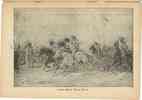
demanded flour, bacon, and provisions, and captured the horses. Being sure of their Frank, Marion Thornburg, John Smith, and Bill World, determined "to stand them off," and being well armed, fought them all day successfully, killing two and wounding others, with only a slight fresh wound to Frank. At night they succeeded in setting fire to the cabin, compelling the little garrison to retreat. When all was still, the gloating victors, thinking the fire had done its work of death, approached, dancing and laughing around the blazing pile. Waiting until well bunched together, the quartet opened a fusillade from their repeating rifles with a murderous energy, born of desperation, so deadly effective and surprising, that consternation reigned supreme. Shouting, yelling, shrieking, halloing, down the hill they scrambled, rolled, or fell, while on an almost parallel line went the four avengers, re-loading as they ran. Assembling at the bottom, a hasty but noisy council Frank, five deadly volleys were poured into the crowd, which seemed doubly demoralizing. In the confusion thus created, and assisted by an unusually dark night out on the level plains- spurred by a glimmer of hope, encouraged by a chance for life- sped the little party, and arrived at a ranch kept by two men named Jones and Harper. Hastily waking them only to find their horses gone, and refreshing up, a start was made for the fort. In the morning the Indians reappeared, and a running fight for two miles ensued, Jones and Harper both being killed, and Thornburg severely wounded. Reaching a point where a stand could be made, sand was thrown up for breastworks, and the now despondent fugitives prepared to sell their lives at the highest price that total resignation to the inevitable could command. All day long was one strategy after another tried. Thornburg receiving another wound, Smith a bad one in the shoulder, and World one in the arm. Jones and Harper's ranch being well stocked with provisions and whisk, created a diversion, however, and at evening the reds withdrew and held high carnival, as it was afterwards learned, resulting in a row among themselves. A cold, rainy night added to their fortunes, and wounded, foot-sore, yet thankful, they made the fort, survivors of one of the greatest fights in the annals of white and Indian warfare, and living examples of what may be accomplished by "those who never say die." The Indians accord it as the most stubborn and destructive fight they ever had, acknowledging seventeen killed outright and a great many wounded, and after hostilities ceased, looked with wonder on "the heroes of the Horseshoe."
Going to the Sweet Water mines, Frank scouted for the second Cavalry, Major Gordon, and in '73 was on the Yellowstone with General Custer, and is known as "Utah" Frank. Being an all-round prairie man, he will be found in almost all the scenes represented in Buffalo Bill's Wild West. _______________________
JOHN NELSON- "CHA-SHA-SHA-O-PO-GE-O," And his Indian Family.
Will be one of the objects of interest in the camp of "the Wild West." To the majority of dwellers in the realms of civilization it is hard to realize that hundreds of our own race and blood, very often intelligent and even accomplished men, gladly exchange all the comforts and advantages of our mode of life for the privations and danger, relieved by the freedom and fascinations of the nomads of the plains. Such, however, is the fact, and many by their marrying into the tribe are adopted as members, achieve tribal honors and possess great influence for good or evil, generally becoming interpreters, through whom all Government communications pass. Among the most honored and reliable of these in his section is John Nelson who, by general honesty of character and energy, has gained fame and respect among whites and Indians. Being thorough plainsman years ago his standing sought for by all. He guided Brigham Young and the Mormons across the then "Great Desert" to their present location in Utah. He married Chief Lone Wolf's daughter of the Ogallala tribe has six children whom he supports in comfort as a trapper of beaver and otter. Nelson is a representative of the best class of "Squaw Men." _____________________________ IMMENSE EXTENT OF ONLY STATE- TEXAS. A man once told me that "figures don't lie." Comparison is the only way by which we can realize quantity. From north to south, Texas measures 670 miles; from east to west, 825 miles. Inside her boundaries are 175,000,000 acres of land, or 275,000 square miles of territory. Texas contains an area as large as France and Spain together. Take the States of Ohio, Maryland, and Virginia; add to them the States of New
34
(34)