
16
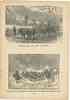
BUFFALO BILL AS A BULL WHACKER.
BUFFALO BILL GUIDING AN ARMY SUPPLY TRAIN IN A SNOW-STORM.
(15)
17
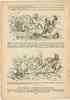
enormous spurs, with jingling pendants, are fastened to the boots, and announce in no uncertain sound the presence of the beau-ideal vaquero in full dress. His saddle is of the pure Mexican type, with high pommel, whereon hands the inevitable lariat, which in his hands is almost as certain as a rifle shot. Ordinarily he is a peaceful young fellow, but when the whisky is present in undue proportions, he is a good
(Image)
individual to avoid. Like the cow-boy, he is brave, nimble, careless of his own life, and reckless, when occasion requires of those of other people. At heart he is not bad. The dependence on himself which his calling demands, the dangers to which he is subjected while on duty, all compel a sturdy self-reliance. True types of this in exhibiting the fact that he possesses it in a sufficient degree at least for his own protection. True types of this peculiar class, seen nowhere else than on the plains, will be among the attractions of the show; and the men will
(Image)
illustrate the method of their lives in connection with the persuit and catching of animals, together with the superb horsemanship that is characteristic of their training.
TONY ESQUIVAL- CHAMPION VAQUERO RIDER, Born in Mexico, and is descended from the best Castillian and native stock dating through the history of the section along the Rio Grande. He possesses all the sterling qualities for which the higher bred rancheros are famed. As a pony Express Rider, Hardsman, and Horseman, he stands unexcelled.
18
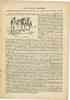
"OLD CHARLIE," THE HORSE That carried Buffalo Bill one hundred miles in nine hours and forty minutes.
Mr. Cody is a great lover of man's best friend among the animal kingdom- the horse. The peculiar career he has followed has made his equine friend such a sterling necessity as a companion, an assistant, a confident, that he admits, as every frontiersman and scout does, a great deal depends, even life itself in inumerable emergencies, on the genral sagacity of this noble brute. For the purposes of the trial, the hunt, the battle, the pursuit, or the stampede, it was essentially necessary to select for chargers with which to gain success, animals excelling in the qualities of strength, speed, docility, courage, stamina, keen scent, delicacy of ear, quick at sight, sure-footed, shrewed in perception, nobleness of character, and general intelligence. History records, and a grateful memory still holds dear, numberless famous quadruped allies that Buffalo Bill has, during his long career, possessed, and many are the stories told on the frontier and in the army of "Old Buckskin Joe," "Brigham," "Tall Bull," "Powder Face," "Stranger," and "Old Charlie."
"Old Bucksin Joe" was one of his early favorites, who, by long service in army scouting, became quite an adept, and seemed to have a perfect knowledge of hte duties required of him. For this reason, when ordered to find and report the location of the savages in their strongholds, at times hundreds of miles away over a lonely country, infested by scouting parties of hostiles liable at any instant to pounce upon one, Old Buckskin was always selected by Cody to accompany him on the trail when the work was dangerous. Mounted ona nother horse, he would let Buckskin follow untrammeled, even by a halter, so as to reserve him fresh in case of discovery and the terrible necessity of "a ride for life." Quick to scent danger, he instinctively gave evidence of his fears, and would almost assist his saddling for quickly insert his head in the bridle, and once on his back Joe was always able to bid definace to the swiftest horses the Indians possessed, and the longer the chase the further they were left in his rear. On one occassion his master described a band of one hundred warriors who gave them chase from the head waters of the Republican River to Fort McPherson, a distance of one hundred and ninety-five miles. It was a season when the ponies were in condition, and the savage band, though thirsting for the scalp of their well-known foe, "Pa-he-has-ka" (the long-haired scout), dropped behind until, on the last fifty miles, but fifteen of the fleetest were in pursuit, Buckskin leaving them out of sight twenty miles from the Fort.
This ride, famed in a, famed in army annals, caused Old Buckskin to go blind, but the gratitude of his master was such that Joe was kept and carefully attneded to until his death, which occurred a few years ago at Cody's home, North Platte. Buckskin was accorded a decent funeral, and a tombstone erected over his remains inscribed, "Old Buckskin Joe, the horse that on several occassions saved the life of Buffalo Bill, carrying him safely out of the range of Indian bullets. Died of old age 1882."
"Bringham" was another celebrity of his race, and it was on his back Mr. Cody clinched his undisputed title of "Kind Buffalo Killer," and added permancy to the name of "Buffalo Bill" by killing sixty-nine buffaloes in one run, and such was his steed's knowledge of hunting that game, that he discarded sadle and bridle while following the herd, killing the last half while riding this renowned pet of the chase bareback.
Many other tried and true ones have enhanced his love for their race, the last of the famous old-timers being owned and ridden by him in his daily exhibitions with the Wild West for the past three seasons, traversing the continent five times , traveling thousands of miles and never missing a performance- "Old Charlie ," who possesses all the virtues that go to form a "noble horse." charlie is seventeen years old, was broken in by Mr. Cody, and has never been ridden by any one else (except Miss Arta Cody, an accomplished horsewomen), and for many years has been the participant of all his master's skirmishes, expedition, long rides, and hunts; has been ridden over all kinds of rough country, prairie-dog towns, mountain and plain; has never stumbled or fallen, being beyond a doubt one of the surest-footed animals man ever rode, and for endurance is a second Buckskin Joe, if not better- on one occassion, in an emergency, having carried his master over a prairie road one hundred miles in nine hours and forty-five minutes, rider and trappings weighing two hundred and forty-three pounds. "Old Charlie's" great point is his wonderful intelligence, which causes him to act in a manner as to almost lay claim in his conduct to judiciousness. In the most lonely or unattractive place, or in one of the most seductive to equine rambles, when his master removes saddle and bridle, he can trust Charlie to stay where he is left, wrap himself in a blanket, take the saddle for a pillow, go to sleep contented, knowing his faithful steed will be close to hand, or, after browsing fully, will come and lie close beside him, sink into slumber, with ear at tension, one eye open, and at slightest disturbance arouse him to meet the threatened danger. All the Indians in the country, keen as he is scent them, intuitively as he dreaded them, could not make them leave or stampede him until his owner is mounted, challenging in his respect the instincts of the highest-class of watch-dog.
He cares not how much load you put on his back, having carried five hundred pounds of buffalo-meat; will pull as much by tying a lariat to the pommel as an ordinary horse with a collar; will hold the strongest buffalo or steer, but when a harness is placed on his back, and a collar is placed rouond his neck, will not pull an ounce, and if now soon relieved will viviously resent the (to him) seeming degradation.
He is a splendid example of the tractability of his species , and a fine exponent of the practical nature of the fronteirsman's invaluable companion, by the perfect repose he exhibits in pursuits and scenes so foreign to the experince of most of his kind, showing an avidity to join battle, in the stage-coach attack (which he joins without saddle, bridle, or rider), singling out his master, keeping close to him throughout the fight, exhibiting anxiety for his welfare. Thus daily in the Wild West Exhibition does he endorse before the public the writer's eulogy, and in Buffalo Bill's great shooting act on horseback assists his master to present a picture of horse and rider such as was never dreamt of by the novelist, or depicted by the painter.
(17)
19
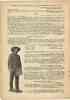
LETTERS OF COMMENDATION FROM PROMINENT MILITARY MEN.
WAR DEPARTMENT, ADJUTANT-GENERAL'S OFFICE, WASHINGTON, AUGUST 1O, 1886.
To whom it may concern:
MR. WILLIAM F. CODY was employed as Chief of Scouts under Generals Sheridan, Custer, Crook, Miles, Carr, and others, in their campaigns against hostile Indians on our frontier, and as such rendered very valuable and distinguished services.
S. W. DRUM, Adjutant-General.
[COPY.]
5th AVENUE HOTEL, NEW YORK, JUNE 29, 1887.
HON. WM. F. CODY, London, England:
DEAR CODY, - . . . In common with all your countrymen, I want to let you know that I am not only gratified, but proud of your management and general behavior; so far as I can make out, you have been modest, graceful, and dignified in all you have done to illustrate the history of civilization on this Continent during the past century.
I am especially pleased with the graceful and pretty compliment paid you by the Princess of Wales, who rode with you in the Deadwood Coach while it was attacked by the Indians, and rescued by the Cowboys. Such things did occur in our days, and may never again.
As near as I can estimate there were in 1865 about nine and a half millions of buffaloes on the plains between the Missouri River and the Rocky Mountains; all are now gone - killed for their meat, their skins and bones.
This seems like desecration, cruelty, and murder, yet they have been replaced by twice as many neat cattle. At that date there were about 165,000 Pawnees, Sioux, Cheyennes, Kiowas, and Arapohoes, who depended on these buffaloes for their yearly food. They, too, are gone, and have been replaced by twice or thrice as many white men and women, who have made the earth to blossom as the rose, and who can be counted, taxed, and governed by the laws of nature and civilization. This change has been salutary, and will go on to the end. You have caught one epoch of the world's history, have illustrated it is the very heart of the modern world - London, and I want you to feel that on this side the water we appreciate it.
This drama must end; days, years, and centuries follow fast, even the drama of civilization must have an end.
All I aim to accomplish on this sheet of paper is to assure you that I fully recognize your work, and that the presence of the Queen, the beautiful Princess of Wales, the Prince, and British public, are marks of favor which reflect back on America sparks of light which illuminate many a house and cabin in the land where once you guided me honestly and faithfully in 1865-6 from Fort Riley to Kearney in Kansas and Nebraska. Sincerely your friend, W. T. SHERMAN.
STATE OF NEBRASKA.
To all to whom these presents shall come, GREETING:
Know Ye, that I, JOHN M. THAYER, Governor of the State of Nebraska, reposting special trust and confidence in the integrity, patriotism, and ability of the Hon. William F. Cody, on behalf and in the name of the State do hereby appoint and commission him as Aide-de-Camp of my Staff, with the rank of Colonel, and do authorize and empower him to discharge the duties of said office according to law.
IN TESTIMONY WHEREOF I have hereunto subscribed my name and caused to be affixed the Great Seal of the State.
Done at Lincoln, this 8th day of March, A. D. 1867. JOHN M. THAYER.
By the Governor,
G. G. LAUR, Secretary of State.
The following letter received with photograph of the hero of the "March to the Sea," Gen. W. T. Sherman:
New York, December 25, 1886. TO HON. WM. F. CODY: - With the best compliments of one who, in 1866, was guided by him up the Republican, then occupied by the Cheyennes and Arapahoes as their ancestral hunting-grounds, now transformed into farms and cattle-ranches, in better harmony with modern civilization, and with his best wishes that he succeed in his honorable efforts to represent the scenes of that day to a generation then unborn. W. T. SHERMAN, General.
New York, December 25, 1886. HON. WM. F. CODY: DEAR SIR, - Recalling the many facts that came to me while I was Adjutant-General of the Division of the Missouri, under General Sheridan, bearing upon your efficiency, fidelity, and during as a guide and scout over the country west of the Missouri River and east of the Rocky Mountains, I take pleasure in observing your success in depicting in the East the early life of the West. Very truly yours, JAMES B. FRY, Assistant Adjutant-General, Brevet Major-General, U. S. A.
HEADQUARTERS, ARMY OF THE UNITED STATES. Washington, D.C., January 7, 1887. MR. WILLIAM F. CODY was a scout, and served in my command on the Western frontier for many years. He was always ready for duty, and was a cool, brave man, with unimpeachable character. I take pleasure in commending him for the many services he has rendered to the Army, whose respect he enjoys, for his manly qualities. P. H. SHERIDAN, Lieutenant-General.
Los Angeles, Cal., January 7 25, 1878. HON. WM. F. CODY: DEAR SIR, - Having visited your great Exhibition in St. Louis and New York City, I desire to congratulate you on the success of your enterprise. I was much interested in the various life-like representations of Western scenery, as well as the fine exhibition of skilled marksmanship and magnificent horsemanship. You not only represent the many interesting features of frontier life, but also the difficulties and dangers that have been encountered by the adventurous and fearless pioneers of civilization. The wild Indian life as it was a few years ago will soon be a thing of the past, but you appear to have selected a good class of Indians to represent that race of people, and I regard your Exhibition as not only very interesting, but practically instructive. Your services on the frontier were exceedingly valuable. With best wishes for your success, believe me, very truly yours, NELSON A MILES, Brigadier-General, U. S. A.
"HE IS KING OF THEM ALL."
HEADQUARTERS, MOUNTED RECRUITING SERVICE, St. Louis, Mo., May 7, 1885.
MAJOR JOHN M. Burke: DEAR SIR, - I take pleasure in saying that in an experience of about thirty years on the plains and in the mountains, I have seen a great many guides, scouts, trailers, and hunters, and Buffalo Bill (W. F. Cody) is king of them all. He has been with me in seven Indian fights, and his services have been invaluable. Very respectfully yours. EUGENE A. CARR, Vrecet Major-General, U. S. A.
UNITED STATES MILITARY ACADEMY, WEST POINT, N. Y., January 11, 1887. . . . I have known W. F. Cody (Buffalo Bill) for many years. He is a Western man of the best type, combining those qualities of enterprise, daring, good sense, and physical endurance which made him the superior of any scout I ever knew. He was cool and capable when surrounded (18)
20
by dangers, and his reports were always free from exaggeration. He is a gentleman in that better sense of the word which implies character, and he may be depended on under all circumstances. I wish him success.
W. MERRITT, Brevet Major-General, U. S. A., Late Major-General Volunteers. ________
HON. WM. F. CODY: DEAR SIR, I take great pleasure in testifying to the very efficient service rendered by you " as a scout," in the campaign against the Sioux Indians, during the year 1876. Also, that I have witnessed your Wild West Exhibition. I consider it the most realistic performance of the kind I have ever seen. Very sincerely, your obedient Servant.
GEORGE CROOK, Brigadier-General, U. S. A. ________ WASHINGTON, D. C., February 8, 1887.
Mr. Cody was chief guide and hunter to my command, when I commanded the District of North Platte, and he performed all his duties with marked excellence.
W. H. EMORY, Major-General, U. S. A. ________
HEADQUARTERS, 7TH CAVALRY, FORT MEAD, DAKOTA TERRITORY, February 14, 1887
MY DEAR SIR,--Your army career on the frontier, and your present enterprise of depicting scenes in the Far West, are so enthusiastically approved and commended by the American people, and the most prominent men of the U. S. Army, that there is nothing left for me to say. I feel sure your new departure will be a success. With best wishes, I remain, yours truly.
JAMES W. FORSYTH, Colonel 7th Cavalry. ________
JERSEY CITY, 405 BERGEN AVR., February 7, 1887.
HON. WM. F. CODY: MY DEAR SIR,--I fully and with pleasure endorse you as the veritable "Buffalo Bill," U. S. Scout, serving with the troops operating against hostile Indians, in 1808, on the plains. I speak from personal knowledge, and from reports of officers and others, with whom you secured renown by you services as a scout and successful hunter. You sojourn on the frontier at a time when it was a wild and sparsely settled section of the Continent, fully enables you to portray that in which you have personally participated--the Pioneer, Indian Fighter, and Frontiersman. Wishing you every success, I remain, very respectfully yours,
H. C. BANKHEAD, Brigadier-General, U. S. A. ________
HOTEL RICHMOND, WASHINGTON, D. C., January 9, 1887.
. . . W. F. CODY (Buffalo Bill) was with me in the early days, when I commanded a Battalion of the 5th Cavalry, operating against the hostile Sioux. He filled every position and met every emergency with so much bravery, competence, and intelligence, as to command the general admiration and respect of the officers, and become Chief of Scouts of the Department. All his successses have been conducted on the most honorable principles.
W. B. ROYALL, Colonel 4th Cavalry, U. S. A. ________
HEADQUARTERS, 1ST CAVALRY, FORT CUSTER, M. T.
. . . I often recall your valuable services to the Government, as well as to myself, in years long gone by, specially during the Sioux difficulties, when you were attached to my command as Chief of Scouts. Your indomitable perseverance, incomprehensible instinct in discovering the trails of the Indians, particularly at night, no matter how dark or stormy, your physical powers of endurance in following the enemy until overtaken, and you unflinching courage, as exhibited on all occasions, won not only my own esteem and admiration, but that of the whole command. With my best wishes for your success, I remain your old friend,
N. A. M. DUDLEY, Colonel 1st Cavalry, Brevet Brigadier-General, U. S. A. ________
TALLAHASSEE, FLA., January 12, 1887.
HON. WILLIAM F. CODY,--I take great pleasure in recommending you to the pubilc, as a man who has a high reputation in the Army as a Scout. No one has ever shown more bravery on the Western plains than yourself. I wish you success in you proposed visit to Great Britain. Your obedient servant,
JNO. H. KING, Brevet Major-General, U. S. A. ________
Lines Inspired on Witnessing the Prairie Chief Caressing his Baby Daughter, LITTLE IRMA CODY.
Only a baby's fingers, patting a brawny cheek, Only a laughing dimple in the chin so soft and sleek, Only a cooing babble, only a frightened tear, But it makes a man both brave and kind To have them ever near. The hand that seemed harsh and cruel, Nerved by a righteous hate, As it cleft the heart of the Yellow Hand, In revenge of Custer's fate, Has the tender touch of a woman, As, rifle and knife laid by, He coos and tosses the baby, Darling "apple of his eye." --RICHMOND.
(Picture) UNGUIDED VICTIMS OF A PRAIRIE SNOW-STORM. (19)