
11
About this time a halt was made, and you bet I was mighty glad of it. Suddenly two to three scouts rode up. A hurried council was held, during which the pipe was passed. Everything seemed to be now arranged, and, after a little further advance, again a halt, when, amid great but suppressed excitement, every Indian mounted his now almost frantic steed, each eagerly seeking to edge his way without observation to the front.
About two hundred horses almost abreast in the front line, say one hundred and fifty wedging in half way between formed a half second line, and one hundred struggling for place - a third line; the chiefs in front, gesticulating, pantomiming and, with slashing whips, keeping back the excited mass, whose plunging, panting ponies, as impatient as their masters, fretted, frothed, and foamed - both seemed moulded into one being, with only one thought, one feeling, one ambition, as with flashing eye they waited for the signal "Go," to let their pent-up feelings speeds on to the honors of the chase.
Their prey is in fancied security, now quietly browsing to the windward in a low, open falt, some half a mile wide and two or three miles long, on top of a high divide, concealed from view by rising and breaks. Gradually they approach the knoll, their heads reach the level, the backs of the buffalo are seen, then a full view, when Pi-ta-ne-sha-a-du (Old Peter, the head chief) gives the word, drops the blanket, and they are "off."
Whew ! wheez ! thunder and lightning ! Jerome Parks and Hippodromes ! talk of tornadoes, whirlwinds, avalanches, water spouts, prairie fires, Niagara, Mount Vesuvius (and I have seen them all except old Vesuv.); boil them all together, mix them well, and serve on one plate, and you will have a limited idea of the charge of this "light brigade." They fairly left a hole in the air. With a roar like Niagara, the speed of a whirlwind, like the sweep on death in their souls, they pounce on their prey, and in an instant, amid a cloud of dust, nothing is visible but a mingled mass of flying arrows, horses' heels, buffaloes; tails, Indian heads, half of ponies, half of men, half of buffalo, until one thinks it a dream, or a heavy case of "jim-jams."
I just anchored in astonishment. Where are they? Ah! there is one: there is another, a third, four, five. Over the plains in all directions they go, as the choice meat hunters cut them out, while in a jumbled mass, circling all around is the main body. The clouds of dust gradually rise as if a curtain was lifted, horses stop as buffaloes drop, until there is a clear panoramic view of a busy scene all quiet, everything still (save a few fleet ones in the distance): horses riderless, browsing proudly conscious of success; the prairie dotted here, there, everywhere with dead bison; and happy, hungry hunters skinning, cutting, slashing the late proud monarch of the plains.
I was so interested in the sight that I came near being left, when fortunately a lucky long-range shot (the only one fired during the day) at a stray heifer saved my reputation. In about two hours every pony was loaded, their packing being quite a study, that would need a deserved and lengthy description. It was wonderful.
As I had a heap of walk out, I proposed to ride in, so took a small cut of choice meat - a straight-cut - for camp. Every pony was packed down only mine, seeing which "Peter's papoose" ("the sun chief") invited himself up behind. Talk of gall - an Indian has got more cheek than a Government mule. He laughed at my objections, but as he had loaned me the pony I had to submit. He even directed the gait, and kept up a continual jabbering of "Wisgoots, ugh!" which I afterwards learnt meant "Hurry up; I am tired, hungry, and dry - how!
A reproduction, as far as practicable, of the method of buffalo hunting, will be a feature of Buffalo Bill's "Wild West," with a heard of bison, real Indians, hunters, and Western ponies.
A HISTORICAL COACH OF THE DEADWOOD LINE.
The denizens of the Eastern States of the Union are accustomed to reagrd the West as the region of romance and adventure. And, in truth, its history abounds with thrilling, incidents and surprising changes. Every inch of that beautiful country has been won from a cruel and savage foe by danger and conflict. In the terrible wars of the border which marked the early years of the Western settlements, the men signalized themselves by performing prodigies of valor, while the women, in their heroic courage and endurance, afforded a splendid example of devotion and self-sacrifice. The history of the wagon trains and stage coaches that preceded the railway is written all over with blood, and the story of suffering and disaster, often as it has been repeated, is only known in all of its horrid details to the bold frontiersmen who, as scouts and rangers, penetrated the strongholds of the Indians, and, backed by the gallant men of the army, became the avant courriers of Western civilization and the terror of the red man.
Among the most stirring episodes in the life of the Western pioneer are those connected with the opening of new lines of travel, for it is here, among the trails and canyons, where lurk the desperadoes of both races, that he is brought face to face with the danger in its deadliest forms. No better illustration of this fact is furnished than in the history of the famous DEADWOOD COACH, the scarred and weather-beaten veteran of the original "star route" line of stages, established at a time when it was worth a man's life to sit on its box and journey from one end of its destination to the other. The accompanying picture affords an idea of the old relic. and it is because of its many associations with his own life that it has been purchased by "Buffalo Bill" and added to the attractions of his "GREAT REALISTIC EXHIBITION OF WESTERN NOVELTIES."
It will be observed that it is a heavily built Concord stage, and is intended for a team of six horses. The body is swung on a pair of heavy leather underbraces, and has the usual thick "perches," "Jacks," and brakes belonging to such a vehicle. It has a large leather "boot" behind, and another at the driver's foot-board. The coach was intended to seat twenty-one men - the driver and two men beside him, twelve inside, and the other six on the top. As it now stands, the leather blinds of the windows are worn, the paint is faded, and it has a battered and travel-stained aspect that tells the story of hardship and adventure. Its trips began in 1875, when the owners were Messrs, Gilmour, Salisbury & Co. Luke Voorhees is the present manager. The route was between Cheyenna and Deadwood, via Fort Larale, Rawhide Buttes, Hat or War Bonnet Creek, the place where Buffalo Bill killed the Indian chief "Yellow Hand," July 17, 1876, Cheyenne River, Red Canyon, and Custer. Owing to the long distance and dangers, the drivers were always chosen for their coolness, courage, and skill.
In its first season the dangerous places on the route were Buffalo Gap, Lame Johnny Creek, Red Canyon, and Squaw Gap, all of which were made famous by scenes of slaughter and the deviltry of the banditti. Conspicuous among the latter were "Curley" Grimes, who was killed at Hogan's Ranch; "Peg-Legged" Bradley; Bill Price, who was killed on the Cheyenne River; "Dunk" Blackburn, who is now in the Nebraska State Prison, and others of the same class, representing the most fearless of the road agents of the West.
On the occasion of the first attack the driver, John Slaughter, a son of the present marshal of Cheyenne, was shot to pieces with buckshot. He fell to the ground, and the team ran away, escaping with the passengers and mall, and safely reached Greely's Station. This occurred at White Wood Canyon. Slaughter's body was recov
(10)
12
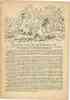
HISTORICAL COACH OF THE DEADWOOD LINE.
The Indians' Attack on which will be Represented in Buffalo Bill's "Wild West," and also its Rescue by the Scouts and Plainsmen.
ered, brought to Deadwood, and thence carried to Cheyenne, where it is now buried. The old coach here received its "baptism of fire," and during the ensuing summer passed through a variety of similar experiences, being frequently attacked. One of the most terrific of these raids was made by the Sioux Indians, but the assault was successfully repelled, although the two leading horses were killed. Several Commercial travelers next suffered from a successful ambush, on which occasion a Mr. Liebman, of Chicago, was killed, and his companion shot through the shoulder.
After this stormy period it was fitted up as a treasure coach, and naturally became an object of renewed interest to the robbers; but, owing to the strong force of what is known as "shotgun messengers" who accompanied the coach, it was a long time before the bandits succeeded in accomplishing their purpose. Among the most prominent of these messengers were Scott Davis, a splendid scout, and one of the self-appointed undertakers of many of the lawless characters of the neighborhood; Boone May, one of the best pistol shots in the Rocky Mountain regions, who killed Bill Price in the streets of Deadwood, together with "Curley" Grimes, one of the road agents; Jim May, a worthy brother - a twin in courage if not in birth. Few men have had more desperate encounters than he, and the transgressors of the law have had many an occasion to feel the results of his keen eye and strong arm whenever it has become necessary to face men who are prepared to "die with their boots on." Still another of these border heroes (for such they may be justly termed) is Gail Hill, now the deputy sheriff of Deadwood, and his frequent companion was Jesse Brown, and old-time Indian fighter, who has a record of incident and adventure that would make a book. These men constituted a sextette of as brave fellows as could be found on the frontier, and their names are all well known in that country.
At last, however, some of them came to grief. The bandits themselves were old fighters. The shrewdness of one party was offset by that of the other, and on an unlucky day the celebrated Cold Spring tragedy occurred. The station had been captured, and the road agents secretly occupied the place. The stage arrived in its usual manner, and without suspicion of danger, the driver, Gene Barnett, halted at the stable door. An instant afterwards a volley was delivered that killed Hughey Stevenson, sent the buckshot through the body of Gail Hill, and dangerously wounded two others of the guards. The bandits then captured the outfit, amounting to some sixty thousand dollars in gold.
On another occasion the coach was attacked, and, when the driver was killed, saved by a woman - Martha Canary, better known at the present time in the wild history of the frontier as "Calamity Jane." Amid the fire of the attack, she seized the lines and, whipping up the team, safely brought the coach to her destination.
When Buffalo Bill returned from his scout with Gen. Crook, in 1876, he rode in this self-same stage, bringing with him the scalps of several of the Indians whom he had met. When afterwards he learned that it had been attacked and abandoned, and was lying neglected on the plains, he organized a party, and, starting on the trail, rescued and brought the vehicle into camp.
With the sentiment that attaches to a man whose life has been identified with the excitement of the far West, the scout has now secured the coach from Col. Voorhees, the manager of the Black Hills stage line, and hereafter it will play a different role in its history from that of inviting murder and being the tomb of its passengers. And yet the "Deadwood Coach" will play no small part in the entertainment that has been organized by Buffalo Bill and partners for the purpose of representing some of the most startling realities of Western life, in a vivid representation of one of the Indian and road agents' combined attacks.
(11)

13
THE COWBOYS Among the many features of "The Wild West" not the least attractive will be the advent in the Eadt of a band of vertible "cow boys" a class without whose add sif the greatest grazing. Pampas of the West would be valueless, and the Eastern necessities of the table, the tan-yard, and the factory would be meagre. These will be the genuine cattle-herders of a reputable trade, and not the later misnomers of "the road", who, in assuming an honored title, have tarnished it in the East, while being in fact the cow-boys greatest foe, the thieving, criminal "rustler". To Wilke's Spirit of March, the editor is indebted for a just tribute and description of the American ranchman.
The Cow-Boy. The cow-boy! How often spoken of, how falsely imagined, how greatly despised (where not known), how little understood! I've been there considerable. How sneeringly referred to, and how little appreciated, although his title has been gained by the possession of many of the noblest qualities that form the romantic hero of the poet, novelist and historian; the plainsman and the scout. What a school it has been for the latter! As "tall oaks from little acorns grow," the cow-boy serves a purpose, and often develops into the most celebrated ranchman, guide, cattle-king, Indian fighter, and dashing ranger. How old Sam Houston loved them, how the Mexicans hated them, how Davy Crockett admired them, how the Comanches feared them, and how much you "beef-eaters" of the rest of the country owe to them, is a large-sized conundrum. Composed of many "to the manner born," but recruited largely from Eastern young men, they were taught at school to admire the deceased little Georgie in exploring adventures, and though not equaling him in the "cherry-tree goodness", were more disposed to kick against the bull-dozing of teachers, parents and guardians.
As the rebellious kid of old times filled a handkerchief (always a handkerchief, I believe) with his all, and followed the trail of his idol, Columbus, and became a sailor bold, the more ambitious and adventurous youngster of later days freezes on to a double-barreled pistol and steers for the bald prairie to seek for tune and experience. If he don't get his system full it's only because the young man weakens, takes a back seat, or fails to become a Texas cow-boy. If his Sunday-school ma'am has not impressed him thoroughly with the chapter abour our friend Job, he may at first
(Image)
13
14
be astonished; but he'll soon learn the patience of the old hero, and think he pegged out a little too soon to take it all in. As there are generally openings, likely young fellows can enter, and not fall to be put through. If he is a stayer, youth and size will be no disadvantage for his start in, as certain lines of the business are peculiarly adapted to the light young horsemen, and such are highly esteemed when they become thoroughbreds, and fully possessed of "cow sense."
Now, "cow sense" in Texas implies a thorough knowledge of the business, and a natural instinct to divine every thought, tick, intention, want, habit, or desire of his drove, under any and all circumstances. A man might be brought up in the States swinging to a cow's tall, yet, taken to Texas, would be as useless as a last year's bird's nest with the bottom punched out. The boys grow old soon, and the old cattle-men seem to grow young; thus it is that the name is applied to all who follow the trade. The boys are divided into range-workers and branders, road-drivers and herders, trail-guides and bosses.
As the railroads have now put an end to the old-time trips, I will have to go back a few years to give a proper estimate of the duties and dangers, delights and joys, trials and troubles, when off the ranch. The ranch itself and the cattle trade in the State still flourish in their old time glory, but are being slowly encroached upon by the modern improvements that will, in course of time, wipe out the necessity of his day, the typical subject of my sketch. Before being counted in and fully endorsed, the candidate has had to become an expert horseman, and test the many eccentricities of the stubborn mustang; enjoy the beauties, learn to catch, throw, fondle - oh ! yes, gently fondle (but not from behind) - and ride the "docile" little Spanish-American plug, an amusing experience in itself, in which you are taught all the mysteries of rear and tear, stop and drop, lay and roll, kick and bite, on and off, under and over, heads and tails, hand springs, tiple somersaults, standing on your head, diving, flip-flaps, getting left (horse leaving you fifteen miles from camp - Indians in teh neighborhood, etc.) and all the funny business included in the familiar term of "bucking"; then learn to handle a rope, catch a calf, stop a crazy cow, throw a beef steer, play with a wild bull, lasso an untamed mustang, and daily endure the dangers of a Spanish matador, with a little Indian scrape thrown in, and if there is anything left of you they'll christen it a first-class cow-boy. Now his troubles begin (I have been worn to a frizzled end many a time before I began); but after this he will learn to enjoy them - after they are over.
As the general trade on the range has often been described, I'll simply refer to a few incidents of a trip over the plains to the cattle markets of the North, through the wild and unsettled portions of the Territories, varying in distance from fifteen hundred to two thousand miles - time, three to six months - extending through the Indian Territory and Kansas to Nebraska, Colorado, Dakota, Montana, Idaho, Nevada, and sometimes as far as California. Immense herds, as high as thirty thousand or more in number, are moved by single owners, but are driven in bands of from one to three thousand, which, when under way, are designated "herds." Each of these have from ten to fifteen men, with a wagon driver and cook, and the "kingpin of the outfit," the boss, with a supply of two or three ponies to a man, an ox team, and blankets; also jerked beef and corn meal - the staple food. They are also furnished with mavericks or "doubtless-owned" yearlings for the fresh meat supply. After getting fully under way, and the cattle broke in, from ten to fifteen miles a day is the average, and everything is plain sailing in fair weather. As night comes on, the cattle are rounded up in a small compass, and held until they lie down, when two men are left on watch, riding round and round them in opposite directions, singing or whistling all the time, for two hours, that being the length of each watch. The singing is absolutely necessary, as it seems to soothe the fears of the cattle, scares away the wolves or other varmints that may be prowling around, and prevents them from hearing any other accidental sound, or dreaming of their old homes, and if stopped would in all probability be the signal for a general stampede. "Music hath charms to soother the savage breast," if a cow-boy's compulsory bawling out lines of his own composition,
Lay nicely now, cattle, don't heed any rattle, But quietly rest until morn; For if you skedaddle, we'll jump in the saddle, And head you as sure as you're born,
can be considered such.
Some poet may yet make a filt. On the odds and ends of cow-boys' wit.
But on nights when "Old Prob." goes on a spree, leaves the bung out of his waterbarrel above, prowls around with this flashbox, raising a beeeze whispering in tones of
(13)
15
founder, and the cow-boy's voice, like the rest of the outfit, is drowned out, steer clear, and prepare for action. If them quadrupeds don't go insane, turn tail to the storm, and strike out for civil and religious liberty, then I don't know what "strike out" means. Ordinarily so clumsy and stupid-looking, a thousand beef steers can rise like a flock of quail on the roof of an exploding powder mill, and will scud away like a tumble weed before a high wind, with a noise like a receding earthquake. Then comes fun and frolic for the boys!
Talk of "Sheriden's ride, twenty miles away!" That was in the daytime, but this is the cow-boy's ride with Texas five hundred miles away, and them steers steering straight for home; night time, darker than the word means, hog wallows, prairie dog, wolf, and badger holes, ravines and precipices ahead, and if you do your duty, three thousand stampeding steers behind. If your horse don't swap ends, and you hang to them until daylight, you can bless your lucky stars, Many have passed in their checks at this game. The remembrance of the few that were foot loose on the Bowery a few years ago will give an approximate idea of the three thousand raving bovine on the war path. As they tear through the storm at one flash of lightning they look all tails, and at the next flashm all horns. If Napoleon had had a herd at Sedan, headed in the right direction, he would have driven old Billy across the Rhine.
The next great trouble is in the driving season. When cattle strike swimming water they generally try to turn back, which eventuates in their "milling," that is, swimming in a circle, and, if allowed to continue, would result in the drowning of many. There the daring herd must leave his pony, doff his togs, scramble over their backs and horns to scatter them, and with whoops and yells, splashing, dashing, and didoes in the water, scare them to the opposite bank. This is not always done in a moment, for a steer is no fool of a swimmer; I have seen one hold his own for six hours in the Gulf after having jumped overboard. As some of the streams are very rapid, and a quarter to half a mile wide considerable drifting is done. Then the naked herder has plenty of amusement in the hot sun, fighting green-headed flies and mosquitoes and peeping for Indians, until the rest of the layout is put over- not an easy job. A temporary boat has to be made of the wagon-box, by tacking the canvas cover over the bottom, with which the ammunition and grub is ferried across, and the running- gear and ponies are swum over afterwards. Indian fights and horse thief troubles are part of the regular rations. Mixing with other herds and cutting them out, again avoiding too much water at times, and hunting for a drop at others, belongs to the regular routine.
Buffalo chips for wood a great portion of the way (poor substitute in wet weather) and the avoiding of prairie fires later on, varies the monotony. In fact, it would fill a book to give detailed account of a single trip and it is no wonder the boys are hilarious when it ends, and like the old toper, " swears no more for me," only to return and go through the mill again.
How many, though, never finish, but mark the trail with theirsilent gravest! no one can tell. But when Gabriel toots his horn, the "Chisholm trail" will swarm with cow-boys. "Howsomever, we'll all be thar," let's hope for a happy trip, when we say to this planet, adios!
THE VAQUERO OF THE SOUTH-WEST.
Between the "cow-boy" and the "vaquero" there is only a slight line of demarcation, The one is usually an American inured from boyhood to the excitements and hardships of his life, and the other represents in his blood the stock of the Mexican, or it may be of the hald-breed.
In their work, the methods of the two are similar; and, to a certain extent, the same is true of their association. Your genuine vaquero, however, is generally, when off duty, more of a dandy in the style and get-up of his attire than his careless and impetuous compeer. He is fond of gaudy clothes, and Eastern man is that circus has broken loose in the neighborhood; a rich jacket, embroidered by his sweetheart perhaps, envelopes his shapely shoulders; a sash of blue or red sild is wrapped around his waist, from which protrude a pair of revolvers; and buckskin trousers, slit from the knee to the foot and ornamented with rows of brass or silver buttons, complete his attire, save that
(14)