
16
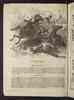
(Image) Tutors of a Stampede.
The Cow Boys.
Among the many features of "the wild West." not the least attractive will be the advent in the East of band of veritable "cow-boys," a class without whose aid the great grazing Pampas of the West would be values and the Eastern necessities of the table, the ten yard, and the factory would be meager. These will be the genuine cattle herders of a reputable trade, and not the later misnomers of "the road," who, in assuming an honored title, have tarnished it in the East, while being in fact the cow-boys' greatest for, the thieving criminal "rustler." To Wilkes' Spirit, of March, the editor is indebted for a just tribute and description of the American ranchman.
THE COW-BOY.
"The cow-boy! How often spoken of how falsely imagined, how greatly despised (where not known) how little understood! I've been there considerable. How sneeringly referred to, and how little appreciated, although his title has been gained by the possession of many of the noblest qualities that form the romantic hero of the poet, novelist, and historian: the plainsman and the scout. What a school it has been for the latter? As "tall oaks from little acorns grow" the cow-boy serves a purpose, and often develops into the most celebrated Frenchman, guide cattle king, Indian fighter, and dashing ranger. How old Sam Houston loved them how the Mexican hated them, how Davy Crockett admired them, how the Comanches feared them, and how much you "beef eaters" of the rest of the country owe to them, is a large-sized conundrum. Composed of many "to the manner born," but recruited largely from Eastern young men, they were taught at school to admire the deceased little Georgie in exploring adventures and though not equaling him in the "cherry-tree goodness," were more disposed to kick against the bulldozing of teachers, parents, and guardians.

17
As the rebellious kid of old times filled a handkerchief of (always a handkerchief, I believe) with his all, and followed the trail of his idol, Columbus, and became a sailor bold, the more ambitious and adventourous youngster of later days freezes on to a double-barreled pistol, and steers for the bald prairie to seek fortune and experience. If he don't get his system full, it's only because the young man weakens, takes a back seat, or fails to become a Texas cow-boy. If his Sunday-school ma'am has not impressed him thoroughly with the chapter about our friend Job, he may at first be astonished: but he'll soon learn the patiene of the old hero, and think he pegged out a little too soon to take it all in. As there are generally openings, likely young fellows can enter, and not feel to be put through. If he is a stayer, youth and size will be no disadvantage for his start in, as certain lines of the business are peculiarly adapted to the light young horsemen, and such are highly exteemed when they become thoroughbreds, and fully possessed of "cow sense."
Now "cow sense" in Texas implies a thorough knowledge of the business, and a natural instinct to divise every thought, trick, intention, want, habit or desire of his drove, under any and all circumstances. A man might be brought upon the States swinging to a cow's tail, yet, taken to Texas would be as useless as a last year's bird's neset with the bottom punched out. The boys grow old soon, and the old cattlemen seem to grow young: thus is is that the name is applied to all who follow the trade. The boys are divided into rangeworkers and branders, road-drivers and herders, trail-guides and bosses.
As the railroads have now put an end to the old-time trips, I will have to go back a few years to give a proper estimate of the duties and daugers, delights and joys, trials and troubles, when off the ranch. The ranch itself and the cattle trade in the State still flourish in their old-time glory, but are being slowly encroached upon by the modern improvements that will in course of time, wipe out the necessity of his day, the typical subject of my sketch. Before being counted in and fully endorsed, the candidate has had to become an expert horseman, and test the many eccentricities of the stubborn mustang; enjoy the beauties, learn to catch, throw, fondle--oh! yes, gently fondly (but not from behind)--and ride the "doeile" little Spanish-American plug, an amusing experience in itself, in which you are taught all the mysteries of rear and tear, stop and drop, lay and roll, kick and bite, on and off, under and over, heads and tails, hand springs, triple somersaults, standing on your head, driving, flip-flops, getting left (horse leaving you fifteen miles from camp--Indians in the neighborhood, etc.) and all the funny business included in the familiar term of "bucking;" then learn to handle a rope, catch a calf, stop a crazy cow, throw a beef steer, play with a wild bull, lasso an untrained mustang, and daily endure the dangers of a spanish matador, with a little Indian seraje thrown in, and if there is anything left of you they'll christen it a first-class cow boy. Now his troubles begin (I have been worn to a frizzled end many a time before I began); but after this he will learn to enjoy them--after they are over.
As the general trade on the range has often been described, I'll simply refer to a few incidents of a trip over the plains to the cattle markets of the North, through the wild and unsettled postion of the Territories, varying in distance from fifteen hundred to two thousand miles--time, three to six months--exceding through the Indian Territory and Kansas to Nebraska, Colorado, Dakota, Montana, Idaho, Nevada, and sometimes as fas as California. Immense herds, as high as thirty thousand or more in number, are moved by single owners, but are driven in bands of one to three thousand, which, when under way, are designated "herds." Each of these have from ten to fifteen men, with a wagon driver and cook, and the "king" [of one outat, three?] boss, with a supply of two or three ponies to a man, an ox team, and blankets; she jecked beef and corn meal--the staple food. They are also furnished with mavericks or "doubtless-owned" yearlings for the fresh meat supply. After getting fully under way, and the cattle broke in.
18
from ten to fifteen miles a day in the average, and everything is plain sailing, in fair weather. As night comes on, the cattle are rounded up in a small compass, and held until they lie down, when two men are left on watch, riding round and round them in opposite direction, singing or whistling all the time, for two hours, that being the length of each watch. This singing is absolutely necessary, as it seems to soothe the fears of the cattle, scares away the wolves or other varmints that may be prowling around, and prevents them from hearing any other accidental sound, or dreaming of their old homes, and if stopped would, in all probability, be the sign for a general stampede. "Music hath charms to soothe the savage breast," if a cow-boy's compulsory crawling out lines of his own composition:
Lay nicely now, cattle, don't heed any rattle; But quietly rest until morn; For if you skedaddle, we'll jump in the saddle, And head you as sure as you're born,
can be considered such.
Some poet may yet make a hit On the odds and ends of cow-boys' wit.
But on nights when "Old Prob," goes on a spree, leaves the bung out of his water barrel above, prowls around with his flash box, raising a breeze whispering in tones of thunder, and the cow-boy's voice, like the rest of the outfit, is drowned out, steer clear, and prepare for action. If them quadrupeds don't go insane, turn tail to the storm, and strike out for civil and religious liberty, then I don't know what "strike out" means. Ordinarily so clumsy and stupid looking, a thousand beef steers can rise like a flock of quail on the roof of an exploding powder mill, and will scud away like a tumble weed before a high wind, with a noise like a receding earthquake. Then comes fun and frolic for the boys!
Talk of "Sheridan's ride, twenty miles away," That was in the daytime, but this is the cow-boy's ride with Texas five hundred miles away, and them steers steering straight for him; night time, darker than the word means, hog wallows, prairie dog, wolf and badger holes, ravines and precipices ahead, and, if you do your duty three thousand stampeding steers behind. If your horse don't swap ends, and you hang to them till daylight, you can bless your lucky stars. Many have passed in their checks at this game. The remembrance of the few that were foot loose in the Bowery a few years ago, will give an approximate idea of three thousand raving bovines of the warpath. As they tear through the storms at one flash of lightning, they look all tails, and at the next flash all horns. If Napoleon had a herd at Sedan, headed in the right direction, he would have driven old Billy across the Rhine.
The next great trouble is crossing streams, which are invariably high in driving season. When cattle strike swimming water they generally try to turn back, which eventuates in their "milling," that is swimming in a circle, and, if allowed to continue, would result in the drowning of many. There the daring herder must leave his pony, doff his togs, scramble over their backs and horns to scatter them, and, with whoops and yells, splashing, dashing, and didoes in the water, scare them to the opposite bank. This is not always done in a moment, for a steer is no fool of a swimmer; I have seen one hold his own for six hours in the Gulf after having jumped overboard. As some of the streams are very rapid, and a quarter to half a mile wide, considerable drifting is done. Then the naked herder has plenty of amusement in the hot sun, fighting green head flies and mosquitoes, and peeping around for Indians, until the rest of the lay-out is put over -- not an easy job. A temporary boat has to be made of the wagon box, by tacking the canvas cover over the bottom, with which the ammunition and grub is ferried across, and the running gear and ponies swam over afterwards. Indian fights and horse thief troubles are part of the regular rations. Mixing with other herds and cutting them out, again avoiding too much water at times, and hunting for a drop at others, belongs to the regular routines.
Buffalo chips for wood a great portion of the way (poor substitute in the wet weather), and the avoiding of prairie fires later on, varies the monotony. In fact it would fill a book to give a detailed account of a single trip, and it is no wonder that the boys are hilarious when it ends, and, like the old toper, "swear no more for me," only to return and go through the mill again.
How many, though, never finish, but mark the trail with their silent graves! no one can tell. But when Gabriel toots his horn, the "Chisholm trail" will swarm with cow-boys. "Howsomever, we'll all be thar," let's hope, for a happy trip, when we say to this planet, adios! J. B. OMOHUNDRO (TEXAS JACK).
Among the leading celebrities in the present party will be the renowned BUCK TAYLOR, a man whose great strength, nerve, endurance, and skill is historical in the West; JIM LAWSON, equally distinguished as a lassoist and roper; Bud Ayers, Dick Bean, and others, who will appear in feats of horsemanship, riding bucking mustangs, roping cattle, throwing buffalo, etc., eclipsing in agility and danger the Spanish matadors of old.
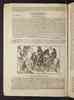
(IMAGE) The Vaquero of the Southwest.
Between the "cow-boy" and the "vaquero" there is only a slight line of demarcation. The one is usually an American inured from boyhood to the excitement and hardships of his life, and the other represents in his blood the stock of the Mexican, or it may be of the half-breed.
In their work, the methods of the two are similar; and, to a certain extent, the same is true of their associations. Your genuine vaquero, however, is generally, when off duty, more of a dandy in the style and get-up of his attire than his careless and impetuous compeer. He is fond of gaudy clothes, and when you see him riding well-mounted into a frontier town, the first thought of an Eastern man is that a circus has broken loose in the neighborhood, and this is one of the performers. The familiar broad-rimmed sombrero covers his head; a rich jacket, embroidered by his sweetheart perhaps, envelopes his shapely shoulders; a sash of blue or red silk is wrapped around his waist, from which protrude a pair of revolvers; and buckskin trousers, slit from the knee to the foot and ornamented with rows of brass or silver buttons, complete his attire, save that enormous spurs, with jingling pendants, are fastened to the boots, and announce in no uncertain sound the presence of the beau-ideal vaquero in full dress.
His saddle is of the pure Mexican type, with high pommel, whereon hangs the inevitable lariat, which in his hands is almost as certain as a rifle shot.
Ordinarily he is a peaceful young fellow, but when the whisky is present in undue proportions, he is a good individual to avoid. Like the cow-boy, he is brave, nimble, careless of his own life, and reckless, when occasion requires, of those of other people. At heart he is not bad. The dependence on himself which his calling demands, the dangers to which he is subjected while on duty, all compel a sturdy self-reliance, and he is not slow in exhibiting the fact that he possesses it in a sufficient degree at least for his own protection. True types of this peculiar class, seen nowhere else than on the plains, will be among the attractions of the show; and the men will illustrate the methods of their lives in connection with the pursuit and catching of animals, together with the superb horsemanship that is characteristic of their training.
19
"OLD CHARLIE," The Horse THAT CARRIED BUFFALO BILL ONE HUNDRED MILES IN NINE HOURS AND FORTY-FIVE MINUTES.
Mr. Cody is a great lover of man's best friend among the animal kingdom--the horse. The peculiar career he has followed has made equine friend such a sterling necessity as a companion, an assistant, a confident, that he admits, as every frontiersman and scout does, a great deal depends, even life itself in innumerable emergencies on the general sagacity of this noble brute. For the purposes of the trail, the hunt, the battle, the pursuit, or the stampede, it was essentially necessary to select for chargers with which to gain success, animals excelling in the qualities of strength, speed, docility, courage, stamina, keen scent, delicacy of ear, quick of sight, sure footed, shrewd in perception, nobleness of character, and general intelligence. History records, and a grateful memory still holds dear, numberless famous quadruped allies that Buffalo Bill has during his long career possessed, and many are the stories told on the frontier and in the army of "Old Buckskin Joe," "Brigham," "Tall Bull," "Powder-Face," "Stranger", and "Old Charlie."
"Old Buckskin Joe" was one of his early favorites, who, by long service in army scouting, became quite an adept, and seemed to have a perfect knowledge of the duties required of him. For this reason, when ordered to find and report the location of the savages in their strongholds, at times hundreds of miles away over a lonely country, infested by scouting parties of hostiles liable at any instant to pounce upon one, Old Buckskin was always selected by Cody to accompany him on the trail when the work was dangerous. Mounted on another horse, he would let Buckskin follow untrammeled, even by a halter, so as to reserve him fresh in case of discovery and the terrible necessity of "a ride for life." Quick to scent danger, he instinctively gave evidence of his fears, and would almost assist his saddling or quickly insert Iris head in the bridle, and once on his back Joe was always able to bid defiance to the swiftest horses the Indians possessed, and the longer the chases the further they were left in his rear. On one occasion his master descried a band of one hundred warriors, who gave them chase from the headwaters of the Republican River to Fort McPherson, a distance of one hundred and ninety-five miles. It was at a season when the ponies were in good condition, and the savage band, though thirsting for the scalp of their well-known foe, "Pa-he-has-ka" (the long-haired scout), dropped behind until, on the last fifty miles, but fifteen of the fleetest were in pursuit, Buckskin leaving them out of sight twenty miles from the Fort.
This ride, famed in army annals, caused Old Buckskin to go blind, but the gratitude of his master was such that Joe was kept and carefully attended to until his death, which occurred a few years ago at Cody's home, North Platte. Buckskin was accorded a decent funeral, and a tombstone erected over his remains inscribed, "Old Buckskin Joe, the horse that on several occasions saved the life of Buffalo Bill, by carrying him safely out of the range of Indian bullets. Died of old age, 1882."
"Brigham" was another celebrity of his race, and it was on his back Mr. Cody clinched his undisputed title of "King Buffalo Killer," and added permanency to the name of "Buffalo Bill" by killing sixty-nine buffalo in one run, and such was this steed's knowledge of hunting that game, that he discarded saddle and bridle while following the herd, killing the last half whilst riding this renowned pet of the chase bareback.
Many other tried and true one have enhanced his love for their race, the last of the famous old-timers being owned and ridden by him in his daily exhibitions with the Wild West for the past three seasons, traversing the continent five times, traveling thousands of miles and never missing a performance--"Old Charlie," who possesses all the virtues that go to form a "noble horse." Charlie is seventeen years old, was broken in by Mr. Cody, and has never been ridden by any one else (except Miss Arta Cody, an accomplished horsewoman), and for many years has been the participant of all his master's skirmishes, expeditions, long rides and hunts; has been ridden over all kinds of rough country, prairie-dog towns, mountain and plain, has never stumbled or fallen, being beyond a doubt one of of the surest-footed animals man ever rode, and for endurance is a second Buckskin Joe, if not better--on one occasion, in an emergency, having carried his master over a prairie road one hundred miles in nine hours and forty-five minutes, rider and trappings weighing two hundred and forty-three pounds. "Old Charlie's" great point is his wonderful intelligence, which causes him to act in a manner as to almost lay claim in his conduct to judiciousness. In the most lonely or unattractive place or in one of the most seductive to equine rambles, when his master removes saddle and bridle, he can trust Charlie to stay where he is left, wrap himself in a blanket, take the saddle for a pillow, go to sleep contented, knowing his faithful steed will be close at hand, or, after browsing fully, will come and lie close beside him, sink into slumber, with ear at tension, one eye open, and at the slightest disturbance arouse him to meet the threatened danger. All the Indians in the country, keen as he is to scent them, intuitively as he dreaded them, could not make him leave or stampede him until his owner is mounted, challenging in this respect the instincts of the highest class of watch-dog.
He cares not how much load you put on his back, having carried five hundred pounds of buffalo-meat; will pull as much by tying a lariat to the pommel as an ordinary horse with a collar; will hold the strongest buffalo or steer, but when a harness is placed on his back and a collar is placed round his neck, will not pull an ounce, and if not soon relieved will viciously resent the (to him) seeming degradation.
He is a splendid example of the tractability of his species and a fine exponent of the practical nature of the frontiersman's invaluable companion, by the perfect repose he exhibits in pursuits and scenes so foreign to the experience of most of his kind, showing an avidity to join battle, in the stage-coach attack (which join without saddle, bridle, or rider), singing out his master, keeping close to him throughout the fight, exhibiting anxiety for his welfare. Thus daily in the Wild West Exhibition does he endorse before the public the writer's eulogy, and in Buffalo Bill's great shooting act on horseback assists his master to present a picture of horse and rider such as was never dreamt of by the novelist, or depicted by the painter.
Shakespeare on the Horse. IN "VENUS AND ADONIS."
Imperiously he leaps, he neighs, he bounds, And now his woven girth's he breaks asunder; The hearing earth with his hard hoof he wounds. Whose hollow womb resounds like heaven's thunder; The iron hit he crushes 'tween his teeth, Controlling what he was controlled with.
His ears up-pricked, his braided hanging mane Upon his compassed crest now stand on end; His nostrils drink the air, and forth again As from a furnace, vapors doth he send; His eye, which scornfully glisters like fire. Show his hot courage and his high desire.
Sometimes he trots, as if he told the steps With gentle majesty and modest pride; Anon he rears upright, curvets, and leaps, As who should say, Lo: thus my strength is tried; And this I do to captivate the eye Of the fair breeder that is standing by.
What rocketh he his rider's angry stir, His flattering holla, or his "Stand, I say"! What cares he now for curb of pricking spur, For rich caparisons, or trapping gay? He sees his love, and nothing else he sees, Nor nothing else with his proud sight agrees.
Look, when a painter would surpass the life In limning out a well-proportioned steed, His art with nature's workmanship at strife, As if the dead living should exceed; So did this horse exceed a common one, In shape, in color, courage, pace, and bone.
Round hoof'd, short jointed, fetlocks shag and long. Broad breast, full eye, small bead, and nostrils wide, High crest, short ears, straight legs, and passing strong, Thin mane, thick tail, broad buttock, tender hide. Look, what a horse should have he did not lack, Save a proud rider on so proud a back.
20
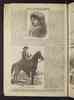
Miss LILLIANT T. SMITH, THE CALIFORNIA GIRL, AND CHAMPION RIFLE SHOT.
(Picture)
Was born at Coliville, Mono county, Cal. in the fall of 1871; is, consquently, only past her 14th year. Born in a country where game was plenty, and good marksmanship as highly thought of as excellence in any particular accomplishment in the older localities of our variously constituted country, her childhood was passed amid an atmosphere well calculated to develop that precocious skill that has astonished the Pacific Coast and rendered her famous throughout the land. Horsemanship there being so nearly allied to the cradle -- in fact, having been often carried in babyhood on the pommel of the saddle -- it is little to be wondered at that she commenced horseback riding as soon as she could sit one, and whilst on foot still "a toddler," mounted she was an infantile expert. At six years of age she had a bow-gun and could kill birds readily, and at seven expressed herself as dissatisfied with "dolls," and wanted a "little rifle." When nine years old her father bought her a Ballard rifle, twenty-two calibre, weight seven pounds, (which she uses yet) with which, after a little practice and instruction, she, on her first foray, mounted on her little pony, bagged two cotton-tails, there fack-rabbits, and two quails. From this our her enthusiasm was such, that after her studies were over, she spent her leisure time with horse, dog, and gun, on the surrouding ranges hunting, and generally brining home a plentiful supply of game. On her father accompanying her to a lagoon near the San Joaquin River in Merced county, when ducks were plentiful, he was greatly astonished by her killing forty red-heads and mallards, mostly on the wing. On another occasion when on a camping excursion in Santa Cruz county, hearing her dog bark in a canon, and thinking he had "treed a squirrel, sure," she mounted her mustang, and on her return amazed the campers and surprised her mother by depositing at her feet a very large wildcat that she had shot on a limb of a high redwood tree, hitting it squarely in the heart. The admiring campers on their return proclaimed through publication her remarkable feats and at a party given in her honor christened her the champion "California Huntress." Her fame spread throughout the "Golden State," and her father was induced to present her to the public of San Francisco, where in July, 1881, she gave seven successful receptions at Woodward gardens -- her marvelous accuracy and extreme youth creating the greatest sensation, winning for her a host of admirers and many complimetns from those who, before seeing, had been incredulous. After a short practice at shooting glass-balls thrown from the hand she made a score of 323 succssive shots without a miss, and out of 500 breaking 495.
Miss Lillian, owing to the opportunities in that section, has made her reputation in practical shotting, such as a Turkey shoot at Hollister, San Benito county, in the holidays of 1883, where at 150 yards she killed so many turkeys she was set back to 200 yards, but her dexterity at that distance being equally destructive the managers arranged with her "to drop our and give the boys a chance at the turkeys too." Being invited to a mud-hut shot, at 50 to 175 yards, according to the accessibility of the marshy ground, she, in one-half hour, bagged fifty, receiving a valuable prize. July 4, 1883, at Hollister, distance 30 feet at a swinging bell target, with a one-inch center, she scored 200 bells, with a Ballard rifle, in fifteen minutes and on July 23rd, at Dunn's ranch near San Filipo, she killed six dozen doves in two hours with a rifle. October 25, 1883, at a meeting of the Colusa Gun Club she was induced to try her skill at live pigeons thrown from three plunge traps, with a 10-pound shot gun, 10 gauge, 2 drams powder, 1 ounce shot, and scored ten our of twelve, resulting in the club having the manufacturers at Meriden, Conn., present her as a testimonial, a 12 gauge Parker shot gun. This remarkable little lady has shot successfully, in tournaments with various gun clubs on the Coast, matches with such noted shots as Geo. I. Kingsley, Crittenden Robinson, John Kerrigan, taking two valuable prizes and the special prize given by Philo Jacoby, President of the Schuetzen Rifle Club, San Francisco, March 15, 1885. She will appear daily with the Wild West.
(Picture) JIM KID, WYOMING COWBOY. ________
On the 17th of July, 1876, at Hat or War Bonnet Creek, W. F. Cody ("Buffalo Bill") fought and killed te Cheyenne Chief, Yellow Hand, in a single-banded encounter, in front of Gen. Wesley Merritt, Gen. E. A. Carr, the Fifth United States Cavalry, and the chief's band of 800 warriors, and thus scored the first scalp for Custer.