
71
was of a very demonstrative character, and he soon became a favorite with the audience. Of the piece in which he appeared, "The Knight of the Plains," nothing particularly can be said in its favor as a dramatic work. It makes no, ambitious claims in this respect. It has, however, less of the fire-and-fury and gore-and-gizzard about it than most constructions of the kind, presents some striking situations and tableaux, and contains some characters which, for eccentric make-up and broad and extravagant burlesque, are extremely ludicrous, being, indeed, what the gallery divines would term "immense." The acting, although some of it is very effective with the spectators, is not noteworthy. The intelligent-looking and handsome donkey acted his part capitally, making a deserved hit. The audience was at times stormy in its demonstration, particularly in the upper tiers. The "Knight of the Plains" will be repeated this evening.
72
OPERA HOUSE. -- The Buffalo Bill attractions at the Opera House, last night, filled the budding, literally from pit to dome. The galleries were black with people, the juvenile element of the population being largely represented, and the noise and hubub from this upper realm was suggestive of a Dublin theater, barring the wit of the Milesian gods, which was wanting, The house was a paying one, and "Bill's Best Trail" as a pecuniary card, proved what the traveling agents would style "im-mense." The supporting company is not an inferior one, and a diverting farce, which was the prelude to the "Knight of the Plains," developed some quite respectable talent for comedy. After this the curtain was rung up on the opening scene -- a pretty fair picture of the prairies -- in a four-act play, in which Cody personates the Knight of the Plains.
Col. Prenties Ingraham, the author of the melodrama, ought to feel at home in Nashville, of which city he was for a time a resident in his earlier years. His father, the late Rev. J. H. Ingraham, was the principal of a prosperous Female Seminary in this city, and, we believe, was at one time rector of Christ Church. Col. Ingraham's literary qualifications are inherited. His father was a prolific writer, and the author of quite a number of works of fiction which bad extensive circulation before the war. The play
73
Ingraham's literary qualifications are inherited. His father was a prolific writer, and the author of quite a number of works of fiction which had extensive circulation before the war. The play is, of course, somewhat sensational, as the average of American border-life dramas essentially are. But there is less of the harrowing, blood-curdling, gunpowdery rant and fustian than might be expected from its title. Written expressly for the prominent part, that of "Buffalo Bill," ample scope for the histrionic capabilities of Mr. Cody, has been judiciously afforded by the author in the arrangement of the play. It is true there is nothing strikingly original in the plot, and the situations are somewhat after the dime novel order of suggested romance, but the language is devoid of coarseness, and while, in the play, a good deal is left to the imagination, there is enough in the action and spirit of the interpreter to furnish an entertainment of a popular kind, and if there is nothing particular instructive there is nothing positively demoralizing in the story. For the purpose for which it was written, namely, to introduce the famous scout and his specialties, it is a success. The marksmanship of the latter, in the first act, and a unique barbaric dance, in native costume, by the copper-head children of the prairies, constitute the best features of the entertainment. An appropriate climax to this scene was the rescue of her lover - the scout - by Wild Nellie - (Miss Deuier) in a striking tableau which "brought down the house," especially the upper portion of it. Buffalo Bill makes his first entrance, mounted on a superb charger - which mute actor acquitted himself with as much credit as any of the rest of the company. Buffalo Bill has a fine stage presence and with the exception of a little of
74
tions are somewhat after the dime novel order of suggested romance, but the language is devoid of coarseness, and while, in the play, a good deal is left to the imagination, there is enough in the action and spirit of the interpreter to furnish an entertainment of a popular kind, and if there is nothing particular instructive there is nothing positively demoralizing in the story. For the purpose for which it was written, namely, to introduce the famous scout and his specialties, it is a success. The marksmanship of the latter, in the first act, and a unique barbaric dance, in native costume, by the copper-head children of the prairies, constitute the best features of the entertainment. An apporpriate climax to this scene was the rescue of her lover - the scout - by Wild Nellie - (Miss Deuier) in a striking tableau which "brought down the house," especially the upper portion of it. Buffalo Bill makes his first entrance, mounted on a superb charger - which mute actor acquitted himself with as much credit as any of the rest of the company. Buffalo Bill has a fine stage presence, and, with the exception of a little of the stiffness and elocutionary deficiences which mark the amateur, is not a bad actor. The support was fair, and the performance was repeatedly and heartly applauded to the close.
The same play will be presented at the matinee, to-day, and Buffalo Bill's marvellous rifle shooting is in itself, alone, a sight worth seeing. The closing performance of the engagement will be given to-night.
The receipts last night were $1,080.25, the largest by nearly $100 taken in for two seasons past.
75
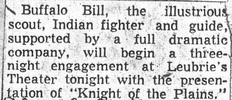
Buffalo Bill, the illustrious scout, Indian fighter and guide, supported by a full dramatic company, will begin a three night engagement at Leubrie's Theater tonight with the presentation of "Knight of the Plains."