

46
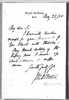
In some recent investigations on germinating dodder Cuscuta Gronovii, we have observed an interesting fact in regard to the manner of separating itself from the soil which we have not found mentioned elsewhere When the plant has reached something adapted to its needs as a parasite -Forsythia viridissima in our observations-it winds about it- loosely, at first, then after the manner of a tendril quickly contracts bringing its coils close to the [Last] that the haustoma, may penetrate the bark. This contraction pulls up the root leaving it loosely hanging by the [Last] sometimes half an inch above the soil, where it withers and dries. Botanical Lab.-Mt. Holyoke Sem.- Feb.17, 1888
48
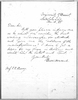
University of Deseret Salt Lake City Mar. 12 88
Dear Sir,
Will you please inform me as to which you consider the best working microscope for students and give me the address of the manufacturers? I desire to get a dozen for my class in Botany and would like the latest and best.
Yours truly Olson Howard
Prof. C. E. Bessey.
49
Miami University, DEPARTMENT OF
OXFORD, OHIO BOTANY AND GEOLOGY
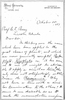
October 30 1887 Prof C. E. Bessey Lincoln, Nebraska Dear Sir, In thinking over the names which have been applied to the great classes of plants, and which are now generally accepted, Protophyta, Zygophyta tc. it has seemed to me it might be advisable to apply a similar term to the only class not satisfactorily settled, I mean the Phanogamia. Why not have a term with a similar termination to the others? It seems to me desirable so as to make the nomenclature uniform.
50
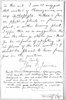
To this end I would suggest that instead of Phaenogamia, we say anthophyta. Anthos a flower, phutin, a plant or flowering plant, or another bearing plant. I offer this as a suggestion. How does the change strike you? Would you be in favor of adopting it in place of the old word? I should be pleased to hear from you on the question. Very Truly Jos. F. James
[Lovrutz Okera] (Philosophischen Pflanzensystem 1817) used the word Anthophytae for the Dicotydedous. Am not certain that it was in this work but think it was. [Luerssen], in Handbuch der Systemalischen Botanik Bd II, 1882, [green] Anthophyta, or a synonym or subtitle for [phan-- ]
Prof James