
676
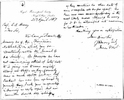
Royal Microscopist Society Kings College, London 25" April 1887
Prof. C [A?] Bessey Dear Sir,
We have just recd the January no of the American Naturalist in which you so courteously notice the Journal of the Society. As however we have not received any others of later date it is giving use to some anxiety among our staff – as they formerly came in much earlier and as Prof. Packard has now been replaced by yourself [?] I ask your co-operation in securing us early copies lest our Committee should stop exchanges
as they sometimes do when date of issue & reception are too far apart. As I am sure some misunderstanding is the most likely cause. Should be sorry for it to be [?] into [?] on boths ides.
[Asking?] you in anticipation I am Dear Sir Yours very truly James West.
677
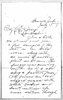
Geneva Nebr., July 5, 87
Prof. C. E. Bessey. Dear Teacher:
in a little box I will send you a few samples of the must of our wild roses, along with as much of another plant as I can. This fungus was growing on the top of a sod along a pasture fence. it formed an oval shaped mass with white borders and dark interior. In cross section through
678
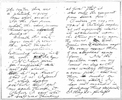
the centre there was a whiteish or gray layer which seemed to be the fas[?] from which the spore forming threads were apparently developed.
Beneath this white layer could be seen the white threads of the mycelium running down into the soil.
spores [illustration] white layer
If I have given you sufficient data will you please [sic.] let me know what it is? I found it while digging post holes and put my spade through it (before I saw what it realy was thinking
at first that it was only the excrement from some bird.)
I notice you say, in regard to [Astilago maydew?], "it not infrequently makes its appearance upon the stems and even upon the leaves." [sic.] Also, Fischer von Wildheim says "The ovary appears there of an abnormal spongy form." Now [the?] question arose in my mind one day, as was walking through a corn field, – what are these [sic.] branches on the corn stalk? I have not succeeded in finding any thing deffinite. I thought perhaps
679
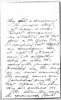
they [sic.] are a development of the fungus itself, but upon a a second thought, by comparing the structure with that found on the Cedar Tree, I concluded that they & it are homologous. Am I right? It would seem to be altogather likely for when the spores of the fungus are produced in the ovary as is most [?]. They simply cause an abnormal growth of that organ. Then when they are produced on the stem they cause the epidemis to burst
680
2
and the result is a [?]? I have examined all the literature I have, but can find no hint as to whether the fungus causes the growth of a [?] in which the spores are found or whether this growth is to be accounted for otherwise. I noticed that whatever the relation of the [?] to the host plant it has, while [?] and even after it has began to be dissolved, the same smell as the green stalk.